

Well child visits start in a baby's first week and continue through age 21. The first three years are the busiest, which can make it hard to keep track of which checkup comes next.
On the current American Academy of Pediatrics (AAP) schedule, a child is due for 12 exams from 3 to 5 days old through age 3, each with its own set of checks.
Knowing the well child visit schedule ahead of time helps you book each checkup on time, plan for visits that usually include shots, and arrive with your questions ready.
What Is the Well Child Visit Schedule?
The well child visit schedule is the set of ages when the AAP recommends a routine checkup, even if your child is healthy. The AAP periodicity schedule lists a well child visit at each of these ages:
- 3 to 5 days old (and within 48 to 72 hours of leaving the hospital)
- 1 month
- 2 months
- 4 months
- 6 months
- 9 months
- 12 months
- 15 months
- 18 months
- 24 months (2 years)
- 30 months (2.5 years)
- 3 years
- 4 years
- 5 years
- 6 years
- 7 years
- 8 years
- 9 years
- 10 years
- 11 years
- 12 years
- 13 years
- 14 years
- 15 years
- 16 years
- 17 years
- 18 years
- 19 years
- 20 years
- 21 years
Your pediatrician may also add visits between these ages when something needs a closer look. The most common is a newborn weight check around 2 weeks old, to make sure your baby is back to birth weight. Some offices also skip a separate 15- or 30-month checkup and cover those checks at a nearby visit, so ask yours which visits they schedule.
The schedule can start even before birth: the AAP recommends a prenatal visit with a pediatrician for first-time parents, parents of higher-risk pregnancies, and anyone who asks for one.
What Happens at Well Child Visits at Each Age?
Each well child visit includes a physical exam, growth measurements, and questions about your child's development and behavior.
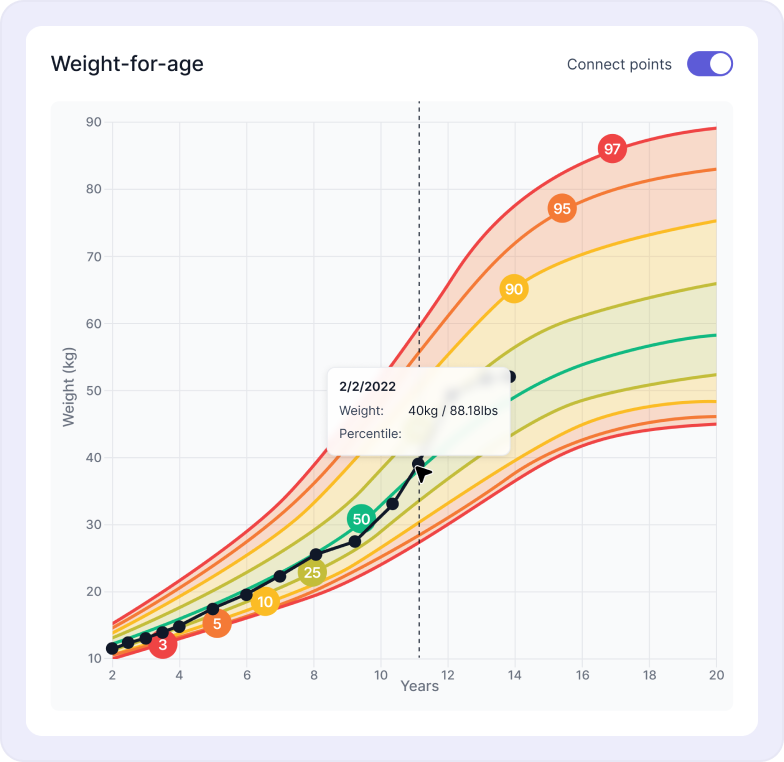
Height and weight are plotted on growth charts: a girl's growth chart compares her with other girls her age, and a boy's growth chart does the same for boys.
Along with these checks at every visit, the AAP recommends screens at set ages. Here's what your pediatrician adds at each stage, from the first week through age 21:
Newborns and Infants (First Week to 9 Months)
The first-week visit checks your baby's feeding and weight, and looks for signs of jaundice (yellowing of the skin). The pediatrician also confirms that the newborn hearing and blood screens were done and reviews the results.
There's also a short postpartum depression screen at every checkup from 1 to 6 months. Postpartum depression affects about 1 in 7 women after giving birth, and it can be treated, so the screen is a regular chance to raise concerns.
At 9 months, your baby gets the first standardized developmental screen, which a 2020 AAP developmental screening report recommends. It tests skills like moving, talking, and problem-solving.
At other visits, the pediatrician asks about developmental milestones such as smiling, rolling over, and babbling.
If your baby was born early, the pediatrician uses corrected age, counted from your due date, for milestone checks and developmental screens until about age 2.
Toddler Years (12 to 30 Months)
The 12-month visit adds a blood test for anemia (too few healthy red blood cells). To check whether your child has been around lead, the pediatrician asks about possible sources in your home at several visits.
Children on Medicaid or in areas where lead exposure is more common also get a blood test at 12 and 24 months.
Your child gets a second developmental screen at 18 months and a third at 30 months. Autism screening also starts at 18 months and repeats at 24 months, in line with AAP autism guidance.
Preschool and School Age (3 to 10 Years)
Blood pressure checks start at age 3 and happen yearly after that, and a cholesterol blood test is due once between ages 9 and 11.
Vision screens happen yearly from 3 to 6 and again at 8 and 10, and hearing screens happen yearly from 4 to 6 and again at 8 and 10.
The AAP's developmental screening report also calls for a closer look at development and school readiness at the 4- and 5-year visits, before your child starts elementary school.
Adolescence (11 to 21 Years)
Questions about tobacco, alcohol, and drug use start at 11, and a depression and suicide risk screen happens yearly from 12.
Teens also get a second cholesterol test between 17 and 21, plus an HIV test at least once between 15 and 21. Vision is checked again at 12 and 15, and hearing once in each of the 11 to 14, 15 to 17, and 18 to 21 age ranges.
Before the exam, the pediatrician will usually ask you for some time alone with your teen. Pediatricians keep what teens share private, unless a teen says they're being hurt or may hurt themselves or others.
Well Child Visit Chart of Checks and Vaccines by Age
The chart below pairs each well child visit with its main checks and shows whether vaccines are usually due under the AAP's 2026 immunization schedule.
| Age | What's checked | Vaccines |
|---|---|---|
| 3 to 5 days | Feeding, weight, jaundice check | Usually not |
| 1 month | Growth, postpartum depression screen | Sometimes |
| 2, 4, and 6 months | Growth, postpartum depression screen | Yes |
| 9 months | Developmental screen | Sometimes |
| 12 months | Anemia blood test, lead exposure check | Yes |
| 15 months | Growth, development | Yes |
| 18 months | Developmental and autism screens | Sometimes |
| 24 months | Autism screen, lead exposure check | Usually not |
| 30 months | Developmental screen | Usually not |
| 3 years | Blood pressure, vision | Usually not |
| 4 to 6 years | Vision, hearing, school readiness | Yes, once in this range |
| 7 to 10 years | Vision, hearing, cholesterol | Sometimes |
| 11 to 12 years | Substance use and depression screens, cholesterol (if not done at 9 or 10) | Yes |
| 13 to 15 years | Depression screen | Usually not |
| 16 years | Depression screen | Yes |
| 17 to 21 years | Depression screen, cholesterol, HIV test (if not done at 15 or 16) | Usually not |
Two vaccines follow their own timing: the yearly flu vaccine from 6 months old and the COVID-19 vaccine, which the AAP recommends for all children ages 6 to 23 months and for older children at higher risk.
Which Well Child Visits Include Vaccines?
The well child visits that usually include vaccines are the 2-, 4-, and 6-month visits and the 12- and 15-month visits, based on the AAP's 2026 immunization schedule.
Later doses fall at one visit between ages 4 and 6, at 11 or 12 years, and at 16 years.
Because some shots can be given across a span of several months, other visits may include one, too. The 1-month visit, for example, can include the second hepatitis B dose, since its window runs from 1 to 2 months.
If your child misses a vaccine, there's no need to restart the series. As the AAP immunization schedule confirms, clinicians can give the missed dose at a later visit. Your pediatrician's office can plan a catch-up schedule that builds on the doses your child already has.
What Happens If Your Child Misses a Well Child Visit?
If your child misses a well child visit, the pediatrician can catch up on the skipped checks and screens at the next visit. The AAP's periodicity schedule says anything missed should be brought up to date at the earliest possible time.
A 2018 study (Wolf et al., Pediatrics) of more than 150,000 children at clinics serving low-income families in 20 states found the 15- and 18-month visits and the 4-year visit were the least attended checkups for young children. Kids who miss these visits could end up missing the developmental and school readiness checks done at those ages, as well.
In a 2020 study (Wolf et al., Annals of Family Medicine), caregivers whose children had missed visits named transportation, time off work, and child care as barriers. If any of these factors makes visits difficult, tell the front desk when you book, since the office may be able to offer a time that fits your schedule.
Most health plans, including Medicaid and CHIP, cover the well child visits on this schedule with no copay. If you bring up a new problem during the visit, though, that part may be billed separately.
How Should You Prepare for a Well Child Visit?
To prepare for a well child visit, take care of a few things at home before you arrive:
- Write down your top questions: List any concerns about sleep, eating, or behavior. Raise the biggest one at the start of the visit.
- Finish forms early: If the office sends questionnaires ahead of time, fill them out before the visit so you have time to think through each answer.
- Bring paperwork: Pack your child's vaccine record, a list of any medicines, and any school or sports forms that need a signature.
- Prep older children: Tell your child what to expect, including whether vaccines are likely.
How Can You Keep Track of Your Child's Well Child Visits?
You can keep track of your child's well child visits by booking each one before you leave the last. Because the schedule is set well ahead, many offices try to book the next checkup for you at checkout. A few other habits make the schedule easier to follow:
- Keep your contact details up to date: Make sure the office has your current phone number. If the next checkup wasn't booked at your last visit, many offices text or call when it's due, and they send reminders before booked visits too.
- Save the next due date: After each checkup, add the next visit (from the schedule above) to your calendar.
- Ask about online records: Find out whether your clinic lets you view your child's vaccine record and growth chart online.
Some clinics make this easier for families. Independent practices that use Develo, the AI-native operating system for pediatrics, can send reminders when a well child visit is due, plus questionnaires you can fill out on your phone with no app to download.
Develo's family portal also keeps vaccine records, growth charts, visit summaries, and letters for each child in one place, with siblings in the same view.
If the next checkup on your well child visit schedule is coming up, call your pediatrician's office to book it.
Frequently Asked Questions
How Many Well Child Visits Does a Baby Have in the First Year?
A baby has six well child visits in the first year on the AAP periodicity schedule, starting 3 to 5 days after birth and ending at 9 months. The 12-month checkup comes next, on the baby's first birthday.
Can My Child Get Vaccines at a Well Child Visit With a Cold?
Yes, a child with a mild cold can usually get vaccines at a well child visit. The AAP immunization schedule lists moderate or severe illness, with or without fever, as a reason for caution, so the pediatrician will check how sick your child is first.
At What Age Do Well Child Visits Stop?
Well child visits on the AAP periodicity schedule end with the 21-year checkup, though some pediatric offices move patients to an adult primary care doctor at age 18. Ask your pediatrician when to switch, so care continues without a gap.