
.avif)
The 18-month autism screening is a routine part of pediatric well-child visits. It helps providers identify early signs of developmental differences and decide next steps for evaluation or support.
Here’s how pediatric clinics run the screening, interpret scores, and guide families through the process.
What Is the 18-Month-Old Autism Screening?
The 18-month-old autism screening is a standardized check for early signs of autism spectrum disorder (ASD) during a child's well child visit.
The AAP recommends developmental surveillance at every visit, general developmental screening at 9, 18, and 30 months, and ASD-specific screening at 18 and 24 months.
This screening matters because early intervention leads to stronger outcomes in communication, social skills, and cognitive development.
The median age of ASD diagnosis in the U.S. is still 47 months, and only half of kids are diagnosed by age 3. That's more than two years after the recommended first screening. That gap represents lost time for families and children who could benefit from earlier support.
Why Screen At 18 Months?
Eighteen months is the earliest reliable window for ASD-specific screening tools like the M-CHAT-R/F.
By this age, many toddlers show observable social and communication behaviors. These include pointing, responding to their name, and engaging in pretend play. Screeners can measure those behaviors.
Research shows that roughly 32% of toddlers eventually diagnosed with ASD appear typical at 18 months and then regress between 18 and 24 months. That's one reason the AAP recommends a second ASD screening at 24 months.
Still, the 18-month-old autism screening catches many children who do show early signs. The sooner those children connect with specialists and early intervention programs, the better their long-term trajectory.
How the M-CHAT-R/F Works
The Modified Checklist for Autism in Toddlers, Revised with Follow-Up (M-CHAT-R/F) is a two-stage parent-report screening tool designed for children aged 16-30 months.
Stage 1: The 20-Question Checklist
A parent or caregiver answers 20 yes/no questions about their child's behavior. The questionnaire takes less than five minutes to complete and about two minutes to score.
Questions cover behaviors like:
- Responding when their name is called
- Making eye contact
- Pointing with one finger to show interest
- Engaging in pretend play
- Showing interest in other children
For most items, a "no" response indicates a potential risk of ASD. For items 2, 5, and 12, a "yes" response indicates risk.
Stage 2: The Follow-up Interview
If a child scores in the medium-risk range (3 to 7), a clinician conducts a structured follow-up interview. This takes roughly 5 to 10 minutes and helps reduce false positives.
The child is referred for evaluation if the follow-up confirms two or more at-risk responses.
How to Score the M-CHAT-R/F
The M-CHAT-R/F uses a three-tier risk system based on a total score of 0 to 20:
A positive M-CHAT-R/F screen doesn’t mean a child has autism. They need further evaluation. Children who screen positive but don't receive an ASD diagnosis are still at elevated risk for other developmental delays.
In the original validation study, toddlers whose total score was ≥3 on the initial M‑CHAT‑R and ≥2 on the follow‑up had about a 47.5% chance of receiving an ASD diagnosis and a 94.6% chance of having some developmental delay or concern that warranted referral or support.
What the 18-Month-Old Autism Screening Looks For
The M-CHAT-R/F targets specific social, communication, and behavioral markers tied to ASD. Here's what each category covers.
Social Engagement
Does the child respond to social cues? This includes looking when called, showing interest in other children, and bringing objects to show a parent.
Communication
Does the child use gestures and sounds to communicate? Pointing, waving, and babbling are key markers at this age. Clinics that track broader developmental milestones with screening tools can identify concerns across multiple domains at once.
Repetitive Behaviors And Restricted Interests
Does the child show unusual sensory responses, fixate on specific objects, or repeat movements like hand-flapping? These patterns are harder to detect at 18 months but can signal risk.
How to Administer the M-CHAT-R/F
Running the 18-month-old autism screening smoothly depends on your workflow. Here's what high-performing clinics do.
Send the Screener Before the Visit
The M-CHAT-R/F is a parent-completed questionnaire. Clinics that send it digitally via a patient portal or text message collect responses before the child walks in the door. That gives the provider time to review results and plan the visit around the screening outcome.
Paper-based workflows create delays. A parent fills out the form in the waiting room, a nurse manually scores it, and the provider sees the result halfway through the appointment. Digital screening tools eliminate that friction.
Auto-Score and Document in the Chart
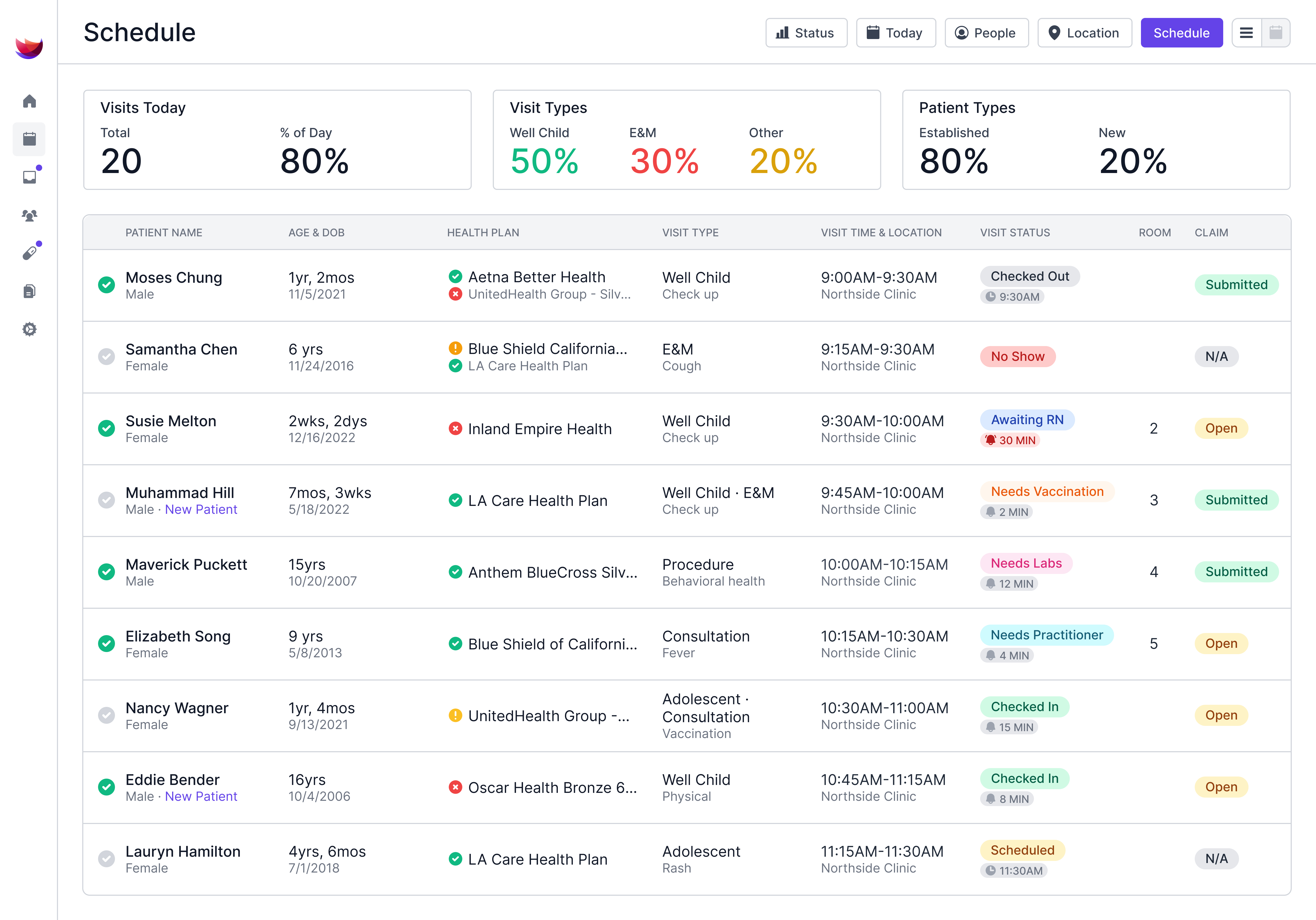
Manual scoring takes time and introduces errors. Clinics using EMRs with built-in screener scoring get results instantly, attached to the patient's chart and ready for the provider to review.
This is especially useful during high-volume well child days. When you're seeing 30+ patients per day, you need screening data organized and visible, not buried in a stack of paper forms.
Use the Follow-up Interview When Indicated
Medium-risk scores (3 to 7) require the follow-up interview. Some clinics skip this step due to time constraints, which leads to unnecessary referrals or missed cases.
Building the follow-up into your workflow keeps the two-stage process intact and improves screening accuracy.
Billing for the 18-Month-Old Autism Screening
Pediatric clinics bill ASD screening under CPT code 96110, which covers developmental screening with a standardized tool.
Each distinct screener administered during a visit counts as one unit of 96110. If you run both the M-CHAT-R/F and the SWYC during the same visit, that's two units.
A few billing tips for your practice:
- Document the tool used, the score, the interpretation, and the action taken
- Attach the screener to the visit note or chart for audit support
- Bill each unit separately if your payer requires line-item detail (modifier 59 may apply)
Clinics that struggle with pediatric billing often leave money on the table with screener codes.
Automating charge capture for screening visits helps close that gap. Tracking CDC growth charts and screening results in one system makes documentation faster and more consistent.
What Happens After a Positive Screen
A positive 18-month-old autism screening is the start of a process rather than a diagnosis.
For High-Risk Scores (8 to 20)
Refer immediately for a diagnostic evaluation and early intervention services. No follow-up interview is needed at this score level.
For Medium-Risk Scores After Follow-up
If the follow-up interview confirms risk (2+ failed items), refer for evaluation. If the follow-up clears the child, continue developmental surveillance and rescreen at 24 months.
What to Tell Parents
Parents hear "autism screening" and often jump to worst-case scenarios.
Providers play a key role in framing results with clarity and empathy:
- A positive screen means further evaluation is needed, not that their child has ASD
- Children who screen positive but don't have ASD often have other developmental needs worth addressing
- Early intervention services are available before a formal diagnosis and can begin through an early intervention referral
Clinics that use structured behavioral health screening tools, like CRAFFT, for older patients already understand the value of embedding screeners into routine visits. The same principle applies to the M-CHAT-R/F at 18 months.
Challenges With the M-CHAT-R/F at 18 Months
No screening tool is perfect. The M-CHAT-R/F has known limitations at 18 months.
Sensitivity Drops at Younger Ages
The M-CHAT-R/F may be more accurate at 24 months than at 18 months. Some children don't show enough observable ASD-related behaviors at 18 months to trigger a positive screen.
That's why the AAP recommends screening twice to account for regression and late-emerging symptoms.
False Positives Are Common
The M-CHAT-R was designed to maximize sensitivity, which means it casts a wide net. Many children who screen positive won't receive an ASD diagnosis.
The follow-up interview significantly reduces false positives, so skipping Stage 2 is a mistake. When both stages are completed, the tool's positive predictive value for developmental concerns is strong.
Parent Reporting Bias
The M-CHAT-R/F relies entirely on parent or caregiver responses. Overreporting, underreporting, or misunderstanding questions all affect accuracy.
Providing the screener in a family's preferred language helps. The M-CHAT-R/F is available in 80+ languages and dialects (with more on the way), making it accessible to diverse patient populations. Even the physical environment matters.
How to Improve Your 18-Month-Old Autism Screening Workflow
A few operational changes make a meaningful difference in screening completion rates and accuracy.
You can improve autism screening by following these tips:
- Digitize the screener: Send the M-CHAT-R/F to caregivers before the visit through your patient portal or via text. Pre-visit completion saves chair time and lets providers review results in advance.
- Auto-populate screeners by age: Your EMR should know that an 18-month well child visit triggers the M-CHAT-R/F. Manual selection of the right screener wastes time and creates gaps.
- Score and document automatically: Clinics that still hand-score the M-CHAT-R/F lose time and accuracy. The right pediatric practice software auto-scores the screener, files it to the chart, and connects it to billing codes.
- Build the follow-up into your schedule: Medium-risk results need the follow-up interview. Block time for it during the visit or assign a nurse to call families within the week.
- Track screening completion rates: If your 18-month-old autism screening rate is below 80%, you have a workflow problem. Reporting tools help you spot missed screenings before they become patterns.
Other Screening Tools Used at 18 Months
The M-CHAT-R/F is the most common ASD screener at 18 months, but it's not the only option:
- SWYC (Survey of Well-being of Young Children): A screening tool that covers developmental milestones, behavioral health, and family risk factors. Many clinics use it alongside the M-CHAT-R/F to capture a broader view of a child’s development.
- POSI (Parent's Observations of Social Interactions): A shorter ASD-specific screener that can supplement the M-CHAT-R/F, particularly for follow-up at the 24-month visit.
- STAT (Screening Tool for Autism in Toddlers): A Level 2 screener administered by trained professionals, typically used after a positive M-CHAT-R/F result as a bridge to formal evaluation.
Choosing the right combination of tools depends on your clinic's patient population, workflow, and engagement strategy for reaching families early.
Run Your 18-Month-Old Autism Screening Without the Manual Work
Getting the M-CHAT-R/F right at every well child visit takes more than a paper form and a scoring sheet. It takes a system built for how pediatric clinics operate.
Develo is a modern EMR built exclusively for independent pediatric practices. It replaces the patchwork of screener tools, intake apps, and manual scoring that slows your team down.
Here's how Develo supports 18-month-old autism screening and other clinical workflows:
- Digital screeners auto-populated by age so the M-CHAT-R/F is sent to caregivers before the visit, completed on their phone, and scored automatically.
- Results filed directly to the patient chart with no manual data entry, scanning, or transcription.
- Automated charge capture that attaches CPT 96110 and other billing codes to screening visits based on visit context.
- Pediatric-specific growth charts, documentation templates, and vaccination workflows designed for well child visits, not retrofitted from adult medicine.
- Family engagement tools, including text reminders, a caregiver portal, and pre-visit intake, that reduce front-desk workload.
You don't need separate vendors for screeners, intake, billing, and charting. Book a free demo to see how Develo helps your clinic standardize the 18-month-old autism screening from pre-visit to billing, without the busywork.
Frequently Asked Questions
1. What Does a Positive M-CHAT Score Mean?
A positive score means your child may be at risk for ASD or another developmental delay and needs further evaluation. It's not a diagnosis. Children who screen positive but don't have ASD often have other developmental needs that benefit from early attention.
2. How Long Does the M-CHAT-R/F Take to Complete?
The initial questionnaire takes less than five minutes for a parent to complete. Scoring takes about two minutes. The follow-up interview, if needed, takes 5 to 10 minutes.
3. How Is the 18-Month-Old Autism Screening Billed?
Clinics bill under CPT code 96110. Each standardized screener administered counts as one unit. Documentation should include the tool used, the score, and the clinical action taken.
4. Is the M-CHAT-R/F Available in Other Languages?
Yes. The M-CHAT-R/F has been translated into 80+ languages and dialects, making it accessible for multilingual patient populations.
5. How Common Is Autism in the U.S. Right Now?
CDC data from 2025 estimates that 1 in 31 children (3.2%) have been identified with ASD, up from 1 in 36 in 2020.


.avif)