
.avif)
Developmental screening tools are standardized questionnaires that flag potential delays in how a child moves, communicates, solves problems, and interacts socially.
Choosing the right ones (and building the right workflow around them) matters more than most practices realize.
Screening vs. Surveillance vs. Evaluation: Why the Distinction Matters
These three terms get used interchangeably, but they serve different purposes. Billing depends on getting it right.
- Developmental surveillance is the ongoing process of observing, asking questions, and noting milestones at every well child visit. It doesn't use a scored tool. Think of it as your clinical radar.
- Developmental screening uses a standardized, validated tool at specific ages to identify children who need further evaluation. That's what instruments like the ASQ-3 or SWYC accomplish.
- Developmental evaluation is the deep dive. Specialists (developmental pediatricians, psychologists, speech-language pathologists) administer it when a screen flags a concern. Tools like the Bayley Scales of Infant Development (BSID-IV) and the ADOS-2 for autism diagnosis fall into this category.
A common mistake in pediatric practices: relying on surveillance alone and assuming that clinical observation replaces formal screening.
The AAP's clinical report is clear that surveillance is not screening and should never substitute for validated developmental screening tools.
When Does the AAP Recommend Developmental Screening?
The AAP Bright Futures Periodicity Schedule recommends general developmental screening at three specific well child visits:
- 9 months
- 18 months
- 30 months
Autism-specific screening is recommended at:
- 18 months
- 24 months
If a child misses one of these visits, the CDC recommends completing the screening at the next visit. You should also screen at any age when surveillance or a parent's concern raises a red flag.
These aren't arbitrary ages. The 9-month screen catches early motor and communication delays. The 18-month screen often surfaces the first signs of autism. The 30-month screen targets language and cognitive skills that predict school readiness.
Remember: Skipping any of them creates blind spots.
3 Main Developmental Screening Tools: Quick Comparison
Three parent-report developmental screening tools hold AAP validation: the ASQ-3, SWYC, and PEDS. Each takes under 15 minutes and can be scored in a clinical setting.
Here's how they stack up:
A 2020 JAMA Pediatrics study says that specificity for older children (43 to 66 months) drops to around 71% for the SWYC, while the ASQ-3 holds at about 92%.
How the Main Developmental Screening Tools Work
ASQ-3 (Ages and Stages Questionnaire, Third Edition)
The ASQ-3 is the most widely used developmental screening tool in pediatric primary care.
It covers children from 1 to 66 months with 21 age-specific questionnaires across five domains: communication, gross motor, fine motor, problem-solving, and personal-social.
What it does well: High specificity (around 89% for children under 42 months), meaning fewer false positives. It's well-studied, available in multiple languages (English, Spanish, Arabic, Chinese, French, Vietnamese), and accepted by Medicaid programs in most states.
Where it falls short: The ASQ-3 doesn't cover behavioral or social-emotional development on its own. If you use it, you'll typically pair it with the ASQ:SE-2 for that piece. That's two separate forms per visit, which adds additional time and complexity on top of a lengthy questionnaire.
How scoring works: Each of the five domains is scored on a 0 to 60 point scale. Scores fall into three zones: above the cutoff (development on track), in the monitoring zone (close to the cutoff; rescreen recommended), or below the cutoff (refer for further evaluation). Cutoffs vary by age interval and domain.
Cost: Requires a license purchase from Brookes Publishing. Forms can be photocopied from the kit.
SWYC (Survey of Well-Being of Young Children)
The SWYC was developed at Tufts Medical Center and covers children from 1 to 60 months. It stands out because it screens developmental milestones, behavioral/emotional concerns, and family risk factors in a single form.
It also includes the POSI (Parent's Observations of Social Interactions), an autism-specific section administered between 16 and 35 months.
What it does well: It's the most comprehensive of the three tools. A single form handles what would take two or three separate instruments.
It also captures environmental factors (like postpartum depression and substance use in the home) that affect a child's development. And it's available at no cost from Tufts Medical Center.
Where it falls short: Less research backing than the ASQ-3, though it's growing. Specificity drops for older children (around 71% for ages 43 to 66 months vs. 92% for the ASQ-3 in that same age range).
How scoring works: Each age-specific form has a developmental milestone section with a cutoff score. If a child's score falls at or below the cutoff, it flags risk and prompts follow-up or referral. The behavioral symptom and family risk sections have their own separate cutoffs.
Cost: Free.
PEDS (Parents' Evaluation of Developmental Status)
PEDS covers birth through age 8 and takes a different approach. Instead of testing specific skills, it asks parents open-ended questions about their concerns across developmental domains.
What it does well: It's quick (about 2 minutes to complete) and respects what parents already notice about their child's development. It's effective at engaging families who might feel overwhelmed by longer questionnaires.
Where it falls short: Lower specificity than the ASQ-3 or SWYC (around 80% for younger children). About 30 to 40% of screens need a second step using the PEDS:DM (Developmental Milestones) for a clearer picture.
Scoring requires the administrator to categorize types of concerns, so non-clinical staff need training.
How scoring works: PEDS sorts parent concerns into three paths.
- High risk (2 or more significant concerns, or 1 predictive concern) leads to referral.
- Moderate risk (1 non-predictive significant concern) leads to a second-stage screen with the PEDS:DM.
- Low or no risk means continued surveillance.
Cost: Paid forms and scoring materials are available from PEDSTest.com. Online scoring is also available.
Autism-Specific Developmental Screening Tools
General developmental screening tools don't replace autism-specific instruments. The AAP recommends universal autism screening at 18 and 24 months. Two tools dominate this space.
M-CHAT-R/F (Modified Checklist for Autism in Toddlers, Revised with Follow-Up)
The M-CHAT-R/F is the most widely used autism-specific screening tool in pediatric practice. Parents answer 20 yes-or-no questions about their child's behavior, and the built-in follow-up interview helps reduce false positives.
- Age range: 16 to 30 months
- Time: 5 to 10 minutes for the initial screen, plus follow-up if needed
- Cost: Free
- Languages: Available in over 50 languages
How scoring works: A total score of 0 to 2 is low risk. Scores of 3 to 7 trigger a follow-up interview. Scores of 8 to 20 are high risk and warrant immediate referral, following the CDC's screening guidance for ASD.
ASQ:SE-2 (Ages and Stages Questionnaire: Social-Emotional, Second Edition)
The ASQ:SE-2 screens social-emotional development from 3 to 72 months. It covers self-regulation, communication, autonomy, coping, and relationships.
Many practices use it alongside the ASQ-3 to capture behavioral and emotional domains that the general screener misses.
How scoring works: Each age-specific form has a cutoff score. Scores above the cutoff indicate social-emotional concerns that need follow-up or referral. Cutoffs vary by age interval.
Other Important Developmental Screening Tools
Beyond the three AAP-validated general screeners and autism-specific tools, several other instruments show up in clinical and early childhood settings. Examples of other screeners include:
- Denver II (DDST-II): Screens fine motor, gross motor, language, and personal-social skills from 1 month to 6 years.
Once a standard, it's now less common in primary care because it requires direct administration by a trained professional rather than parent report. New York State's Early Intervention Program still lists it as a recognized screening tool.
- Bayley Infant Neurodevelopmental Screener (BINS): Targets 3 to 24 months and identifies neurological impairments and developmental delays. It's more commonly used in follow-up for premature infants than in routine well child visits.
- CSBS DP Infant-Toddler Checklist: Screens for communication and symbolic behavior delays from 6 to 24 months. Useful when you suspect a language or social communication delay, but the general screener comes back clean.
- Brigance Inventory of Early Development III: Covers birth through 7 years across motor, speech, language, adaptive, and social-emotional domains. Used more often in early childhood education (like Head Start programs) than in clinical settings.
What Happens After a Positive Screen?
A positive screen doesn't mean a diagnosis. It means the child needs closer attention. Your next steps depend on the score:
- Borderline result: Rescreen in 2 to 3 months. Continue developmental surveillance at every visit. You can use a different tool or the same tool at the next interval.
- Positive result: Refer to the state's Early Intervention program (for children under 3) or to the local school district (for children 3 and older) for a full developmental evaluation. Families can also self-refer.
- High-risk autism screen (M-CHAT-R/F score 8+): Refer directly for diagnostic evaluation without waiting for a rescreen.
One useful benchmark: the Head Start Performance Standards require programs to complete or receive a current developmental screening within 45 days of a child entering the program.
Even outside Head Start settings, that timeline gives you a reference point for how quickly screening should happen.
Paper Screeners vs. Digital Developmental Screening Tools
Paper-based screening has been the default for decades, but it creates bottlenecks that digital workflows solve.
Paper-based screening means printing forms, handing them to parents in the waiting room, collecting them, hand-scoring, manually entering results into the EHR, and filing the original. Each step introduces delay and error risk, and inconsistent documentation often leads to missed billing.
Digital screening sends the form to a parent's phone or tablet before the visit. While the parent experience is fairly standardized, it is worth pointing out the experience for practice staff varies. Most EMRs require manual steps to score the digital screen and/or transfer the screen results into the EMR given reliance on third party tools separate from the EMR system. Compared to paper-based screening though, there are material workflow improvements to most digital screen arrangements.
This matters for pediatric practices because well child visits are high-volume. Many of you see 30+ patients a day. Shaving even a few minutes off each screening workflow frees up time you can spend on direct patient care, practice growth, or follow-up with flagged families.
Billing for Developmental Screening (CPT 96110)
Developmental screening tools are billable under CPT code 96110, which covers standardized developmental screening with scoring and documentation per encounter. Most payers reimburse when you document which validated tool was used, the date, and the score.
Key billing details:
- 96110 covers the administration and scoring of a standardized developmental screening tool. You can bill per instrument, so if you administer both the ASQ-3 and M-CHAT-R/F at the same visit, that's two units.
- 96127 covers brief behavioral or emotional screening (like the PSC-17 or PHQ-A for adolescents), not general developmental screening.
Practices still using paper forms and manual scoring often miss billing for 96110 because the process isn't documented consistently in the chart.
While digital screening workflows consistently improve the parent experience and partially improve workflows for practice staff, existing solutions do not auto-populate billing codes by instrument upon completion– the same billing gap remains as for paper screens.
Choosing the Right Developmental Screening Tools for Your Practice
No single tool fits every practice. The best choice depends on your patient population, workflow, and what you're trying to catch.
- If you want the broadest coverage with one tool: The SWYC combines developmental, behavioral, and family risk screening, plus autism screening at key ages. It's also free, which removes cost as a barrier.
- If your state Medicaid program requires a specific tool: Most states accept the ASQ-3. Check your state's EPSDT periodicity schedule for approved instruments before switching tools.
- If parent engagement is a priority: PEDS respects the parent voice and takes under 2 minutes. Pair it with the PEDS:DM when the initial screen warrants a second look.
- For autism screening: The M-CHAT-R/F at 18 and 24 months is the standard. It's free, validated across 50+ languages, and includes a follow-up interview to reduce unnecessary referrals.
Whatever developmental screening tools you choose, the practice workflow around them matters as much as the tools themselves. A great instrument that sits in a drawer doesn't screen anyone.
Simplify Developmental Screening With Develo
Develo is a modern pediatric software platform built exclusively for independent pediatric practices. It replaces the patchwork of paper forms, third-party screener tools, and manual scoring that slows down well child visits.
If you're looking for a better way to manage developmental screening tools alongside your full clinical workflow, here's what Develo brings to the table:
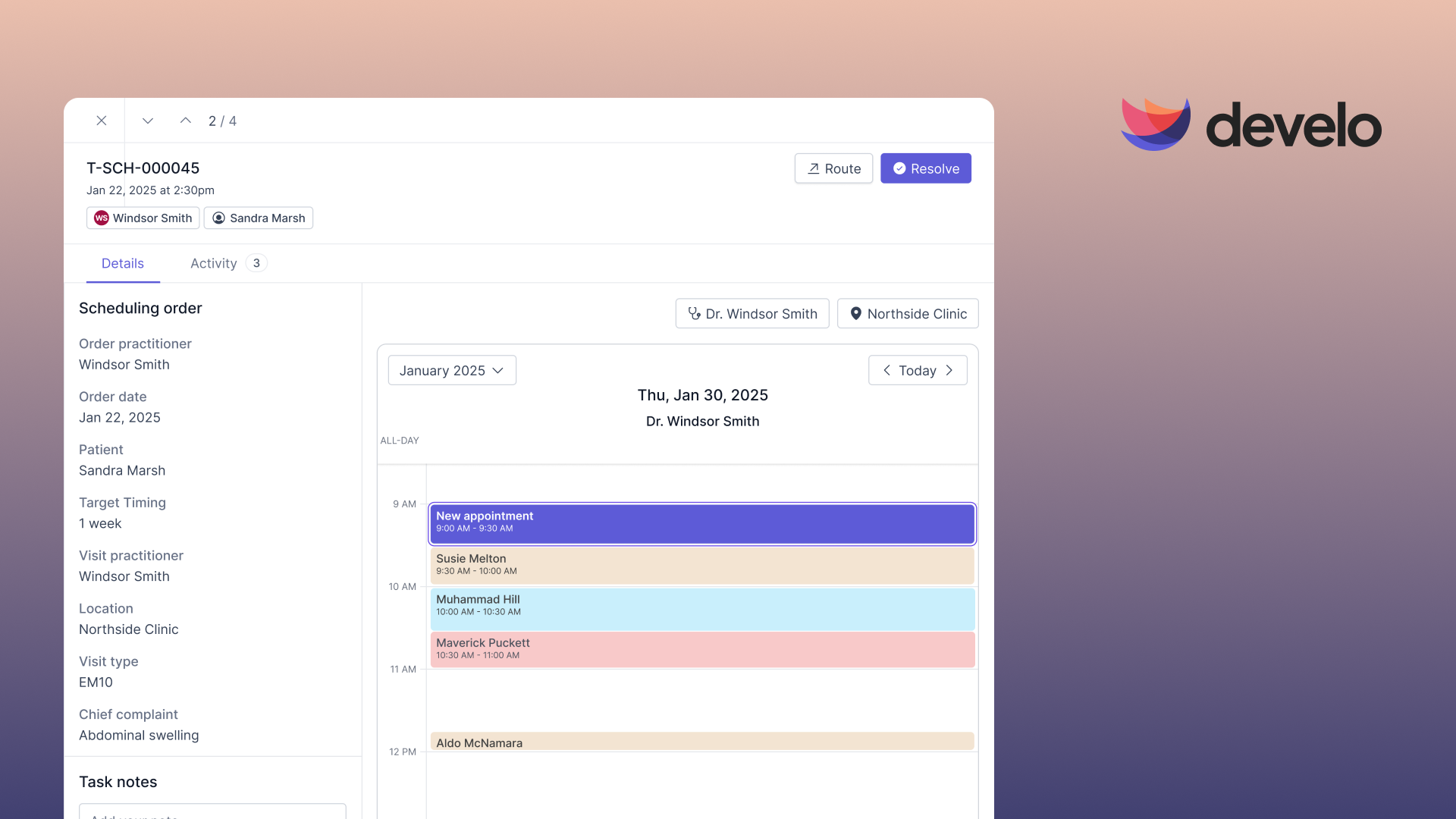
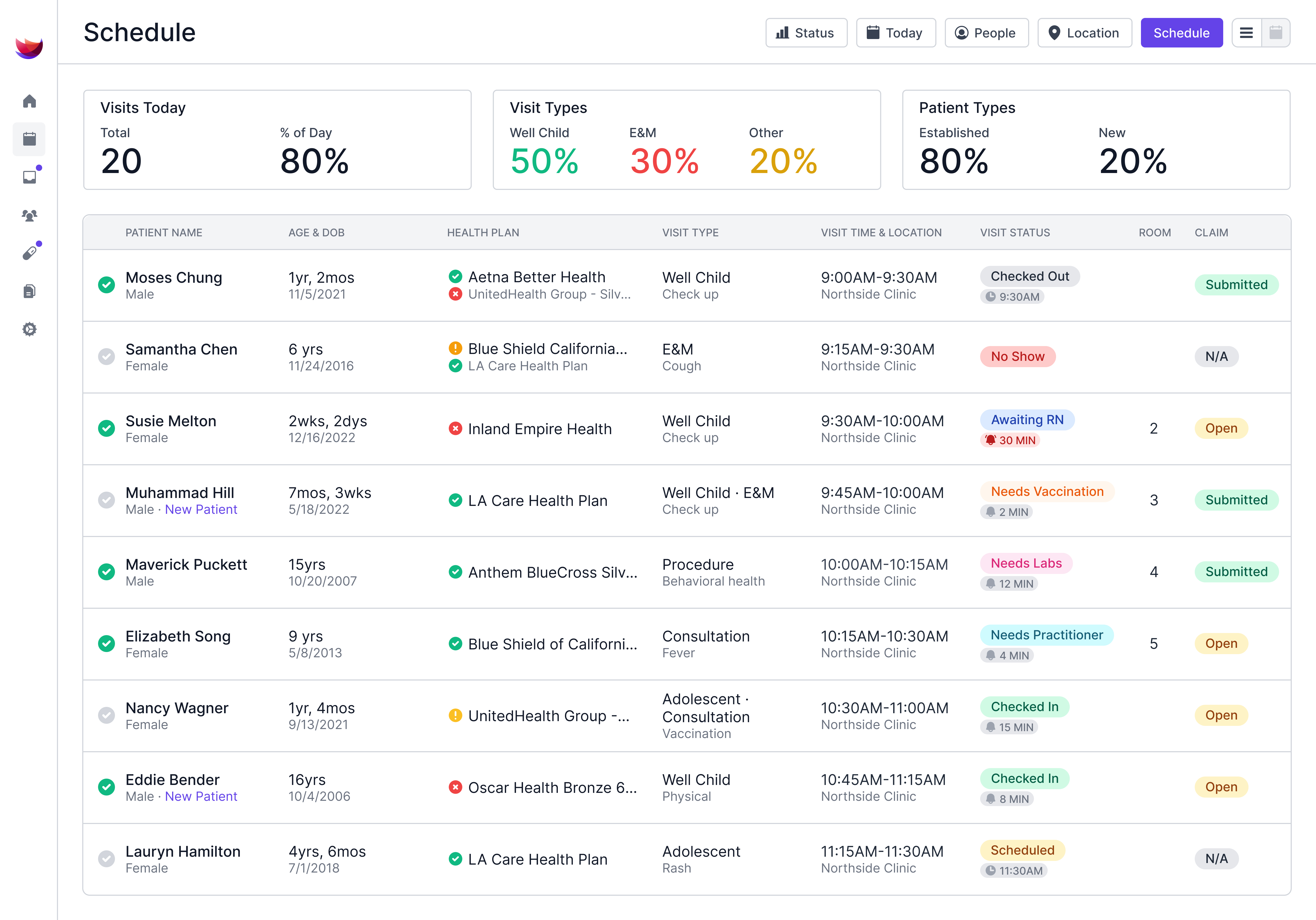
- Digital clinical screeners auto-populated by well child periodicity: The right developmental screening tools appear for each patient based on their age at the time of their well child visit, with no manual selection required.
- Pre-visit completion via visit digital intake: Parents complete screeners on their phone before they arrive or while in the waiting room, so results are in the chart before you walk in.
- Screening tasks uniquely flag abnormal digital screen results to the pediatrician. By having developmental screen results available ahead of time, pediatricians can proactively engage parents as needed ahead of visits.
- Automatic scoring and documentation: Screener results are scored instantly and linked to the visit, with automatic incorporation into pediatrics-first clinical documentation. There is no need to manually scan paper screen results, or manually add in digital PDF result files into the EMR.
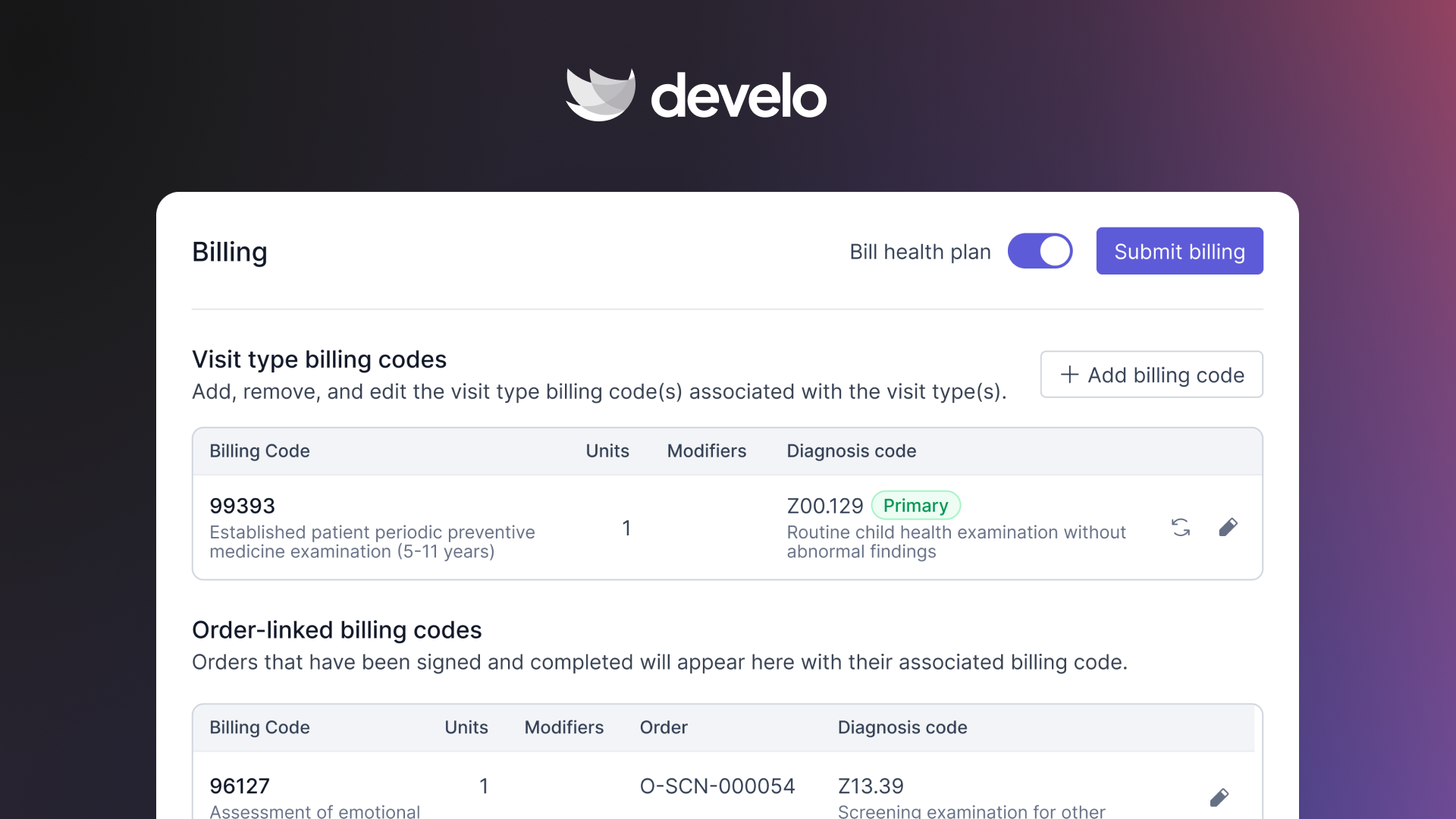
- AI-powered charge capture: Developmental screenings that are completed drive fully automatic 96110 billing as well as additional modifier and/or diagnosis code adjustments without any manual entry by pediatricians or billers. Develo makes it near impossible to underbill for developmental screens.
You don't need separate software for screeners, a different platform for intake, and a legacy EMR that wasn't built for pediatrics. You need one system where developmental screening tools, clinical documentation, and billing work together from check-in to claim.
Book a free demo to see how Develo handles developmental screening for your practice.
Frequently Asked Questions
1. What Is the Most Commonly Used Developmental Screening Tool in Pediatrics?
The most commonly used developmental screening tool in pediatrics is the ASQ-3 (Ages and Stages Questionnaire, Third Edition). It covers children from 1 to 66 months across five developmental domains and is accepted by Medicaid programs in most states.
The AAP lists it alongside the SWYC and PEDS as a validated general developmental screening tool for primary care use.
2. At What Ages Should Developmental Screening Tools Be Administered?
Developmental screening tools should be administered at 9, 18, and 30 months during well child visits, per the AAP Bright Futures Periodicity Schedule. Pediatric practices can choose to use developmental screeners at other well child visits too.
Autism-specific screening with a tool like the M-CHAT-R/F is recommended at 18 and 24 months. You should also screen at any age when a parent or clinician raises a developmental concern during surveillance.
3. What Is the Difference Between Developmental Screening and Developmental Surveillance?
Developmental screening uses a validated, scored tool (like the ASQ-3 or SWYC) to identify children at risk for delays at specific ages.
Developmental surveillance is the informal, ongoing process of observing milestones and asking parents questions at every well child visit. The AAP's clinical report states that surveillance does not replace screening, and both are needed for early identification.
4. Are Developmental Screening Tools Free?
Some developmental screening tools are free. Others require a paid license. The SWYC and the M-CHAT-R/F are both available at no cost.
The ASQ-3 requires a license purchase from Brookes Publishing, and the PEDS requires paid forms from PEDSTest.com. Practices can choose based on cost, workflow fit, and state requirements.
5. How Do You Bill for Developmental Screening?
Developmental screening is billed under CPT code 96110, which covers the administration and scoring of a standardized developmental screening tool per encounter.
You must document the specific tool used, the date, and the score in the medical record. If you administer two tools at the same visit (for example, the ASQ-3 and M-CHAT-R/F), you can bill the code for each instrument.
.png)

.avif)