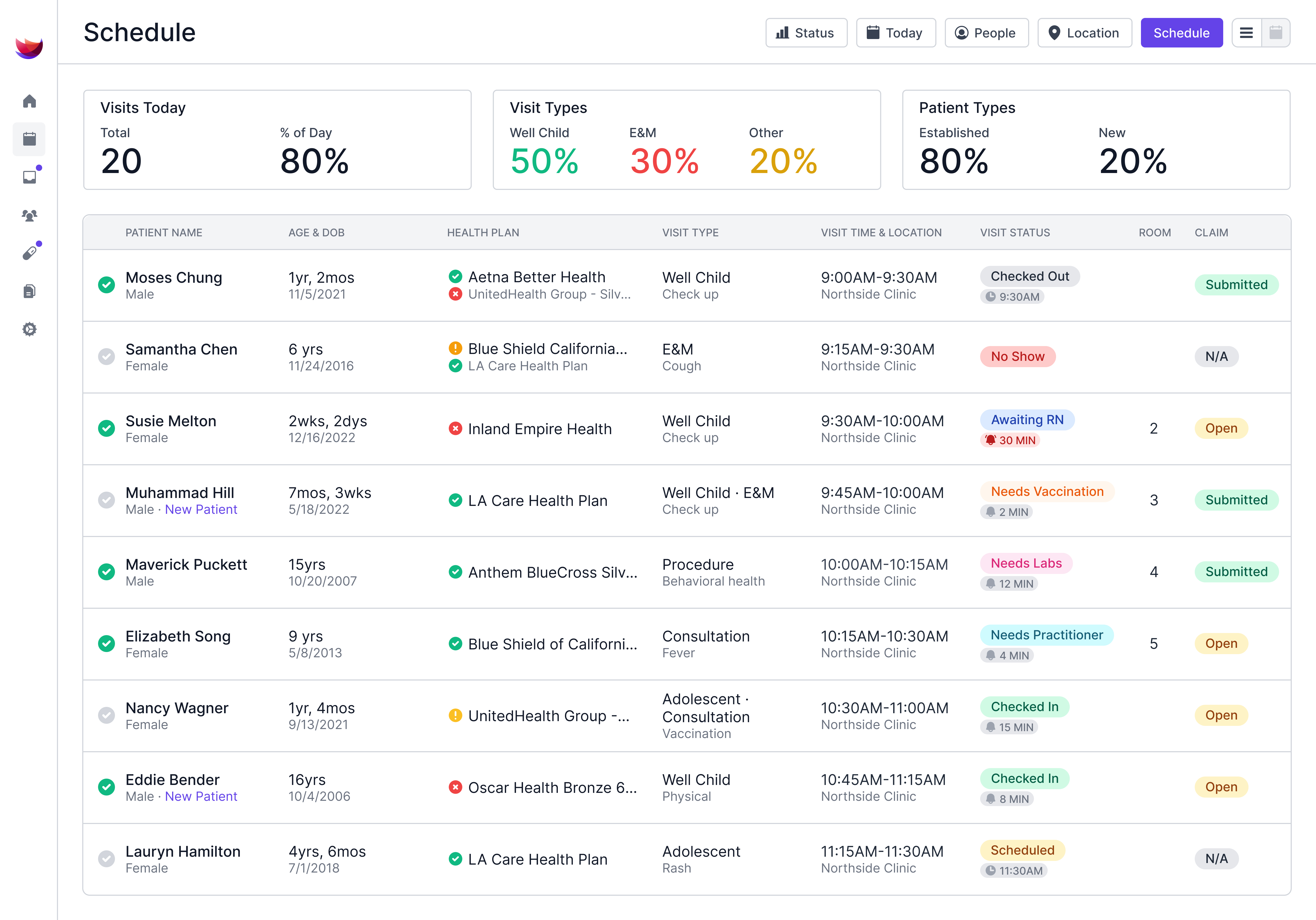


This article highlights the pediatric coding guidelines, documentation priorities, and billing changes that practices need to review for 2026.
Clinical recommendations for preventive care, immunizations, and screening timelines reflect the current American Academy of Pediatrics (AAP) guidance, which pediatric practices widely use as the standard framework for care delivery.
This reflects the continued use of AAP-based schedules in pediatric practices, even as pediatric practices navigate occasional differences between AAP and CDC immunization guidance.
Why Pediatric Coding Guidelines Differ From Adult Medicine
Pediatric coding follows a different rhythm than adult primary care. Vaccine schedules add layers of billable services, and family dynamics create billing complexity that adult practices never deal with.
These workflows are closely tied to AAP preventive care guidelines, including Bright Futures and the AAP immunization schedule, which shape how pediatric services are delivered and documented.
Age drives the code you select. Preventive visit CPT codes change based on the patient's exact age at the time of service. Use the wrong age bracket, and the claim gets rejected.
Vaccine billing requires two components. You bill the product code and the administration code separately. Skip one, and you lose revenue on every shot.
Screening tools generate their own codes. Developmental and behavioral screenings, like the M-CHAT, are billable under CPT 96110 with proper documentation.
What Matters for Pediatric Vaccine Coding in 2026
Pediatric vaccine workflows in 2026 are shaped by two key factors: Updated CPT guidance and the continued use of the AAP immunization schedule as the clinical standard.
Here’s what matters:
- Vaccine timing and recommendations should follow the AAP immunization schedule, even as CDC guidance has shifted.
- New CPT codes (90482-90484) allow practices to report time-based immunization counseling when no vaccine is administered.
- Documentation must clearly support whether counseling occurred and who provided it, since this determines which administration codes apply.
- Product and administration codes must still be reported together and linked to Z23 to avoid denials.
How to Select the Right E/M Level for Sick Visits
E/M coding rules haven’t fundamentally changed for 2026, but many pediatric practices still undercode sick visits by misapplying MDM or time-based selection.
Check out our pediatric coding guide for a full breakdown of how to select E/M levels using MDM and total time. For 2026, the priority is to audit how consistently you apply E/M rules in documentation and coding workflows, rather than relearning them.
Preventive Visit Coding: Getting Age Brackets Right
Preventive visit coding remains a common denial trigger in 2026, especially when age bands or diagnosis pairings don’t align with payer expectations.
For well child visit billing codes, infants under 1 year of age require either 99381 for new patients or 99391 for established patients.
A similar pattern follows for three other non-adult age ranges:
- Early childhood (1 to 4 years): 99382 new patients, 99392 established patients
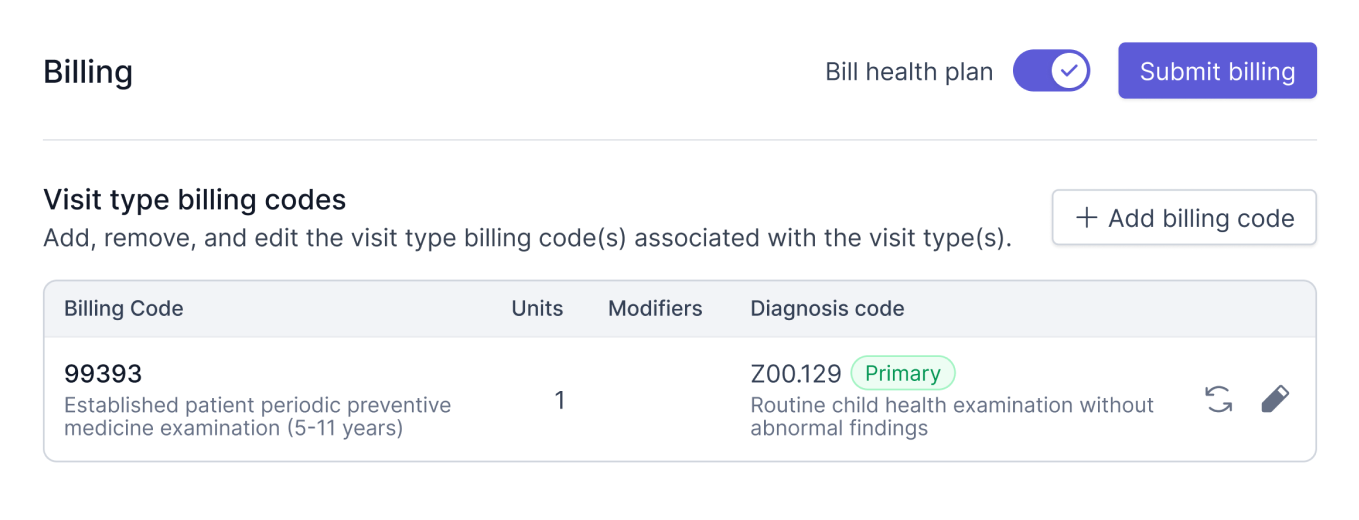
- Late childhood (5 to 11 years): 99383 new patients, 99393 established patients
- Adolescent (12 to 17 years): 99384 new patients, 99394 established patients
On the diagnosis code side, use Z00.129 for routine exams without abnormal findings and Z00.121 when abnormalities are documented for patients >28 days old and <18 years old. Remember that newborn visits require different diagnosis codes.
It’s also important to pay attention to the fact that age thresholds vary between billing and diagnosis codes:
- Z00.110 is for well child visits for newborns under 8 days old
- Z00.111 is for well child visits for newborns 8 to 28 days old
Submitting a preventive CPT code with an acute diagnosis creates a mismatch that payers flag immediately, so documentation must clearly separate preventive and problem-focused services.
Pay close attention to transition points, especially at age 18, when patients move to the adult preventive code set (99385/99395).
Also, switch to using general adult medical examination diagnosis codes: Z00.00 without abnormal findings and Z00.01 when abnormalities are documented.
Vaccine Billing: The Two-Component Rule
Vaccine billing fundamentals remain consistent, but 2026 introduces important updates in how practices approach immunization counseling, documentation, and clinical guidance.
Each immunization still requires both a product code and an administration code.
Product Codes
Each vaccine has its own CPT code.
Pentacel, PCV15/PCV20 (now the routine pneumococcal conjugate options for children under 5, largely replacing PCV13 in new vaccination series), rotavirus, and flu vaccines all have different product codes.
Administration Codes
Administration codes depend on who gives the vaccine and whether counseling occurs for patients ages 18 and younger.
When a physician counsels the family:
- 90460: First vaccine/toxoid component with counseling, with billing unit count equal to the total number of administered vaccines
- 90461: Each additional vaccine/toxoid component with counseling
When clinical staff administers without physician counseling:
- 90471: First injection
- 90472: Each additional injection
- 90473: First intranasal or oral administration
- 90474: Each additional intranasal or oral
For patients aged 19+, 90460 and 90461 no longer apply. Instead, vaccine administration is billed using 90471, 90472, 90473, and 90474 based on the specific combination of injected vs. intranasal or oral vaccines.
Select vaccines call for their own vaccine administration codes, namely the following immunizations:
- Covid vaccines (pediatric and adult ages): 90480
- RSV vaccines, specifically nirsevimab (N-RSV-MAb; Beyfortus) and clesrovimab (C-RSV-MAb; Enflonsia) for pediatric and adult ages: 96380 where counseling is provided, or 96381 where counseling isn’t provided
For visits where you provide vaccine counseling but don’t administer a vaccine, you can use the new 2026 CPT codes 90482-90484 to report time‑based immunization counseling without administration, as long as your documentation supports the time and payer rules.
Always link both the product code and administration code to the same ICD-10 code. For immunizations, that code is Z23 (encounter for immunization).
Note: While coding follows CPT and payer rules, clinical vaccine recommendations should align with the AAP immunization schedule used in pediatric practice.
Developmental Screening Codes and Documentation
Pediatric practices are expected to perform standardized developmental screenings at key ages.
The AAP’s Bright Futures guidelines recommend developmental surveillance at every well-child visit, standardized screening at 9, 18, and 30 months, and autism-specific screening at 18 and 24 months.
These intervals come directly from the Bright Futures preventive care framework, which guides pediatric screening schedules in clinical practice.
CPT 96110 covers developmental screening using a standardized instrument. It’s reported for each screening tool you administer.
To bill 96110, your documentation must include three things:
- Name of the screening tool used (M-CHAT, PEDS, etc.)
- Score or result
- Clinician interpretation
Without all three, the code isn’t defensible in an audit. Templated language in your EMR helps, but the specific score and interpretation must be unique to each patient.
Behavioral health screenings like the CRAFFT for adolescent substance use follow the same documentation rules. The tool name, score, and clinical interpretation must all appear in the chart.
2026 ICD-10 and CPT Updates That Affect Pediatric Coding Guidelines
The most meaningful changes in pediatric coding for 2026 come from annual CPT and ICD-10 updates, which directly affect documentation, reimbursement, and clinical workflows.
Staying current with these annual updates is a core part of following pediatric coding guidelines. The AAP’s Coding for Pediatrics manual (now in its 31st edition) is the gold standard reference in 2026.
ICD-10 Updates (Effective October 1, 2025)
CMS and NCHS release new ICD‑10‑CM diagnosis codes on a fiscal‑year cycle, with the main annual update effective October 1, 2025, and additional mid‑year updates (for example, on April 1, 2026, for the FY 2026 files).
See CMS’s ICD‑10 code updates page for current files and effective dates.
Here’s a quick overview of the 2026 ICD‑10‑CM updates relevant to your practice:
- New obesity codes for children: Adds more granular obesity codes that distinguish severity classes in children by BMI percentile. These update less-specific codes and give practices better tools for documenting pediatric obesity severity.
- Type 2 diabetes in remission: To use these new codes correctly, the provider must explicitly document that the condition is “in remission” rather than “resolved.”
CPT Updates (Effective January 1, 2026)
These CPT changes align with the 2026 CPT code set released by the AMA, with new Category I codes effective on January 1, 2026. See the AMA announcement on the CPT 2026 code set for more details.
The 2026 CPT code set adds:
- New immunization counseling codes: Three new time‑based codes (90482-90484) for reporting immunization counseling when no vaccine is administered that day.
See this overview of new CPT vaccine counseling codes and confirm the details against your CPT 2026 manual.
- Updated immunization administration codes: CPT 90480 and 90481, effective for 2026, support the administration of influenza and COVID-19 combination vaccine products. Code 90481 is new for 2026 to support the products represented by codes 90631 and 90635.
- New Flu/COVID-19 combination vaccine product codes: Effective in May and July 2025, codes 90612 and 90613 for influenza/COVID-19 combination vaccines have been newly published to the 2026 code set, though both are still pending FDA approval.
- New codes for remote patient monitoring: Adds five new codes for remote monitoring services over 2-15 days (within a 30-day period). This is especially important for managing chronic conditions in pediatrics.
Extra codes for emerging vaccines, including pandemic influenza and combination products, are also updated regularly in the CPT manual.
Tip: For practices tracking growth charts, this means documenting the diagnosis alongside the BMI percentile.
2026 Checklist to Reduce Pediatric Claim Denials
Reducing denials and average accounts receivable (AR) days in 2026 requires aligning coding workflows with current CPT updates, payer requirements, and documentation standards.
Here are five steps to lower your denial rate and reduce average AR days:
- Verify insurance eligibility before every visit: Outdated demographics and lapsed coverage cause avoidable rejections.
- Train clinical staff on documentation standards: Billers can’t fix what providers didn’t document.
- Drive charge capture automation: If your system has little to no pediatric charge capture automation, consider transitioning to a better system. Providers can’t be expected to keep up with complex billing code, billing code unit, diagnosis code, and modifier requirements that constantly evolve.
- Run pre-submission claim checks: Flag mismatched CPT and ICD-10 pairings before claims go out the door.
- Audit coding patterns monthly: Compare provider-level billing distributions against benchmarks. Look for undercoding and overcoding.
- Track denial reasons by category: Identify whether your denials come from eligibility issues, coding errors, or payer policy changes. Each category requires a different fix.
Pediatric coding guidelines only work when the entire team, from front desk to biller, follows them consistently. The right solutions make that consistency automatic.
Code, Bill, and Get Paid With Pediatric Coding Built Into Your Operating System
Following pediatric coding guidelines is easier when your EMR does the heavy lifting.
Develo is an AI-native, pediatrics-specific operating system built for independent pediatric practices. It automates the coding workflows that drive lost revenue and denials in pediatrics.
Traditional EMRs and billing solutions are built around high volumes of clicks to enter and process claims, visit-by-visit.
That’s why most practices still use paper superbills despite having clinical and billing computerized workflows, and why existing systems struggle to automate even the simplest coding requirements. Their dated foundations were fundamentally not built for pediatric coding, where patient age, payer line of business, and specific visit context all matter.
Here’s what Develo brings to your billing operations:
- Digital clinical screeners auto-populate by patient age, automatically score, and generate linked billing line items without extra data entry.
- Pediatric documentation templates for well child, sick, and other visit types keep charting consistent while automating billing across the full breadth of pediatric visits.
- AI charge capture applies pediatric-specific billing codes based on visit context, patient age, and insurance type to reduce undercoding and missed charges.
- Built-in E/M calculator recommends the appropriate E/M level based on the medical decision-making complexity and/or time, so providers code at the level supported by the visit activity and documentation.
- Pre-submission claim checks flag incomplete claims, CPT and ICD-10 mismatches, missing modifiers, and other issues before claims even leave your practice.
You don’t need to memorize every pediatric coding guideline when your system applies them in real time. Book a free demo and see how Develo helps your practice code smarter, bill faster, and grow with confidence.
Frequently Asked Questions
1. What Are the Most Common Pediatric Coding Guidelines Mistakes?
Common mistakes include using the wrong age bracket on preventive visit codes, submitting vaccine product codes without administration codes, skipping Modifier 25 on same-day sick and preventive visits, and undercoding E/M levels below what the documentation supports.
2. How Do Pediatric Coding Guidelines Handle Same-Day Sick and Well Child Visits?
Pediatric coding guidelines say to bill both same-day sick and well child visits using an age-based code and an E/M code with a modifier.
Here’s how: Bill the preventive visit using the age-based code (99391 to 99394). Bill the sick visit E/M code (99212 to 99215) with Modifier 25. Link each to its own ICD-10 diagnosis and write separate documentation for each part of the visit.
Don’t settle for a system that forces you to document under two separate notes just because it was a joint well-sick visit.
3. How Can Pediatric Practices Reduce Claim Denials?
Pediatric practices can reduce claim denials by verifying insurance eligibility before each visit. Then, run pre-submission claim checks to catch mismatches.
You can also follow these tips: Run audit provider coding patterns monthly. Train staff on documentation requirements. Track denial reasons by category to target the root cause.
4. What Is the Difference Between CPT 90460 and 90471 in Pediatric Vaccine Billing?
The main difference comes down to whether a physician is present for patients aged 18 or younger at a vaccination visit.
CPT 90460 applies when a physician provides face-to-face counseling during vaccine administration. CPT 90471 applies when clinical staff administers the vaccine without physician counseling.
The 90460 and 90461 series are typically reimbursed at a higher rate because they account for the physician's counseling time.
.avif)
.png)
.jpeg)
.png)