
.avif)
Childhood asthma still drives hospitalizations each year in the U.S. The pediatric asthma score (PAS) gives you a fast, structured way to measure how severe an exacerbation is and decide what to do next.
What Is the PAS?
The pediatric asthma score is a clinical scoring tool that rates the severity of an acute asthma exacerbation in children aged 2 and older. It replaces subjective assessments with a standardized, repeatable number.
The PAS uses five bedside observations: respiratory rate, oxygen saturation, auscultation findings, retractions, and dyspnea. Each component gets a value of 1, 2, or 3. The total ranges from 5 (minimal distress) to 15 (severe distress).
Published research shows ED admission rates for pediatric asthma range from approximately 7% to 23%, and a standardized scoring tool helps you determine which patients need escalation.
You score it before treatment begins, then reassess after each intervention. This creates a trackable trend that shows whether a patient is improving or getting worse.
Children's Mercy clinical practice guidelines describe the PAS as a validated tool. It reduces length of stay, cuts costs, and improves care quality when paired with a treatment protocol.
PAS vs. PASS vs. PRAM: What’s the Difference?
Multiple scoring tools exist, and the abbreviations trip people up.
Here's how they break down:
- PAS (Pediatric Asthma Score): A 15-point tool using respiratory rate, oxygen saturation, auscultation, retractions, and dyspnea. Widely used in U.S. emergency departments and inpatient settings.
- PASS (Pediatric Asthma Severity Score): A related system based on wheezing, prolonged expiration, and work of breathing. Developed and validated in the early 2000s.
In at least one study, PASS outperformed spirometry at predicting the need for further treatment.
- PRAM (Pediatric Respiratory Assessment Measure): A 12-point scale using five parameters: suprasternal retractions, scalene muscle contraction, air entry, wheezing, and oxygen saturation.
Originally developed by Chalut et al. (2000) in children aged 3 to 6, then validated across ages 2 to 17 in a separate prospective cohort study by Ducharme et al. (2008).
A systematic review published in PMC identified 17 different pediatric asthma severity scores using combinations of 15 clinical parameters.
The most common parameters across all scores were expiratory wheeze (88%), inspiratory wheeze (77%), respiratory rate (59%), and general accessory muscle use (53%).
No single score has been universally adopted. The choice depends on institutional preference, training resources, and clinical setting.
The 5 Components of the PAS
Each of the five components receives a value of 1 (mild), 2 (moderate), or 3 (severe). Here's what you evaluate:
1. Respiratory Rate
Normal breathing rates differ by age. The PAS adjusts its thresholds accordingly:
- Ages 2 to 3: Score 1 = ≤34 breaths/min | Score 2 = 35 to 39 | Score 3 = ≥40
- Ages 4 to 5: Score 1 = ≤30 | Score 2 = 31 to 35 | Score 3 = ≥36
- Ages 6 to 12: Score 1 = ≤26 | Score 2 = 27 to 30 | Score 3 = ≥31
- Ages 13+: Score 1 = ≤23 | Score 2 = 24 to 27 | Score 3 = ≥28
A child breathing faster than expected for their age group earns a higher score on this component.
2. Oxygen Saturation
Oxygen saturation (SpO₂) measured via pulse oximetry tells you how well the lungs are delivering oxygen to the blood. Commonly used thresholds to score oxygen saturation are:
- Score 1: >95% on room air
- Score 2: 90 to 95% on room air
- Score 3: <90% on room air, or requiring supplemental oxygen
According to the Johns Hopkins All Children's Hospital asthma clinical pathway, continuous pulse oximetry monitoring is not necessary when saturation stays above 90% on room air. The goal is to maintain SpO₂ above 90%.
3. Auscultation (Breath Sounds)
You listen to the chest with a stethoscope and grade what you hear:
- Score 1: Normal breath sounds or end-expiratory wheezing only
- Score 2: Expiratory wheezing throughout
- Score 3: Inspiratory and expiratory wheezing, or diminished/absent breath sounds
A silent chest, where airflow is so restricted that no wheeze is audible, scores a 3 and signals a life-threatening situation.
4. Retractions
Retractions are visible pulling of the skin around the ribs, sternum, or collarbones during breathing. They indicate a child is working hard to move air:
- Score 1: None or mild intercostal retractions
- Score 2: Intercostal and substernal retractions
- Score 3: Intercostal, substernal, and supraclavicular retractions (with or without nasal flaring)
5. Dyspnea (Work of Breathing)
This component captures the child's ability to speak and their overall respiratory effort:
- Score 1: Speaks in full sentences, coos and babbles (infants)
- Score 2: Speaks in partial sentences, short cry
- Score 3: Speaks in single words or short phrases, grunting
How to Interpret PAS Results
Once you score all five components, the total maps to a severity category that directly drives treatment decisions. According to Kelly (2000) in Ann Allergy Asthma Immunol and the MDCalc PAS Calculator:
Some institutions use these same thresholds (≤7 mild, 8 to 11 moderate, ≥12 severe) to trigger specific medication protocols. Others add a "minimal symptoms" tier for scores of 0 to 4 in protocols that start the scale at zero rather than the PAS minimum of 5.
The key takeaway: A higher score means more aggressive intervention is needed, and you should reassess more frequently.
How Clinics Use the PAS During Visits
The PAS isn't scored once and forgotten. It's used repeatedly throughout a visit to track response and guide next steps.
Triage
When a child arrives with wheezing, coughing, or shortness of breath, a nurse or respiratory therapist performs the first assessment. This initial score determines the starting treatment tier.
Treatment Matching
The score directly determines which medications a child receives.
Based on the Johns Hopkins All Children's pathway:
- Mild (PAS ≤7):
- Albuterol via metered-dose inhaler (MDI) with spacer (dose based on weight)
- Consider oral corticosteroids
- Moderate (PAS 8 to 11):
- Albuterol nebulization with ipratropium bromide
- Oral corticosteroids
- Severe (PAS ≥12):
- Continuous albuterol nebulization with ipratropium
- IV corticosteroids (methylprednisolone)
- Consider IV magnesium sulfate, noninvasive ventilation, or terbutaline
Reassessment Cycles
After each bronchodilator treatment, you repeat the score. Most protocols call for reassessment within 15 to 30 minutes of completing a treatment.
If the score drops to ≤7, the patient moves into an observation period. If it stays elevated or climbs, treatment escalates, and the patient shifts to the next severity tier's medication protocol.
Disposition Decisions
The score plays a central role in discharge vs. admission decisions:
- PAS ≤7 after treatment + stable observation period: Discharge home with a follow-up plan
- PAS 8 to 11 that isn't improving: Transfer to inpatient pediatric unit
- PAS ≥12 that isn't responding: Transfer to a pediatric intensive care unit (PICU)
Research from Indiana University School of Medicine using the PASS found that children who scored ≥12 (severe) at PICU admission spent a median of 21.5 hours on continuous albuterol, compared to 10 hours for mild and 15 hours for moderate groups.
Their median PICU stay was 35.6 hours vs. 17.6 hours for the mild group. Both differences were statistically significant (P = 0.001).
Why Outpatient Pediatric Clinics Should Know the PAS
Emergency departments get the most attention when it comes to the PAS, but outpatient clinics benefit from understanding and using it too. Here’s how:
- Asthma action plans reference PAS logic: When you create an asthma action plan for a family, the severity zones (green, yellow, red) align with the same symptom categories the PAS measures. Knowing the scoring framework helps you write clearer, more actionable plans.
- Post-visit documentation improves: When a child visits your clinic for asthma symptoms that don't require emergency care, documenting a PAS-style assessment adds clinical specificity. It strengthens the chart, supports billing accuracy, and creates a baseline for future visits.
- Care coordination gets easier: If an established patient ends up in the ED, a documented history of scores from clinic visits gives the emergency team context about the child's baseline severity and trajectory.
- Follow-up visits are more targeted: A child who was recently hospitalized with a score of 12+ needs a different follow-up plan than one who had a mild exacerbation managed at home.
The score gives you a shared reference point. Pairing that data with smart pediatric marketing strategies can also help your practice reach more families who need proactive asthma management.
Pediatric Asthma Risk Score (PARS): A Predictive Tool for Future Asthma Development
The Pediatric Asthma Risk Score (PARS) isn’t the same as the PAS. While the PAS measures the severity of an active exacerbation, PARS is a predictive tool developed by Cincinnati Children's Hospital Medical Center.
PARS estimates the likelihood that a young child will develop asthma based on risk factors like family history, allergies, and eczema. It's designed for screening, not for scoring an acute episode.
Clinicians, researchers, parents, and students can access the PARS tool through its website or companion mobile apps. Keeping families informed and engaged while they're in your waiting room is another way to reinforce these screening conversations.
Charting the PAS: Where EMR Design Matters
Recording a PAS is straightforward on paper. Recording it in an EMR and making it useful for follow-up visits, trend tracking, and billing is a different story.
General EMRs treat pediatric asthma the same way they treat adult COPD: With generic respiratory templates that weren't designed for age-adjusted scoring. This creates friction. You either skip the scoring or chart it in free-text notes, where it gets buried.
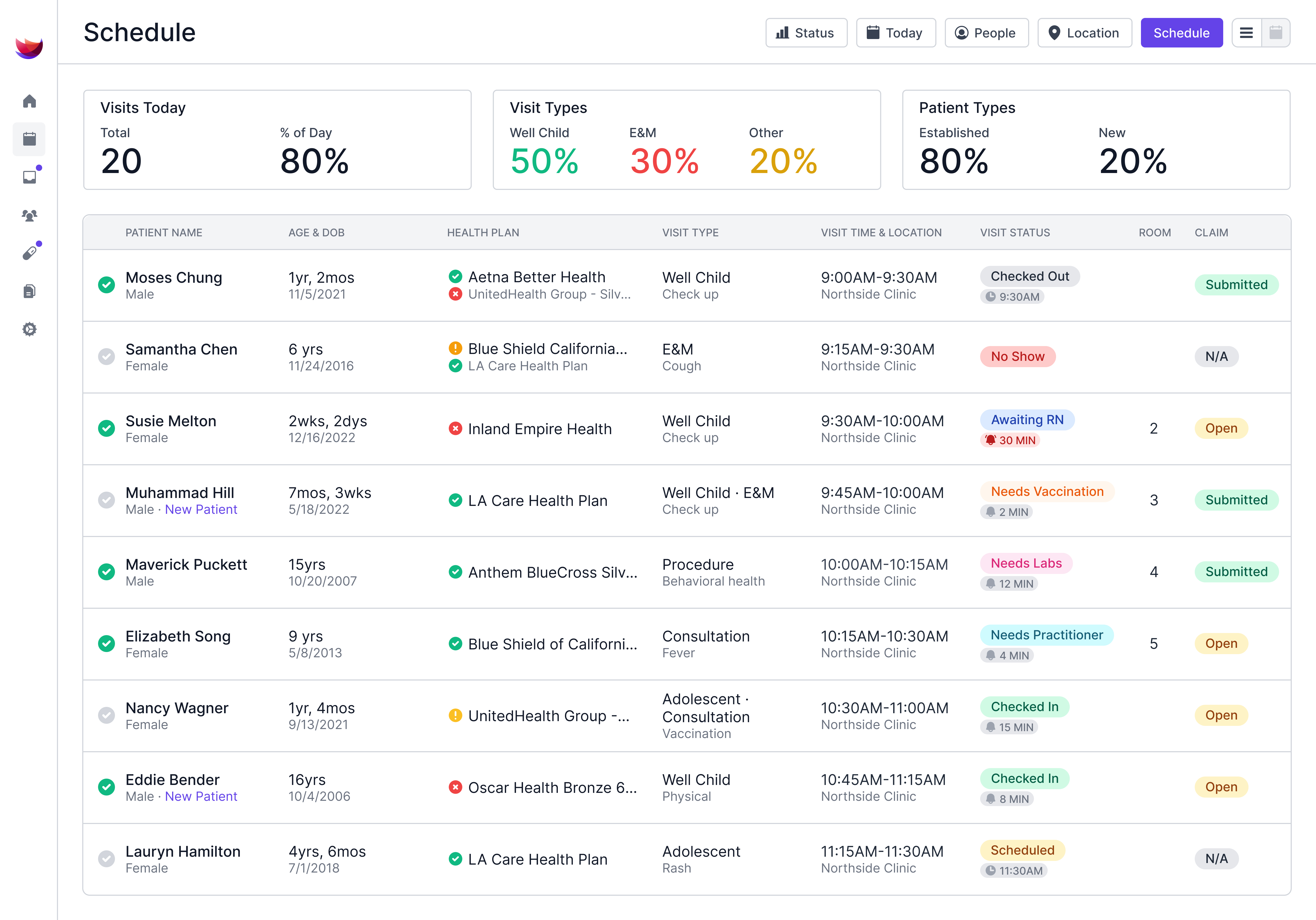
A pediatric-specific EMR changes this by building the PAS into structured clinical workflows. When the score is a discrete data field (not buried in a narrative note), it becomes searchable, trendable, and reportable.
The documentation also feeds billing. An asthma visit with a documented PAS supports higher-complexity E&M coding because the structured assessment demonstrates a higher level of medical decision-making involved.
Document and Act On PAS Results With Develo
Develo is the AI-native operating system for pediatrics, unifying clinical (EMR) + billing (RCM) + family engagement (CRM) capabilities, and it was built from day one for outpatient pediatric care.
It replaces decades-old legacy EMR systems and the patchwork of generic tools that slow down documentation and create gaps in clinical data.
Develo brings purpose-built workflows for pediatric practices managing asthma patients:
- Pediatric visit documentation templates are designed around how pediatricians chart, with structured fields for respiratory assessments, severity scoring, and treatment decisions in asthma-specific templates.
- AI charge capture that automates billing for asthma care and drives accurate billing for simple and complex asthma visits alike.
- Family portal where caregivers can access after-visit summaries, review asthma action plans, send messages to the care team, and book same-day visits for asthma-related needs.
- Digital pre-visit check-in and intake that captures updated insurance and demographics, as well as important asthma pre-visit details via a fully digital Asthma Control Test (ACT) screen.
Develo's FHIR-native data architecture stores clinical information as structured, searchable data rather than locking it in narrative notes.
That means your scores, treatment patterns, and outcomes are accessible for reporting, quality improvement, and care coordination. See how all Develo solutions work together to support your practice.
Book a free demo and see how Develo helps your practice document, track, and act on clinical scores from the same system that runs your schedule, billing, and family engagement.
Frequently Asked Questions
1. What Is a Normal Pediatric Asthma Score?
A pediatric asthma score of 5 to 7 indicates a mild exacerbation, the lowest severity category on the PAS scale. A score of 5, where every component scores a 1, means the child has minimal respiratory distress.
Scores in this range typically correspond to a predicted peak flow above 70% and often allow the child to be treated with an inhaler and observed for discharge.
2. At What Score Should a Child Go to the Hospital?
Most clinical protocols use a PAS of 8 or higher as the threshold for hospital-level treatment. A score of 8 to 11 (moderate) calls for nebulized bronchodilators with ipratropium and systemic corticosteroids.
A score of 12 to 15 (severe) requires continuous nebulization, IV steroids, and possible PICU admission. If a child scores ≥12 and doesn't improve after treatment, transfer to intensive care is standard.
3. How Often Should the PAS Be Reassessed?
You should reassess the score after every bronchodilator treatment, typically within 15 to 30 minutes of completion.
Respiratory therapists score the patient before and after each short-acting beta-agonist administration and document the result. Repeated scoring creates a trend that drives escalation or de-escalation decisions.
4. Can the PAS Be Used in Outpatient Clinics?
Yes. While the PAS is most commonly associated with emergency departments, outpatient pediatric clinics can use it to objectively document the severity of asthma symptoms during sick visits.
A documented PAS adds clinical specificity to the chart, supports accurate E&M coding, and gives emergency teams a baseline if the patient later needs urgent care.
5. What Is the Difference Between the PAS and the PRAM Score?
Both measure exacerbation severity, but they use different clinical parameters and different scoring ranges.
The PAS is a 15-point, 5-component tool that evaluates respiratory rate, oxygen saturation, auscultation, retractions, and dyspnea. The PRAM is a 12-point tool that evaluates suprasternal retractions, scalene muscle contraction, air entry, wheezing, and oxygen saturation.
The choice between them depends on institutional protocol and staff training.