
.avif)
A note from Aaron
I started Develo because the software running independent pediatrics was built for adult medicine two decades ago, and has been patched ever since. Four years in, the same pattern is repeating with AI. Most EMRs treat AI as yet another add-on: pick an ambient scribe vendor, run a pilot, bolt it into part of the visit workflow, schedule a version upgrade, and run a multi-year testing and deployment cycle. The roadmap slide says 2027 for at best a partially integrated experience.
We took a different path from the first line of code. Develo is a pediatric operating system, so intelligence has somewhere to live. It doesn't need to be bolted on, because there's no seam to bolt it to. That difference is not philosophical — it's why we can ship an AI capability in a normal release week instead of a multi-quarter program.
Today six AI capabilities are live for practices on Develo, with more already in development. None of these are a separate application, a separate login, or a separate contract with a third party. They are named for the job they do, they show their work, and they leave the pediatrician or their staff in command.
Here's what each one is, and what it replaces.
Develo provider scribe
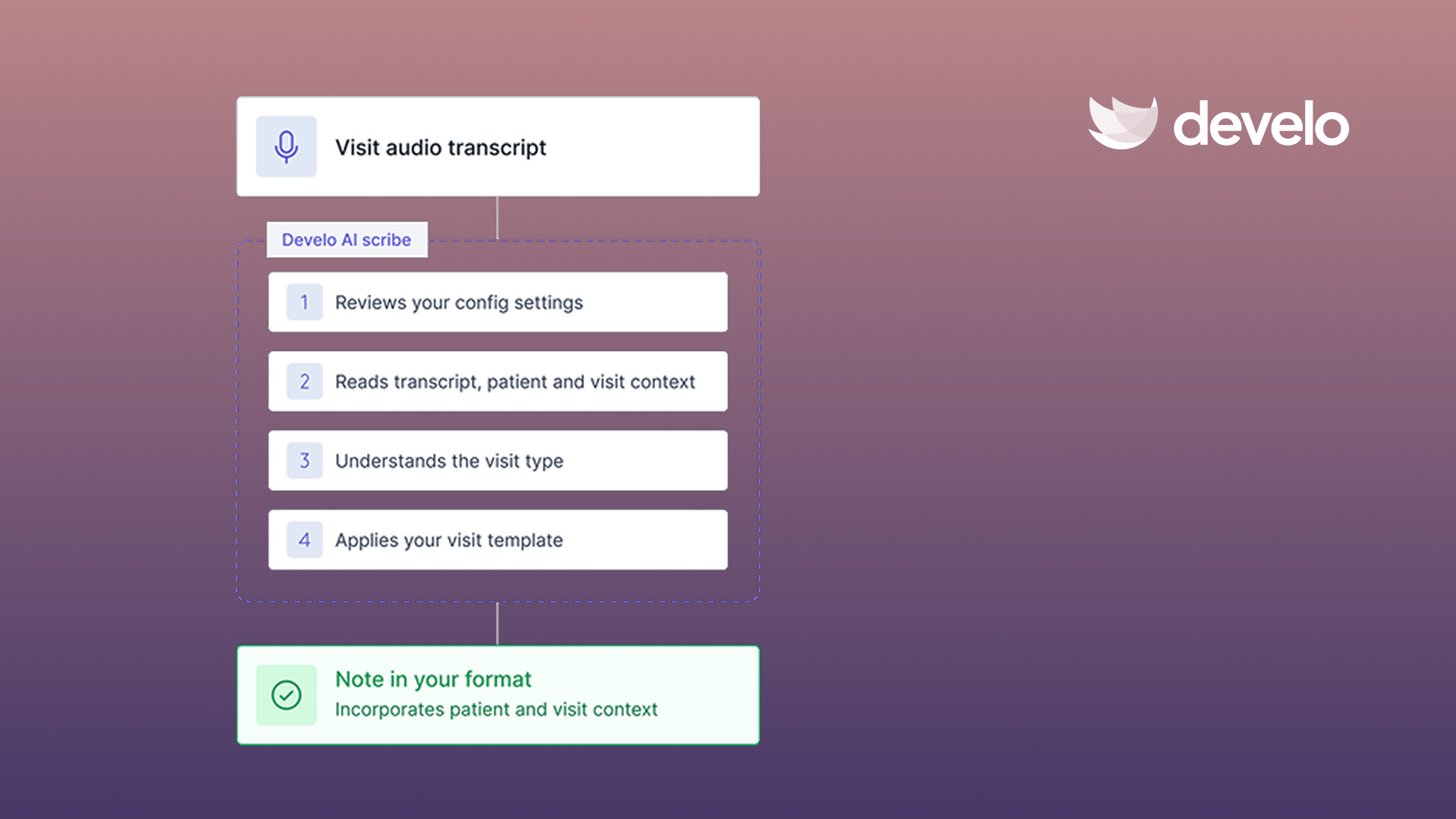
The note writes itself — inside your note. Write straight into your note, no copy-paste, with a multilingual experience powered by visit context beyond the transcript. Built for pediatricians.
What it replaces: a third-party ambient scribe running in a second browser tab or a phone app, and the copy-paste round trip that follows every visit. Also the after-hours charting session that exists because the note was never finished in the room.
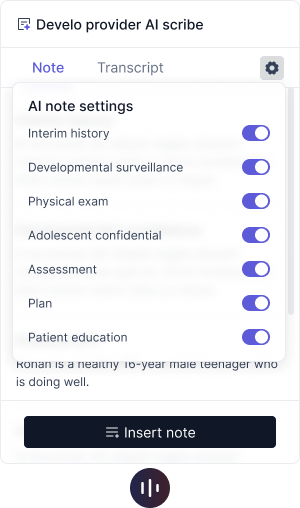
Why AI-native matters here: a bolt-on scribe only knows what it heard. Develo's scribe is inside the chart, so it works from visit context — the problem list, the growth data, the immunization history, what happened at the last visit — not just the audio. That's the difference between a transcript turned into prose and a pediatric note. Section-level controls (interim history, developmental surveillance, physical exam, adolescent confidential, assessment, plan, patient education) stay under the provider's control, and no audio is retained.
Develo intake scribe
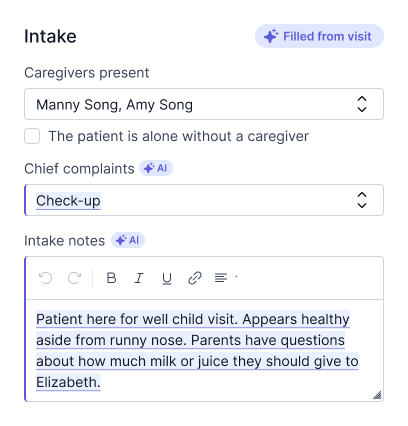
The same capability, moved to the front of the visit. Streamline visit intake with the same multilingual, no audio retained, and context-backed experience. Built for nurses and medical assistants.
What it replaces: a nurse or medical assistant typing intake into structured fields while a caregiver talks — and the second pass a provider makes later to reconcile what was captured with what was actually said.
Why AI-native matters here: almost nobody in pediatrics scribes intake. Ambient documentation is sold as a provider product because that's how it's licensed per seat. When AI is part of the operating system rather than a per-provider add-on, the natural question changes from which providers get the scribe to where else in the visit does this help — and intake is the obvious answer. Caregivers present, chief complaints, and intake notes come back pre-filled from the conversation, in the caregiver's language, ready for the provider to confirm.
Ask Develo
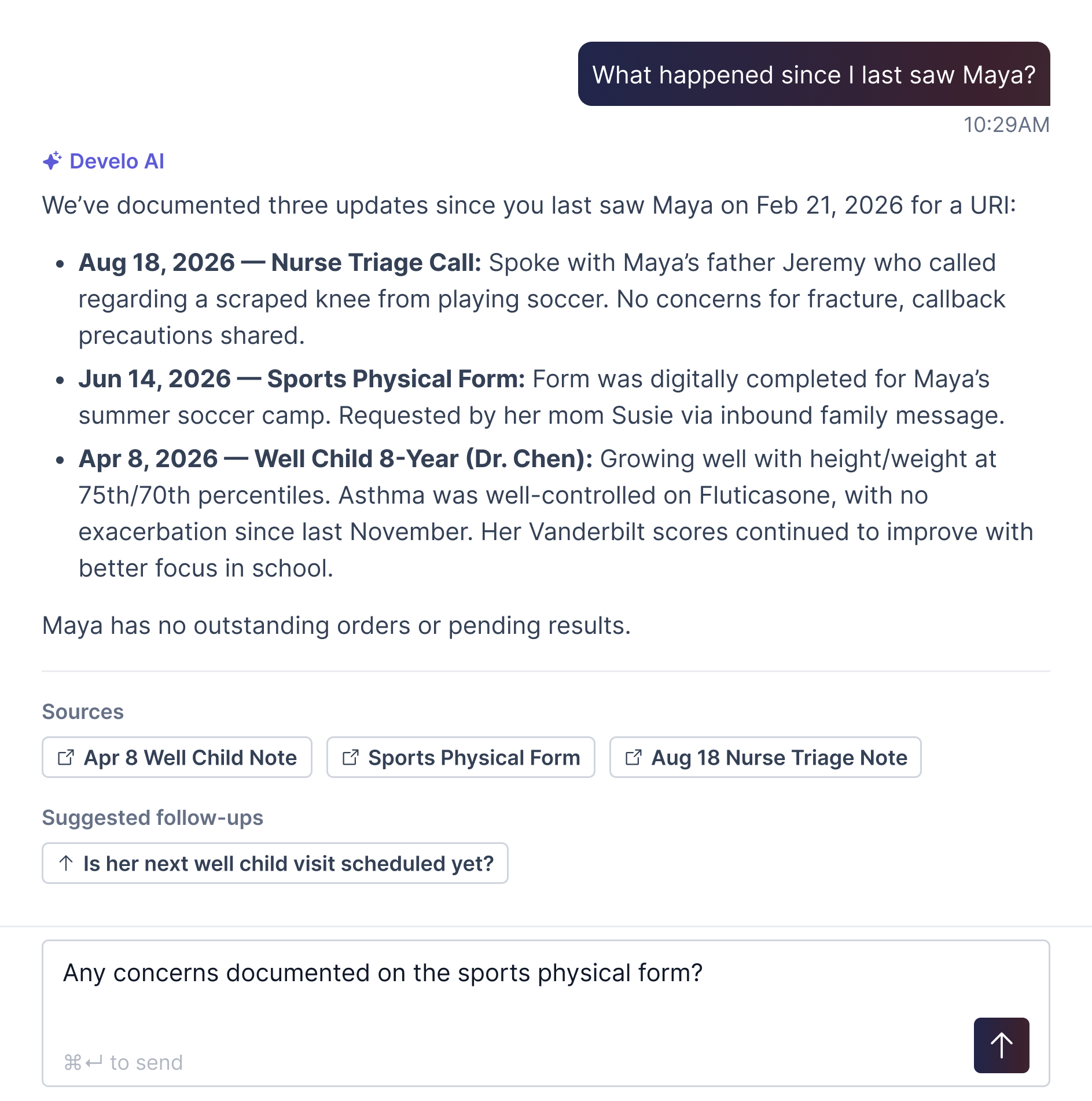
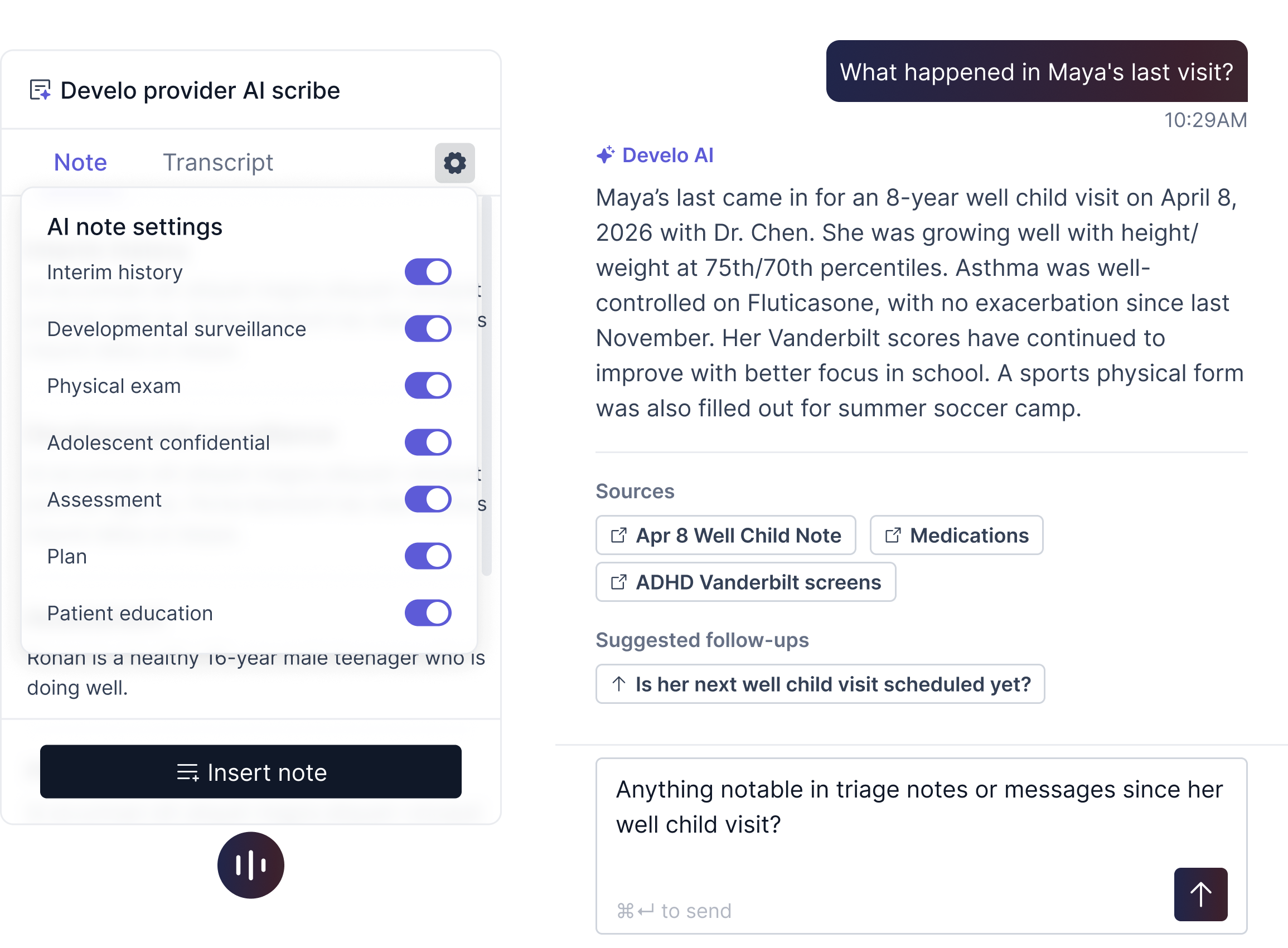
15 minutes of chart review in 60 seconds. Ask anything about a patient to get caught up, with answers linked back to patient medical records.
What it replaces: the multi-window exploration. Opening five notes, two triage messages, the medication list, and a screening score to reconstruct what has happened to a patient since you last saw them — usually while the family is already in the room.
Why AI-native matters here: every answer is sourced. Ask what happened since the last visit and you get the summary plus the notes, forms, and screens it came from, one click away.
It also reads the whole record, not just visit notes and a handful of structured fields — triage messages and family communications, the inbound documents doc intel has already read and tagged, forms, screening instruments, growth and immunization data. That breadth is where legacy systems structurally can't follow. Their inbound documents sit in the chart as images nobody has processed, so there is nothing for an AI layer to read. And a great deal of what should be structured pediatric data — developmental surveillance, screening scores, caregiver relationships — was never modeled as data in those systems in the first place, so it can't be retrieved even in principle.
A chatbot bolted onto an EMR through an interface can only see what the interface exposes, which is why those tools tend to summarize the last note and stop. Ask Develo reads the entire record because it is built into the patient chart.
Develo doc intel
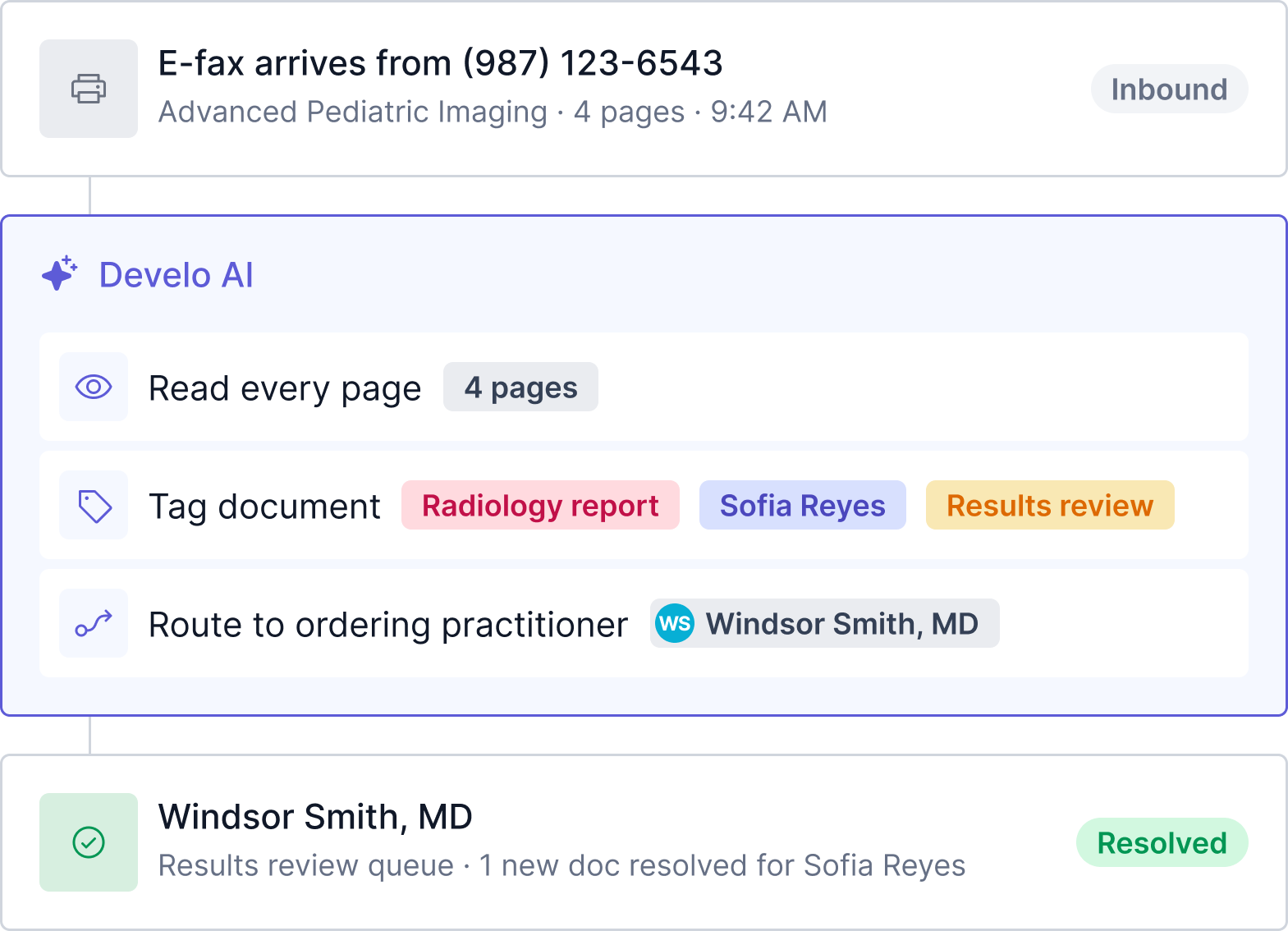
Every inbound document, tagged before anyone opens it. Auto-tag e-faxes and uploaded files for single-click filing into patient charts. Extends Develo's leading e-fax experience and cuts admin burden.
What it replaces: the records queue — a staff member opening every inbound fax to work out what it is, who it belongs to, and where it goes. In larger practices this is a job. In smaller ones it's the thing that never gets done until it becomes a problem.
Why AI-native matters here: the document arrives, Develo reads every page, classifies it by type and sub-type, titles it, and routes it to the ordering practitioner — and then writes an audit line showing exactly what it did and when, so staff can verify or correct it. Automation you can't inspect is automation nobody trusts.
The payoff shows up in three places. Staff get their morning back — single-click filing replaces open, read, identify, tag, and file, on every page that comes in. Results reach the right provider sooner — routing happens on arrival instead of whenever someone works down the queue, which is the difference between a result reviewed today and one reviewed Thursday. And documents stop going missing — nothing sits unfiled because the one person who knows where it goes is out.
It's worth saying plainly how far back the starting line is here. Many EMRs still don't support e-fax natively at all: the practice pays a separate fax service, then prints or downloads and manually uploads into the chart. Develo already had the leading e-fax experience in pediatrics, and doc intel means every one of those faxes now arrives read, titled, and tagged. That tagging is what makes it usable downstream — a tagged specialist note is something Ask Develo can cite and the scribe can pull in as visit context. An untagged image sitting in a documents folder is invisible to both, which is why systems without native e-fax aren't one step behind on this. They're several.
Develo reports Q&A
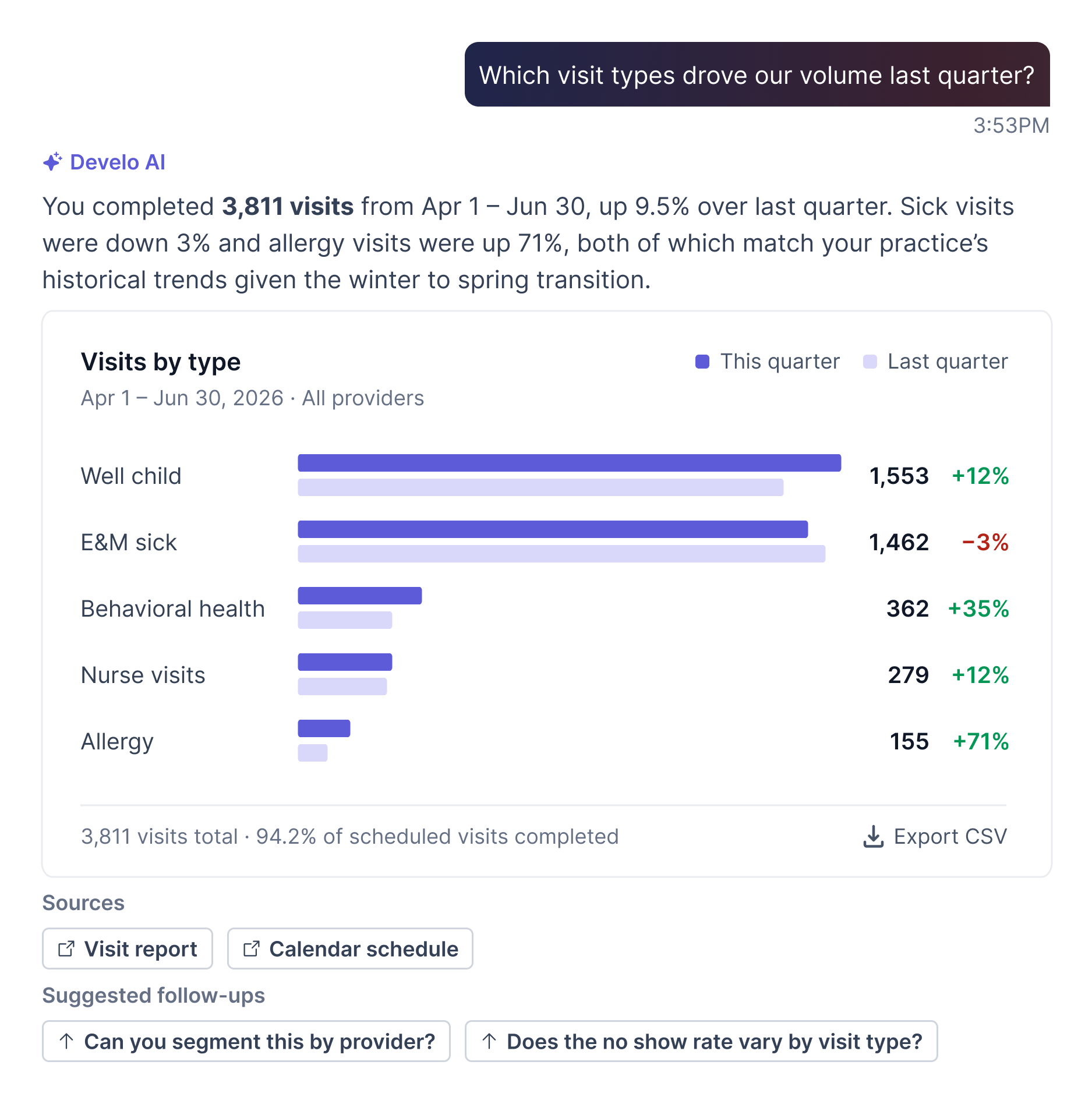
Ask your data a question, skip the report builder. Ask plain-English questions of your clinical and administrative data and get back detailed text and graph answers. No report builder nor analyst needed.
What it replaces: the report builder, the analyst, and the change-request ticket. On legacy systems, a question like "which visit types drove our volume last quarter?" is either a report you don't know how to build, a data export into a spreadsheet, or a paid request to your vendor.
Why AI-native matters here: ask in English, get the number, the chart, the sources it drew from, and a suggested next question. A practice manager can answer a board question in the meeting rather than after it. This is the capability where the operating system advantage is most visible — clinical and administrative data live in the same system, so the answer can cross both without an integration.
Develo AI forms
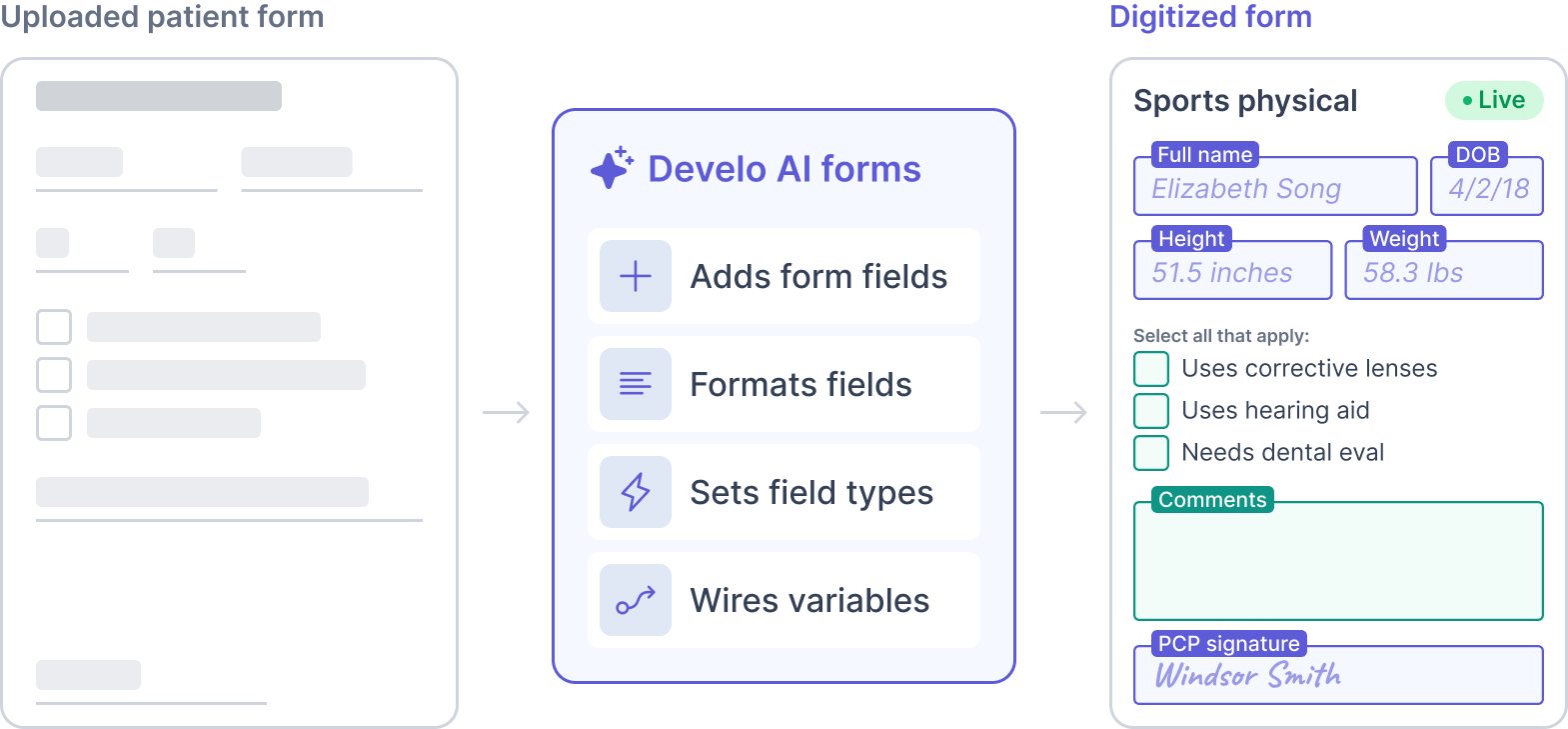
Paper to live form, without a build project. Drop in any practice or patient form and Develo auto-digitizes it, wiring in the right variable and dynamic fields.
What it replaces: the third-party forms vendor, and the vendor change request behind it. The reason so many practices still hand a clipboard to a caregiver is not that nobody wanted to digitize the form — it's that digitizing it meant a ticket, a queue, a fee, and six weeks.
Why AI-native matters here: upload the sports physical, the consent, the screener, the practice-specific intake sheet. Develo reads it, builds the fields, maps the variables that should auto-populate from the chart, and gives you a live form. The unlock isn't one form — it's that the cost of digitizing any form drops to near zero, so practices stop rationing which ones are worth it.
That pays off three ways. Your staff gets time back — no printing, scanning, chasing signatures, or re-keying a clipboard into the chart, which is real administrative load off the front desk every week. Families get an easier visit — forms filled out on a phone before they arrive, with what you already know about them pre-filled, instead of a clipboard and the same questions for the fourth time. And your practice reads as modern — parents notice when the experience matches what they get everywhere else in their lives, and that impression is a real part of why families choose a pediatric practice and stay with it.
Why we could ship six while the category ships one
Legacy EMRs update quarterly at best, across dozens of fragile versions, with multi-month testing and roll-out cycles. Develo ships minor releases weekly and major releases biweekly, with zero downtime — every practice on the current version, always. That cadence is the entire reason this list has six capabilities on it instead of one.
The rest of it is architecture. Develo is one operating system covering the chart, billing, practice management, and the family experience. When intelligence has one place to sit and one record to read, adding a capability is a feature release. When it has to be integrated — a scribe vendor here, a document vendor there, a forms tool alongside — every capability is a practice-level integration project.
That is what "AI-native, not AI bolted on" actually means, and it's why Develo practices are the ones seeing the benefit while the legacy systems are just rolling out their ambient scribe.
What's next
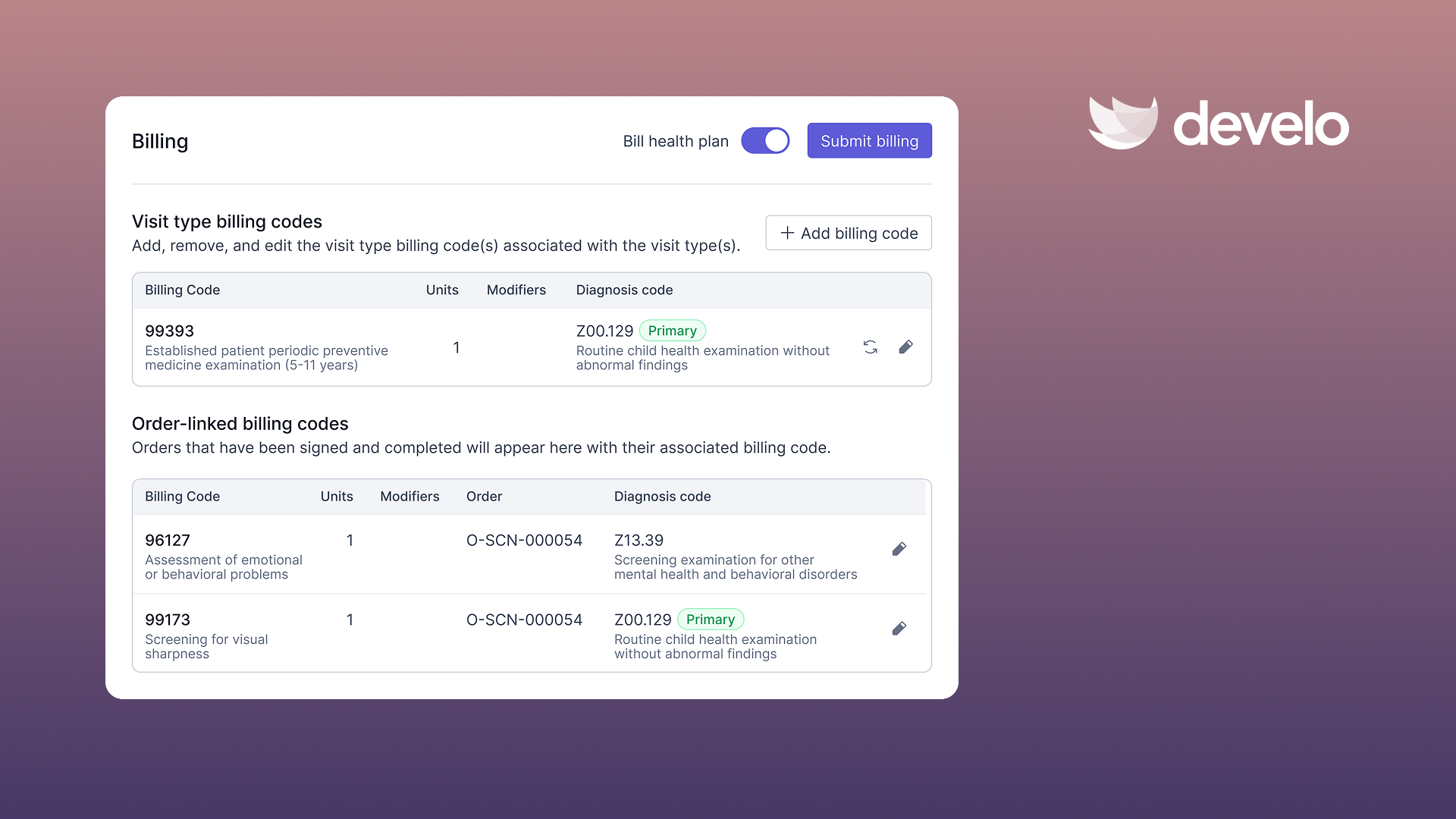
We're not done. Ask Develo answers questions today; the path is to let it act on the chart — add a diagnosis, update allergies — with the pediatrician still in command of every step. We're extending the same approach into pediatric billing, where AI should be surfacing the reimbursement a pediatric practice is leaving on the table, not just assisting with the processing of what's already there.
If you are wondering whether AI can work in your practice's EMR, we'd rather show you what it looks like when it's already in place — don't hesitate to reach out.
.png)

.png)
.avif)