
.avif)
Every clinician knows the feeling of writing notes long after the last patient went home. An AI medical scribe is meant to end that. It listens to the visit and hands back a draft note for you to review and sign, and for plenty of practices, it delivers.
For others, it just swaps typing for editing. What you check before you buy decides which experience you get, so this guide covers how the technology works and exactly what to test.
What Is an AI Medical Scribe?
An AI medical scribe is software that listens to a patient visit and turns the conversation into a draft clinical note. It runs in the background on a phone or laptop, and the clinician reviews, edits, and signs the draft note.
The category is often called ambient documentation, because the capture is passive and nobody dictates to it. The tool drafts documentation and stops there. Diagnosis and treatment suggestions fall under clinical decision support, a separate category of software, although the categories are merging with emerging options covering both.
How Ambient Scribes Work
An AI medical scribe moves a conversation into the chart through four stages.
- Capture: a microphone on a phone, laptop, or dedicated device records the visit while the clinician talks with the patient and family.
- Transcription and speaker attribution: speech becomes text, and the system labels who said what, separating the clinician from the patient and anyone else in the room.
- Drafting: a language model extracts clinically relevant content from the transcript and structures it into a note format, usually SOAP (Subjective, Objective, Assessment, Plan), setting aside small talk and repetition.
- Review and signature: the clinician reviews the draft, corrects any errors, and signs it. Tools with deeper EMR integration write the finished note straight into the record and surface suggested codes or orders alongside it.
The review and signature stage carries the weight. The draft is raw material, and the clinician who signs the note is responsible for its accuracy.
How to Evaluate an AI Medical Scribe
Every vendor demo can look similarly impressive. The questions below get at what actually differs between tools. Ask them of every scribe you shortlist.
The AMA reported on The Permanente Medical Group's rollout of ambient scribes to 7,260 physicians across more than 2.5 million patient encounters. Among physicians who used the tool infrequently or not at all, two barriers stood out, and both are worth testing in a pilot.
The first was lack of integration with existing note templates. The second was the perception that editing an AI draft took longer than typing the note from scratch. A fast typist with a simple template may genuinely be quicker on their own, so pilot with a mix of clinicians before you decide.
Where AI Scribes Fall Short
AI scribes fall short in predictable ways. A published review of documentation from AI scribes and language models concluded that careful proofreading by the signing physician remains essential, because errors of omission, fabrication, or substitution can appear in generated text and are easily missed.
A pediatric room adds a fourth failure mode, misattribution, because several people are speaking at once.
- Omission: clinically relevant detail said aloud never reaches the draft, which is harder to catch than a visible error because nothing looks wrong.
- Fabrication and substitution: the model produces plausible content the conversation didn't contain, or swaps a word or number for a similar one, such as a dose or which ear is infected.
- Misattribution: speech is assigned to the wrong person, turning a parent's observation into a patient's own report.
None of this makes the tools unsafe. It does mean the review step is real clinical work, and a signed AI draft carries the same weight as anything else you put your name to.
What Changes in a Pediatric Practice
A pediatric visit changes what an AI medical scribe must handle because the assumptions behind these tools are based on adult encounters.
- Three people talk, sometimes four: a caregiver reports the history, the child adds to it, and a sibling may interrupt. Whether a symptom came from the parent or the patient should be noted, so speaker attribution carries more weight here than in an adult visit.
- Rooms are loud: crying infants, movement on the exam table, and a toddler talking over the clinician all degrade the audio a scribe depends on.
- Well child visits are structured differently: anticipatory guidance, growth, and development take up the visit, and a scribe tuned to a problem-focused adult encounter tends to under-capture these topics.
- Adolescent visits have a confidential portion: when the parent steps out, what a teen shares about sexual health, substance use, or mood shouldn't land in a part of the note a parent can see through the family portal or an after-visit summary. Ask where the scribe writes confidential content and how it keeps that content apart from the rest of the note.
- Counseling must appear in the note: vaccine administration codes 90460 and 90461 apply when a physician or other qualified health care professional provides face-to-face counseling, and the patient is 18 or younger; documentation reflecting the counseling supports correct code selection. Otherwise, the correct codes are 90471 through 90474.
- Screening needs specifics: a developmental screen billed under 96110 requires that the tool, score, and interpretation be recorded, and a general scribe will not know to look for them.
- Numbers said aloud carry clinical weight: weight-based dosing and growth measurements must be accurately reflected in the note.
Our pediatric coding guide covers the code selection rules in more depth.
AI Scribing Built for Pediatrics
Pediatric-built scribing carries the note through to the codes and the record. But most legacy EMR vendors don't build their own scribe; they partner for one because they can’t deliver it in-house. Office Practicum's comes from Insight Health, Greenway's from Nabla, and eClinicalWorks practices add Sunoh.ai as a separate per-user subscription. The EMR vendor owns the chart and another company owns the AI, and a scribe built that way only knows what it heard, not what the chart already holds, and meets the EMR via a disjointed user interface experience. Every fix waits on two roadmaps, and the rest of the pediatric workflow, from the adolescent confidential section to vaccine counseling to charge capture, sits on the other side of that seam. For many EMRs, that scribe is the whole AI story.
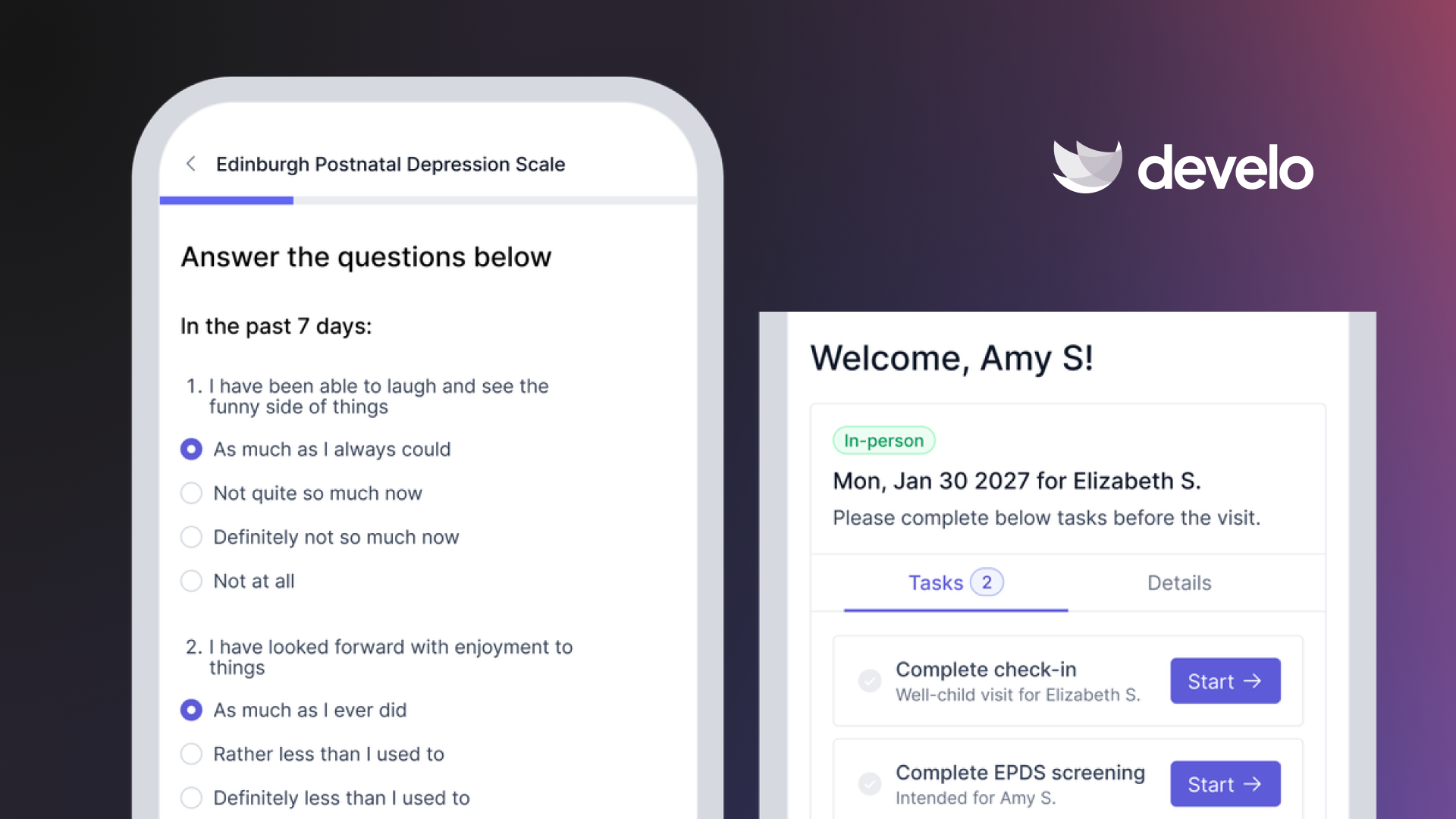
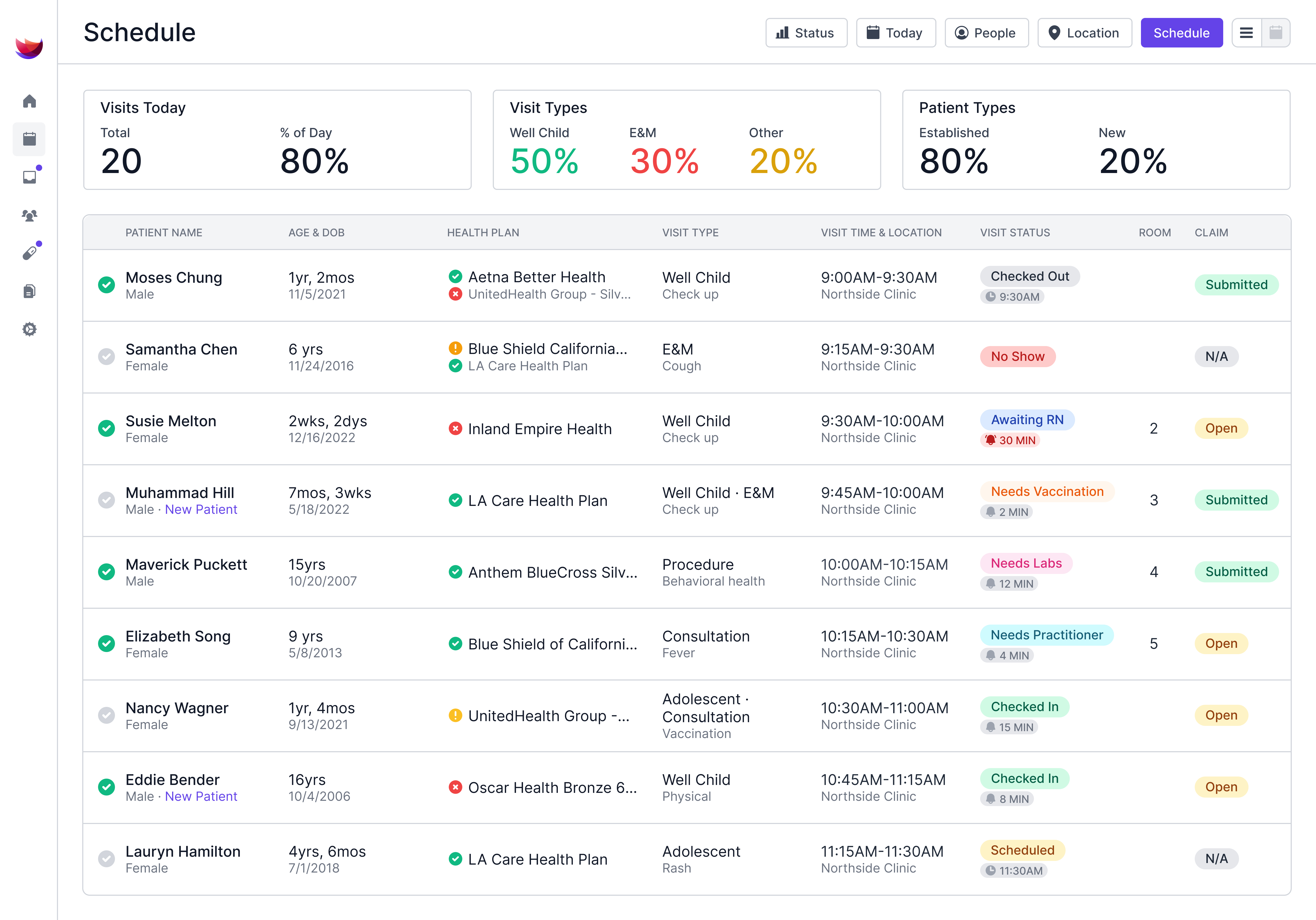
Develo takes the other route. It is the AI-native pediatric operating system built solely for independent pediatric practices, unifying charting, billing, practice management, and family engagement, so the note is one step in a connected AI-enabled workflow.
- Develo AI scribe: intake mode at the front of the visit and provider mode in the exam room, both writing into the note section-by-section.
- Pertinent context beyond visit audio: Develo AI scribe pulls in what's pertinent to today's visit from the problem list, growth data, immunizations, in-house tests, and screening results, not just the audio transcription.
- Your templates, your review: Develo AI scribe works with your existing templates and free-text notes, and you finalize every section before signing your note.
- Adolescent confidentiality: Develo AI scribe writes sensitive content into the dedicated adolescent confidential section of the visit note. A corresponding adolescent confidential patient education section ensures sensitive guidance is provided to the teenager or young adult only, excluding parents and other guardians.
- Privacy by design: Develo signs a BAA with every practice, no visit audio is ever retained, and the transcript stays transiently available for seven days outside the formal visit documentation.
- Automated charge capture: orders completed during the visit carry their billing and diagnosis codes through, and pediatric rules set codes, units, and modifiers, so the vaccine given and the screen done both reach the claim.
- One AI suite, not one scribe: Develo AI scribe sits beside Ask Develo for catching up on a patient, Develo doc intel for tagging e-faxes and uploaded files, Develo reports Q&A for plain-English questions about practice data, and Develo AI forms for digitizing paperwork, all built into the same system, with more already in development.
There is a trade-off. This suits a practice ready to run its records and billing on one pediatric platform, and it asks more of you than adding a scribe to the EMR you already have. Book a demo to see Develo’s scribe in action for any pediatric visit.
Frequently Asked Questions
Are AI Scribes Accurate?
Yes, but only enough to draft from, not to sign unread. Published reviews document errors of omission, fabrication, and substitution in generated clinical text, which is why the signing physician is responsible for proofreading. Treat the output as a first draft that still needs clinical judgment.
Do AI Scribes Work With My EMR?
Some do, but most do not. The majority of AI scribes, including those marketed by traditional EMR systems, produce a note you copy and paste out of a separate interface, disjointed from your core EMR experience. That copy-paste step gives back much of the time saved. Ask any vendor to demonstrate the finished note landing in your own system, on your templates, in an automated fashion. Don't sign if they can't meet this foundational bar.
Are AI Scribes HIPAA Compliant?
Yes, but only if the vendor signs a business associate agreement (BAA), which HHS requires before a practice shares protected health information with a vendor. Ask where audio is stored and whether it trains models. State recording laws vary; in all-party-consent states, everyone in the room must agree, including the parent at a child's visit.
How Much Does an AI Medical Scribe Cost?
Prices range from about $40 to several hundred dollars per clinician per month. A 2026 Medical Economics feature found budget tools near $40, mid-range tools upward of $100, and enterprise platforms with deep EMR integration at several hundred dollars, often on multiyear contracts. Integration fees move the real number, so ask for the all-in per-clinician cost before comparing vendors.
How Is an AI Scribe Different for a Pediatric Practice?
Speaker attribution and audio quality are harder in pediatrics. A caregiver, a child, and often a noisy room complicate what the tool has to separate. Well child structure, vaccine counseling, and developmental screening also require specific details that a general scribe isn't tuned to capture.
.png)
.png)
.png)
.avif)