
.avif)
"AI-native" has become one of the most-used phrases in health tech, and one of the least defined. Vendors apply the label to everything from a single AI scribe to a full platform rebuild, which makes it hard to tell what an AI-native EHR actually is.
What Is an AI-Native EHR?
An AI-native EHR is an electronic health record system built with AI at its core from the start. The AI is part of how everyday work gets done: writing notes, assigning billing codes, and managing schedules.
In an older system, that same AI is a separate add-on, layered onto tools built long before AI existed. The two approaches behave differently, and it shows up in how well the AI performs.
AI-Native vs. AI-Powered: The Difference
The clearest way to separate AI-native from AI-powered is to look at where the AI lives in the system.
Why Architecture Is the Deciding Factor
A system can only be AI-native if its foundation supports it, and that means two things: a modern cloud architecture, and a data model designed to be read by software. Older systems run on-prem or in a private cloud, on data models built before AI existed — where much of what matters clinically was never structured as data at all. Inbound faxes sit as unprocessed images. Screening scores, developmental surveillance, and caregiver relationships live in free text.
Adding AI to that means stitching a model onto software with nothing clean to read. AI-native systems start from the opposite premise: structure the record first, so the AI has consistent access to the full patient and visit context.
Interoperability standards like FHIR matter here too, but for a different reason than vendors usually imply. FHIR governs how a system exchanges data with the outside world, not how its own AI reads the chart. A vendor that is FHIR-native has usually done the structural work anyway; a vendor that bolted FHIR onto the edges has not. The architecture determines whether AI works across the entire workflow or only in one isolated corner. It's precisely why most AI scribes work from the visit transcript alone: the clinical data is sitting right there in the EMR, but the scribe can't reach it.
What an AI-Native EHR Looks Like in Practice
The value of an AI-native system shows up in the daily work. It changes the workflow in a few key areas:
- Clinical documentation: the AI scribe drafts the note inside the chart from the full context of the visit — the conversation plus the problem list, growth data, and immunization history — not from an audio transcript alone. In pediatrics that gap is decisive: a transcript-only scribe cannot see that this is a 15-month well-child visit with two catch-up vaccines due.
- Coding and charge capture: codes, units, modifiers, and diagnoses are set at the point of care for the provider to confirm, which is where sick-and-well splits, vaccine administration codes, and developmental screening charges get missed and become denials.
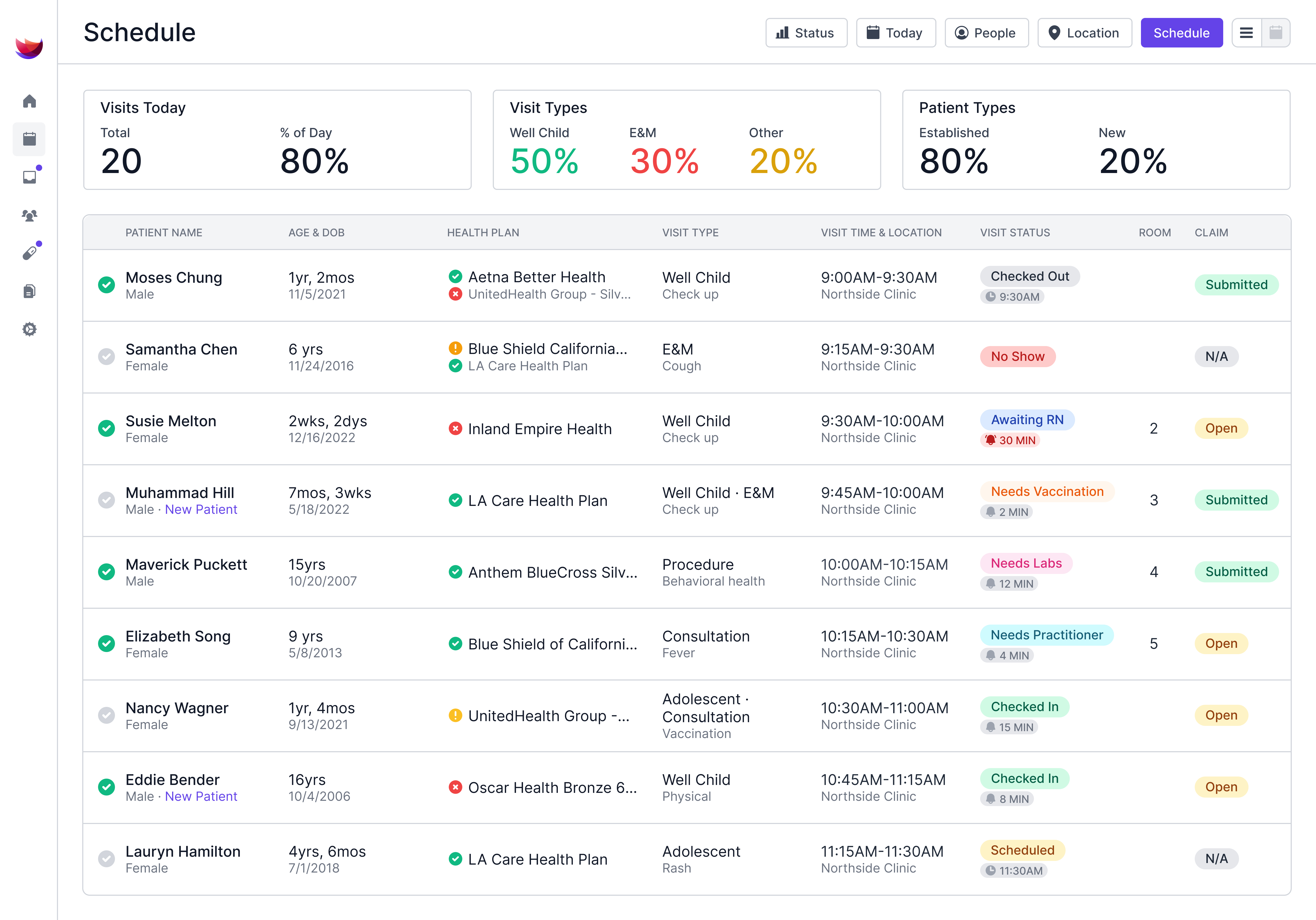
- Scheduling and intake: age-appropriate screeners, forms, and reminders go out automatically based on the child's age and last visit, and scored results flag concerning findings to the provider before the family arrives.
- Billing and follow-up: claims, family balances, and payment reminders are handled in the same system, with no handoff to a separate tool and no second vendor to reconcile.
The common thread is that the work remains in one connected system. Practices don't have to stitch together or maintain a stack of separate tools.
How to Evaluate Whether an EHR Is Truly AI-Native
Because the label is used loosely, a few questions separate genuine AI-native systems from rebranded legacy ones:
- Was the platform built recently and on cloud architecture, or is it an older system with AI added?
- Does the AI work across documentation, coding, and billing, or only in one of those areas?
- Does the AI draw on the full patient and visit context, or only a transcript?
- Is the AI part of the core workflow, or a separate module that a clinician has to open?
- Does the vendor ship AI improvements regularly, or rarely?
- Was the AI trained on and tuned for pediatric workflows, or for ambulatory medicine generally?
A system that only answers the first half of those questions is AI-powered, not AI-native. That can still be useful — but the ceiling is set by the architecture underneath, and no number of AI features bolted on top raises it.
AI-Native EHR vs. EMR: A Note on Terms
EHR and EMR are often used as synonyms. In everyday use, the difference is simple:
- EMR: a practice's own digital chart.
- EHR: records meant to be shared across organizations.
Most vendors use the two terms interchangeably, and for most of them the distinction genuinely doesn't matter — either way, the product is a place to store records.
Develo calls itself something else on purpose. It's the AI-native operating system for pediatrics: clinical (EMR), billing (RCM), and family engagement (CRM) in one system built solely for independent pediatric practices. Not a chart with billing bolted to the side, and not an engagement add-on — practices replace an entire legacy technology stack with it.
AI-Native, Applied to a Specialty
A general AI-native EHR is built for ambulatory care broadly. A specialty-built one assumes the workflows of its field from the start, which is where the AI-native idea gets more concrete.
Most systems sold to pediatric practices are adult ambulatory platforms with a pediatric module added later. The architecture assumes one adult patient per record, so everything pediatrics actually needs — sibling and guardian relationships, growth trajectories, developmental surveillance over years, VFC inventory split from private stock — arrives as a customization on top of a model that was never built for it. AI inherits that. A model reading a chart where screening scores live in free text and inbound faxes are unprocessed images has nothing to work with, no matter how good the model is.
Develo was built the other way around: six AI capabilities run inside one system, not as add-ons beside it.
- Develo provider scribe drafts the note inside the chart, multilingual, from full visit context — the problem list, growth data, and immunization history, not just the audio.
- Develo intake scribe does the same at the front of the visit, for nurses and medical assistants. Almost nobody in pediatrics scribes intake.
- Ask Develo answers questions in the patient chart and links every answer back to the record it came from — including triage messages, tagged documents, forms, and screening data.
- Develo doc intel auto-tags inbound e-faxes and uploads by patient, document type, and sub-type, then routes to the ordering practitioner.
- Develo reports Q&A takes a plain-English question and returns text and graphs, with no report builder and no change-request ticket.
- Develo AI forms turns a paper form into structured digital fields without a build project.
That set only works because of what's underneath it: Develo is ONC-certified, FHIR-native, and hosted on AWS, with minor releases weekly and major releases biweekly, all via background updates with zero downtime. The AI and the record are one system, and both keep moving. See how the six capabilities work together, or book a Develo demo.
Frequently Asked Questions
What Is the Difference Between AI-Native and AI-Powered EHRs?
The main difference between AI-native and AI-powered EHRs is where the AI lives. An AI-native EHR is built from the ground up with AI, so intelligence runs through the entire workflow. An AI-powered EHR is an older system with AI features added on top.
Are AI-Native EHRs Cloud-Based?
Generally yes, because AI needs consistent, real-time access to structured data to work across a full workflow, and legacy on-prem and private-cloud systems weren't built to provide it. Cloud architecture is close to a prerequisite. Interoperability standards like FHIR are a separate question — they govern how a system exchanges data with other organizations, and they're a reasonable proxy for whether a vendor has done the structural work to share more granular patient context, but they aren't what gives the AI access to the chart.
Is an AI-Native EHR the Same as an AI Scribe?
No, an AI-native EHR is not the same as an AI scribe. An AI scribe handles a single task (such as drafting notes), while an AI-native EHR embeds AI into documentation, coding, billing, and scheduling. A scribe can bolt onto a legacy system; AI-native describes the architecture of the entire platform.
How Can a Practice Spot a Truly AI-Native EHR?
A practice can spot a truly AI-native EHR with a few checks: recent cloud architecture, AI that spans many workflows, and AI that uses full patient context. One good test: if turning off the AI leaves a complete legacy product, the system is only AI-powered.
Does an AI-Native EHR Take Decisions Away From the Clinician?
No. AI-native describes where the AI sits in the architecture, not who decides. In a well-built AI-native system the AI does the work — drafting the note, setting the codes, tagging the document — and the clinician or staff member reviews, modifies, and confirms the output before it's final. The distinction that matters is that the AI is embedded in the workflow rather than running as a separate tool, not that it operates unsupervised.
.png)


.avif)