
.avif)
Independent pediatric practices keep reaching for the same tired marketing tactics, so here are the 11 pediatric marketing ideas that fill schedules in 2026, plus the ones to skip.
Pediatric Marketing Is a 20-Year Game
Pediatric marketing is the set of strategies independent pediatric practices use to attract new families, retain existing ones, and grow visit volume across a relationship that often lasts two decades.
That timeline makes pediatric marketing different from other healthcare marketing. One newborn is the start of well child visits, sick visits, vaccines, and screenings that run to age 18. Younger siblings join the same practice, and the parent starts recommending you at preschool drop-off.
The practices growing fastest treat every well check as a renewal, and every sibling who joins extends the relationship. Lose a family early, and you lose years of visits, not one.
Why Most Generic Marketing Ideas Fail in Pediatrics
Most generic marketing tactics fail in pediatrics because they ignore three realities of the specialty: high visit volume, family-centered decision-making, and adolescent confidentiality requirements.
Every failure traces back to one root cause: the marketing was designed in isolation from the practice's daily workflow. The recall list, the family relationships, and the teen confidentiality rules all live in the EMR. Tactics that run outside that system require manual labor that a busy practice rarely has.
11 Pediatric Marketing Ideas to Fill Your Schedule in 2026
1. Turn Your Recall List Into a Marketing Channel
One of the best marketing channels you have is your own recall list. Children miss 30% to 50% of recommended well child checkups. Most of those families are already on your panel and have stopped coming in.
A well child visit pays roughly $75 on state Medicaid schedules to $150 or more from commercial plans, with vaccine administration codes (90460/90461) billed on top. New patients bill 99381–99385 and established patients 99391–99395 — a recovered overdue patient is usually the established range. Recovering even a small share of overdue patients adds revenue you've already earned.
How to do this:
- Pull a monthly report of patients overdue for well child visits, sorted by months overdue
- Send a personalized text from the practice rather than a generic blast
- Include a self-scheduling link instead of a "call us to book"
- Follow up 14 days later if no booking, then once more at 30 days
Why a text works: a randomized controlled trial in an urban pediatric resident clinic — a high-no-show setting, 38.1% at baseline — cut no-shows to 23.5% with text reminders, a 14.6 percentage point drop. Your baseline is probably lower; the direction is well established.
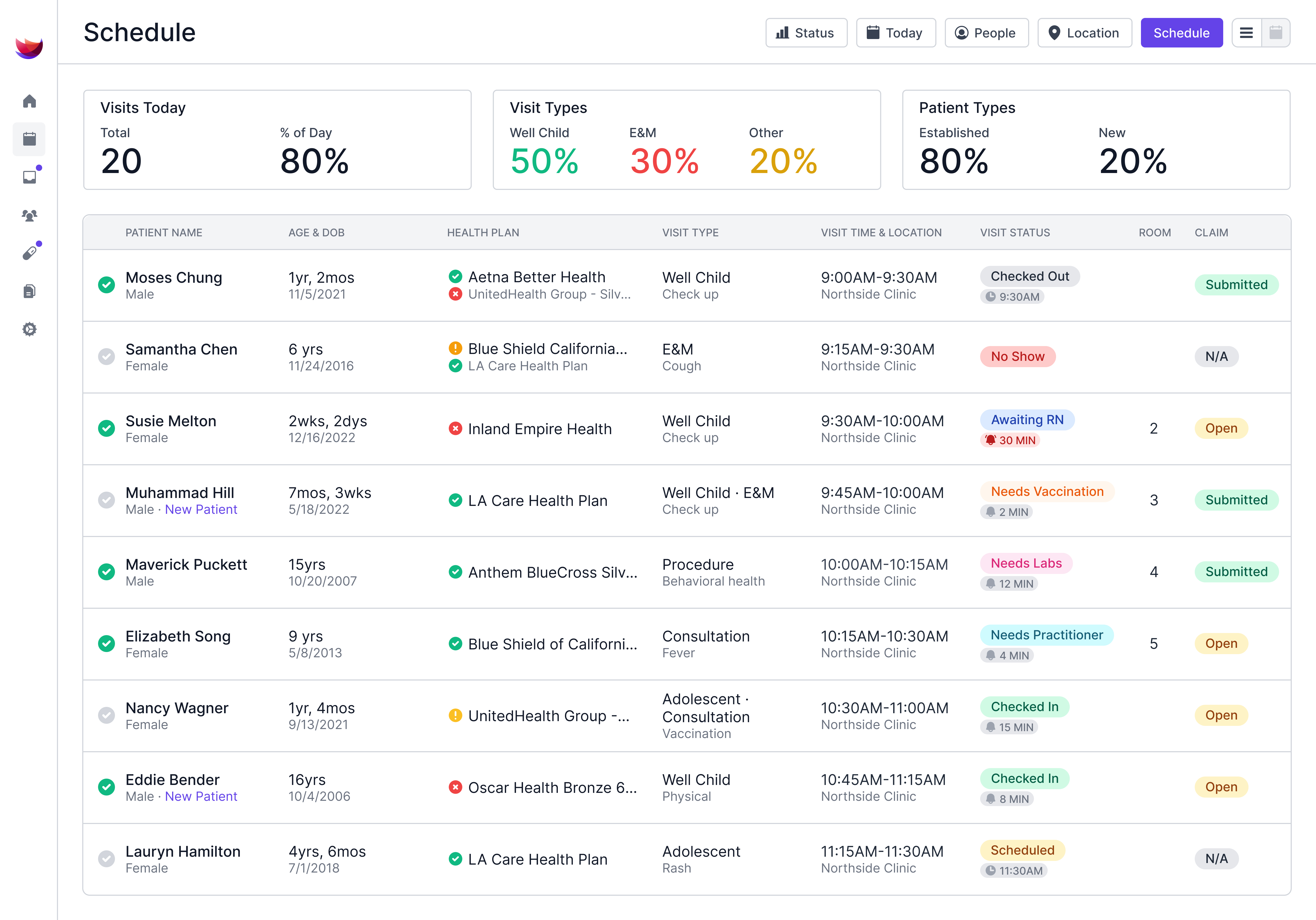
The barrier is almost always the EMR. Legacy systems make pulling overdue lists a manual export-to-Excel exercise, which is why most practices never do it. Develo automates recall outreach by each child's age and last visit date, so it runs in the background.
2. Win Google Business Profile for "pediatrician near me"
Health questions are among the most common things people bring to Google, and many are local "find a provider" queries. For many parents, a practice's Google Business Profile (GBP) is the first impression they get before they reach the homepage, yet most still treat it as a one-time setup.
What separates a winning pediatric GBP from a generic one:
- Photos of your actual office and team, not stock photos of stethoscopes. Profiles with real photos get more clicks, calls, and direction requests than bare listings, so add interior shots, your team, and your waiting room.
- Weekly posts. Posts don't rank on their own, but they're what a parent comparing three profiles actually reads. Post seasonal updates (flu shot availability, school physical season, summer hours), and they double as content.
- Service-specific listings. "Well child visits," "sick visits," "ADHD evaluations," "lactation support," "newborn visits." Each one is a search opportunity.
- Active review management. Google names review count and score as part of local prominence, and recent reviews are the first thing a parent scanning the local pack reads. Respond to every review, positive and negative, within a day.
- Q&A section seeded with real parent questions. "Do you offer same-day sick visits?" "Do you accept my insurance?" Answer them yourself before someone else does.
Build a simple post-visit text that asks for a Google review. A steady trickle of recent reviews beats a burst of old ones.
3. Make New-Baby Onboarding Your Highest-Converting Moment
The week after a baby is discharged from the hospital is often the window that decides which practice a family picks for the next two decades. The family is overwhelmed, scared, and looking for a pediatrician they can trust long-term.
Whichever practice makes the first visit feel calm and competent wins a lifetime customer. Call it operations dressed as marketing. The practices that lock in newborns do three things:
- Same-week newborn visits, guaranteed. "We always have room for newborns" should appear on your website, GBP, and discharge handout to local L&D nurses.
- Digital intake before they arrive. A new mom should not be filling out a paper clipboard with a five-day-old. Send the intake by text the day after they call to schedule.
- A 48-hour post-visit follow-up text. "How's feeding going? Any questions before the next visit?" The highest-impact 30 seconds of marketing your practice can do.
The third item is where most practices break down. They don't have the workflow to make it happen consistently. In an operating system built for pediatrics, these touchpoints fire automatically instead of depending on a staff member remembering and having the time.
4. Build a Referral Pipeline With Local OB-GYNs and L&D Units
OB-GYNs and labor and delivery units are where expectant parents are standing when they choose a pediatrician. The AAP recommends a prenatal visit with a pediatrician in the third trimester, so the decision is often made before the baby arrives — yet almost none of those practices market to that channel intentionally. Most made an introduction once, years ago, and haven't followed up since.
A working OB referral program:
- Drop off updated practice info sheets quarterly (new providers, accepting new patients, accepted insurance, after-hours coverage)
- Send a thank-you (email or note) for every newborn that books, naming the specific OB who referred
- Host an annual lunch-and-learn at high-referring OB practices: bring food, bring one of your pediatricians, and let the OB staff put a face to your name
- Track referrals in your EMR by source, so you can see which OB practices are sending patients
The practices that don't run this kind of program rely entirely on Google and word-of-mouth, both slower and less reliable.
5. Use Back-to-School Season as a 90-Day Growth Sprint
Mid-July through September is peak season for pediatric marketing. Every child in your service area needs a sports physical or school form, and many parents wait until the last possible week. The practice that's easiest to book gets the wave.
Tactics that work:
- Enable self-scheduling on your website by June 1, not September 5
- Advertise Saturday and evening sports physical clinics on GBP, local Facebook parent groups, and school newsletters
- Bundle visits so one visit covers a physical, flu shot, and back-to-school anxiety screener
- Direct outreach to coaches and athletic directors at the largest schools in your service area in mid-July
Every new family that comes in for a one-time sports physical is a candidate to become a primary care patient. A "we'd love to be your family's pediatrician" follow-up within 30 days is the difference between a one-time visit and a 20-year relationship.
6. Treat Your Family Portal as a Marketing Channel
Most pediatric practices treat their family portal like a regulatory checkbox. Exists, technically works, but nobody uses it. The practices growing fastest treat it as one of the most valuable channels they own.
A family-engagement portal is the place where:
- Parents see growth charts and feel attached to your practice (emotional retention)
- Reminders for the next well check land before the family even thinks about it
- Pre-visit intake gets done at home, freeing exam-room time
- Payment plans and outstanding balances get managed without front-desk friction
- Adolescent patients can message providers directly while respecting confidentiality rules
Every login is a brand touchpoint. Develo is designed around the family relationship — the way families actually use healthcare — not an adult EMR with a patient-only portal added later.
7. Build Content Around the Questions Parents Google at 2 a.m.
Worried parents and busy pediatricians reach for very different search terms, and the parents' version is where the traffic is. These are some examples of high-volume pediatric queries that practices rarely write for:
- "When should I take my baby to the ER for a fever?"
- "How much is too much screen time for a 4-year-old?"
- "Is my child's poop normal?" (yes, really, it ranks)
- "What time should a 7-year-old go to bed?"
- "When can my baby start solids?"
- "Should I be worried about my child's cough?"
Each of these is a chance to publish a 600- to 900-word page on your website with the AAP-aligned answer, written in plain language, signed by a real pediatrician at your practice. Publish one or two of these per month, and organic traffic compounds over time.
What doesn't work: vague wellness blog posts ("The importance of pediatric care") with no specific search intent behind them. If you can't picture a parent typing the question into Google, don't write the post.
8. Run a Community Vaccine or Back-to-School Clinic
Free or low-cost community events get written off as vague “community outreach.” Done right, they move real new-patient numbers.
The format that works:
- Pick one specific service that solves a parent pain point (flu shots, sports physicals, school form signing, kindergarten vision screening)
- Partner with a local school, library, or community organization for the venue (free marketing, real credibility)
- Cap the event at 2 to 3 hours so it doesn't drain your team
- Capture intake info digitally for every attendee, with explicit opt-in to follow up
- Send a "thanks for coming, here's how to make us your pediatrician" message within 7 days
The follow-up is the whole game. Events without a follow-up workflow get warm fuzzies and no patients.
9. Market to Teen Patients (Most Practices Forget This)
Adolescent care is among the most under-marketed segments in pediatrics, and it's also the segment where practices lose the most patients. Around age 13 to 15, families start asking whether their pediatrician is "still right" or whether the teen should move to adult primary care.
What retains teens (and their younger siblings):
- Adolescent-confidential messaging. Teens can communicate with their pediatrician directly without parents seeing every message, in compliance with state confidentiality laws and the AAP guiding principles for information sharing and blocking in pediatric care under the 21st Century Cures Act.
- A teen-specific page on your website. Address acne, mental health, sports performance, and contraception in a real voice.
- ADHD and mental health screening. Normalize these as part of well child visits. A separate visit can still be done when needed.
- Imagery and tone that speak to teens, too. A site built only around babies and toddlers can signal to older kids that they've outgrown the practice.
Many older pediatric EMRs make it hard to keep teen records separate from what parents can see, so practices stay cautious about marketing to teens.
Develo separates teen records from parental visibility where state law requires it, keeping adolescent messaging and notes confidential while still linking the chart to siblings and guardians. That makes the adolescent segment something to grow into rather than a compliance risk to avoid.
10. Reduce No-Shows as a Retention Strategy
Skipped visits cost you twice: an empty slot today, and often a family that's halfway out the door. Every no-show you recover is a slot filled and a family kept. Text message reminders have the clearest evidence behind them — the trial in idea #1 — and they measurably reduce no-show rates.
Recover those visits, and you win back revenue the practice already earned. A few habits separate the practices that keep no-shows lowest:
- Multi-channel reminders. Try email 7 days out, text 1 day out, and a final text 2 hours before the visit. Save phone calls for families who miss reminders or have a history of no-shows.
- Easy rescheduling. A reply text or a one-click portal link, not a phone tree.
- Waitlist automation. Same-day cancellations get filled within 30 minutes by texting the waitlist.
- A small no-show fee, where you're allowed to charge one. Federal and state rules prohibit charging Medicaid patients for missed visits — Colorado's policy statement is a typical example — so on most pediatric panels this applies only to commercially insured families, and only where the policy is disclosed in advance and applied consistently.
Every recovered no-show is revenue you'd otherwise have lost on overhead you've already paid.
11. Make Your Billing Experience a Referral Driver
Nobody recommends a pediatrician because the billing was great. But plenty of parents stop recommending one because the billing was a nightmare.
Family-centered billing (one statement covers all the siblings, payment plans are easy to set up, a parent doesn't get three different bills for one visit) is invisible when it works and reputation-destroying when it doesn't.
Practices on generalist EMRs such as eClinicalWorks or athenahealth — adult systems retrofitted for pediatrics — can't bill cleanly at the family level. That’s why “we got six bills last month for one family” shows up so often in pediatric practice complaints.
Develo's billing infrastructure treats the family as the financial unit, with one balance, one statement, and payment plans that span siblings. This removes one of the most common reasons families leave a practice they otherwise liked.
What Pediatric Marketing Tactics to Skip in 2026
Some pediatric marketing tactics look good on paper but don’t always bring in the right families or justify the staff time. They include:
- Paid Facebook/Instagram ads for new patients. The cost per booked patient is hard to justify for general acquisition, outside narrow pushes like a new location launch.
- Untargeted direct mail postcards. Generic postcard blasts rarely pay off, though tightly targeted mail with a trackable next step, like a QR code or dedicated phone line, can still work.
- Yellow Pages and print directory listings. These rarely deserve a budget unless you have proof they still drive calls in your market.
- Influencer partnerships with no booking path. Local creators can build awareness, but they’re hard to justify unless the campaign sends families to a clear next step, like booking a visit or joining a waitlist.
- Generic “wellness blog” content with no SEO intent behind it. Broad health writing burns hours without reaching families actively searching for a pediatrician.
Each of these casts a wide net and hopes a future patient is in it. The ideas worth your time do the reverse: they reach the family already searching for you, the OB already sending patients, or the family already on your panel.
Pick the One That Fixes Your Biggest Leak
You don't need to start executing all 11 pediatric marketing ideas to notice a change in your practice. It's best to start with one, then add others as you need them.
Start with the idea that fixes the current issue you’re dealing with:
- Schedule has gaps? Start with #1 (recall) and #10 (no-shows). Both pull revenue from your existing panel.
- Not enough new patients? Start with #2 (GBP), #4 (OB referrals), and #7 (parent-question content).
- Losing patients to competitors? Start with #6 (portal adoption) and #11 (family billing).
- Teen patients aging out? Start with #9 (adolescent strategy).
The hard part isn’t knowing which tactics work. It’s making them happen consistently. Develo helps turn marketing, family communication, and follow-up into repeatable systems instead of extra work for your team.
Marketing Tactics Need an Operating System to Run On
Marketing is only one part of pediatric growth. Practices still need to bring in new families, keep existing families engaged, reduce no-shows, and recover overdue visits.
Develo is the AI-native pediatric operating system built solely for independent pediatric practices, unifying charting, billing, practice management, and family engagement in one modern system — with AI woven throughout rather than bolted on.
Most of these ideas break for the same reason: the recall list, the family relationships, the intake forms, and the billing all sit in a system that won't act on them, so every campaign turns into manual work. Develo keeps all of it on one record and acts on it, and the AI is native rather than a separate product you buy on top.
Here’s what you can do with Develo:
- Run recall campaigns for overdue well child visits, vaccines, follow-ups, and other care gaps
- Send targeted family communications instead of broad, one-size-fits-all messages
- Automate no-show reminders, rescheduling, and waitlist outreach
- Keep caregiver communication, adolescent messaging, and family billing connected
- Give families one portal for scheduling, records, forms, billing, and follow-up
- Turn any paper form into a digital one — Develo AI forms identifies the fields and variables automatically, so newborn intake, school forms, and event sign-ups go out by text instead of on a clipboard
- Replace disconnected marketing, intake, billing, and communication tools
Book a free demo to see how those workflows run in practice.
Frequently Asked Questions
How Much Should a Pediatric Practice Spend on Marketing?
A pediatric practice should spend a small single-digit percentage of revenue on marketing, but where the spend goes matters more than the amount. Tactics that pull revenue from your existing panel return more per dollar than new-patient acquisition.
How Long Before Pediatric Marketing Efforts Show Results?
Pediatric marketing works on different timelines: paid ads within days, Google Business Profile and local SEO within three to six months, and content marketing within six to twelve months. Operational tactics like recall and no-show reduction often show revenue impact within 30 to 90 days.
How Do Small Pediatric Practices Compete With Hospital-Affiliated Systems?
Small pediatric practices compete with hospital-affiliated systems by leaning into continuity, accessibility, and family-centered operations. Same provider for 18 years, same-day sick visits, sibling scheduling, and family billing are all things hospitals can't replicate at scale.
Should Pediatric Practices Hire a Marketing Agency or Run It In-House?
Pediatric practices should run most marketing in-house and hire an agency only for specialized work. Recall, reviews, texts, and portal adoption require operational integration. Agencies add value for SEO content, paid ad management, and brand design.
What Metrics Should Pediatric Practices Track to Measure Marketing ROI?
Pediatric practices should track four metrics: new patient source, no-show rate trend, well child visit adherence by age cohort, and family billing collection rate. Ask every new family how they heard about you, and the data populates itself.

.avif)

.avif)