

Pediatric CPT codes are the five-digit billing codes your practice uses to report visits, vaccines, and screenings. This guide breaks down the most common codes, how to use them, and what changed in 2026.
What Are Pediatric CPT Codes?
Pediatric CPT codes are five-digit numbers assigned by the American Medical Association (AMA) that describe services performed during a patient visit. They tell payers what you did during the encounter.
Every billable action gets a code. An office visit, a vaccine injection, a developmental screening, a rapid strep test. Each one has its own CPT code.
Pediatric CPT codes differ from adult codes in a few ways. Well child visits use age-banded preventive medicine codes rather than standard E/M levels.
Vaccine administration uses component-based coding for patients under 18. Screening codes like 96110 and 96127 show up far more often in pediatrics than in any other specialty.
You pair each CPT code with an ICD-10 diagnosis code that explains why you performed the service.
A well child visit pairs with a Z-code (like Z00.129 for a routine child health exam without abnormal findings). A sick visit pairs with a condition-specific code (like J06.9 for an acute upper respiratory infection).
Submitting a preventive CPT code with an acute-illness ICD-10 code creates a mismatch that payers flag immediately.
Types of Pediatric CPT Codes at a Glance
Before diving into each category, here's a high-level view of the pediatric CPT codes most clinics bill daily:
Well Child Visit CPT Codes
Well child visits use age-specific preventive medicine codes 99381 to 99385 (new patients) and 99391 to 99395 (established patients). The code depends on the patient's age on the date of service.
New patient codes (first visit at the practice):
- 99381: Infant, younger than 1 year
- 99382: Early childhood, ages 1 through 4
- 99383: Late childhood, ages 5 through 11
- 99384: Adolescent, ages 12 through 17
- 99385: Young adult, ages 18 through 39
Established patient codes (seen within the past three years):
- 99391: Infant, younger than 1 year
- 99392: Early childhood, ages 1 through 4
- 99393: Late childhood, ages 5 through 11
- 99394: Adolescent, ages 12 through 17
- 99395: Young adult, ages 18 through 39
Selecting the wrong age bracket is one of the most common causes of claim rejection in pediatric billing. Always verify the patient's age on the date of service rather than the date the appointment was scheduled.
These codes include the physical exam, growth tracking using standardized pediatric growth charts, developmental assessment, anticipatory guidance, and immunization review.
ICD-10 pairing for well child visits:
Sick Visit E/M Codes for Pediatrics
Sick visits use the standard E/M code set: 99202 to 99205 for new patients and 99212 to 99215 for established patients. You select the level based on medical decision-making (MDM) or total time spent on the encounter.
Since the 2021 AMA E/M guideline revisions took effect, you pick the E/M level using one of two paths.
Path 1: Medical Decision-Making (MDM)
Most pediatricians use this method.
MDM looks at three components, and you need two out of three at the target level:
- Number and complexity of problems addressed during the visit
- Amount and complexity of data reviewed (lab results, imaging, records from outside providers)
- Risk of complications, morbidity, or mortality from the treatment plan
A straightforward ear infection typically supports a 99213. Add systemic symptoms like fever plus dehydration, and the clinical picture often moves to 99214.
Path 2: Time-Based Coding
Total time includes face-to-face and non-face-to-face work on the date of the encounter.
Established patient time thresholds:
New patient time thresholds:
CPT code 99417 may be reported for prolonged office or outpatient E/M services when time-based coding exceeds the required threshold for certain high-level visits. It’s most commonly used with 99215 and 99205 when visit extends beyond the time thresholds of those codes (54 or 74 minutes, respectively).
G2211 is another add-on code worth knowing. It’s reportable only as an add-on to office or other outpatient E/M codes 99202-99205 and 99211-99215 when the provider serves as the ongoing focal point for the patient’s continuous and comprehensive care.
Congress placed a moratorium on Medicare payment for G2211 from its original 2021 proposal through CY 2024, when it became payable starting from January 1, 2024, though payer adoption beyond Medicare still varies significantly.
It's not reported with preventive medicine services such as 99381-99395 and shouldn’t be used when the visit is solely for an acute, self-limited problem or when the provider's relationship with the patient is discrete or time-limited.
As of January 1, 2025, G2211 may be reported even when the base E/M code carries Modifier -25, but only when the additional service billed on that date is an allowed Medicare Part B preventive service. Confirm payer-specific rules before billing to be safe.
Always confirm payer‑specific rules before combining them with procedures or Modifier -25 on the same date.
Vaccine Administration Codes
Vaccine billing in pediatrics requires two separate codes per vaccine: One for the product and one for administration. Missing either one results in a partial or full denial.
With physician counseling (patients under 18):
- 90460: First vaccine component administered with counseling
- 90461: Each additional component at the same visit
For example, a DTaP-IPV-Hib combination vaccine (Pentacel) is billed as five antigen components for CPT administration coding purposes. You would bill 90460 once and 90461 four times.
Without physician counseling:
- 90471: First injection
- 90472: Each additional injection
- 90473: First intranasal or oral administration
- 90474: Each additional intranasal or oral administration
Some state Medicaid programs require codes 90471 to 90474, even for patients under 18, when the vaccine is nurse-administered without physician counseling. Always verify your state-specific Medicaid rules, as they vary widely.
Each vaccine product also has its own CPT code (for example, 90700 for DTaP). The product code and the administration code must be linked to the same ICD-10 diagnosis code, typically Z23 (encounter for immunization).
Common vaccine product codes in pediatrics:
New for 2026: Immunization Counseling Codes
Three new pediatric CPT codes took effect January 1, 2026: 90482, 90483, and 90484. They let you bill for vaccine counseling when the vaccine isn’t administered on the same date of service, per the AMA’s coding update.
These codes are time-based. Documentation must include which vaccines were discussed, the total time spent counseling, and the reason the vaccine wasn’t given (such as parental deferral or patient refusal). They should be paired with appropriate diagnosis codes:
- Z71.85 for Encounter for immunization safety counseling
- Vaccine refusal diagnosis Z-codes: Z28.21, Z28.82, and/or Z28.89
This matters for pediatric practices because vaccine hesitancy conversations happen daily. Before 2026, that counseling time wasn’t billable when the shot was declined.
One caveat: CMS assigned these codes a status indicator of "I," meaning they’re not valid for Medicare payment. Commercial payers and Medicaid plans may cover them, but you need to verify coverage with each payer before building these into your workflow.
When reported alongside an E/M visit, append Modifier -25 to the E/M code to show that the office visit was a separate service from the counseling.
If counseling covers multiple vaccines and none are administered, add the times together and report one code based on the total time.
Developmental and Behavioral Screening Codes
The two most commonly used pediatric screening codes are 96110 (developmental screening) and 96127 (brief emotional/behavioral assessment). Both are billed per standardized instrument and reported separately from the E/M or preventive visit.
96110: Developmental screening. This is used when a standardized instrument like the M-CHAT-R/F is completed, scored, and documented.
Documentation must include the tool name, the date, the score, who administered it, and the provider's interpretation of the results, plus a plan or next step.
96127: Brief emotional/behavioral assessment. Used for standardized tools like the PHQ-A (adolescent depression), Vanderbilt (ADHD), or CRAFFT (substance use screening). This carries the same documentation requirements as 96110, billed per instrument.
The key distinction: 96110 covers overall developmental milestones (motor, language, cognitive, social). 96127 focuses on emotional and behavioral health (depression, anxiety, ADHD). They’re two different services and shouldn’t be confused.
Append Modifier -25 to the E/M code when billing screening codes alongside a well child or sick visit.
The AAP's Bright Futures periodicity schedule recommends developmental screening at the 9-, 18-, and 30-month visits and autism-specific screening at the 18- and 24-month visits. Emotional and behavioral screening is recommended annually starting at age 3.
Modifier -25: The Most Used Modifier in Pediatrics
Modifier -25 signals a separately identifiable E/M service on the same day as a procedure or preventive visit. You append it to the E/M code whenever you bill two distinct services in the same encounter.
The most common scenario: A child comes in for a well child exam, and the provider discovers an ear infection during the visit.
You bill:
- The well child preventive code (99391 to 99395) with a Z-code diagnosis
- A separate E/M code (99212 to 99215) with Modifier -25 and the illness diagnosis
The chart must document both services separately. The preventive note covers the exam, anticipatory guidance, and developmental screening. The problem-focused note covers the acute complaint with its own history, findings, and treatment plan.
Without Modifier -25, the payer assumes you are billing twice for one encounter and denies the second code. Other common modifiers in pediatric coding:
The 6 Most Common Pediatric CPT Code Mistakes
These are the pediatric CPT code errors that cause the most denials and lost revenue. Each one is preventable with the right checks in place:
- Wrong age bracket on preventive visits: A 12-year-old billed under 99393 (ages 5 to 11) instead of 99394 (ages 12 to 17) gets rejected. Use EMR-based age checks that flag mismatches before claim submission.
- Missing vaccine administration codes: Billing the product code (90700 for DTaP) without the administration code (90460 or 90471) results in a denial. Both are required every time.
- CPT and ICD-10 mismatch: Pairing a preventive visit CPT code with an acute-illness diagnosis code triggers an automatic flag. A well child visit should pair with Z00.129 (without abnormal findings) or Z00.121 (with abnormal findings).
- Bundled screening codes: Some payers consider developmental or vision screenings part of the well child visit and deny separate payment. Know which services your major payers bundle and which they reimburse separately.
- Missing Modifier -25 on combined visits: When a sick-visit E/M code is billed alongside a preventive code, Modifier -25 must be appended to the E/M code. Without it, the claim gets denied.
- Outdated codes: CPT and ICD-10 codes update annually. Using last year's deleted or revised codes results in immediate rejections.
Update your chargemaster on both cycles every year (ICD-10 on October 1 and CPT on January 1). The AAP Coding Newsletter is a reliable source for staying current.
How to Reduce Coding Errors and Denied Claims
The fastest way to reduce pediatric CPT code denials is to automate the checks that catch errors before claims go out. Manual charge capture leaves room for missed codes, wrong age brackets, and CPT-ICD mismatches on every visit.
Many practices also improve claim accuracy by standardizing their pediatric office workflow across scheduling, documentation, vaccine administration, and billing processes.
Three areas where pediatric practices lose the most revenue:
- Under-coding well child visits: Forgetting to bill screening codes (96110, 96127) separately from the preventive visit leaves money on the table at every appointment.
- Skipping vaccine component counts: Combination vaccines contain multiple antigen components. Each one generates an add-on code (90461). Undercounting components is one of the most common forms of underbilling in pediatrics.
- Not billing immunization counseling: The new 2026 codes (90482 to 90484) finally let you capture conversations about vaccine hesitancy. Practices that update their workflows now will recover revenue that was previously unbillable.
A pediatric-specific EMR that automates charge capture based on visit context, patient age, and payer rules eliminates the manual guesswork that causes most denials.
Built-in E/M calculators, vaccine administration logic, and pre-submission error checks have become standard features in modern pediatric billing systems.
Bill Pediatric CPT Codes Accurately With the Right Platform
Getting pediatric CPT codes right is half documentation, half systems. When your core system automates charge capture based on patient age, visit type, and payer rules, your team spends much less time manually billing visits and much more time with patients.
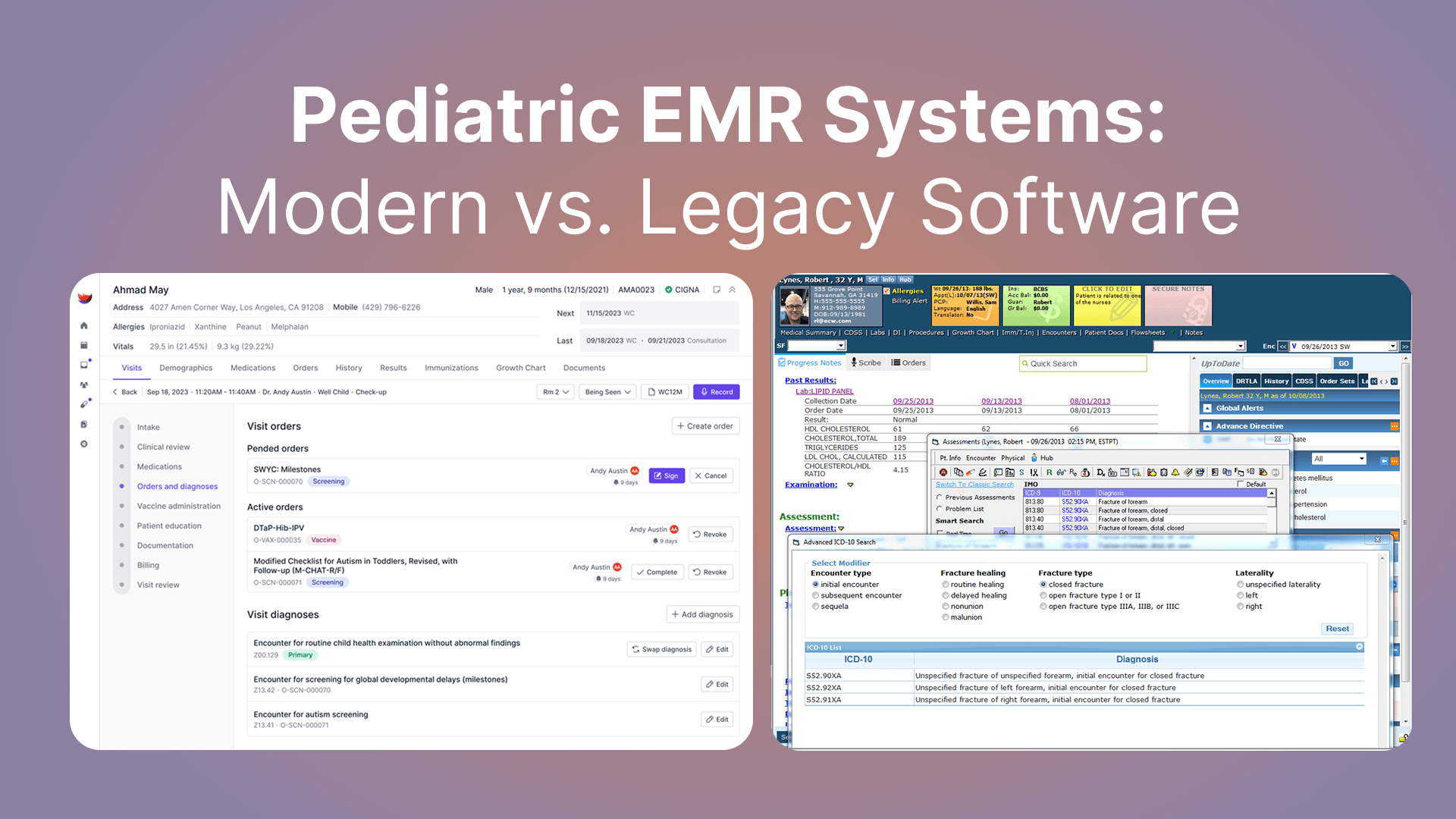
Develo is purpose-built for outpatient pediatric practices. It connects scheduling, charting, billing, and family engagement in one pediatrics operating system with capabilities extending beyond EMRs. As the first and only AI-native operating system for pediatrics, Develo unifies clinical (EMR), billing (RCM), and family engagement (CRM) capabilities while delivering AI automation that is not possible with legacy EMR systems.
Here's how Develo helps you code and bill pediatric visits accurately:
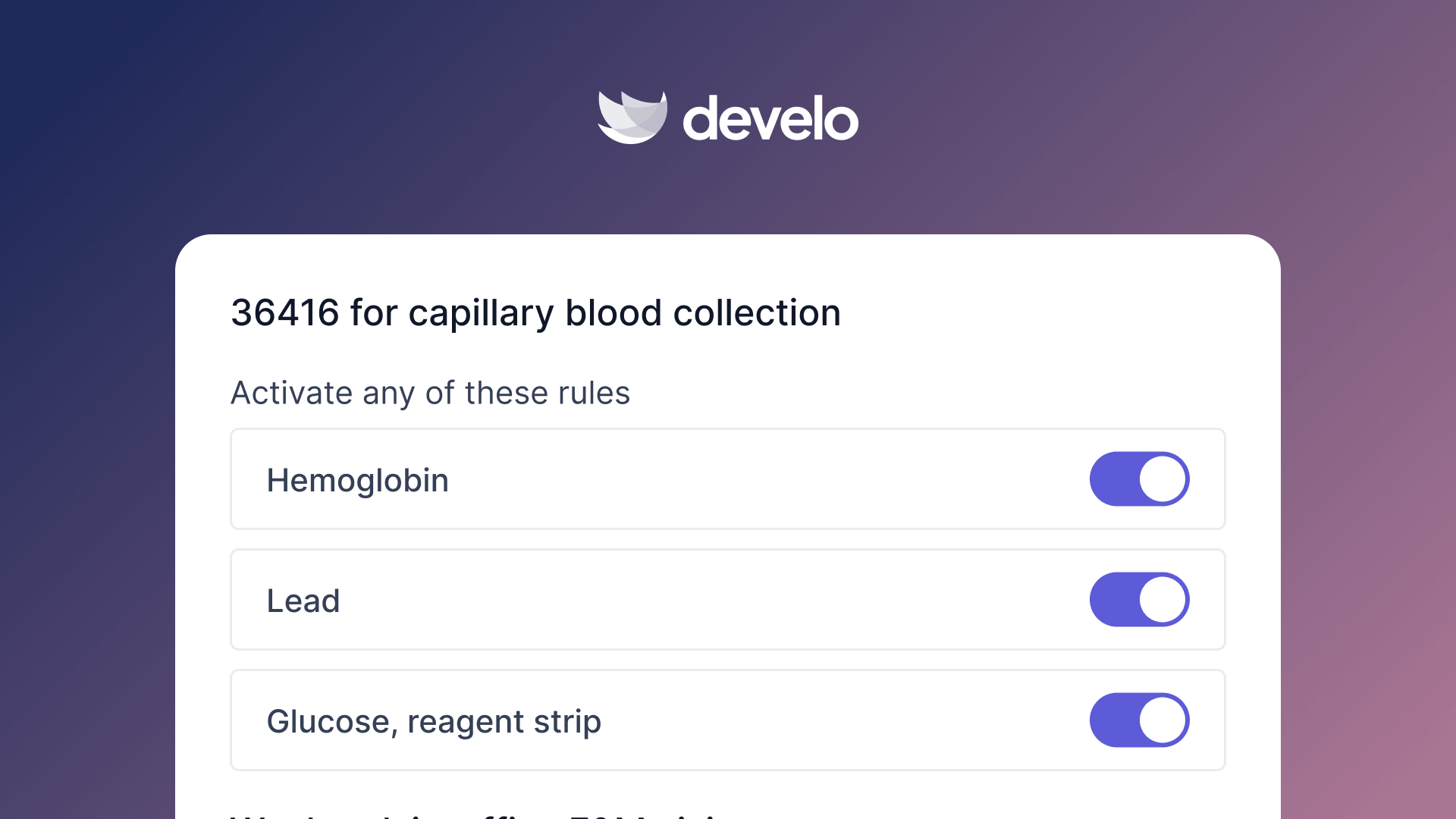
- Automated charge capture that applies billing codes based on visit context, patient age, and insurance type, such as auto-applying vaccine admin codes based on health plan type, visit type, and the number of vaccine shots and components administered
- Built-in E/M calculator that recommends the correct E/M level based on pediatrics-specific time and medical decision-making (MDM) inputs, so your providers stop under-coding sick visits
- Pre-submission error checks that flag CPT-ICD mismatches, missing modifiers, and wrong age brackets before a claim leaves your practice
- Pediatric visit templates for well child, sick, and general E/M encounters that extend into granular billing code requirements
- Payer-level billing rules that automatically adjust claims based on each payer's specific requirements, reducing denials from bundling or coverage gaps (e.g., state-level Medicaid requirements for vaccines, quality-driven billing code or diagnosis code requirements)
- Family-level financial management that tracks balances, credits, and payments across siblings under the same guarantor
You don't need to memorize every pediatric CPT code. You need a platform that knows pediatric billing inside and out and catches errors before they cost you. Book a free demo and see how Develo helps your practice bill pediatric CPT codes with confidence.
Frequently Asked Questions
1. What CPT Codes Are Used for Well Child Visits?
CPT codes 99381 to 99385 are used for new-patient well child visits, while 99391 to 99395 are used for established patients. The correct code depends on the patient’s age on the date of service.
2. How Do You Bill Vaccines in Pediatric CPT Coding?
Pediatric vaccine billing requires you to submit both a vaccine product code and a vaccine administration code. For patients under 18 with physician counseling, use 90460 for the first component and 90461 for each additional component.
3. When Should You Use Modifier -25 in Pediatrics?
Use Modifier -25 when a provider performs a separately identifiable E/M service on the same day as a preventive visit or procedure. Pediatric practices commonly use it when a sick visit is addressed during a well child exam.
4. What Are the New 2026 Pediatric CPT Codes for Immunization Counseling?
CPT codes 90482, 90483, and 90484 now cover vaccine counseling when a vaccine isn’t administered during the same visit, with the correct code depending on the total documented counseling time.
The codes are time-based: 90482 (3 to 10 minutes), 90483 (10 to 20 minutes), and 90484 (over 20 minutes).
Develo uniquely automates vaccine counseling codes based on documented vaccine refusal during a visit, including linking of the right vaccine refusal diagnosis Z-codes (Z28.21, Z28.82, and/or Z28.89) as well as Z71.85 for Encounter for immunization safety counseling.
5. What Is the Difference Between CPT Code 96110 and 96127?
The main difference between CPT code 96110 and 96127 is what they cover.
CPT code 96110 covers developmental screening, while 96127 covers emotional and behavioral health assessments. They’re separate services and may both be billed when medically appropriate and properly documented.

%20(1).png)


.avif)