

In the Kareo vs Practice Fusion matchup, Kareo (now Tebra) fits practices that want billing and front-desk automation in one system. Practice Fusion fits solo providers who mostly need straightforward charting at a low entry price.
The right pick for a pediatric clinic depends on your size and how much pediatric-specific work fills your day.
Both are general ambulatory EMRs, so neither was built around kids and families. This overview draws on each vendor's published pricing and product pages, plus Capterra user reviews. The verdict below describes which type of clinic each one fits best.
Kareo vs Practice Fusion at a Glance
Pricing checked November 2026. Verify directly with each vendor.
Choose Kareo (Tebra) if: Billing is your biggest headache, and you'd like claims, booking, and reminders in the same system as your charts.
Choose Practice Fusion if: Your days are mostly charting and prescriptions, and you'd trade built-in billing for a $199 monthly license.
Meet Kareo (Now Tebra) and Practice Fusion
Kareo (Tebra): General Ambulatory EMR With Billing Services
Kareo merged with PatientPop and became Tebra in November 2021, and you'll still see both names used interchangeably. Tebra's own pricing page now says plainly that "Kareo is now part of Tebra."
So, is Kareo an EHR? Yes. Its clinical module is a cloud-based EMR, sold alongside practice management, billing, and patient engagement tools for practices across many specialties.
Tebra leans on billing, online booking, and marketing tools. Its pediatrics page markets structured well child templates and growth charts that fill in at every visit. The same platform also runs family medicine, primary care, and mental health practices.
One Capterra reviewer captured the friction: "It's not very user friendly, it's very finicky and isn't very forgiving if you press a wrong button" (Anna T., April 2026).
Practice Fusion: Cloud EMR for Small Practices
Practice Fusion is a cloud-based EMR owned by Veradigm (formerly Allscripts). It started out free and now charges a monthly per-provider fee on an annual contract.
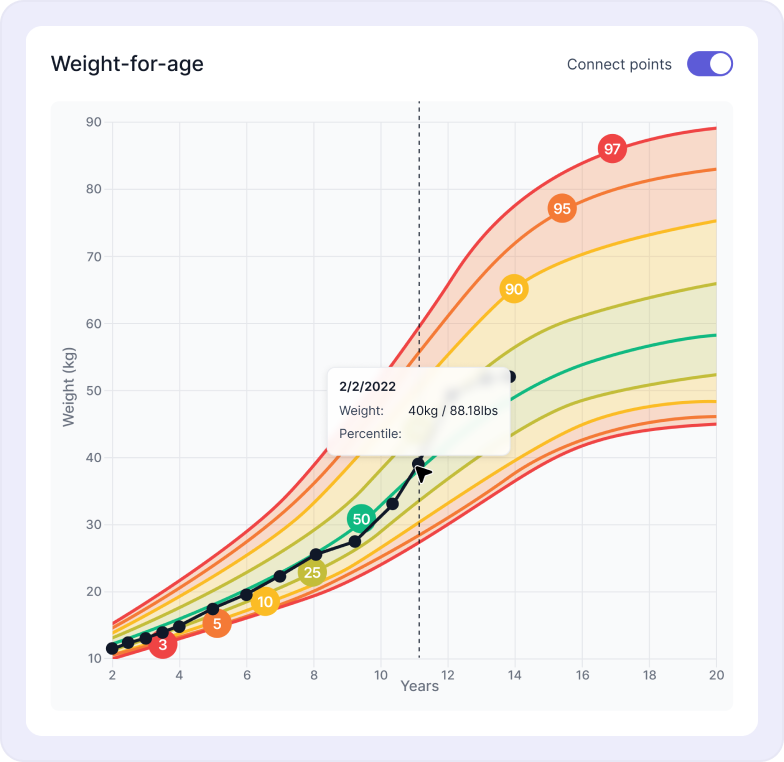
It's a general ambulatory EMR built for small independent practices. Pediatric clinics can use it, and its pediatrics page lists checkups by age with automated growth charts.
Before you sign an annual contract, check the parent company's direction: Veradigm put the whole company through a strategic review, including a possible sale, and ended it in January 2025 without receiving any final proposals. At the time, it said it would focus on a standalone strategy. Since then, Veradigm has said it cut 15% of its workforce in 2025, and its September 2026 investor presentation commits to a portfolio review that will "invest, sustain, sunset/sell" products without naming which ones. Practice Fusion is its EMR for small practices.
One Administrative Staffer on Capterra rated it well for charts, clinical notes, and e-prescribing, but said billing and scheduling meant running another product alongside it (Freya G., March 2026).
Kareo vs Practice Fusion: Feature-by-Feature Comparison
Charting and Pediatric Workflows
Kareo (Tebra): General ambulatory design with pediatric templates layered on top. Tebra markets age-based well child templates and growth charts, but it doesn't describe how its records handle siblings or multiple guardians, so ask to see those cases in a demo.
Practice Fusion: Solid for everyday charting, and reviewers like how fast it is to learn. Pediatric content is thinner: you get checkup templates by age and growth charts, but there's no mention of family-linked charts or an adolescent confidentiality workflow, two basic needs in any pediatric office.
Winner: Tie. Tebra markets more pediatric structure and Practice Fusion keeps a solo provider's charting day simple, but neither markets family-linked records.
Scheduling and Family Engagement
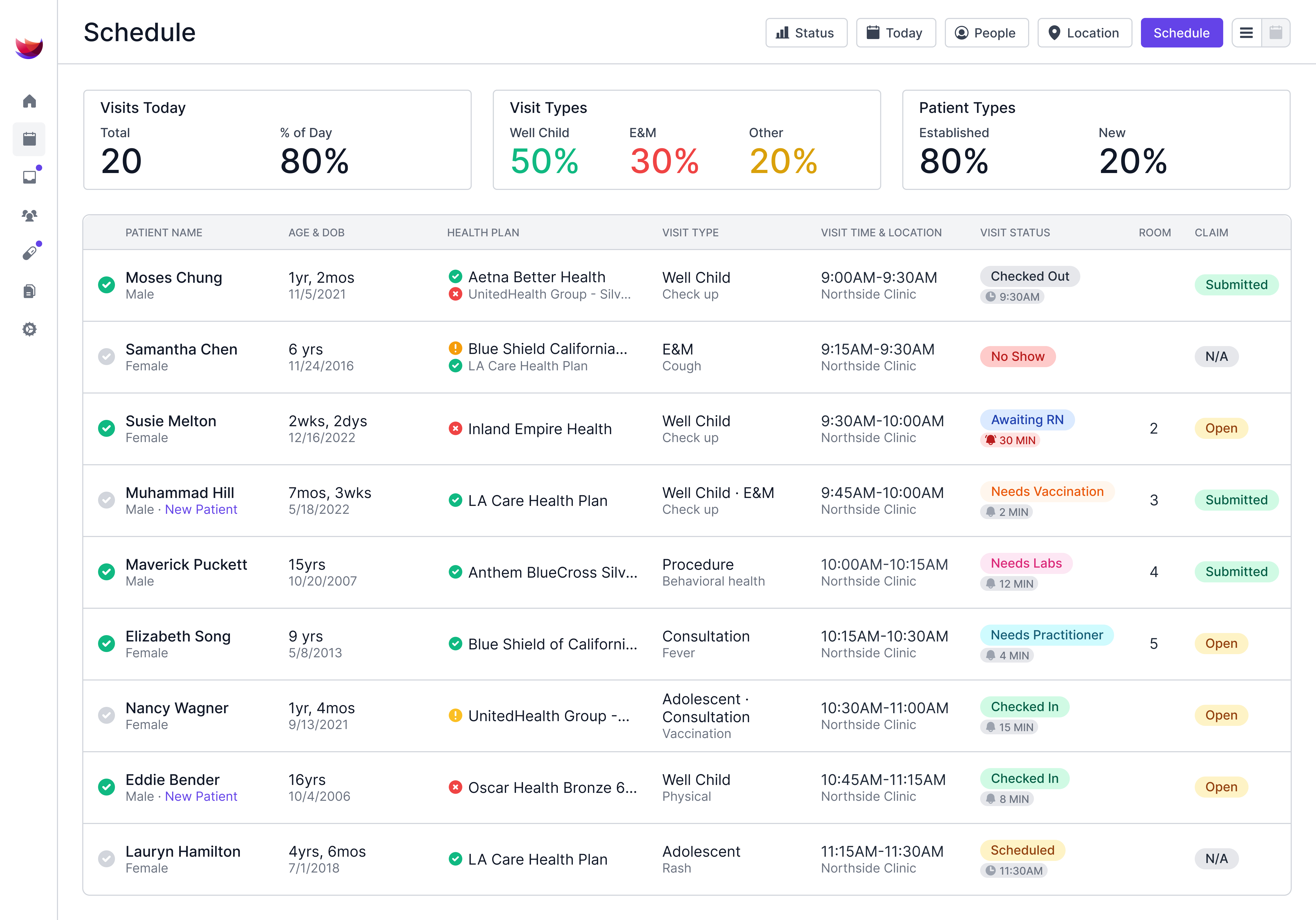
Kareo (Tebra): Scheduling is a strength. Patients can book online, the practice gets a provider calendar, and Tebra's patient engagement tools add secure messaging and reminders by text, email, or phone.
One Capterra reviewer said the online booking feature "has been great in reducing the number of phone calls" (Elise B., November 2025).
Practice Fusion: Patients can book and cancel visits online through the FollowMyHealth portal, and text, voice, and email reminders come with the subscription. Premium reminders and patient engagement tools come through an Updox add-on.
Neither vendor describes a portal built around caregivers, and in pediatrics one parent often manages several children. Ask each vendor whether a parent with three kids gets one login or three separate patient records.
Winner: Kareo (Tebra). Online booking and built-in outreach save your front desk real phone time.
Billing
Kareo (Tebra): Billing is a core part of the platform. You get claims management, eligibility checks, and denial tracking, plus optional managed billing services. Tebra's pediatrics page says it flags common pediatric billing issues, from vaccine administration codes to Medicaid and CHIP rules.
Practice Fusion: Practice Fusion now sells integrated billing software with a built-in clearinghouse, plus an outsourced billing service. It doesn't publish a price for either one, so get a quote before you compare totals with a Tebra bundle.
Either way, pediatric coding needs a careful eye: vaccine admin codes, well child visits, and Medicaid rules are where general systems lean hardest on your billers, which is why a pediatric billing cheat sheet earns a spot next to the monitor.
Ask each vendor whether it tracks VFC and private vaccine stock separately and checks each child's VFC eligibility against the dose's funding source before the claim goes out. It's the fastest way to tell a pediatric billing workflow from a general one.
Winner: Kareo (Tebra). Billing is the core of the platform, while Practice Fusion sells it as a separate product.
E-Prescribing
Kareo (Tebra): E-prescribing comes with integrated prescription drug monitoring program (PDMP) checks and EPCS. Tebra's pricing page lists EPCS setup at a one-time fee of about $75 per provider, and PDMP integration at $500 per facility (one-time) plus about $50 per user each year.
Practice Fusion: E-prescribing is where Practice Fusion stands out. The license covers e-prescribing for regular and controlled substances, with EPCS available in all 50 states and D.C.
Winner: Practice Fusion. EPCS is part of the license, and Capterra reviewers praise its e-prescribing.
AI and Automation
Kareo (Tebra): Tebra now sells a suite it calls AI Smart Staff. It includes AI Note Assist (an ambient scribe built into the EMR), an AI Billing Assistant that reviews claims before submission, and an AI Voice Assistant for patient calls. Each is an add-on: AI Note Assist and Billing Assistant cost $99 per provider per month, and the Voice Assistant costs $149.
Practice Fusion: Practice Fusion doesn't market an AI scribe or ambient documentation on its own site. Automation is mostly templates, e-prescribing, and reminders. Its parent company, Veradigm, markets its ambient scribe for Veradigm EHR, a separate product.
Winner: Kareo (Tebra). Right now, it's the only one of the two with a native AI scribe and AI claim review.
Kareo vs Practice Fusion Pricing
The cost gap between Kareo and Practice Fusion comes down to what you're buying: Practice Fusion prices the EMR on its own, while Tebra's bundles fold in billing.
Practice Fusion publishes its price: from $199 per provider per month with a required annual commitment.
That license lets one provider e-prescribe, sign charts, and submit claims, and it comes with three signing staff licenses, plus unlimited non-signing staff. There's a two-week free trial with no credit card required.
Kareo (Tebra) publishes rates up to $799 per provider per month, depending on whether you buy a single solution or a full bundle. At standard claim volume, Practice Essentials (clinical EMR, billing, and telehealth) runs $599 per physician per month, and Practice Automation, which adds patient engagement tools, runs $799.
Non-physician providers pay $399 and $449, and practices that submit 100 or fewer claims a month get lower starting rates. To learn what pediatric clinics pay in practice, see our Tebra pricing breakdown.
Bottom line: Practice Fusion has a lower entry price. A Tebra bundle costs three to four times as much per physician with a standard caseload, but it includes billing and front-desk tools that Practice Fusion quotes separately.
Kareo vs Practice Fusion Pros and Cons
Kareo (Tebra)
Pros
✅ Billing, scheduling, and patient engagement in one platform
✅ Online booking cuts front-desk phone volume
✅ Optional managed billing services for practices without an in-house biller
✅ Markets pediatric well child templates and growth charts
✅ Native AI scribe and AI claim review
Cons
❌ Full bundles start at $599 per physician per month
❌ Billing side and reports take time to learn
❌ Pediatric workflows sit on a shared multi-specialty core
❌ AI Note Assist, AI Billing Assistant, and AI Voice Assistant cost $99 to $149 per provider per month on top of the bundle
Practice Fusion
Pros
✅ Lower entry price and a two-week free trial
✅ Quick to learn for basic charting
✅ Strong e-prescribing with EPCS included
✅ Text, voice, and email visit reminders included in the subscription
Cons
❌ Billing software and services aren't in the published price
❌ Reviewers report it's hard to reach a live person for support
❌ Annual commitment with little flexibility
❌ Thin pediatric content beyond age-based templates and growth charts
❌ No native AI scribe
What Users Report About Kareo and Practice Fusion
On Capterra, Tebra holds a 4.0 rating across 1,390 reviews, and Practice Fusion holds 3.7 across 441 reviews (both checked November 2026).
Tebra users like the all-in-one setup and online booking. Debbie D. called it "cost effective, great support" in June 2026, while April M. cautioned in March that "The billing side is more difficult to understand."
Support is a recurring complaint, and our Kareo EMR reviews roundup covers more Tebra user feedback.
Practice Fusion users praise the charting. "Great for charting and e-prescribing," wrote Melissa D. in April 2025. The complaints cluster around support access and price creep: "The fact that it used to be free and now the price is much higher," Eileen F. elaborated in July 2026.
Physicians comparing EMRs on Reddit tend to describe Practice Fusion as a reasonable starting point for new practices, though several commenters say it lacks features they later needed.
Kareo vs Practice Fusion: Which Should You Choose?
Our take: Both are generalist tools that pediatric clinics extend with workarounds and add-ons. Between the two, the deciding question is whether you need billing built in or just want simple, low-cost charting.
Choose Kareo (Tebra) if you:
- Run a multi-specialty practice where pediatrics is one of several service lines
- Want billing, scheduling, and patient outreach handled in one system
- Would rather hand billing to a managed service
Choose Practice Fusion if you:
- Are a solo provider or very small office
- Need a basic, easy-to-learn EMR for charting and e-prescribing
- Want a lower entry price and a free trial before you commit
Choose Develo if you:
- Run an independent pediatric practice, from solo to multi-site, and want charting, billing, practice management, and family engagement in one system
- Need sibling-linked records, family balances, and adolescent confidentiality built in rather than worked around
- Want pediatric billing automation plus an optional onshore pediatric RCM team, not a generalist billing add-on
Can You Use Kareo and Practice Fusion Together?
Yes, historically. Tebra's help center still documents a Kareo and Practice Fusion integration that lets practices chart in Practice Fusion and bill in Kareo.
The data flows one way, however. Patient demographics, insurance details, and the superbill move from Practice Fusion into Kareo, and only error alerts flow back the other way. The guide hasn't been updated in years, so confirm with both vendors that the interface still works before you plan around it.
The Verdict
If billing is the hardest part of your week, Kareo (Tebra) is the stronger pick. It's built around claims, eligibility, and front-desk automation, and it now markets pediatric templates on top.
If you're a small practice that mainly charts and prescribes, Practice Fusion is simpler and cheaper to start, as long as you get a billing quote up front and can live with the support complaints reviewers raise.
A dedicated pediatric clinic will run up against the same limit: both were designed for general medicine, so family-linked records and caregiver communication often need a separate fix.
If you're still weighing options, the related articles below compare our picks for Kareo alternatives and Practice Fusion alternatives.
Run Pediatric Care on One AI-Native Platform
When a pediatric clinic is running kids' care on a system shared with adult specialties, bolt-on tools tend to fill the pediatric gaps, adding cost and clicks every day.
Develo is the AI-native pediatric operating system built solely for independent pediatric practices. It unifies charting, billing, practice management, and family engagement in one system designed for outpatient pediatric care.
Develo replaces decades-old legacy EMRs and the patchwork of generic tools that slow down documentation and create gaps in clinical data.
Take vaccines. Develo bills vaccine and admin codes based on the patient's age, Medicaid status, and visit type, so a Medicaid nurse visit with immunizations reaches the provider with the right admin codes (90471–90474) set for review.
When a screen is done but never billed, Develo alerts the provider to likely underbilling before the claim goes out, and the provider makes the final coding call. That's the kind of pediatric coding detail that usually falls to billers after the visit.
With Develo, pediatric practices can:
- Document faster: The Develo AI scribe writes into your visit note using pertinent chart data and suggests billable diagnoses and the E/M level, with a clinician approving every section (priced separately)
- Prescribe in the chart: E-prescribing, including EPCS for controlled substances, is included in the subscription
- Capture more revenue: Automated charge capture sets pediatric billing codes, units, and modifiers by visit type
- Engage families: A family portal lets caregivers message the practice with pictures and files, sign digital forms such as vaccine consents, and pull up immunization records imported from the state vaccine registry
- Speed up intake: Digital pre-visit intake and age-based screeners get completed on the family's phone before they walk in, with no app or portal login required
- Run billing in one place: Claims scrubbing, posting, and denial follow-up happen in the same system as the chart, with an optional onshore RCM services team of pediatric billers employed by Develo, priced as a percentage of insurance collections
- Keep siblings together: Siblings, guardians, and guarantors share one linked family record. A parent with three kids updates shared details once and sees every child's balance in one view, while teens get their own confidential visit summaries
Book a demo to watch Develo handle well child visits, vaccines, and family billing in one place.
Frequently Asked Questions
Is Kareo an EHR?
Yes, Kareo's clinical product is a certified EMR, and it's now sold as Tebra. When Kareo merged with PatientPop in 2021, it brought its EMR, scheduling, and insurance billing into the combined company.
Is Practice Fusion Free?
No, Practice Fusion is no longer free: it dropped its free model in 2018 and now charges a monthly subscription per provider. New practices can test it with a two-week trial first.
Is Kareo or Practice Fusion Cheaper?
Practice Fusion costs less up front: its EMR license starts at $199 per provider per month. Tebra's bundles run $599 to $799 per physician per month at standard claim volume, but that price covers billing software, which Practice Fusion quotes separately.
Can You Switch From Kareo or Practice Fusion to Develo?
Yes. Kareo (Tebra) is among the systems practices have moved to Develo from, and Develo's implementation team has migration templates for Practice Fusion. Data migration, configuration, training, and go-live support are bundled into the subscription, with no implementation fee.
Can Kareo (Tebra) Handle Pediatric Billing Codes?
Yes, Tebra bills standard CPT and ICD-10 codes and markets billing workflows designed for vaccines, well child visits, and Medicaid. Your billers still own the final codes, so test a few of your trickiest vaccine visits during the demo.
Which EMR Is Best for Small Pediatric Practices?
Develo is built for independent pediatric practices of all sizes, from solo offices to large groups. Practice Fusion and Kareo (Tebra) both serve small offices, though pediatrics is one specialty among many for each. For a wider field, see our list of the best EMRs for small pediatric practices.