

Accounts receivable in medical billing is the money your practice expects to collect for services it has already provided. It includes unpaid insurance claims and patient balances.
For pediatric practices, small unpaid claims add up fast. A newborn claim sent before the baby has a member ID, a vaccine claim coded to the wrong funding source, or a balance split between two parents can each sit unpaid while newer charges keep adding to the total.
Use the formula, aging buckets, and six follow-up steps below to learn which balances to work first and why they stalled.
What Is Accounts Receivable in Medical Billing?
On a practice's books, A/R is the total of every posted charge that hasn't been paid, adjusted, or written off. Practices should track the age of outstanding balances from the date of service.
A/R appears as an asset in financial records, but the practice must collect the payment or resolve the balance.
In a typical revenue cycle, an account moves through these stages:
- The charge posts: Staff code the visit and post the charges. The billing system records the amount owed, usually using the practice's fee schedule.
- The claim goes out: The system creates an insurance claim and submits it to the payer, often through a clearinghouse.
- The payer processes the claim: The insurer pays, denies, or adjusts the claim. The ERA explains the payment and adjustment decisions.
- The balance changes: Staff post payments and contractual adjustments. They transfer applicable copays, coinsurance, and deductibles to the patient's account.
- The account closes: Payments, contractual adjustments, or approved write-offs reduce the remaining balance to zero.
Insurance A/R vs Patient A/R
Insurance A/R tracks unpaid amounts that the practice expects insurers to pay. Patient A/R tracks balances owed by patients or their guarantors. They require different follow-up methods:
Patient responsibility varies by coverage and service type. Under applicable Affordable Care Act requirements, many non-grandfathered health plans cover recommended preventive services without cost sharing when patients use in-network providers.
Separately billed services may still generate a patient balance. See HealthCare.gov's preventive care guidance for the coverage rules.
Medicaid has different protections. Federal rules generally limit cost sharing for children and require participating providers to accept applicable Medicaid payment and permitted cost sharing as payment in full.
Staff should adjust contractual differences off the account, so families aren't billed for amounts they don't legally owe. The Medicaid payment-in-full rule explains this requirement.
How to Calculate Days in Accounts Receivable
Days in A/R estimates how many days of average charges remain outstanding. A lower figure usually means faster collections.
Subtract credits from receivables when you calculate days in A/R, as the American Academy of Family Physicians (AAFP) advises. Credit balances are overpayments and refunds that the practice owes back, so they aren't money it's still waiting to collect.
The AAFP calculation uses two steps:
- Calculate average daily charges: Add charges posted during the reporting period, subtract credits received, and divide by the number of days.
- Calculate days in A/R: Divide outstanding receivables, adjusted for credit balances, by average daily charges.
Example: A Four-Provider Pediatric Practice
In this illustrative example, a pediatric practice posts $1.8 million in charges over 12 months after subtracting credits received during that period. Its A/R report shows $240,000 in outstanding balances, including $12,000 in credit balances.
This example assumes that the $1.8 million is already net of credits received, and the $12,000 credit balance hasn't already been removed from A/R.
The AAFP recommends keeping days in A/R below 50, with 30 to 40 days as the preferred range. At 46.2 days, this practice is under the 50-day ceiling but above the preferred range.
Track the figure by payer, too. The AAFP gives an example of a practice averaging 49.94 days overall, while its Medicaid claims average 75 days.
Our guide to RCM KPIs includes days in A/R and other measures that help practices assess collections.
How to Read an Accounts Receivable Aging Report
An A/R aging report groups unpaid balances by the number of days since the date of service. Resubmitting a claim shouldn't make an old balance appear new.
Most reports use 30-day intervals. Each interval helps staff decide which claims need attention first, though age alone doesn't explain why a claim remains unpaid.
Aging reports work best when staff review them by payer, claim status, and balance type. A 90-day-old claim may be awaiting an appeal decision. Another claim of the same age may never have reached the payer. Those accounts need different actions.
Watch the share of A/R older than 90 and 120 days as their own numbers. Total A/R can hold steady while the oldest claims keep growing, and those claims sit closest to filing and appeal limits.
How Fast Does Medicaid Have to Pay a Clean Claim?
A clean claim is one the payer can process without requesting additional information from the provider or another party.
Federal Medicaid fee-for-service rules require state agencies to pay:
- 90% of clean practitioner claims within 30 days of receipt
- 99% within 90 days
The same rule, 42 CFR 447.45, caps Medicaid fee-for-service filing at 12 months from the date of service. That's a ceiling, not a guarantee: states and managed care plans can set shorter filing limits, so check your state's provider manual and each plan contract.
Medicaid managed care plans must meet the same 30- and 90-day standards through their state contracts, unless the plan and the practice agree to a different schedule in the contract. Check the relevant state rules and payer agreement before you escalate a delayed claim.
What Causes High Accounts Receivable?
High A/R often starts with billing errors or delays earlier in the process. In Experian Health's 2026 State of Claims survey, 40% of 204 respondents reported denial rates of at least 10%.
The most frequently cited denial reason was services not covered, selected among the top three reasons by 53% of respondents. The survey covered healthcare finance and billing staff across settings, not pediatric practices specifically.
Five upstream problems can push balances into older aging buckets:
1. Eligibility and Registration Errors
An incorrect member ID, inactive coverage, or wrong primary payer can cause a claim rejection or denial. Pediatric practices often need to coordinate coverage between parents.
Many plans use the birthday rule, which generally makes the plan of the parent whose birthday falls earlier in the calendar year primary. But custody arrangements, court orders, and plan-specific coordination rules can change that result.
Check the child's coverage and coordination-of-benefits information before submitting the claim. A consistent pediatric insurance verification routine catches many of these errors before the visit.
2. Late Charge Entry
Payers can't process a claim until they receive it. Unsigned notes, missing charges, and delayed coding can keep claims in the practice for days before submission.
Track the time between the date of service and claim submission. Daily claim batches and a consistent claim submission process cut avoidable delays.
3. Denials Without an Assigned Owner
A denial can remain unresolved when no one is responsible for the next action. Assign each denial to a staff member or work queue. Record the reason, filing or appeal deadline, and next follow-up date. Prioritize claims by deadline, recoverable amount, and the action needed.
4. Underpayments Recorded as Full Payments
An insurer may pay less than the contracted amount. If staff post the payment and adjust the difference without checking the contract, the practice may lose an opportunity to recover the underpayment. Compare payments with the applicable contracted rates before closing the balance.
5. Patient Balances Without a Payment Process
Families may receive statements weeks after a visit, with no convenient way to review or pay the balance. Clear estimates and accurate statements help families understand what they owe, and online payments with payment plans make it easier.
How to Work Accounts Receivable: 6 Follow-Up Steps
Every open balance needs an owner and a next action date. Not every claim needs every action, and some claims require attention before they reach 30 days.
1. Review Open Balances by Value and Deadline
Start with an aging report that separates insurance and patient balances. For insurance claims, sort by amount outstanding and days left before a filing or appeal deadline, then by payer and claim status.
Don't work every claim strictly from oldest to newest. A large claim approaching an appeal deadline may need attention before a smaller claim that's still processing normally.
2. Find the Root Cause
Read the claim status and remittance information before changing the claim. For denied claims, review the claim adjustment reason codes (CARCs) and any accompanying remark codes.
The X12 CARC list includes these common examples:
Not every unpaid claim has a denial code. Some claims are still processing, while others were rejected before adjudication. Identify the claim's actual status before choosing the next action.
3. Contact the Payer
Check the payer portal or use an electronic claim status request before calling. If the available status doesn't explain the delay, contact the payer and request the information needed to resolve it.
Note who you spoke with and the call reference number, then record the payer's answer and promised next action. Set a follow-up date before you end the call.
4. Correct, Resubmit, or Appeal
Choose the next action based on the problem.
For a rejected claim: Correct the submission error and send the claim according to the payer's instructions. A clearinghouse rejection may mean the claim never reached the payer.
For a denied claim with incorrect information: Check whether the payer requires a corrected or replacement claim. Many payers want a replacement claim that references the original claim number, so follow each payer's corrected-claim instructions.
For a disputed denial: Review the payer's policy and submit an appeal with the necessary documentation before the deadline.
Don't resubmit an unchanged denied claim without checking the payer's instructions. It may be rejected as a duplicate.
5. Document Every Action
Record each follow-up in the account notes. Each entry should show what you did and why, what the payer said, and who owns the next follow-up date. Consistent notes help another biller continue the work without repeating calls or missing deadlines.
6. Report Results and Fix Upstream Problems
Review resolved claims and recurring denial reasons at least monthly. Group the findings by payer and reason code first, then by visit type to find where the error started.
For example, repeated CARC 22 denials for children covered by both parents may point to a registration or coordination-of-benefits problem. Fixing that process, then checking it in a periodic medical billing audit, can keep the same error off future claims.
Medicaid is normally the payer of last resort, but preventive pediatric claims are an exception. Under 42 CFR 433.139, the state pays claims for preventive pediatric services, including EPSDT well child care, and then recovers from any liable plan itself. A state may instead hold payment until the other plan has had 90 days to pay, so check your state's rule before an EPSDT claim sits in A/R waiting on a commercial EOB.
RCM automation can also reduce repetitive work, such as claim-status checks, queue sorting, and payment posting. Staff still need to review exceptions, verify payer decisions, and resolve disputed claims.
Where Pediatric Accounts Receivable Gets Stuck
Pediatric practices face billing situations that general medical workflows may not handle automatically.
Newborn coverage, Medicaid eligibility, and vaccine funding all change who can be billed, and family relationships decide who receives the statement.
Newborn Claims
Newborns may receive care before an insurer issues a separate member ID. Under 42 CFR 435.117, certain babies born to mothers covered by Medicaid qualify for deemed newborn eligibility through their first birthday.
The rule has eligibility conditions, and states have procedures for identifying and billing these children. Until the state issues the baby's own number, claims for a deemed newborn can go out under the mother's Medicaid ID. For employer-sponsored coverage, eligible parents generally have at least 30 days after birth to request special enrollment, with coverage effective from the date of birth.
The federal special enrollment rule sets these minimums for group health plans. When a newborn claim is denied, confirm eligibility and the payer's billing instructions before you resubmit it.
Medicaid Renewal Months
Since January 1, 2024, states have generally been required to provide 12 months of continuous eligibility for children under 19 enrolled in Medicaid or CHIP, subject to permitted exceptions. Medicaid's continuous eligibility guidance explains this.
Annual renewals can still affect coverage, however. Check eligibility before visits, and look into any mismatch before assuming that a child has lost coverage.
VFC Vaccine Doses
Practices can't charge families or insurers for vaccine doses supplied through the federal Vaccines for Children (VFC) program. If a payer asks for vaccine product codes on the claim, follow its instructions, but don't charge for the federally supplied dose itself. The product and administration code rules are covered in our vaccine billing guide.
The CDC's VFC information for providers permits administration fees within applicable limits. If a parent or guardian can't afford the administration fee, the provider must remove it. The practice can't refuse vaccination because the family can't pay.
A separate CDC operations guide also bars sending unpaid administration fees to collections. For a child who isn't enrolled in Medicaid, a practice that bills the fee after the visit may send one bill only, within 90 days of the dose.
Build these rules into patient billing and collections workflows so staff don't pursue balances that families aren't required to pay.
Split Households and Family Billing
A child's insurance subscriber, legal guardian, and billing guarantor may be different people. A parent who brings the child to a visit isn't automatically responsible for every charge.
Keep these relationships separate in the billing system. Confirm each child's insurance coverage, authorized contacts, and guarantor information. Statements and portal access should follow the applicable legal and account permissions.
Confidential adolescent visits need their own check. A statement or insurance EOB that lists a teen's confidential visit can disclose it to the parent who pays the bill. Under HIPAA, a patient who pays in full out of pocket can ask the practice not to send that service to their health plan (45 CFR 164.522), and many states have their own confidentiality rules for minors' sexual and mental health care. Before a confidential visit's balance goes on a family statement, check who will receive it.
Manage Accounts Receivable in Medical Billing With Develo
Develo is the AI-native operating system for pediatrics, unifying charting, billing, practice management, and family engagement in one system built for outpatient pediatric care.
Develo moves A/R work to the front end and middle of the revenue cycle. Traditional billing leans on the back end, where billers find a lapsed plan or a missing code after the claim is denied and then rework it while the balance ages. That's like maintaining your car only after something breaks down. Develo catches those problems earlier, with AI eligibility checks before the visit, a family data model that links siblings, guardians, and guarantors, automated charge capture during the visit, and claim scrubbing before submission, so fewer balances start aging for avoidable reasons.
For A/R, Develo offers:
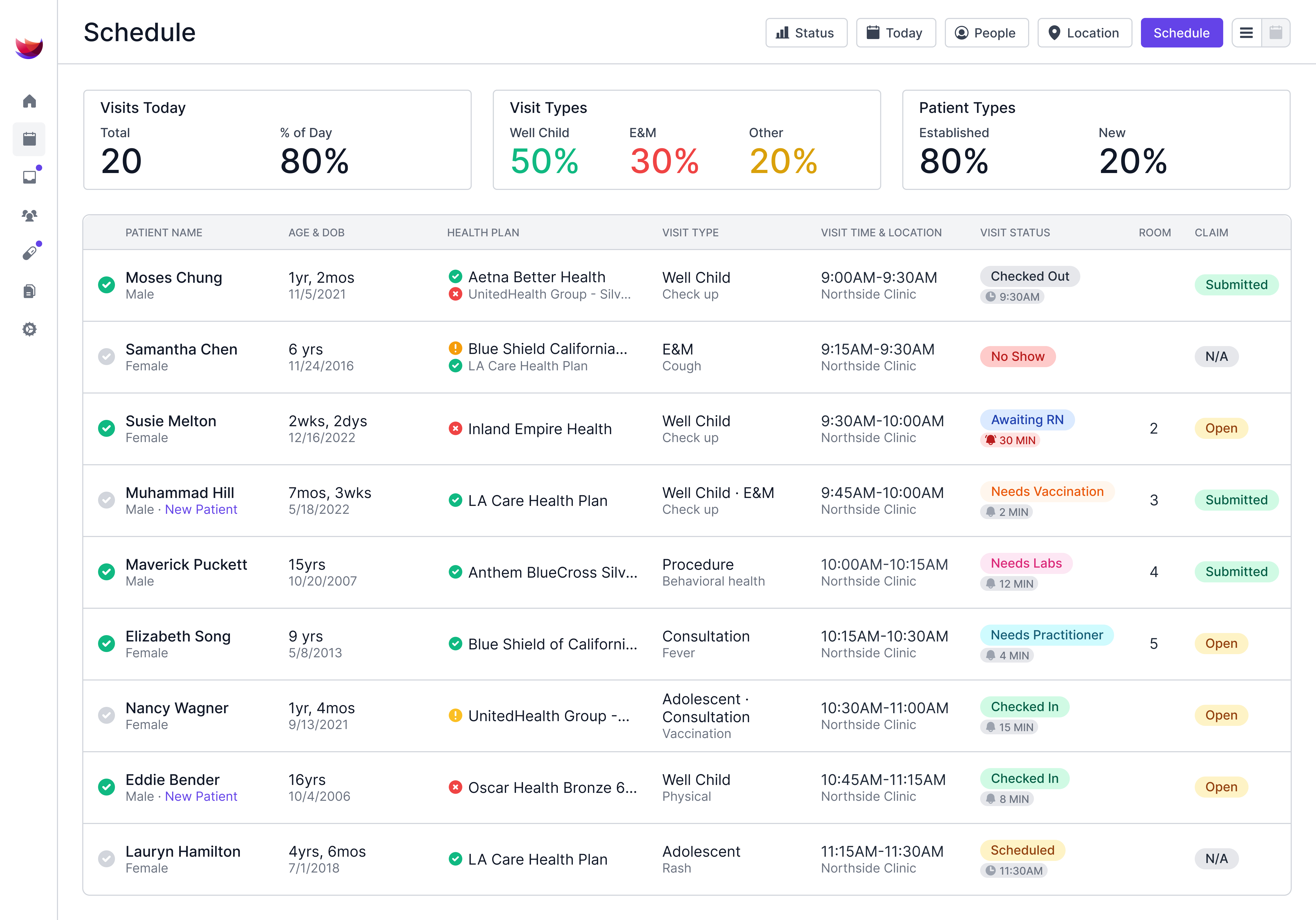
- Digital intake and AI eligibility checks: Caregivers update demographics and insurance and complete forms on their phones before the visit, with no app or portal required. Develo then reads the insurance card automatically and runs each eligibility response through AI-assisted interpretation, so coverage problems surface before the claim instead of as a denial weeks later.
- Automated charge capture: Rules set pediatric codes, modifiers, and diagnoses by visit type at the point of care, and alerts flag possible underbilling. The provider makes the final coding call. Providers can complete billing before they sign the note, and billers can close out a visit's billing themselves, so unsigned notes don't hold claims in the practice.
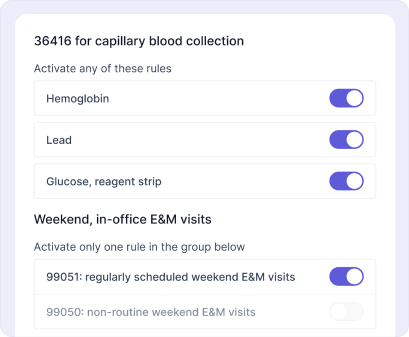
- Pre-submission claim scrubbing: Develo's rules engine scrubs claims before submission, and each rule can fix a claim automatically or route it to a specified work queue, so every exception has an owner. Develo also manages coordination of benefits so the right plan is billed first, ages each claim against its payer's filing window, and flags potential duplicates before a claim reaches the payer.
- Automated payment posting: ERA payments post automatically, so billers spend less time matching remittances to claims. With your fee schedule entered, Develo also flags payments that come in below your contracted rates.
- VFC-aware immunization inventory: Inventory is tracked by funding source and lot expiry, and Develo auto-checks that a child's VFC eligibility matches the dose's funding source. Vaccine and administration codes bill by age, Medicaid status, and visit type.
- Family payments: Caregivers get text reminders with a payment link and a live family balance, can pay balances across siblings in full or in part, including by Apple Pay or Google Pay, and can set up payment plans for larger balances. Detailed statements are customized per guarantor in the family portal.
- Revenue cycle reporting: Reporting runs on real-time data, with configurable dashboards for billers and practice leaders, data exports for your own analysis, and Develo reports Q&A for plain-English questions about your numbers, answered as text or a graph. That means billing leads can check A/R aging and days in A/R without building a report.
Practices that want more billing support can add embedded billing services. Develo's RCM services team is staffed by pediatric billing experts who are onshore and employed by Develo, not offshore or outsourced as billing is at most EMR vendors. They work denials, Level-1 appeals, and A/R follow-up inside the same system and draw on Develo's internal analytics on pediatric coding and reimbursement trends. The service is optional and priced as a percentage of collections, so it earns only when the practice does.
Book a demo to see how Develo handles A/R in medical billing for your practice, from charge capture to the last family payment.
Frequently Asked Questions
What's the Role of Accounts Receivable in Medical Billing?
The role of accounts receivable in medical billing is to show which charges are still waiting on an insurer or a family, so billers know where to follow up. Sorting those balances by age and payer will surface the claims closest to a deadline.
How Do You Calculate Days in Accounts Receivable?
You calculate days in accounts receivable by dividing your adjusted A/R balance by the average charges you post per day. Keep the reporting period and credit treatment the same each month so the trend stays comparable.
What's a Good "Days in A/R" Benchmark?
A good "days in A/R" benchmark is 30 to 40 days, according to AAFP guidance, with 50 days as the upper limit. Check each payer against that range, too, since a single slow Medicaid plan can run well above the practice average.
When Should a Practice Write Off an Old Balance?
A practice should write off an old balance when its review confirms that the amount is uncollectible or requires an adjustment under the payer contract, applicable law, or approved practice policy. Staff should document the reason and distinguish contractual adjustments from bad debt. A missed appeal deadline or completed statement cycle doesn't automatically make a balance uncollectible.