

RCM key performance indicators (KPIs) show where cash is stuck, which claims fail, and how much of what you bill you keep.
For an independent pediatric practice running on high-volume, low-dollar visits, tracking the right handful of RCM KPIs catches small revenue leaks weeks before they hit the bank account.
The 8 RCM KPIs: Quick View
The benchmarks below are healthy targets to aim for. Days in A/R, A/R over 90 days, clean claim rate, denial rate, and net collection rate come from a 2024 guide published by the Healthcare Financial Management Association (HFMA), and the rest are widely used industry rules of thumb.
Metrics for Cash Speed
Two metrics show how fast cash reaches your account:
The quickest way to move both metrics is to get charges out sooner and lift your clean claim rate. In a pediatric practice, vaccine-heavy visits are where charge lag shows up most.
Newborns are the pediatric wrinkle in aged A/R. Early newborn visits are often billed before the baby is added to a parent's plan, so those claims pend or deny until enrollment catches up. Families generally have 30 days to add a newborn to commercial coverage, so a weekly check on unenrolled newborns keeps those claims from drifting into the 90-plus bucket.
Metrics for Claim Accuracy
Three metrics show how accurate your claims are, from submission through the payer's first decision:
- Clean claim rate: The share of claims that go out clean, with no edits. HFMA's KPI guide, citing Becker's ASC, sets the target at 98%, so treat anything under 95% as a sign your front-end checks need work.
- Denial rate: The share of submitted claims a payer refuses. HFMA puts the optimal rate under 5% and the industry average at 5% to 10%, and it recommends resolving 85% of denials within 30 days.
- First-pass resolution: The percentage of claims paid correctly on the first submission. Aim for 90% or higher; when it slips, the cause is usually upstream in eligibility, coding, or documentation.
Metrics for Revenue Capture
Keeping what you earn comes down to three numbers: net collection rate, cost to collect, and patient collection rate.
- Net collection rate: The share of allowed revenue you collect after contractual adjustments, so it strips out agreed discounts and shows real performance. HFMA sets 95% as the floor and 97% to 99% as optimal; anything lower points to money leaking through late filing, underpayments, or weak follow-up.
- Cost to collect: What you spend to bring in each dollar, with 2% to 4% a commonly cited target. Automation usually lowers it, since the same denial worked by hand three times is pure cost.
- Patient collection rate: The share of family balances you actually collect. The money is hardest to collect once the family leaves, so strong practices capture what they can at or before the visit through eligibility checks, up-front estimates, and a card on file.
On a Medicaid-heavy panel, calculate patient collection rate on commercial balances only: federal rules exempt most children on Medicaid from cost sharing, and CHIP can't charge for well-baby and well child care.
Which KPIs to Start With
Start with days in A/R, then denial rate. Don't stand up all eight at once; add them in order of impact.
- Days in A/R: The clearest read on cash speed. It moves the moment your billing gets faster.
- Denial rate: Paired with days in A/R, it exposes the two problems that hurt most: slow cash and broken claims. Fixing either one tends to pull the rest along.
- Clean claim rate and first-pass resolution: The accuracy metrics that feed the first two. Add them once days in A/R and denial rate report on a regular cadence.
- Net collection rate, cost to collect, and patient collection rate: The capture metrics. Bring these in once the upstream numbers hold steady.
How to Read Benchmarks Without Fooling Yourself
Read every benchmark against your own payer mix, because that context sets your real target. A slow-paying Medicaid mix, for example, can push days in A/R higher with no real collection problem. Three habits keep the numbers honest:
- Read metrics in pairs: Days in A/R next to the 90-plus bucket. Denial rate next to denial recovery.
- Read the trend: One month tells you little, but three months of direction tells you whether a change worked.
- Segment before you average: For a multi-location group, an org-wide number can hide one practice or state dragging the rest down. Break each KPI out by location, TIN, and state, since payer mix and Medicaid rules vary from state to state.
How Develo Tightens Your Pediatric Revenue Cycle
Develo, the AI-native operating system for pediatrics, tightens your revenue cycle by automating the work behind these numbers, from charge capture to pre-submission claim checks. Pediatric revenue runs on high-volume, low-dollar visits and vaccine-heavy coding, so small amounts slip away across many claims, and automation helps catch them.
- Automated charge capture: Cuts the charge lag that inflates days in A/R.
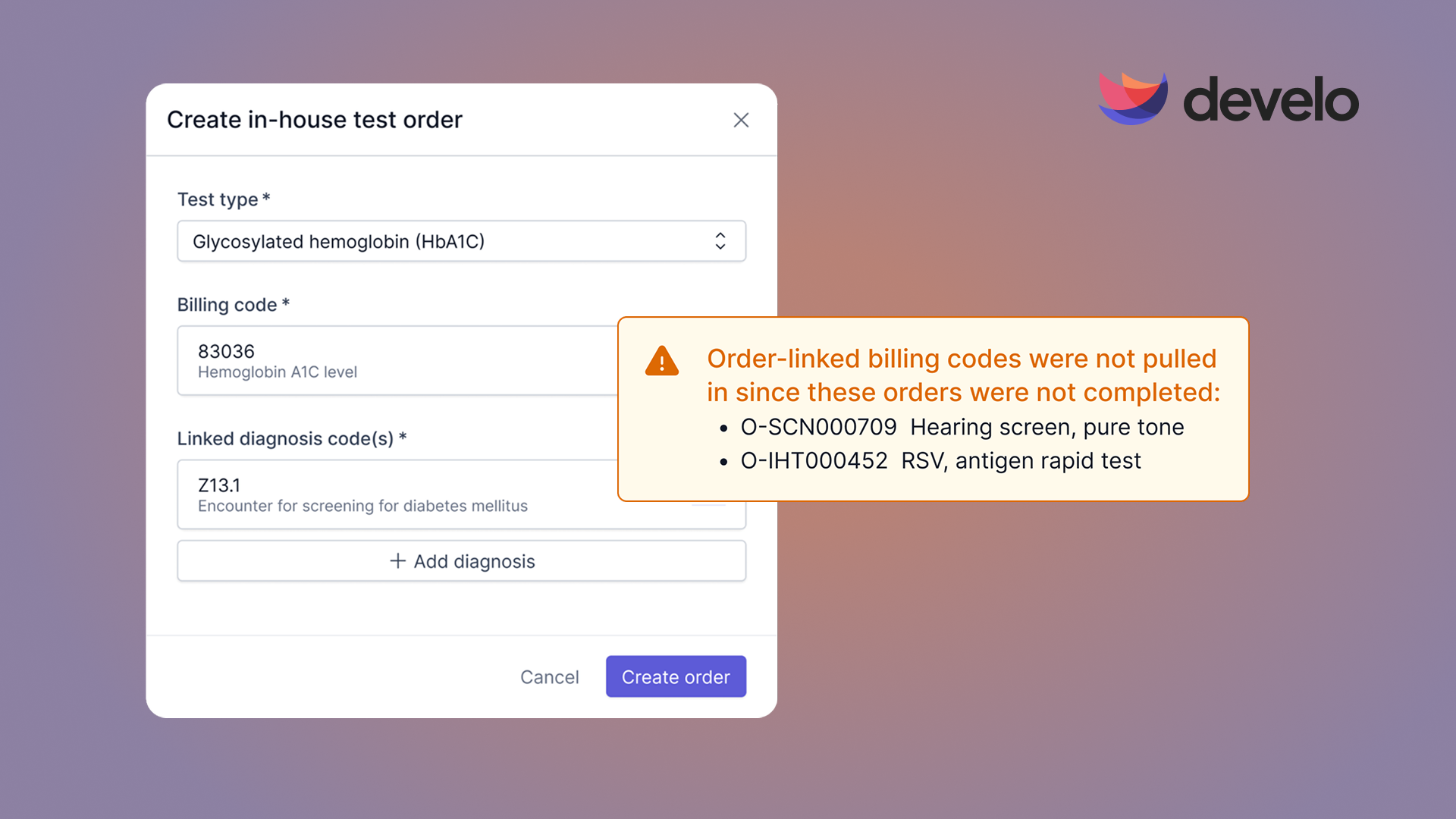
- Pre-submission claim checks: Catch errors before claims go out, lifting your clean claim rate.
- Pediatric-specific coding: Applies pediatric coding rules that reduce the denials dragging down net collections.
- Denials work queue: Denials land in a prioritized queue, so billers work exceptions rather than stacks.
- Billing services: An onshore, pediatric-only billing team works denials, appeals, and A/R follow-up inside Develo, priced as a percentage of collections, with a monthly health score on collections, denials, and A/R.
- Multi-location reporting: Collections, A/R, and denials roll up from a single practice to the whole org or any subset by region, with billing run centrally across every practice and TIN, even across state lines.
- Develo reports Q&A: Ask plain-English questions of your clinical and administrative data and get text and graph answers from real-time data, not last month's snapshot.
- Family payments: Families see balances across all their kids in one view and can pay with a card on file or a tiered payment plan, which helps lift your patient collection rate.
If you run a pediatric practice and want a system built to improve your RCM KPIs, book a demo to see how Develo fits your revenue cycle.
Frequently Asked Questions
What Days in A/R Should You Aim For?
Aim for 30 to 40 days, the healthy range HFMA publishes, though the right target varies with your specialty and case mix. In Develo's experience, the highest-performing pediatric practices average 15 to 20 days. Read it alongside your A/R over 90 days, since a low average can hide a backlog of aged claims.
What Is a Good Denial Rate?
HFMA calls a denial rate under 5% optimal, with 5% to 10% the common industry average. Anything above 10% usually points to problems upstream in eligibility, coding, or claim scrubbing.
Which RCM KPI Is Most Important?
Days in A/R is the best single starting point because it captures how fast cash reaches you. Add denial rate next, since it shows how many claims stall before they're paid, and the two together explain most revenue problems. Start there, then add accuracy and collection metrics once those two are stable.
How Often Should You Review RCM KPIs?
Review your operational KPIs, such as denials and rejections, weekly, then check a fuller financial summary monthly. Set alerts for sharp moves, like a spike in A/R over 90 days. The trend across several months tells you more than any single reading.
Can Develo Help Pediatric Practices Improve Their RCM KPIs?
Yes, Develo helps pediatric practices improve their RCM KPIs. As the AI-native operating system for pediatrics, it combines automated charge capture, pre-submission claim checks, pediatric coding rules, and a prioritized denials queue that target days in A/R, clean claim rate, and denials, and family payments that show balances across siblings in one view help with patient collections. For practices that want billing handled for them, Develo billing services adds an onshore, pediatric-only billing team that works inside the same system that runs the practice, backed by AI-powered revenue cycle intelligence. It's priced as a percentage of collections, so Develo only earns when the practice does, and a monthly health score on collections, denials, and A/R keeps performance transparent.
.png)

.avif)