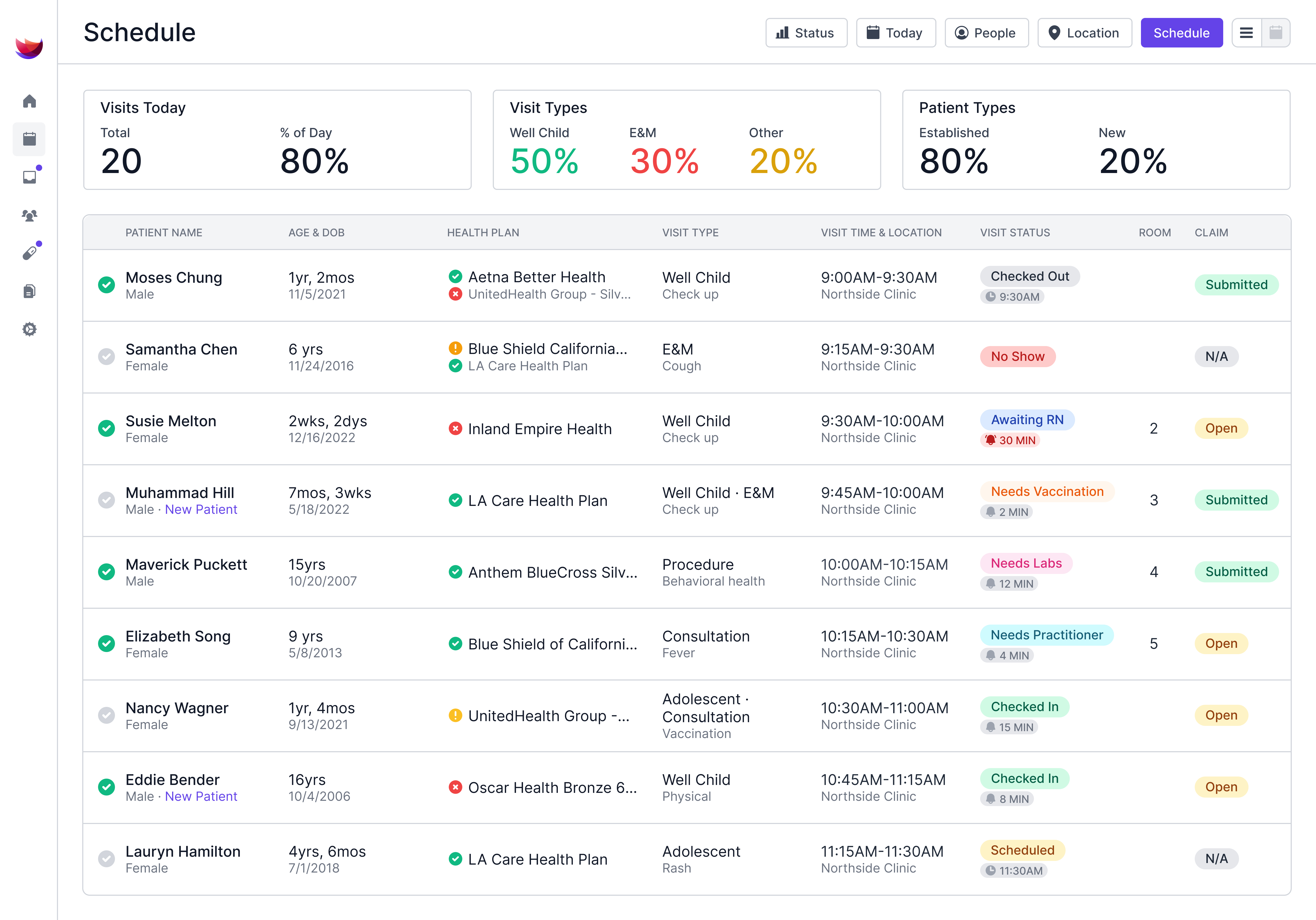


Pediatric insurance verification confirms a child's active coverage, benefits, and financial responsibility before the visit. Get it wrong, and your practice absorbs denied claims, upset parents, and a pile of rework.
What Is Pediatric Insurance Verification?
Pediatric insurance verification is the process of confirming a child's insurance coverage, including overall eligibility, copays, deductibles, and service-specific benefits, before a visit.
In pediatrics, this workflow carries more weight than in adult medicine. Kids sometimes switch plans mid‑year, coverage often follows a parent (not the child), and there can be primary vs. secondary insurance considerations for kids who have two working parents or mixed Commercial and Medicaid coverage.
Also, public programs like Medicaid and CHIP can still change at renewal, even though children now receive at least 12 months of continuous eligibility under federal law.
Why Is Pediatric Insurance Verification More Complicated?
Adult patients usually have stable insurance tied to a single job. Pediatric patients don't.
Here's what makes pediatric insurance verification uniquely messy:
- Frequent plan changes: Parents switch jobs, get married, add dependents, or transition kids onto Medicaid or Children’s Health Insurance Program (CHIP).
- Split custody: A single child may be listed under two different policies. You need to know which is primary.
- Medicaid and CHIP volatility: Coverage for children must be continuous for at least 12 months, but many kids still lose Medicaid at renewal when families miss paperwork or eligibility checks.
- Coverage by service type: Well child visits, vaccines, behavioral health services, and developmental screenings can all have separate coverage rules.
- Multiple siblings on one policy: One denial can cascade across the family's account.
- Newborn care: This is a common pediatric scenario that calls for delayed billing of newborn visits while insurance is set up during the first 30 days of life.
According to the American Academy of Pediatrics (AAP), roughly 37 million children are insured through Medicaid and CHIP, which makes eligibility monitoring a core operational skill for any pediatric practice.
What Should You Verify Before Every Pediatric Visit?
Every pediatric insurance verification should confirm the below data points, especially when they are applicable for a child’s care:
- Patient demographics: Name, date of birth, and member ID match the insurance card exactly.
- Policy active status: Coverage is valid on the date of service.
- Primary care physician (PCP) assignment: The PCP listed matches your practice (critical for HMOs and Medicaid MCOs).
- Copay and deductible: What the family owes at the visit, plus the family's deductible progress.
- Covered services: Well child visit benefits, immunizations, behavioral health, and developmental screenings.
- Secondary insurance: Any coordination of benefits across two policies.
Skip one of these, and you're looking at a denied claim down the road.
The Pediatric Insurance Verification Process: Step by Step
A tight pediatric insurance verification workflow runs on repeatable steps rather than on staff memory. Here are the steps to follow:
- Step 1: Collect at scheduling. Capture policyholder name, ID, group number, and relationship to patient when the appointment is booked.
- Step 2: Run eligibility 48 to 72 hours before the visit. Real-time eligibility checks catch lapsed coverage before the family walks in, and should be run automatically by your system.
- Step 3: Confirm at check-in. Ask the parent to re-verify the card and any demographic changes. Addresses and phone numbers drift constantly.
- Step 4: Document in the EMR. Log the eligibility results, copay amount, and any payer notes associated with the visit. Optimally your eligibility checks are run out of your EMR, and documentation is largely automated.
- Step 5: Re-verify recurring patients quarterly. Even "stable" patients flip plans between well visits. Build re-verification into your recall workflow.
What Are Common Reasons Pediatric Claims Get Denied?
Most pediatric claim denials trace back to the front desk. This is something your team can fix to drop your denial volume.
Top denial causes tied to verification failures include:
- Outdated coverage information: Policy terminated or replaced since the last visit.
- Policyholder mismatch: Claim sent under the child's name instead of the parent.
- Wrong PCP on file: Medicaid MCOs deny visits when the assigned PCP doesn't match the billing provider.
- Inactive Medicaid: Renewal lapsed between appointments.
- Name or DOB mismatch: Small typos cause clean-claim rejection.
- Missing prior authorization: Common with behavioral health referrals and some specialty labs, and less common for primary care needs.
Remember: Fix verification at the source, and denial volume drops at the back end.
Real-Time Eligibility vs. Manual Verification
Real-time eligibility queries a payer's system instantly and returns coverage details within seconds. Manual verification means phone calls, payer portals, and spreadsheets.
The difference is massive for pediatric workflows:
- Speed: Real-time checks run in seconds. Manual calls eat meaningful chunks of staff time per patient.
- Accuracy: Real-time pulls live data. Phone rep details get transcribed and mistyped.
- Scalability: A high-volume pediatric schedule is impossible to verify manually with any rigor.
- Catch rate: Real-time systems flag lapses, benefit caps, and PCP mismatches that phone reps skip.
If your practice still verifies manually, you're burning staff hours and leaving denials on the table.
How Should I Reduce Pediatric Insurance Verification Errors?
Cleaner verification equals fewer denials and faster collections.
Here are a few pointers to keep in mind:
- Verify at multiple touchpoints: Scheduling, 72 hours out, and at check-in.
- Train staff on pediatric edge cases: Custody, coordination of benefits, Medicaid MCOs.
- Use software that flags discrepancies: Outdated demographics, inactive coverage, PCP mismatch.
- Automate real-time eligibility checks: Remove human delay from the pipeline.
- Collect copays at check-in: Lock in cash flow before the parent leaves.
- Monitor denial trends monthly: Find the patterns your process keeps missing.
If your front desk spends the first 20 minutes of every morning on the phone with payers, your workflow needs automation.
How Does Technology Transform Pediatric Insurance Verification?
Modern pediatric platforms like Develo bake verification into the visit flow instead of treating it as a separate task.
Here's what strong technology does for your front desk:
- Runs real-time eligibility automatically: At scheduling and check-in, with no staff action required.
- Flags outdated demographics or inactive policies: Before the visit, not after the denial.
- Prompts parents to update insurance via visit digital intake: On their phone before the visit.
- Posts copays and deductibles directly in the chart: So MAs and providers know what was collected.
- Tracks coverage across siblings: One family, one unified view.
Pre-visit verification also shrinks waiting room friction. Families aren't stuck filling paper forms while you chase down a payer. Your front desk shouldn't be re-keying insurance cards in 2026. The system should already know.
What Are Pediatric Insurance Verification Best Practices?
Strong verification programs share a few common habits:
- Build a verification checklist every front-desk staffer follows without thinking.
- Set a re-verification cadence (quarterly minimum) for chronic-care patients and Medicaid enrollees.
- Partner with a clearinghouse built for pediatric payer mixes, including Medicaid MCOs.
- Tie verification to your billing workflow so denials feed back into process fixes.
- Audit your denial log monthly for verification-related patterns.
- Use family-level accounts to track siblings and guarantors, and to split custody correctly.
Clean insurance data also supports every other part of the chart. Accurate demographics flow into growth charts, vaccine records, and recall lists, which means fewer gaps in care and fewer parent phone calls.
Small habits compound. Practices that verify consistently see steady improvements in first-pass claim rates.
How Does Pediatric Insurance Verification Impact More Than Billing?
A smooth financial experience builds trust. Parents who never get surprise bills recommend your practice. That word-of-mouth becomes the most powerful form of practice marketing for a pediatrician.
Accurate verification also unlocks operational wins:
- Faster check-ins because the system already knows the co-pay.
- Higher collections because you catch deductibles before the family leaves.
- Better recall because demographics stay current.
- Lower staff turnover because the front desk isn't drowning in phone calls or manual updates (sometimes across EMR and intake systems separately).
Insurance verification quietly underwrites the entire practice by driving more efficient operations, capturing more revenue, and delivering improved care experiences.
Automate Pediatric Insurance Verification With Develo
When comparing pediatric practice solutions, most EMRs treat insurance verification as an afterthought. Develo was built differently, from day one as an AI-native, end-to-end operating system for independent pediatric practices of every size with a modern, unified clinical (EMR) + billing (RCM) + family engagement (CRM) experience.
Develo embeds insurance eligibility checks into the visit flow so your front desk stops chasing payers, and integrates insurance verification seamlessly with both front desk and clinical workflows.
Unlike legacy EMRs retrofitted from adult systems, here's what you can do with Develo:
- Run real-time eligibility checks automatically at scheduling and check-in, with co-pay and coverage details surfaced to staff.
- Prompt families to update insurance through digital visit intake before they arrive, eliminating paper cards and manual entries in exchange for a seamless mobile experience.
- Catch outdated demographics with intelligent check-in notifications that tell staff exactly what needs updating.
- Connect verification to automated charge capture so coverage data feeds clean claims from the very first step.
- Automatically link eligibility check results with VFC eligibility to ensure the right vaccines are administered based on a child’s Vaccines for Children (VFC) status.
- Track family-level coverage across siblings with a family-centered data architecture that general EMRs can't match.
- Bundle everything under comprehensive pricing with no add-on fees for clearinghouse, intake, or family portal access.
You shouldn't need Phreesia, a separate clearinghouse, and a billing bolt-on to get pediatric insurance verification right. You need one platform built for pediatrics. Book a demo and see how Develo helps your practice cut denials and speed up check-ins.
Frequently Asked Questions
1. What Information Do I Need to Run a Pediatric Insurance Verification?
You need the child's legal name, date of birth, policyholder name and date of birth, member ID, group number, and payer name. For Medicaid, include the state ID and any MCO plan name. Missing any of these blocks clean eligibility checks and delays the claim.
2. How Often Should I Re-Verify Insurance for Pediatric Patients?
Even though children in Medicaid and CHIP are now entitled to 12 months of continuous eligibility, re‑verify coverage at least once per quarter and at every visit for patients on these programs, so you catch plan changes, MCO switches, or disenrollment at renewal before claims go out.
3. Can I Bill a Well Child Visit if the Parents’ Insurance Changed Between Visits?
Yes, but only to the payer active on the date of service. Verify coverage on the day of the visit, confirm well child visit benefits, and bill the correct payer. Sending the claim to the wrong insurer creates risks of timely filing and guaranteed rework.
4. What's the Difference Between Eligibility Verification and Prior Authorization?
The main difference between eligibility verification and prior authorization comes down to the timing of approval.
Eligibility verification confirms the patient has active coverage and what benefits apply. Prior authorization is the payer's approval for a specific service before it's delivered. Pediatric practices need both, especially for specialty referrals and some behavioral health visits.
5. How Do I Handle Insurance Verification for Kids With Divorced Parents?
To verify insurance for children with divorced parents, the parent who has custody pays first.
If parents have joint custody and no court order designating who covers health insurance for the child, use the birthday rule as your default. When a child is covered under both parents’ plans, the plan of the parent whose birthday falls earlier in the calendar year is usually considered primary.
.png)
.avif)


.avif)