

Pediatric billing and coding reward precision. A single modifier, age cutoff, or missed vaccine component can turn a correctly paid visit into an underpaid one, and across a full schedule, those misses add up.
Below are the 2026 codes, modifier rules, and fixes that keep your claims paid in full.
What Is Pediatric Billing and Coding?
Pediatric billing and coding translate each visit into the standardized codes payers use to reimburse care:
- CPT for what was done
- ICD-10-CM for why
- HCPCS Level II for supplies, some drugs, and payer-specific codes
For pediatric-specific rules, the AAP publishes yearly coding fact sheets and a coding newsletter, and our 2026 pediatric coding guidelines summarize this year's changes. You'll lean on that guidance often, since three features of pediatric care raise the odds of a coding error compared with adult primary care:
- Age drives code selection: Preventive visit codes change by patient age, so a birthday between visits can change the correct code even when the exam looks identical.
- Vaccines stack quickly: A single well child visit can carry multiple vaccine products, each with its own administration and counseling components to capture.
- Families share records: Siblings, guardians, and shifting insurance mean stale demographic or coverage data can lead to denials faster than in single-patient adult care.
Missed vaccine components tend to cost money without triggering a denial, while age-band mismatches and outdated family records more often come back as rejections.
Well Child Visit Coding by Age
Preventive visits use two CPT series: 99381–99385 for new patients and 99391–99395 for established ones. A child is a new patient if no physician or QHP of the exact same specialty and subspecialty in your group has billed a face-to-face service for them in the past three years.
The patient's age on the date of service sets the code, regardless of visit length or complexity. Our pediatric billing cheat sheet keeps these codes on one page.
Pair each preventive code with its ICD-10-CM diagnosis: Z00.110 for newborns under 8 days old, Z00.111 for newborns 8 to 28 days old, Z00.121 or Z00.129 for children from 29 days through age 17 (with or without abnormal findings), and Z00.00 or Z00.01 for patients 18 and older.
Scheduling visits on the AAP Bright Futures periodicity schedule keeps your cadence in line with what payers expect.
Billing a Sick Visit and a Well Child Visit on the Same Day
Combined sick and well child visits are a frequent source of underpayment. When a child comes in for a well child visit and the provider also treats a separate, significant problem, both services can be billed. Add modifier 25 to the problem-oriented E/M code (99202–99215) to mark it as distinct.
The record must show two distinct services. CPT doesn't require separate diagnoses, but tying each service to its own reason for the visit helps the claim hold up in review, especially in pediatrics, where a visit commonly pairs a sick diagnosis with the E/M code and the standard well child diagnosis with the preventive code.
The well exam should be linked to the Z00 code and the problem visit to the condition treated. Leave modifier 25 off, and one of the two services usually gets bundled or denied. How your EMR handles this matters, too. In Office Practicum, for example, the provider writes two separate notes, one for the well child exam and one for the problem, even though both services go out on a single claim.
Immunization Coding
Vaccine visits are where component miscounts pile up fastest, because each administration code carries its own counting rules.
- 90460 and 90461: For patients through age 18 when the physician or QHP provides counseling. Report 90460 for the first component of each vaccine and 90461 for each additional component. Count one component per organism the vaccine protects against: DTaP-IPV guards against four diseases, so it's 90460 once plus 90461 three times.
- 90471–90474: For administration without counseling, or for patients 19 and older. 90471 and 90472 cover injectable routes; 90473 and 90474 cover oral or intranasal.
- 90480 and 90481: COVID-19 vaccine administration codes. 90481 is new for 2026 as an add-on for each additional component of a combination vaccine that includes a COVID-19 component.
- VFC-supplied vaccines: The state supplies the vaccine, so you bill only the administration. Many Medicaid programs still want the product code on the claim at $0.00 with modifier SL, and some limit or don't pay 90461 for VFC doses, so check your state's rules before assuming every component pays.
New for 2026: Standalone Immunization Counseling
The biggest 2026 change allows practices to bill for vaccine counseling on days when no vaccine is administered.
CPT codes 90482–90484 cover at least three minutes of physician or QHP immunization counseling when recommended vaccines aren't administered on that date. If you report one of these codes on the same date as an E/M service, append modifier 25 to the E/M.
They're time-based, billed on total counseling time, and don't apply when an administration code like 90460 already captures that time.
Medicare lists 90482–90484 as non-covered, so payment depends on Medicaid and commercial plans. Some Medicaid programs may still expect the 2022 HCPCS counseling codes (G0310–G0315) that 90482–90484 replace, and some commercial plans ask for 99401–99404.
Pair the claim with a counseling diagnosis like Z71.85, add a Z28 "immunization not carried out" code, and confirm payer policy before counting on it.
Screening and Assessment Coding
Standardized screening is reimbursable work that often goes unbilled, and 47 state Medicaid programs pay 96110 separately from the well child visit, according to NASHP. Per AAP coding guidance:
- 96110: Developmental screening with a standardized tool (e.g., a validated developmental or autism screen like the M-CHAT-R/F), with scoring and documentation per standardized instrument. When two instruments are used at one visit, report each as its own unit, adding modifier 59 if the payer requires it.
- 96127: Brief emotional or behavioral assessment, such as a standardized depression screen.
- 96161: Caregiver-focused screening, such as the Edinburgh Postnatal Depression Scale at infant visits, billed on the infant's claim because it's done for the baby's benefit. Bright Futures recommends postpartum depression screening at the 1-, 2-, 4- and 6-month visits.
- 96112 and 96113: Extended developmental testing when a screen suggests a concern that needs formal evaluation.
When a screen happens during a preventive or problem-oriented visit, bill the screening code in addition to the E/M. Depending on the payer, you may need modifier 25 on the E/M or modifier 59 on the screening code.
Standardized instruments bill on top of the preventive code, while informal developmental surveillance counts as part of the visit itself.
Documented isn't the same as billed. Many practices run screens on paper or through a separate digital tool like CHADIS or Phreesia. Even when the parent or patient completes the screen digitally, the result usually lands in the chart as a PDF or pasted text: someone has to open and review it, it can't be rescored if an answer changes during the visit, and it has to be linked to the right visit by hand. Then someone still has to add 96110 or 96127 with the right diagnosis code. When those steps depend on memory, completed screens go out unbilled.
6 Ways Pediatric Practices Lose Revenue
Most lost revenue traces back to preventable misses:
- Missing modifiers when a sick visit or standardized screen shares a date with a well child visit (modifier 25 on the E/M, or modifier 59 on the screen if the payer requires it), so payers fold the second service into the first.
- Age-cutoff errors that bill the wrong preventive code for the patient's age on the date of service.
- Undercounted vaccine components, where 90461 is skipped on multi-antigen vaccines.
- Unbilled screens and minor procedures that providers perform but never code.
- Stale insurance or demographics that surface as eligibility denials after the visit.
- ICD-10-to-CPT mismatches that fail to justify medical necessity to the payer.
How to Improve Pediatric Reimbursement
The fixes are operational, and most don't require more billing staff:
- Verify eligibility before the visit: A pre-visit check flags lapsed plans, new payers, or the wrong subscriber while there's still time to fix them.
- Capture charges during or right after the visit: When codes come straight from the note, they match the services actually delivered.
- Standardize modifier 25 use: Build note templates with a dedicated section for the problem-oriented service so a reviewer can see the split.
- Audit and train: Periodic chart audits surface patterns, and credentials like the AAPC Certified Pediatrics Coder build in-house expertise.
- Stay current: Working from the latest AAP Coding for Pediatrics manual keeps your team ahead of each year's CPT and ICD-10-CM updates.
Make Accurate Coding the System's Job
Running these checks by hand on every claim is hard to sustain, even for an experienced billing team. Develo is the AI-native pediatric operating system built solely for independent pediatric practices, unifying charting, billing, practice management, and family engagement in one system.
On the billing and coding side, that translates to:
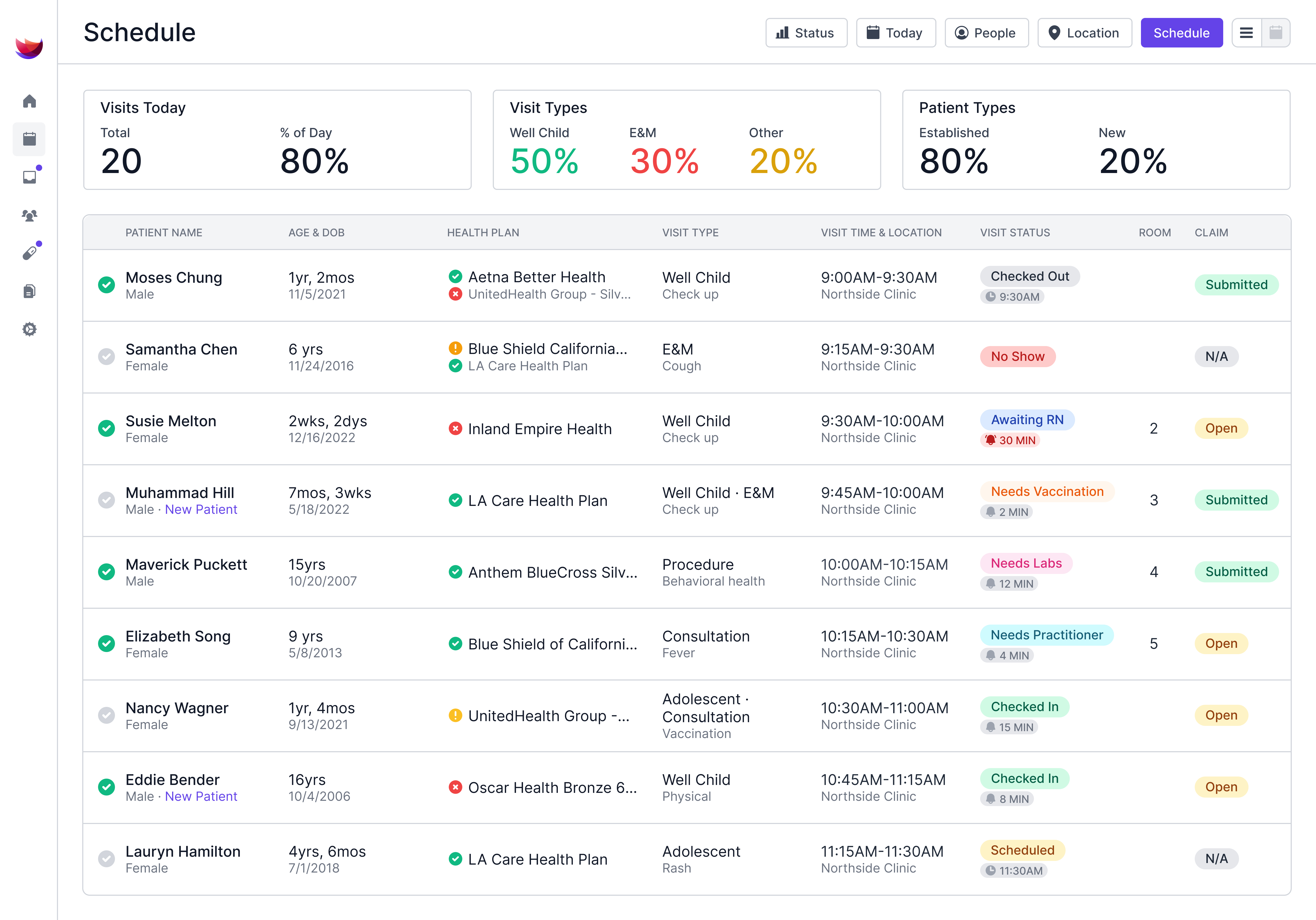
- Automated charge capture in place of manual coding. Most EMRs leave providers and billers to pick every code, unit, modifier, and diagnosis by hand: the team knows the rules, but applying them visit after visit is slow and error-prone. Develo sets them automatically by visit type and patient age, pulls completed orders straight into the charge, and flags services normally billed with a well child or sick visit, so providers confirm the claim instead of building it.
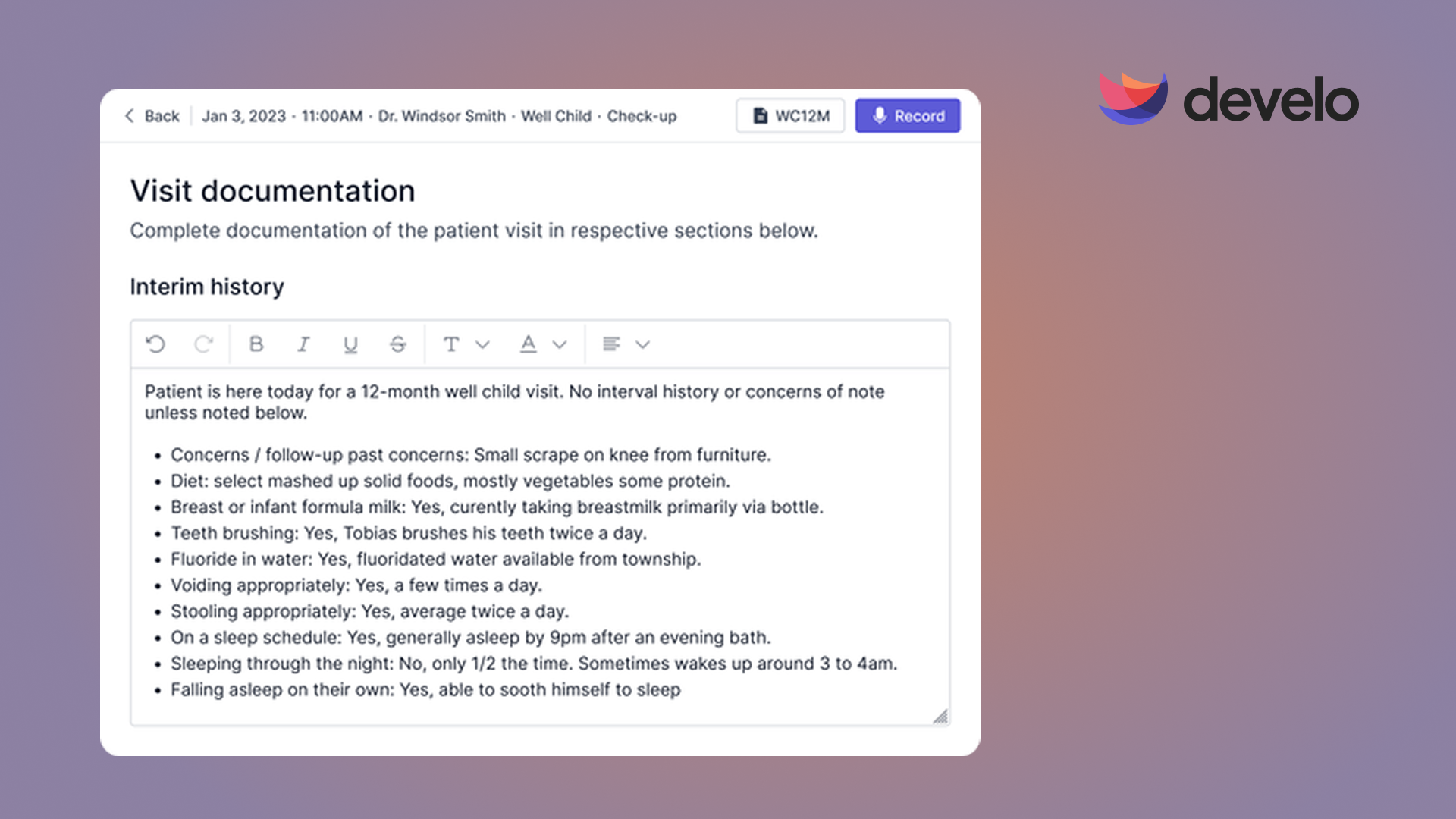
- One note for a combined visit, with separate preventive and problem-oriented sections. When the Develo AI scribe picks up a sick diagnosis during a well child visit, Develo suggests adding the E/M code on top of the preventive code, with modifier 25 applied automatically for the provider to confirm.
- Vaccine billing logic that adds 90461 for every additional component of a combination vaccine, applies administration codes by VFC eligibility, age, and visit type, and adds 90482 with its supporting diagnosis codes when counseling happens without a vaccine, flagging payer counseling coverage before the claim goes out.
- Real-time eligibility checks that flag coverage issues before the family checks in, so lapsed plans and new payers get fixed before a claim exists.
- An onshore, pediatric-only billing team that works inside Develo, for practices that would rather not staff billing in-house.
- Digital screeners built into Develo, not added through a third-party integration. They auto-populate by age, and a completed screen lands in the visit itself, not as a PDF: it's scored automatically, can be rescored if an answer changes during the visit, its screening order is marked complete, and the billing code drops in with the right diagnosis code. A completed screen can't go unbilled unless someone deliberately deletes the charge.
- Pre-submission claim checks that flag modifier and diagnosis-linkage errors, so billers review exceptions instead of every claim.
The result is fewer missed charges and cleaner first-pass claims. Book a demo to see how Develo handles pediatric billing from check-in to paid claim.
Frequently Asked Questions
Can You Bill a Well Child Visit and a Sick Visit on the Same Day?
Yes, you can bill both on the same day. Report the preventive code plus the office visit code, add modifier 25 to the office visit code, and pair it with the diagnosis for the problem you addressed, so the claim is easy to follow in review.
What Is Modifier 25 in Pediatric Coding?
Modifier 25 marks a significant, separately identifiable E/M service performed by the same provider on the same day as another service. In pediatrics, it usually goes on the E/M code when a sick-visit problem or a billable screen shares a date with a preventive visit, though some payers want modifier 59 on the screen instead.
What Are the New 2026 CPT Codes for Vaccine Counseling?
The new 2026 CPT codes for vaccine counseling are 90482–90484: 90482 covers 3 to 10 minutes, 90483 covers more than 10 up to 20 minutes, and 90484 covers anything over 20, with one code reported for the day's total counseling time.
What Is EPSDT in Pediatric Billing?
EPSDT (Early and Periodic Screening, Diagnostic, and Treatment) is the Medicaid benefit that entitles enrolled children under 21 to a defined set of preventive and diagnostic services. It shapes how Medicaid pays for well child visits and screenings.
.png)

.avif)