

Medical claim denial management involves identifying claims that an insurer has refused to pay, correcting or appealing those denials, and addressing the underlying issues to prevent them from happening again.
Pediatric practices face additional challenges, such as billing for newborns who haven't received member IDs, handling denials for sick visits billed alongside well child visits, and correcting claims submitted under the wrong parent's insurance plan.
The five steps below take a denied claim from the remittance file to a closed account, using the reason codes, payer deadlines, and standardized denial metrics that pediatric billers work with.
What Is Medical Claim Denial Management?
Medical claim denial management means sorting out claims a payer has processed and denied in full or in part, from the day the payer's response arrives until the balance is resolved.
That response usually comes as the ERA, an 835 file that shows which claims the payer paid, adjusted, or denied. Each denied line includes a reason code that helps your billing team determine what to do next.
Depending on the reason, the claim gets corrected, appealed, or rebilled to another payer or, where appropriate, to the family.
Denial management is one stage of the pediatric revenue cycle, which also includes registration, charge capture, and payment posting. Problems that start at the front desk often show up weeks later as denials.
Billing problems can be particularly costly for practices serving a large number of Medicaid patients. A 2024 study in The Quarterly Journal of Economics estimated that physicians lose 18% of Medicaid revenue to billing problems.
That estimate counts both payments never collected and the cost of resubmitting claims. The same study put the loss at 4.7% for Medicare and 2.4% for commercial insurers.
What Are the Different Types of Claim Denials?
Before you investigate a claim, check whether the payer processed and denied it or rejected it before adjudication. If the claim was denied, classify the denial based on whether it can be recovered and who needs to resolve it.
Claim Rejections vs Claim Denials
A rejected claim fails front-end edits at the clearinghouse or payer before adjudication, usually because a required field is missing or invalid, such as the member ID or the rendering provider's National Provider Identifier.
Rejections come back on the 999 and 277CA acknowledgment files, because a rejected claim never reaches adjudication or the ERA. Since the payer never accepted it, it generally won't have a payer-assigned claim number. Correct the error and resubmit it as an original claim as soon as possible, since the filing deadline still applies.
A denied claim was adjudicated: the payer processed it and decided not to pay some or all of it. Denials appear on the ERA with a reason code. Resolving a denial takes a corrected claim, an appeal, or a documented decision to adjust the balance.
Hard Denials vs Soft Denials
Billing teams use these labels to sort denials by recoverability. Neither term appears in the official code sets.
- Soft denials: Claims that can be paid after a correction or more documentation. A missing modifier and a diagnosis on the wrong line are common examples.
- Hard denials: Claims that can't be recovered through routine corrections, such as services excluded from a child's insurance plan or claims submitted after the filing deadline when no exception applies.
A hard denial can still have appeal rights, so check the payer's policy before you write off the balance.
Check the plan before you bill a denied balance to the family. Practices that accept Medicaid must accept the state's payment as payment in full, so a denied Medicaid claim generally can't be moved to the family the way a commercial patient-responsibility balance can. With pediatric panels heavily covered by Medicaid, that rule often leaves a denial with three outcomes: corrected, appealed, or written off.
Administrative vs Clinical Denials
Administrative denials (also called technical denials) come from the billing data or process: an inactive policy, a missing authorization, or a wrong member ID.
A biller can usually resolve administrative denials without clinical input.
Clinical denials occur when the payer questions the medical necessity of a service, its diagnosis, or the supporting documentation. These denials generally require a clinician to review the medical record before the billing team prepares an appeal.
How to Manage Medical Claim Denials in 5 Steps
Work the steps in order and give every step a named owner, so claims don't stall between the front desk and billing.
1. Identify and Log Every Denial
Start by matching each denied service line on the ERA to the original claim and patient visit. Then review these three codes to identify why the payer denied or adjusted the claim:
- Group code: This assigns responsibility for the adjustment. X12, which publishes these code sets, lists four in current use: CO (contractual obligation) puts the adjustment on the practice, and PR (patient responsibility) puts it on the family, while OA (other adjustment) and PI (payer-initiated reduction) cover other cases.
- Claim adjustment reason code (CARC): This states why the line was paid differently than billed. CARC 27, for example, means coverage ended before the date of service.
- Remittance advice remark code (RARC): This code provides more detail about the adjustment reason. For CARC 16, X12 requires at least one remark code to explain what information is missing or incorrect.
For every denial, record the:
- Patient, payer, claim number, and date of service
- Denied amount and affected service lines
- Group code, CARC, and RARC
- Date received and correction or appeal deadline
- Assigned biller, next action, and status
Siblings may share the same subscriber and policy number, which increases the risk of linking payments or denials to the wrong patient. Check the child's name and date of birth on each ERA line before you update the account.
2. Find the Root Cause
The CARC shows the reason the payer gave for denying or adjusting the claim, but it doesn't always explain what caused the problem.
To identify the root cause, compare the submitted claim with the eligibility response, registration details, and clinical documentation. Our guide to the most common denials in medical billing gives more codes and their fixes.
Pediatric coverage and coding rules vary by patient age, insurance plan, and service, so four areas need a closer look before you categorize the denial.
Coordination of Benefits (CARC 22)
When a child has coverage under both parents' insurance plans, billing the secondary insurer first can result in a CARC 22 denial.
Under the National Association of Insurance Commissioners' coordination of benefits model regulation, the birthday rule decides which parent's plan is primary. In states that follow the model, the plan of the parent whose birthday falls earlier in the calendar year pays first when the parents are married or live together.
For divorced or separated parents, a court decree makes one parent responsible for the child's coverage. When there's no decree, the model sets out a separate order of plans for the payer to follow.
Medicaid usually pays after other available insurance, but certain pediatric services follow different rules. States must pay for pediatric preventive services without waiting on another insurer, unless the state has justified a 90-day wait based on cost-effectiveness and access to care.
So Medicaid may pay a child's well child visit right away while denying a sick visit from the same month with CARC 22 until the other plan processes it.
Newborn Coverage
Newborn claims may be denied because the infant hasn't received an individual member ID yet, even though they're eligible for coverage.
Group health plans subject to federal special enrollment rules generally allow families to enroll a newborn within 30 days of birth. If the family requests enrollment within that period, coverage takes effect from the date of birth.
Medicaid works differently: a baby born to a mother covered by Medicaid or CHIP on the date of birth is deemed eligible until the first birthday without a separate application.
Claims can go under the mother's Medicaid ID until the state issues the baby a separate number, though a baby whose mother was covered by CHIP rather than Medicaid needs its own number from the start. Before correcting a newborn claim, verify the effective coverage date and the payer's identification requirements.
Timely Filing (CARC 29)
Each payer has its own filing requirements, and claims submitted after the applicable deadline may be denied, even when the services were correctly documented and billed.
Federal Medicaid rules require each state agency to set a claim deadline no later than 12 months from the date of service, and a state can set a shorter one. In Texas' Medicaid policy, for example, most claims are due within 95 days of the date of service.
Commercial insurers and Medicaid managed care plans set their own limits, so keep a reference sheet with each payer's filing and resubmission deadlines.
Age-Specific Coding and Vaccines
Pediatric coding requirements depend on the child's age and the services documented during the visit. For example, the AAP's 2025 guide, Coding for Pediatric Preventive Care, lists preventive care code 99392 for established patients aged 1 to 4 and 99393 for those aged 5 to 11.
The same guide limits vaccine administration codes 90460 and 90461 to patients 18 and younger, and only when a physician or another qualified healthcare professional provides the vaccine counseling face to face.
If the counseling requirements aren't met, codes 90471–90474 may apply instead. Billers should verify the code selection and supporting documentation before correcting the claim.
Check the vaccine stock on every denied vaccine line. A VFC dose is free to the practice, so the payer reimburses only the administration, and many state Medicaid programs want the product code at $0.00 or with a state-specific modifier. A private-stock dose billed as VFC, or the reverse, can deny and is also a VFC accountability problem, so fix the inventory record along with the claim.
Categorize the Root Cause
After identifying the underlying issue, assign the denial to a category that your entire billing team uses consistently. This makes it easier to track recurring denial reasons and identify which parts of the billing process need improvement.
The Healthcare Financial Management Association (HFMA) suggests starting with categories that include medical necessity, authorization, and eligibility, with coordination of benefits listed under eligibility.
Pediatric practices can also track coding errors and timely filing denials separately to identify problems that require targeted changes.
3. Correct the Claim or File an Appeal
Submit a corrected claim when the original submission contains an error that can be fixed, such as a missing modifier, an incorrect member ID, or a diagnosis linked to the wrong service line.
File an appeal when the original claim was submitted correctly, but you believe the payer's decision to deny payment was incorrect.
To submit a corrected claim (also called a replacement claim), use frequency code 7 and include the original payer claim number. Enter these details in box 22 of the CMS-1500 or loop 2300 of the electronic 837P, and check the payer's own resubmission instructions. Use frequency code 8 when you need to void a claim submitted in error.
Without the correct replacement code, a payer may treat the corrected claim as a new submission and deny it as a duplicate.
Here's how the choice works on a common pediatric denial:
- A 3-year-old patient's claim includes both a preventive visit (99392) and a problem-oriented visit (99213). The payer denies the 99213 service.
- Review the visit note to confirm that the problem-oriented service was separately documented. Then check whether modifier 25 was added to 99213 and whether each service was linked to the correct diagnosis.
- If the documentation and coding are correct, file an appeal with the visit note attached. If the modifier or diagnosis linkage is incorrect, submit a replacement claim. If the documentation doesn't support a separate problem-oriented visit, remove 99213 from the claim.
4. Track Each Claim Until It's Resolved
Keep each denied claim open until its balance reaches zero through payment or a documented adjustment. Your work queue should show each claim's status, such as waiting on documentation, resubmitted, or under appeal.
Assign a follow-up date to every open claim and prioritize those with approaching deadlines. For the remaining claims, consider the outstanding amount and how long they've been unresolved. When the payer responds, compare the payment with the expected allowed amount.
A paid correction usually appears as a reversal of the original adjudication (claim status code 22 in the 835, a different code set from CARC 22) followed by the new one. Post both entries, or the account will show a balance that the family doesn't owe.
5. Prevent the Same Denial From Recurring
Reviewing resolved denials shows where errors keep starting, such as in registration, coding, or documentation. Use the root cause to determine which part of the process needs to change:
- Eligibility denials: Re-run eligibility before the visit and at check-in, confirm the child's member ID and primary payer, and ask at registration whether the child is also on the other parent's plan.
- Coding mismatches: Introduce payer-specific claim-scrubbing rules or review recurring coding errors with the provider responsible for the claims.
- Documentation gaps: Update visit templates to capture the information required to support billed services, such as documented vaccine counseling for code 90460.
- Late filings: Set work-queue alerts well ahead of each payer's limit, with the earliest alerts for the plans with the shortest windows.
A documented insurance eligibility verification process lets the front desk catch a parent's job change before the claim goes out.
Each month, sort denials by payer and CARC, then break the largest groups down by CPT code and provider. A rule that fixes one commercial payer's denials can trigger new ones from your state's Medicaid program, so apply each rule only to the payer whose denials prompted it.
Identifying errors before you complete the claim submission process reduces the number of denials your billing team needs to investigate. Our guide to reducing claim denials in pediatrics covers more front-end fixes.
How to Appeal a Denied Medical Claim
An appeal only works when it answers the payer's stated reason for the denial, so build the package around that reason.
Check the Appeal Deadline
Appeal deadlines vary by payer, insurance plan, and level of review. Check the provider agreement, payer manual, or denial notice to confirm the applicable deadline, and record it as soon as the denial arrives.
For Original Medicare, providers have 120 days from receiving the initial determination to request a redetermination. The notice counts as received five days after its date.
Medicare contractors generally decide redeterminations within 60 days. Medicare also handles clerical errors, such as a transposed procedure code, through a reopening rather than an appeal.
Commercial plans and Medicaid managed care plans set their own windows, so don't apply Medicare's 120 days to them.
Include the Right Information
An appeal package should contain:
- Patient and provider identifiers, the claim number, and the date of service
- The denied service, the amount in dispute, and the payer's denial reason
- A short letter that quotes the denial reason and answers it point by point
- Supporting records: the visit note, coding rationale, authorization number, or proof of coverage
- The payer's appeal form, if it requires one
For medical necessity denials, have the treating clinician review the appeal letter before submission. If the clinical note needs clarification, the clinician can add a dated addendum while preserving the original documentation.
Track the Appeal Outcome
Save the submission date and confirmation number, then file the documents sent alongside the payer's response. If the appeal succeeds, check the payment against the allowed amount. If the payer upholds the denial, check whether the next appeal level applies and when it's due.
Track appeal outcomes separately from payments recovered through corrected claims. A low appeal success rate may indicate problems with the supporting evidence or appeal selection, while frequent claim corrections may reveal errors earlier in the billing process.
Which Denial Management Metrics Should You Track?
The HFMA's Claim Integrity Task Force developed standardized metrics to help healthcare organizations measure and compare denial performance. Pediatric practices can start with four of those metrics and add a clean claim rate that they define themselves:
The clean claim rate isn't one of the HFMA's standardized metrics, so document how your practice calculates it, and use the same method each month.
The HFMA reports the initial denial rate by count and by gross charges, and recommends tracking it at the claim line level.
Line-level dollars show what a count hides: 10 denied lines for CPT 96110 can add up to a very different amount than 10 denied lines for CPT 99214.
How Does Billing Software Help With Denial Management?
Billing software takes manual work out of denial management with four functions:
- Eligibility checks: Coverage is verified before the visit, and mismatches are flagged for the front desk.
- Claim scrubbing: Claim fields, codes, and modifiers are checked against payer rules before submission.
- Denial work queues: Denied claims are collected in one list with owners, statuses, deadlines, and next actions.
- Reporting: Denial reasons, payers, recovered dollars, and resolution times are tracked over time.
Some systems can also post ERA payments automatically and identify payments below contracted rates. Appeals still require human review, particularly when the decision involves payer policies, clinical documentation, or disputed medical necessity.
See which billing tasks to automate first in our guide to RCM automation for pediatrics.
Should You Manage Denials In-House or Outsource Them?
Most small pediatric practices don't have the claims volume to support a full-time biller, so in-house denial work often falls to a practice manager who also bills, and experienced pediatric billers are hard to hire. Here's how the two models compare for an independent pediatric practice.
Even when denial management is outsourced, the practice remains responsible for accurate coding and clinical documentation. Before you choose a billing service, ask:
- How it calculates the initial denial rate, and whether it follows the HFMA's definition
- How it tracks appeal deadlines for each payer
- How often it reports recovered dollars by CARC and payer
- Whether it sends recurring errors back to your providers and front desk
Manage Pediatric Claim Denials With Develo
Medical claim denial management slows down when coverage records, visit notes, and payer responses sit in separate systems. Billers can end up spending more time looking for information than resolving the denial itself.
Develo is the AI-native pediatric operating system built solely for independent pediatric practices, unifying charting, billing, practice management, and family engagement in one system. Because the note and claim share one record, it's simple to trace a denial back to the visit that produced it.
Develo moves denial work to the front end and middle of the cycle. Traditional RCM leans on the back end, where a biller finds a lapsed plan or a missing modifier only after the denial arrives. That's like maintaining your car only after something breaks down. Develo sets diagnoses and billing codes during the visit, before the claim is generated, then checks the claim again before it goes out, so fewer denials reach the work queue. The same system catches problems early and works the denials that still come back:
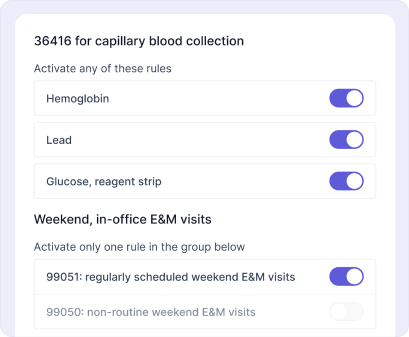
- Automated charge capture: Rules set the diagnoses, billing codes, units, and modifiers during the visit, including on well-sick visits, and update as orders change. Dozens of pediatric-specific rules cover vaccine administration, 99050 and 99051, G2211, and the preventive code by age with its matching Z code, and alerts flag likely underbilling. The provider makes the final coding call.
- AI eligibility checks: Develo reads the insurance card automatically and runs each eligibility response through AI-assisted interpretation, and check-in notifications point the front desk to outdated demographics or insurance. Develo also manages coordination of benefits so the right plan is billed first.
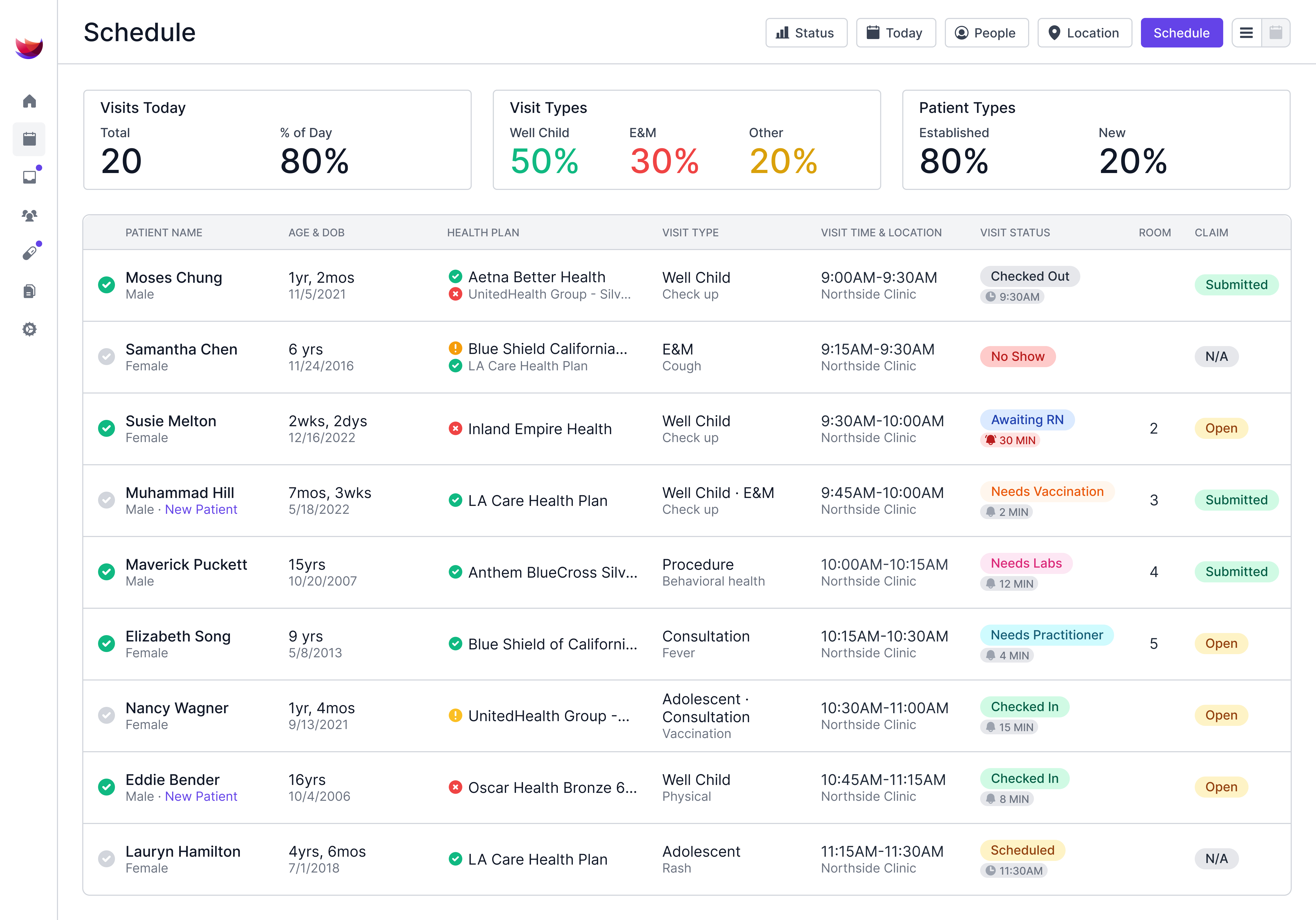
- Denial work queues: Denied claims land in work queues that show each claim's owner, status, deadline, and next action. Develo tracks appeal deadlines by payer and flags claims sitting unbilled or unpaid as each payer's filing deadline nears.
- Vaccine billing: Develo maps VFC eligibility from the child's primary health plan and flags any mismatch with the vaccine inventory chosen, so a VFC dose and a private-stock dose aren't billed the same way. Product and administration codes follow the child's age and visit type.
- Develo AI scribe: The scribe suggests diagnoses for the visit, checks that each one is billable, and suggests the E/M level from the visit transcript, so the codes on the claim trace back to what was documented. A clinician approves every section before it's added to the note.
- Claim scrubbing: Develo maintains its own library of claim scrubbing rules and rolls them out to practices. Each rule can fix the claim automatically or flag it into a specific work queue, and rules can be scoped to one payer, to Medicaid or commercial plans, or to a single provider.
- Payment posting: Payments from each ERA post automatically, so billers start from the claims that still need attention. With your fee schedule entered, Develo also flags payments that come in below your contracted rates.
- Develo doc intel: Inbound e-faxes, such as a payer's appeal decision, are tagged to the right patient chart and routed into task queues with priority and a full audit history.
- Develo reports Q&A: Denial reports break out denials by reason code and payer, and you can ask plain-English questions about denial trends and get answers as text or graphs.
- Optional billing services: Develo's embedded RCM services team is staffed by pediatric billing experts who are onshore and employed by Develo, not offshore or outsourced as billing is at most EMR vendors. They work denials and Level 1 appeals inside your Develo system, so a visit note never needs a records request, and they draw on Develo's internal analytics on pediatric coding and reimbursement trends. It's priced as a percentage of insurance collections.
Book a demo to see Develo's charge capture rules, claim checks, and billing services in a pediatric workflow.
Frequently Asked Questions
What Are the 5 Elements of Claim Denial Management?
The five elements of claim denial management match the five steps in this guide. They're grouped into three jobs: diagnose the denial (log it and find its cause), clear it (correct or appeal, then follow it to resolution), and address the root issue to help prevent future denials.
What Is RCM Denial Management?
RCM denial management is the part of RCM that works denied claims back to payment and traces each one to the upstream step that caused it, such as registration or coding.
What Are the 2 Types of Claim Denials?
Billers usually sort claim denials into two types, soft and hard, by whether the money is still recoverable. A soft denial clears once the claim or its documentation is fixed, while a hard denial ends in an appeal or a write-off.
What's the Difference Between a Claim Rejection and a Claim Denial?
The main difference between a claim rejection and a claim denial is timing: a rejection stops the claim before the payer adjudicates it, and a denial comes after the payer has processed it. Rejected claims go back out as new claims, while denials need a replacement claim, an appeal, or a documented write-off.
How Long Does It Take to Resolve a Denied Medical Claim?
A denied claim can clear in one payment cycle when a simple correction fixes it. Appeals take longer because each level has its own decision window, and Medicare's first level alone gives the contractor about 60 days.
Can Medical Claim Denials Be Automated?
Yes, but only partly: software can handle the repetitive steps, such as checking claims for errors before they go out, posting ERA payments, and routing denials to a work queue. A person still decides which denials to appeal, especially when the dispute involves medical necessity or coverage.