

A single pediatric visit can put a parent's insurance policy, an age-based visit code, and separate vaccine administration codes on one claim. Some children are also covered by two health plans at once. With that many moving parts, one wrong detail on a pediatric claim can send it back unpaid.
When a payer refuses a claim, it gives the reason with a claim adjustment reason code (CARC) on the electronic remittance advice (ERA), the payment report sent back after processing. Many CARCs point to triggers like a teen well child code (ages 12 to 17) billed after the patient has turned 18, or a newborn's claim sent before the baby was added to a parent's plan.
Below, the most common denials in medical billing are paired with their X12 reason codes and a specific fix to help keep them from recurring.
What Are the Most Common Denials in Medical Billing?
Medical billing denials most often stem from coverage problems, coding mismatches, and claim-handling errors such as duplicates or late filing. Payers name the cause of every denial with a standard reason code on the ERA.
Paperwork and coding problems also account for many claim refusals. In 2024 reporting from Massachusetts commercial insurers, 80% of denied medical and surgical claims for office visits and other clinician services were turned down for administrative reasons, such as incomplete claims, coding errors, and duplicates.
The type of insurance plan can change how often payers say no, as well. Across a national sample of 206 million clinician claims from 2019 (Weinreb and Landon, Health Affairs Scholar, 2026), Medicaid managed care plans (health plans that states contract to run Medicaid benefits) initially denied 15.1% of claim value, close to double the 7.8% for commercial plans.
How Do You Read a Denial Code?
A denial code has two main parts: a two-letter group code and a CARC number.
The letters show who is responsible for the unpaid amount, and the number gives the payer's reason for adjusting the claim. In CO-16, for example, CO is the group code and 16 is the CARC.
X12, the standards group behind electronic claim formats, publishes four group codes:
- CO (contractual obligation): Your contract or a regulation caused the adjustment, and your practice usually writes it off without billing the family.
- PR (patient responsibility): The family may owe the amount, as with a deductible or copay.
- PI (payer-initiated reduction): The payer chose to reduce the payment.
- OA (other adjustment): No other group code fits.
A remittance advice remark code (RARC) often comes with the CARC. It adds detail, such as the exact field the payer found missing. Check the RARC first, since it can point straight to the fix.
11 Common Denial Codes and How to Prevent Them
The 11 entries below run roughly in claim order, from coverage checks at scheduling to filing deadlines, and each one ends with a prevention step your team can apply before submission. Our definitions follow the official X12 reason code list.
1. CO-26 and CO-27: Coverage Not Active on the Date of Service
A CO-27 denial means the child's coverage ended before the visit, and CO-26 means the visit happened before coverage began.
Either code can also arrive with a PR prefix, since the group code reflects who the payer holds responsible.
A parent's job change can end a child's employer plan between visits. And Medicaid gaps tend to show up at renewal time, since children under 19 now keep 12 months of continuous eligibility between renewals.
Prevention: Make insurance verification part of scheduling and check-in for every visit.
2. CO-31 and CO-140: Patient Can't Be Matched to the Policy
Payers send CO-31 when they can't find the patient as a member, and CO-140 when the name and member ID on the claim don't match.
Possible causes include a nickname in place of a legal name, a hyphenated last name entered in different ways, or a claim for a newborn whose enrollment hasn't gone through yet.
Prevention: Match the child's legal name, date of birth, and member ID to the insurance card exactly.
3. CO-16: Claim Is Missing Information
Claims that lack information or contain a submission error come back as CO-16.
Payers must add at least one remark code that names the problem, such as a missing National Provider Identifier.
Prevention: Fix the field that the remark code names, and run claims through scrubber software, which checks for errors before claims go out.
4. CO-22: Another Payer Should Pay First
CO-22 tells you that another plan may need to pay first under coordination of benefits. A child on both parents' plans follows a set payment order, and that order can shift after a divorce or when either parent switches plans.
When a child has both Medicaid and a commercial plan, Medicaid generally pays last. Pediatric preventive visits can be an exception, since federal law typically has Medicaid pay those claims first and recover the money from the other plan later.
Prevention: Ask about other coverage at every check-in and record which plan pays first on the family account.
5. CO-197: Prior Authorization Is Missing
Missing approval shows up as CO-197, which means the service needed approval ahead of time, and the claim doesn't show it. Older denial lists still cite CO-15, but X12 retired it in 2018.
Each plan sets its own approval rules, so a service can need approval under one payer and not another.
Prevention: Keep a list of each payer's prior authorization rules by service, and add the authorization number to the claim.
6. CO-11: Diagnosis Doesn't Support the Procedure
A diagnosis that doesn't fit the billed CPT code leads to CO-11, and pairing a preventive visit code with an acute illness diagnosis is one way to trigger it.
In a 2024 study of adults with employer or Marketplace plans (Hoagland et al., JAMA Network Open), service-diagnosis pairs that weren't covered ranked among the most frequent preventive care denials.
Prevention: Link each claim line to its own diagnosis using current pediatric coding rules.
7. CO-6 and CO-9: Code Doesn't Match the Patient's Age
Age mismatches trigger CO-6 for a procedure code and CO-9 for a diagnosis code. Preventive visit codes follow set age bands, so a patient seen after they turned 18 needs 99395 in place of 99394.
The diagnosis changes, too, from a child health exam code (Z00.121 or Z00.129) to an adult exam code (Z00.00 or Z00.01).
Prevention: Pick the visit code from the patient's age on the date of service.
8. CO-4 and CO-97: Modifier and Bundling Problems
Payers return CO-4 when a modifier doesn't fit the procedure code.
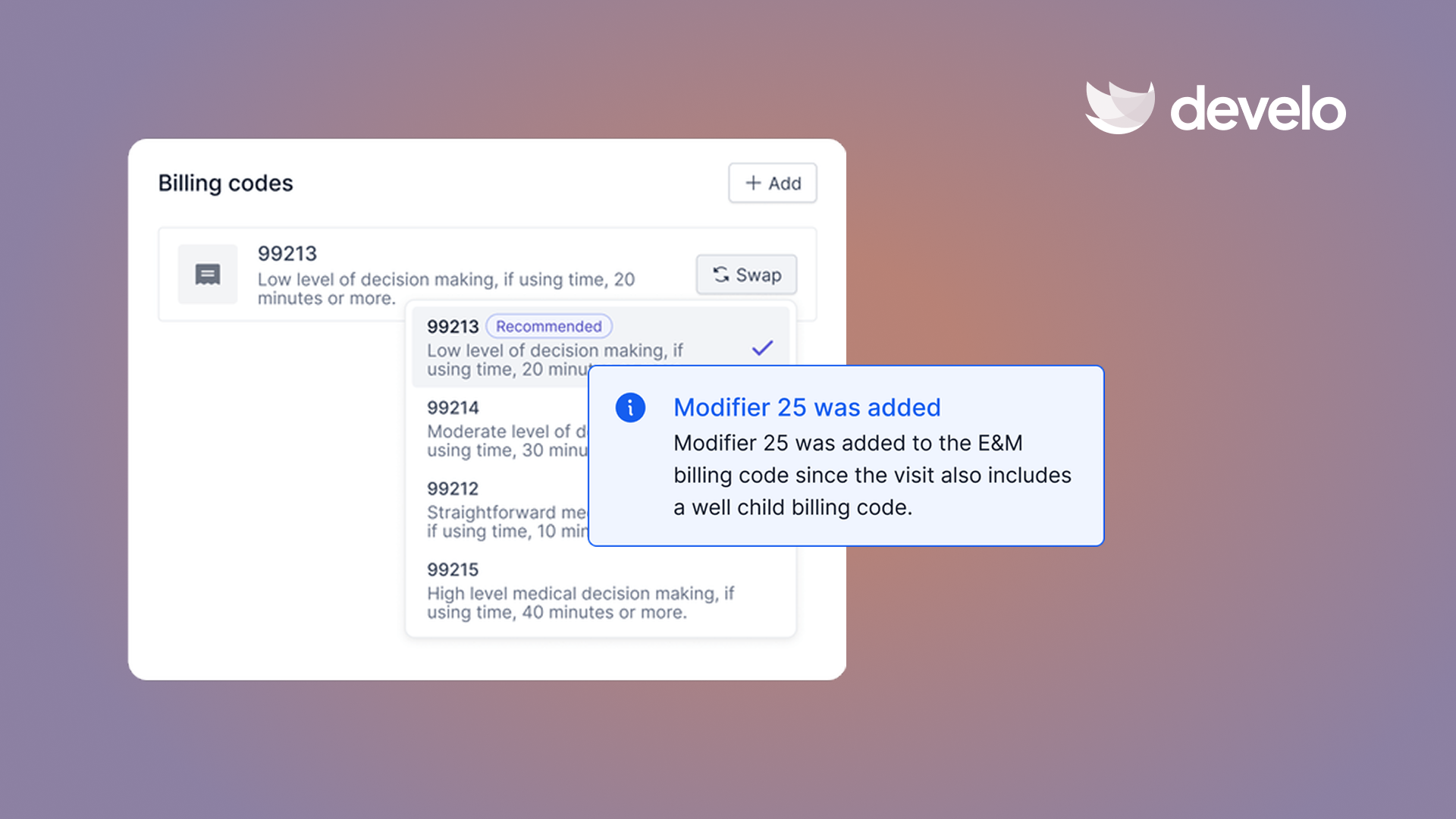
If a well child visit also treats a separate, significant problem, the problem-oriented E/M code needs modifier 25. Without it, a payer may treat the sick care as part of the well child visit and return CO-97, which means the payer counts the sick care as included in the well child visit's payment.
Prevention: Document the sick and well parts of the visit separately, then add modifier 25 to the E/M line.
9. OA-18: Exact Duplicate Claim
An exact duplicate claim comes back as OA-18. Some denial lists label it CO-18, but X12 directs payers to use it with the OA group.
Duplicates can come from resending a claim to check its status.
Prevention: Check claim status in your clearinghouse (the service that sends claims to payers) or the payer's portal before resending anything.
10. CO-29: Filing Deadline Has Passed
A claim that reaches a payer after its filing deadline comes back as CO-29. Filing windows differ by payer, and a claim first sent to the wrong payer can run out of time. Federal rules cap state Medicaid fee-for-service filing windows at 12 months from the date of service, and some states, Medicaid managed care plans, and commercial plans set shorter windows in the provider contract.
Prevention: Track each payer's filing window in your claims work queue.
11. CO-50, CO-96, and CO-167: Service or Diagnosis Not Covered
Coverage limits show up in three codes: CO-50 when the payer decides a service wasn't medically necessary, CO-96 for a charge the plan doesn't cover, and CO-167 when the plan doesn't cover the diagnosis.
A visit note that doesn't explain why a service was needed can also lead to a medical necessity denial.
Prevention: Check benefits for specific services ahead of time, record the medical reason for each service in the chart, and tell families before the visit when a service may not be covered.
Why Do Pediatric Practices Face Extra Denial Risk?
Large Medicaid caseloads, family-level coverage, and age-based codes that change at set birthdays add denial risk for pediatric practices.
In 2024, government health plans covered 34.2% of U.S. children under 19. In the same 2019 claims sample, once appeals were settled or skipped, Medicaid managed care plans still left 7.4% of claim value on clinician claims denied, compared with 4.2% for commercial plans.
Siblings can also share one policy, so a single lapsed plan can lead to denied claims for every child in a household.
Vaccines add a pediatric-only layer. VFC program providers can't charge families for vaccines given to eligible children, only for administering them, and billing rules for VFC doses vary by state Medicaid program. A VFC dose billed like private stock, or a private-stock dose given to a VFC-eligible child, can draw a denial and a program compliance problem at once.
A well-run pediatric revenue cycle should track guarantors (the adults responsible for the bill), custody, and coverage across the whole family.
Catch Denial Risks Earlier With Develo
Many of the most common denials in medical billing start with eligibility, data, or coding errors that software can spot before the claim gets sent.
Develo is the AI-native pediatric operating system built solely for independent pediatric practices, unifying charting, billing, practice management, and family engagement, so coverage, visits, and claims all communicate in one system.
Develo moves denial prevention to the front end and middle of the revenue cycle. Traditional billing leans on the back end, where a biller finds the lapsed plan or the missing modifier only after the denial arrives and then reworks the claim. That's like maintaining your car only after something breaks down.
Develo catches denial causes before and during the visit, checks each claim again before submission, and works the denials that still get through:
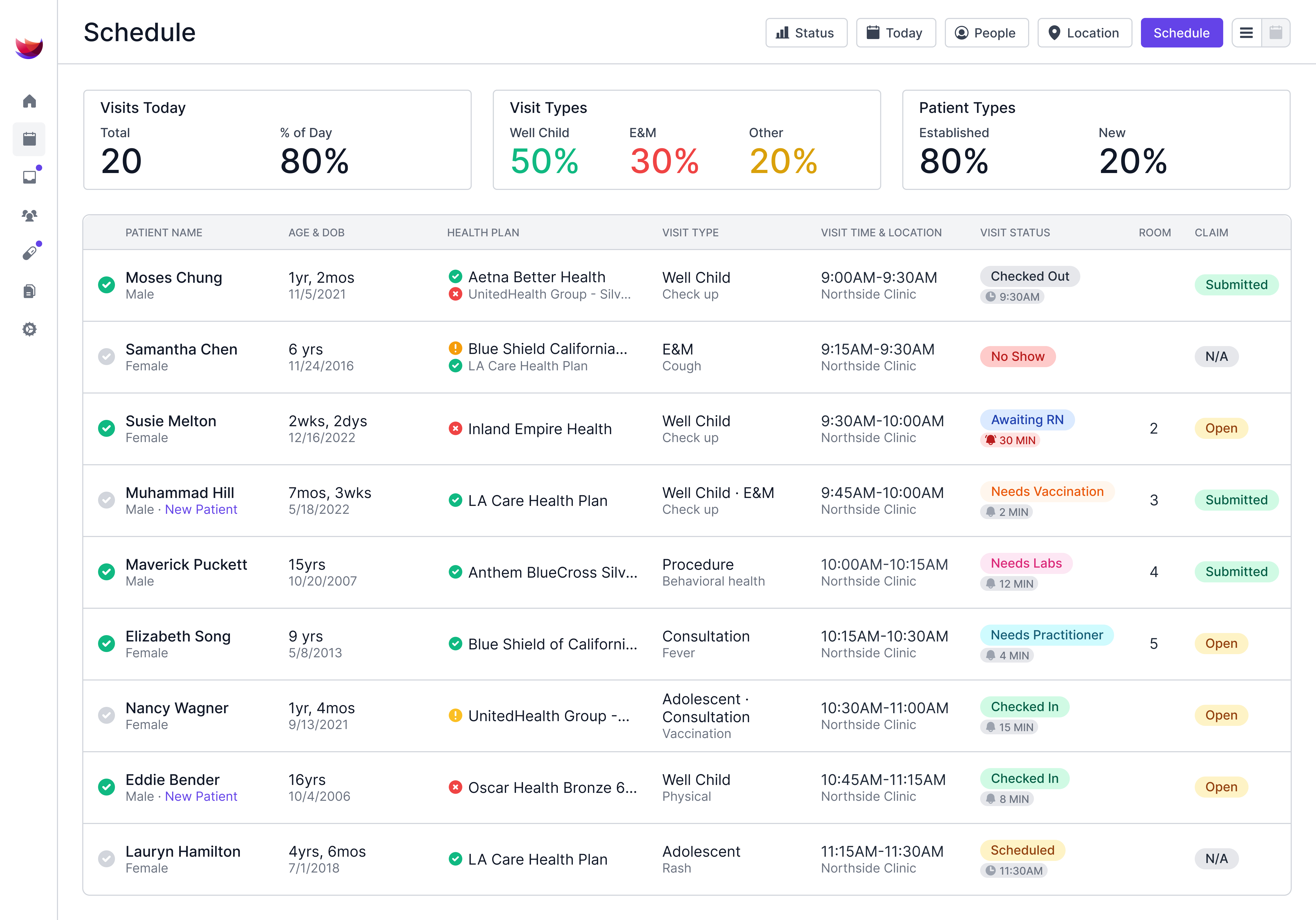
- AI eligibility checks read the insurance card automatically, run when a visit is booked and again at check-in, and interpret each payer response with AI, so the front desk sees a lapsed or changed plan before the visit instead of on a CO-27 denial.
- Check-in notifications point the front desk toward the family details that need a fresh look, such as outdated demographics.
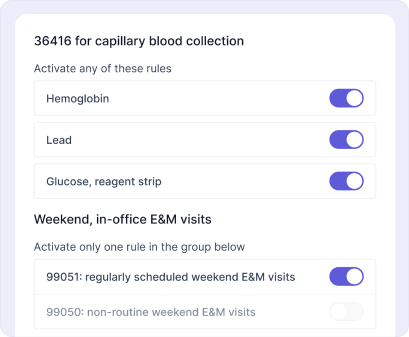
- Automated charge capture uses pediatric billing rules to fill in codes, units, and modifiers for each visit, including the preventive code for the child's age on the date of service and modifier 25 on a well-sick visit, while providers keep the final say on coding.
- Develo AI scribe suggests diagnoses for the visit, checks that each one is billable, and suggests the E/M level from the visit transcript, so each diagnosis on the claim traces back to what was documented.
- Pre-submission claim checks run each claim through rules that can be scoped to a payer, then either correct it automatically or send it to a work queue for review. Develo maintains that rule library and rolls out new rules to practices proactively.
- Claim tracking across plans and deadlines manages coordination of benefits so the right plan is billed first, ages each claim against its payer's filing window, and flags potential duplicates before a claim reaches the payer.
- ERA payments post automatically, and a prioritized denials work queue shows billers which denied claims need attention first.
- Family records track guardian and guarantor relationships for each child, so siblings on one parent's plan stay linked, while each child keeps separate claims.
- An optional embedded RCM services team works rejections, denials, and Level-1 appeals. Its pediatric billing experts are onshore and employed by Develo, not offshore or outsourced as billing is at most EMR vendors, and they draw on Develo's internal analytics on pediatric coding and reimbursement trends.
Book a demo to walk through how Develo flags coverage, coding, and family-record problems on your own pediatric claims.
Frequently Asked Questions
What's the Difference Between a Claim Denial and a Claim Rejection?
The difference between a claim denial and a claim rejection is whether the payer processed the claim: a denial was adjudicated and comes back on the ERA with a group code and CARC, while a rejection is turned back before processing, often at the clearinghouse, because of format or data errors. A fixed rejection goes out as a fresh claim, while a denial is worked from its reason code, either by correcting the claim or by appealing.
Is CO-45 a Denial?
No, CO-45 is a contractual adjustment for the part of your charge above the payer's fee schedule or contracted rate. The practice absorbs that difference, so follow up only when the allowed amount doesn't match your contract.
Can You Resubmit a Denied Claim?
Yes, you can resubmit a denied claim as a corrected claim when the denial came from a fixable error, such as a wrong modifier or a missing field. Send it with claim frequency code 7 (replacement of prior claim) and the original claim number so the payer doesn't treat it as a duplicate.
How Long Do You Have to Appeal a Denied Claim?
The time you have to appeal a denied claim depends on the payer, and each commercial plan or state Medicaid program sets its window in the provider contract or manual. Log the remittance date next to each denial code so your team can track every appeal deadline from the day the denial arrives.