

Payers don't need to spot a big mistake to deny a claim. A lapsed plan or misspelled subscriber name will do it, and so will a diagnosis code that doesn't support the billed service.
Errors like these can happen at check-in, in the visit note, or during claim prep. When a payer flags one, your team ends up doing the work twice: once to send the claim and again to fix, resubmit, or appeal it.
Building the right checks into each step, from verifying coverage at booking to tracing every denial back to its cause, can help your practice reduce claim denials and get more claims paid the first time they're sent.
How Can Your Practice Reduce Claim Denials?
Practices can reduce claim denials by catching errors before a claim goes to the payer. That work starts with coverage and patient details at the front desk and ends with code and payer-rule checks in the billing office.
Getting a claim right the first time protects the effort already spent on it. In a 2018 study at one academic health system (Tseng et al., JAMA), billing and insurance work for a single primary care visit took an estimated 13 minutes and cost $20.49, and a denial adds another round of that work on top.
That extra round doesn't always mean the money is lost. In a large 2019 claims sample, payers eventually paid out roughly half of the denied amount for physician services, though each of those payments took at least one resubmission (Weinreb and Landon, Health Affairs Scholar, 2026).
How much denials cost a practice also depends on who's paying. Physicians lose an estimated 18% of Medicaid revenue to billing problems, counting both the cost of fighting denials and the payments they never collect. For Medicare, that figure is 4.7%, and for commercial insurers, it's 2.4% (Dunn et al., Quarterly Journal of Economics, 2024).
That gap matters more in pediatrics than almost anywhere else. By age 18, 61% of US children have been enrolled in Medicaid or CHIP, and 42% have had a gap in coverage (Shen et al., JAMA, 2025), so pediatric panels carry more of the payer type with the highest denial rate and the most coverage churn.
7 Strategies to Reduce Claim Denials
Each strategy below targets one type of error, in the order that a claim moves through your practice.
1. Verify Insurance Coverage Before Every Visit
An eligibility check before each visit confirms whether the patient's plan is active and covers the service you expect to provide. Run it when the visit is booked, then again at check-in, because coverage can end between the two.
A full check should confirm active coverage on the date of service, network status, and benefits for the expected service. If a child has two plans, it should also show which plan pays first. For a child covered by both parents, most plans follow the birthday rule: the plan of the parent whose birthday comes first in the calendar year pays first, unless a court order assigns coverage to one parent. Good insurance verification can also show copays and deductibles, so the front desk can collect them before the visit.
Medicaid patients need a closer look. Disruptions in Medicaid coverage are common, so the plan on file from a child's last visit may no longer be active.
2. Collect Clean Patient Data at Check-In
At check-in, confirm that the patient's name, date of birth, and member ID match what the payer has on file, spelling included.
Sending intake forms ahead of the visit lets patients or caregivers update their own details at home, so staff only need to confirm what changed and scan both sides of any new insurance card. Ask about job changes, new plans, and custody updates, since each one can change who holds the policy or which plan pays first.
Getting the policyholder right takes extra care with children. When a child is covered as a dependent on a parent's commercial plan, the parent or guardian who holds the policy is the subscriber. Naming the child or the wrong parent as the subscriber can lead to a denial.
Newborns need their own check. A baby often arrives at the first visit before a member ID exists, sometimes before a legal name is on file. Bill under the parent's policy as the plan directs, and re-verify once the baby's own ID is issued. Most employer plans let parents add a newborn within 30 days with coverage back-dated to birth, and a baby born to a mother on Medicaid is automatically eligible for Medicaid for the first year.
3. Secure Prior Authorization Before the Service
Prior authorization is the advance approval some payers require for certain services. Requesting it at scheduling gives the payer time to respond before the patient arrives.
A repeatable prior authorization process starts with a list of the services your top payers need approval for, which might include imaging, certain medications, or therapy visits, depending on the payer. Check that list when each visit is booked. Once approval comes through, record the authorization number, approved dates, and approved units in the chart so the biller can add them to the claim.
Those approval limits need watching, too. A visit that falls outside the approved dates or goes past the approved units may still be denied, even with a valid authorization on file. Request an extension or a new authorization before the limit runs out.
4. Code From Complete Documentation
CPT codes describe the services a provider performs, and ICD-10-CM codes describe the patient's diseases and conditions. Pair each CPT code on the claim with the diagnosis code that explains the reason for the visit.
Before a note is signed, check it for weak spots like these:
- Missing modifiers on same-day services, such as modifier 25 when a provider treats a separate problem during a preventive visit
- Time-based codes billed without the total time recorded in the note
- Unspecified diagnosis codes when the note supports a more specific one
- Retired or replaced codes still sitting in your templates after a code set update
- Vaccine counseling codes 90460 and 90461 billed when no physician or other qualified health professional counseled the family, or for a patient 19 or older, where 90471–90474 apply instead
Review your most-billed CPT codes whenever a new code set takes effect. Share the current coding guidelines with providers so their notes and the codes on the claim line up.
5. Scrub Every Claim Before Submission
Run every claim through a claim scrubber, which checks it against coding rules and payer rules before it reaches the clearinghouse.
Depending on its rules, a scrubber can flag a procedure and diagnosis that don't match, conflicting modifiers, or two codes a payer pays as one bundled service. It can also catch a missing National Provider Identifier for the billing or rendering provider.
Repeat denials can become new scrubber rules. If one payer keeps denying a code that lacks a certain modifier, add a rule that flags that code on future claims. A shared list of payer-specific rules can help new billers learn each payer's habits faster.
6. File Claims Within Payer Deadlines
Track each payer's timely filing limit (the deadline for submitting a claim) and file well before it. A claim that arrives after the limit can be denied, however accurate it is.
Medicare's limit is one calendar year from the date of service, and a Medicare denial for late filing can't be appealed. State Medicaid programs can allow up to 12 months from the date of service, but many set shorter limits (New York Medicaid's is 90 days), and Medicaid managed care and commercial plans may be shorter still, so check each payer's contract or manual.
Send claims within a few days of the visit when you can, and set alerts for any claim that sits unbilled or unpaid as its deadline nears.
7. Track Every Denial Back to Its Cause
A denial log can show which step in your workflow keeps breaking. Record each denial with its payer, the reason code from the remittance (the payer's explanation of what it paid), and the step where the error started.
When one cause appears again and again, fix that part of the workflow. For example, if one payer sends back 20 eligibility denials in a month, start with your check-in process.
While you fix causes, work open denials by appeal deadline and dollar amount, so the claims closest to expiring get handled first.
Track these RCM KPIs each month to see whether your fixes are working:
- Initial denial rate: Denied claims divided by claims submitted
- Clean claim rate: The share of claims that go through on the first submission without corrections
- Days in A/R: The average number of days it takes to collect payment after a visit
Break each number out by payer and provider. If your fixes are working, the denial rate should fall over time while the clean claim rate climbs.
Catch Claim Errors Earlier With Develo
Running seven checks by hand takes staff time at every step, especially when scheduling, charting, and billing live in separate systems. Traditional RCM also leans on the back end, where billers find a lapsed plan or a missing code only after the claim is denied. That's like maintaining your car only after something breaks down. Develo moves that work to the front end and middle of the cycle, so most of the checks above happen before a claim is built.
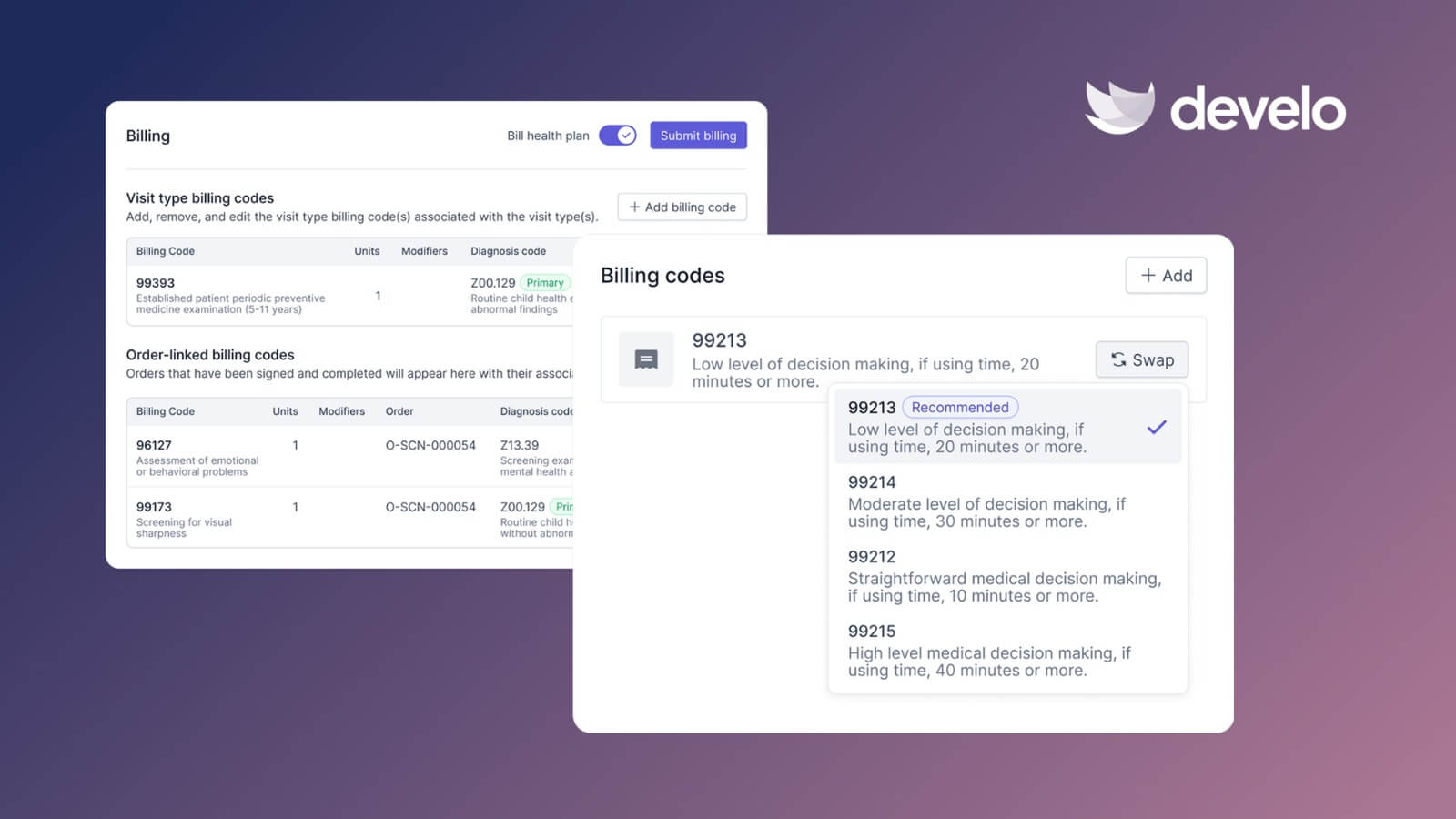
Coding before the claim is generated is Develo's specialty. Most EMRs automate charge capture only in part, with one visit-level code or a few codes pulled from orders, and most claim scrubbers start after the visit ends. Develo sets the diagnoses and billing codes during the visit, so the claim starts out right instead of getting fixed after a denial.
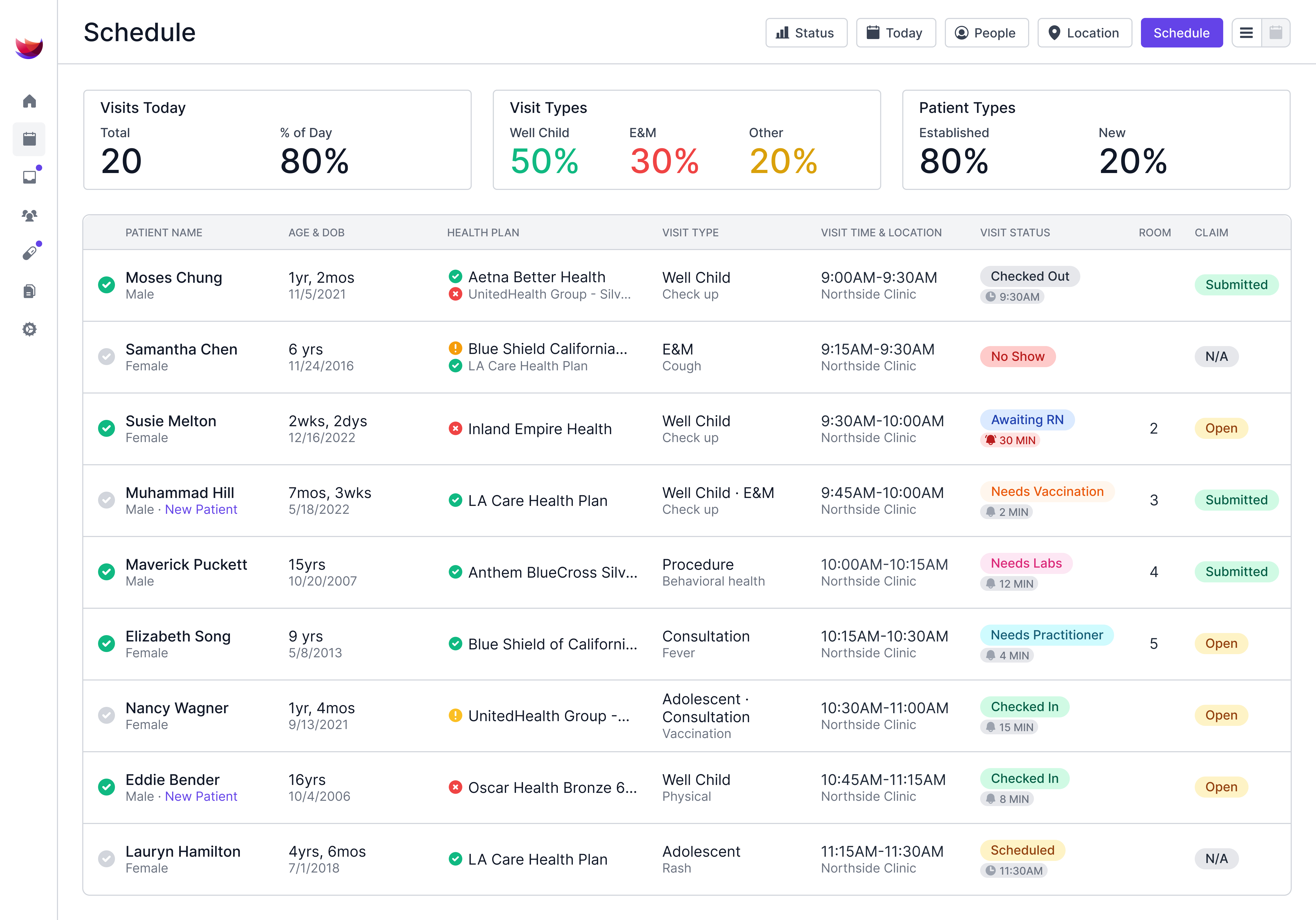
Develo is the AI-native operating system for pediatrics, unifying charting, billing, practice management, and family engagement in one platform built solely for independent pediatric practices. Your front desk, providers, and billers work in the same system, so the checks above happen in one place.
Tools that help pediatric practices reduce claim denials include:
- Digital intake on a smartphone, where caregivers confirm demographics and insurance changes with no app or login, feeding a family data model that links siblings, guardians, and guarantors
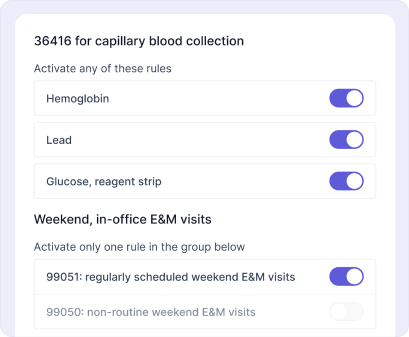
- Automated charge capture during the visit, before the claim is generated. Rules set the diagnoses, billing codes, units, and modifiers by visit type, including well-sick visits, and update as orders are added or changed. Dozens of pediatric-specific rules cover vaccine administration and refusal, after-hours codes 99050 and 99051, G2211, BMI, and counseling, so providers confirm the codes instead of building them
- A rules engine that scrubs every claim before submission and either fixes an issue automatically or routes it to a work queue, with rules scoped by payer, plan type, or provider and drawn from a library Develo maintains and updates
- Timely filing alerts that flag claims sitting unbilled or unpaid as each payer's filing deadline nears
- AI eligibility checks that read the insurance card automatically and run each eligibility response through AI-assisted interpretation, so the front desk sees what coverage means for the visit instead of decoding raw payer responses
- Develo AI scribe, which suggests diagnoses for the visit, checks that each one is billable, and suggests the E/M level from the visit transcript, so what gets billed traces back to what was documented
- Revenue cycle reporting on real-time data, including denials broken out by reason code and payer, with configurable dashboards for billers and practice leaders, data exports, and Develo reports Q&A for plain-English questions about your numbers
Practices that want more hands-on billing can add Develo's embedded RCM services team: pediatric billing experts who are onshore and employed by Develo, not offshore or outsourced as billing is at most EMR vendors. The team works denials and first-level appeals inside Develo, draws on Develo's internal analytics on pediatric coding and reimbursement trends, and is priced as a percentage of collections.
Book a demo to see how Develo helps your practice reduce claim denials at the source.
Frequently Asked Questions
What's a Good Claim Denial Rate?
A good claim denial rate depends on your payer mix, so compare your rate with benchmarks for each payer type. A 2026 study of 2019 clinician claims found initial denial rates of 7.8% for commercial plans, 10.5% for Medicare Advantage, and 15.1% for Medicaid managed care, measured in dollars rather than claim counts (Weinreb and Landon, Health Affairs Scholar).
What's the Difference Between a Rejected Claim and a Denied Claim?
The main difference between a rejected claim and a denied claim is that the payer never processed a rejected claim. Under Medicare's claims manual, a claim with incomplete or invalid information is returned as unprocessable with no appeal rights, so you fix and resubmit it. A denied claim was processed and refused payment, and you can appeal it. A claim scrubber catches many rejection triggers before submission.
How Does Automation Help Reduce Claim Denials?
Automation can help reduce claim denials by running the same eligibility, coding, and payer-rule checks on every claim without relying on staff memory. In one multisite radiation oncology practice, software that checked payer rules when orders were placed was linked to a 65% drop in prior authorization denials (Chen et al., JAMA Network Open, 2025).
How Long Do You Have to Appeal a Denied Claim?
The time you have to appeal a denied claim depends on the payer. Original Medicare, for example, gives you 120 days after you receive its initial decision, but other payers set different deadlines, so look up each plan's window as soon as a denial arrives.