

Getting paid for a pediatric visit depends on details lining up at the front desk, in the visit note, and on the claim itself. A misspelled patient name can leave a claim sitting unpaid, and a missing vaccine administration code can mean a service never gets billed at all. Correcting and resubmitting can hold up payment even longer.
Medicaid raises the stakes, because these claims are denied and reworked far more often than commercial ones.
Tracing a pediatric visit through the revenue cycle step by step can show you where your practice loses money and what to fix before the next bill goes out. The benchmarks and Medicaid figures below come from published research, so you can compare your own numbers against them.
What Is the Revenue Cycle in Healthcare?
The healthcare revenue cycle is every step a practice takes to get paid for care, from the moment a patient books a visit until the last balance is settled.
Revenue cycle management (RCM) is the day-to-day work of keeping billing and payments on track.
A 2024 review of RCM in Plastic and Reconstructive Surgery – Global Open found that better management shortens the wait between submitting a claim and getting paid and improves cash flow.
A simple way to picture the cycle is in three parts:
- Front end: Scheduling, registration, and eligibility checks before the visit
- Middle: Documentation, charge capture, and coding during and after the visit
- Back end: Claim submission, payment posting, denials, and patient collections
Many physicians have to pick up the skills behind all three parts on the job. Few are formally trained in RCM, the 2024 review notes, which can leave doctors spotting billing problems only after revenue is lost.
What Are the Main Stages of the Healthcare Revenue Cycle?
The healthcare revenue cycle splits into seven stages, and a claim doesn't reach the payer until the fourth.
Denied claims can loop back to earlier stages for fixes and resubmission, so one visit may go through parts of the cycle more than once.
Each stage below shows how it plays out in a pediatric practice.
1. Scheduling and Registration
Registration collects the child's legal name, date of birth, insurance details, and guarantor.
For a child, the guarantor is typically a parent or legal guardian. Custody arrangements can add a second policy and a second adult to the account. When both parents cover the child, most state insurance rules follow the birthday rule: the plan of the parent whose birthday falls earlier in the calendar year pays first, unless a court order assigns responsibility.
2. Insurance Eligibility Verification
Eligibility verification confirms that the child's coverage is active on the date of service. A verification check also shows copays and deductibles. If a service needs prior authorization from the payer, staff typically request it at this stage.
Coverage often shifts during childhood: a 2025 JAMA study estimated that 42% of U.S. children go without insurance at some point before age 18. Running insurance verification before every visit catches a lapsed or changed plan before the claim goes out. Medicaid and CHIP now guarantee children under 19 a full 12 months of continuous coverage, a federal requirement since January 1, 2024, so for children on Medicaid or CHIP, coverage is most at risk at the annual renewal rather than mid-year.
3. Charge Capture and Coding
Charge capture records every billable service from the visit, and coding turns those services into standard codes. CPT codes describe the services, and ICD-10-CM codes record the diagnosis or reason for the visit.
A single well child visit can carry a preventive visit code, screening codes, and at least two codes for each vaccine: one for the product and one or more for its administration, since a combination vaccine given with counseling adds a code for each additional component. Accurate pediatric coding depends on a visit note that supports every code on the claim.
4. Claim Scrubbing and Submission
Claim scrubbing checks each claim for errors before it reaches the payer. Some errors caught here might include a missing modifier (a short code that adds detail about how a service was done) or a code that the visit note doesn't support.
Clean claims can then go out electronically through a clearinghouse, which is usually faster than mailing paper claims.
5. Payment Posting
Payment posting records what each payer paid against what you billed. Payers send an electronic remittance advice (ERA) that lists payments and the reasons for any unpaid lines.
Comparing those amounts to your contracted rates can help you spot underpayments.
6. Denial Management
Denial management involves finding out why a claim was denied, fixing it, and resubmitting or appealing before the payer's filing deadline.
When one payer keeps denying the same code, the cause may sit in an earlier stage, such as registration or coding.
7. Patient Collections
Patient collections cover copays, deductibles, and any balance left after insurance pays. Children under 18 covered by Medicaid are generally exempt from copays and other cost sharing, so the family's share applies mainly to commercially insured patients.
Collecting the family's share often takes regular follow-ups, such as automated payment reminders sent by text or email.
What Makes the Revenue Cycle Different in Pediatrics?
The revenue cycle works differently in pediatrics because the insurance and the bill usually belong to a parent or guardian.
Public coverage also reaches most children at some point. That same JAMA study estimated that 61% of children are enrolled in Medicaid or CHIP by their 18th birthday.
Physicians lose an estimated 18% of Medicaid revenue once unpaid claims and the cost of contesting denials are counted, compared with 2.4% for commercial insurers. About 1 in 4 Medicaid claims have payment denied for at least one service, according to that study (Dunn et al., Quarterly Journal of Economics, 2024).
Pediatric billing also comes with a few rules of its own, including:
- Family accounts: One parent may be the guarantor for several siblings, so balances for more than one child can sit on the same account.
- Vaccine billing: Practices can't charge families for vaccines supplied by the Vaccines for Children (VFC) program, only an administration fee for each dose that's waived if a family can't afford it, so VFC vaccines are billed differently from privately bought ones.
- Newborn coverage: A baby born to a mother on Medicaid is deemed eligible for Medicaid until the first birthday, and families have 60 days after a birth to enroll a baby in Marketplace coverage, so a newborn is often seen before a member ID exists.
Each of these rules can trigger a denial, and these pediatric denial fixes walk through how to resolve the most common ones.
A shared pediatric billing cheat sheet gives staff one place to look up CPT, ICD-10, and vaccine codes.
What Does a Weak Revenue Cycle Cost Your Practice?
A weak revenue cycle can cost your practice staff time, delayed cash, and revenue that never arrives.
Billing work alone is expensive. A 2018 study of one large academic health system estimated that the billing and insurance work behind a single primary care visit took 13 minutes and cost $20.49. Billing costs came to an estimated 14.5% of professional revenue for those visits.
Uncollected money adds to that cost. The 2024 RCM review also estimates that providers fail to collect 2% to 5% of net patient revenue, partly because of inefficient processes and partly because disputing claims wears staff down.
Medicaid also pays less to begin with. In 2024, fee-for-service Medicaid paid about 69% of Medicare rates for office visits (Skopec et al., Health Affairs, 2025). Practices with many Medicaid patients can have less room to absorb those losses.
Which Revenue Cycle Metrics Should You Track?
Start with four revenue cycle metrics that show how clean your claims are, how often payers deny them, and how fast you collect.
Published benchmarks from that 2024 review give each metric a target:
- Clean claim rate: The share of claims that pass all billing edits with no manual fixes. Set a target of 95% or higher.
- Denial rate: The share of submitted claims that payers deny, which typically runs 5% to 10%, and lower is better.
- Days in A/R: The average number of days it takes to collect payment, with a target of 30 days or less.
- Net collection rate: The share of expected payments your practice collects. Have a target above 95%.
Reviewing these numbers every month and breaking them down by payer can show a problem with one Medicaid plan that a practice-wide average might hide. Benchmarks vary by source, and the HFMA figures in our guide to RCM KPIs for pediatric practices set a stricter bar: 98% or higher for clean claims and under 5% for denials. In Develo's experience, the highest-performing pediatric practices average 15 to 20 days in A/R.
Manage the Pediatric Revenue Cycle With Develo
Every stage of the revenue cycle in healthcare depends on keeping details consistent, so problems crop up when those details live in separate tools. Moving information between an intake app, an EMR, and a clearinghouse can give a name, policy number, or code more chances to be entered wrong.
Develo is the AI-native pediatric operating system built solely for independent pediatric practices, unifying charting, billing, practice management, and family engagement in one system.
Develo moves RCM work to the front end and middle of the cycle. Traditional RCM leans on the back end, where billers find a lapsed plan or a missing code after the claim is denied and then rework it. That's like maintaining your car only after something breaks down. Develo catches those problems earlier, with AI eligibility checks before the visit, a family data model that links siblings, guardians, and guarantors, automated charge capture during the visit, and an AI scribe that suggests billable diagnoses and the E/M billing code level.
Develo's RCM services team is staffed by onshore pediatric billing experts employed by Develo, while most EMR vendors offshore and outsource their billing. The team knows the system well and draws on Develo's internal analytics on pediatric coding and reimbursement trends.
At each stage, Develo gives pediatric teams tools to:
- Get family updates before the visit via digital intake, with caregivers confirming demographics and insurance on a smartphone (no app or login needed)
- Check eligibility with AI before the visit, as Develo reads the insurance card automatically and runs each eligibility response through AI-assisted interpretation, so the front desk sees what coverage means for the visit instead of decoding raw payer responses by hand
- Set billing codes at the point of care, with charge capture rules for codes, modifiers, and diagnoses by visit type, while the Develo AI scribe suggests billable diagnoses and an E/M level from the visit transcript, and the provider makes the final coding call
- Bill vaccine and administration codes by each child's age, Medicaid status, and visit type, with VFC eligibility matched automatically, all within a tightly connected immunization workflow from inventory management to billing, plus family portal access to immunization records
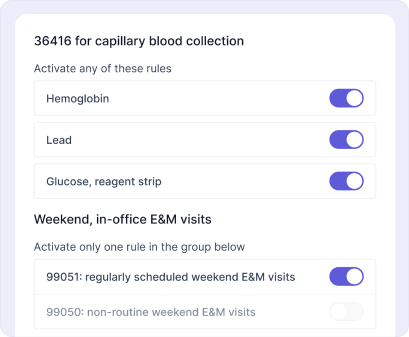
- Scrub claims before submission against a library of pediatric rules Develo maintains and rolls out, where each rule fixes the claim automatically or flags it to a work queue for billers to review
- Post payments automatically from each ERA, and with your fee schedule entered, flag payments that come in below your contracted rates
- Hand off claim follow-up if it's right for the practice, since Develo's optional embedded RCM services team works submissions, denials, and appeals in priority order, with a monthly health score on collections, denials, and A/R
- Collect family balances through the family portal, where caregivers can pay across siblings in one place, or through text reminders that carry a payment link
Develo uses comprehensive pricing built on a per-provider monthly fee, with no implementation fee and no separate clearinghouse charge. AI capabilities are priced separately.
Book a demo to see how Develo catches revenue cycle errors before they turn into denials.
Frequently Asked Questions
What's the Difference Between RCM and Medical Billing?
The main difference between RCM and medical billing is scope: medical billing is one part of RCM. Billing covers preparing claims, sending them to payers, and chasing unpaid amounts, while RCM also takes in the front-desk and coding work that happens before a claim exists.
How Long Does It Take Insurance to Pay a Medical Claim?
Insurance usually takes about 12 to 20 days to pay a medical claim for private plans and 18 to 30 days for Medicare, according to benchmarks in a 2024 RCM review. Billing errors, missing documentation, and paper submissions can each slow down the process.
Should a Small Pediatric Practice Outsource Billing or Keep It In-House?
Whether a small pediatric practice should outsource billing or keep it in-house depends on scale and economics as much as on skill. Most small practices don't have the claims volume to support a full-time biller, so in-house billing usually falls to a fractional role, such as a practice manager who also bills. Experienced pediatric billers are hard to hire, which is why outsourcing often makes more sense at that size. A vendor's estimate of your lost revenue can show whether its projected gains would exceed its fees, and Develo's onshore pediatric RCM team is priced as a percentage of collections, so it earns only when the practice does.