

The 99394 CPT code is one of the most frequently billed codes in pediatric practices and one of the easiest to get wrong.
This code covers preventive wellness visits for established patients between 12 and 17 years old. It sounds straightforward. But age-band errors, modifier confusion, and documentation gaps can lead to denials, delayed payment, and extra administrative work.
Below is a full breakdown of what the 99394 CPT code covers, how it fits within the broader preventive medicine code series, and how to bill it correctly on the first pass.
What Does the 99394 CPT Code Mean?
The 99394 CPT code describes a periodic comprehensive preventive medicine visit for an established patient aged 12 through 17 years.
The American Medical Association (AMA) maintains this code as part of a broader preventative services category.
In plain terms, it's commonly used for annual well child visits for teens who've already been seen by your practice within the past three years.
A visit billed under 99394 typically includes:
- A complete review of medical, family, and social history
- An age-appropriate physical exam covering growth, development, and puberty milestones
- Anticipatory guidance on topics like nutrition, safety, mental health, and substance use
- Risk factor screening for behavioral, emotional, and sexual health concerns
- Review of immunization status and ordering of any necessary labs or diagnostic tests
- Age and context-specific adolescent confidential discussions
The key distinction here: The 99394 CPT code is preventive only. If a provider addresses a specific complaint or manages a chronic condition during the same visit, that work may be reported as a separate E/M billed service when it is significant and separately identifiable.
Where 99394 Fits in the Preventive Medicine Code Series
The 99394 CPT code doesn't exist in isolation. It's part of a seven-code series (99391 through 99397) built for established patients returning for routine preventive care. Each code maps to a specific age range.
Here's the full breakdown:
Pediatric practices primarily use 99391 through 99394 for their patient population. If your practice sees patients into young adulthood, 99395 may apply too.
There's also a parallel series for new patients (99381 through 99387) that mirrors these age ranges. The 99394 CPT code equivalent for a new adolescent patient is 99384.
The distinction between new and established patients follows the three-year rule.
Under CPT guidance, a patient is generally considered established if they have received professional services from the same physician or another physician of the same specialty within the same group practice within the previous three years.
What Happens During a 99394 Visit?
A well child visit billed under the 99394 CPT code covers more than a height-and-weight check. The AAP's Bright Futures guidelines outline the clinical expectations for adolescent preventive visits.
They include:
- History review: The provider documents an updated medical, family, and social history. For teens, this includes screening questions about school performance, peer relationships, and risk behaviors.
- Physical examination: A full head-to-toe exam appropriate for the patient's developmental stage. This includes Tanner staging for puberty assessment, scoliosis screening, and blood pressure checks.
- Developmental and behavioral screening: Adolescent visits often include standardized screeners like the PHQ-A (depression), CRAFFT (substance use), or other validated tools for mental and behavioral health.
- Anticipatory guidance: Counseling on nutrition, physical activity, sleep hygiene, safe driving, sexual health, and internet safety. This is where the provider helps teens build habits that carry into adulthood.
- Immunization review: The 12 through 17 age range commonly includes review of vaccines such as HPV, meningococcal, Tdap, annual influenza, and any catch-up immunizations recommended under the current AAP child and adolescent immunization schedule.
- Lab and diagnostic orders: Vision screening, hearing checks, and lab work (lipid panels, STI screening for older teens) may be ordered. These are also billed with their own CPT codes.
New Patient vs. Established Patient: 99384 vs. 99394
One of the most common billing errors in pediatric practices is confusing new and established patient codes.
The 99394 CPT code is for established patients only. Its new-patient counterpart is 99384.
Here's when each applies:
- Use 99384 when an adolescent (12 through 17) has not been seen by any provider in your group, within the same specialty, in the past three years.
- Use 99394 when the adolescent has been seen by your practice within that window.
The three-year rule is where mistakes happen. A teenager who transferred to your practice two years ago and had a well child visit? That's 99394. A 14-year-old who hasn't been seen since they were 10 (over three years ago)? That's 99384, even though they're "in the system."
New patient preventive codes are often reimbursed at higher rates than the corresponding established patient preventive codes, depending on the payer and fee schedule.
Billing 99394 when 99384 is appropriate means you're leaving money on the table. Billing 99384 when 99394 is correct triggers a denial.
Front-desk teams and scheduling templates need to flag this during check-in, not after the claim is submitted.
Billing 99394 With a Problem-Oriented E/M Code
When a provider addresses a separately identifiable problem during a preventive visit, the practice may bill the preventive service code 99394 and a problem-oriented E/M code such as 99213 or 99214.
In that situation, append modifier 25 to the problem-oriented E/M code, not to 99394, to show that the E/M service was significant and separately identifiable from the preventive visit.
Here's what needs to be true:
- The problem required its own history, exam, and/or medical decision-making beyond the preventive service
- The documentation supports both encounters in the same note
- The problem is linked to a separate diagnosis code (not the Z00.121 or Z00.129 used for the wellness visit)
A common mistake is appending modifier 25 without adequate documentation. Payers audit this. If the note reads like a single encounter with a tacked-on problem, the E/M code gets denied.
Vaccine administration codes are billed separately from 99394. Modifier 25 may still be required when immunization administration is reported on the same date as the preventive visit, so practices should follow current payer policy and pediatric coding guidance.
5 Common Coding Mistakes With the 99394 CPT Code
Even experienced billers trip up on preventive medicine codes.
Here are the numbered mistakes that hit pediatric practices hardest:
- Wrong age band: A patient turns 18 between scheduling and the visit date. The visit now falls under 99395, not 99394. Age is determined on the date of service, not the date of scheduling or the date of claims submission.
- New vs. established confusion: Front-desk staff mark a returning patient as "new" because they switched providers within the group. Unless they were unseen for three-plus years, the 99394 CPT code still applies.
- Missing the preventive intent: Documentation must reflect a wellness-focused encounter. If the note reads like a problem-oriented visit, the payer will deny the preventive code, even if the provider intended it as a check-up.
- Forgetting ICD-10 linkage: The 99394 CPT code pairs with specific diagnosis codes. Z00.121 (routine child health exam with abnormal findings) or Z00.129 (without abnormal findings) are the standard choices. Using the wrong diagnosis code will trigger a mismatch denial.
- Modifier 25 misuse: Modifier 25 belongs on the separately reported problem-oriented E/M code, not on 99394. Use it only when documentation supports a significant, separately identifiable E/M service beyond the preventive visit.
How the 99394 CPT Code Relates to Well Child Visit Schedules
The American Academy of Pediatrics’ Bright Futures Periodicity Schedule outlines recommended preventive care screenings and assessments at well child visits through adolescence.
In practice, that means many adolescent patients are seen annually for preventive care during the 12 to 17-year age range. That can represent up to six preventive visits billed under 99394 before a patient ages into the 99395 bracket.
For pediatric practices, this makes the 99394 CPT code one of the highest-volume preventive codes in the office. When you multiply that across your adolescent panel, even small billing errors compound fast.
Under the Affordable Care Act (ACA), private, non-grandfathered health plans must cover recommended pediatric preventive services without patient cost-sharing when those services are provided in network (unless the plan is exempt for religious or moral objections).
For a straightforward preventive visit, families often will not owe a copay or coinsurance, although cost-sharing may apply if a separately billable problem-oriented service is provided during the same encounter.
But if a problem-oriented E/M code is added, that portion may trigger cost-sharing. This is a detail worth communicating to families at check-in.
Tracking which patients are overdue for their annual preventive visit is also an opportunity to improve revenue and care quality. A pediatric practice with strong recall workflows can improve their well child visit rates and keep the 99394 CPT code volume steady throughout the year.
Documentation Requirements for the 99394 CPT Code
Clean claims start with clean documentation. For the 99394 CPT code, the note needs to reflect all components of a preventive visit, even if the provider handles them quickly.
Required elements include:
- Comprehensive history: Updated medical, family, and social history relevant to the patient's age
- Comprehensive exam: Full physical examination appropriate for an adolescent
- Anticipatory guidance: Documented counseling on age-relevant topics (nutrition, safety, mental health, sexual health)
- Risk factor assessment: Screening for depression, substance use, or other behavioral health concerns
- Immunization review: Current vaccine status and any administered or recommended vaccines
- Lab/diagnostic orders: Any screening tests ordered or reviewed
Templated notes help here, as long as the template is specific to the 99394 age group and not a generic wellness template repurposed across all ages. A 14-year-old's preventive visit note should look different from a 4-year-old's.
Practices using a pediatric-specific EMR with built-in age-appropriate templates and clinical screeners spend less time documenting and produce stronger billing notes.
Tips for Getting the 99394 CPT Code Right Every Time
- Verify patient age at check-in: Don't rely on the schedule. Confirm the date of birth and match it to the correct code on the date of service.
- Use the right ICD-10 codes: Z00.121 for visits with abnormal findings. Z00.129 for visits without. Match the documentation rather than defaulting to one or the other.
- Separate preventive and problem work clearly: If you're adding an E/M code with modifier 25, the note must clearly distinguish which portion was preventive and which addressed a specific complaint.
- Automate what you can: Charge capture automation flags the correct code based on patient age and visit type, reducing manual errors. This is where a purpose-built pediatric platform pays off.
Age-based coding rules run in the background instead of relying on your biller's memory.
- Train front-desk staff on the three-year rule: New vs. established errors start at scheduling. A quick training session saves months of rework, especially if paired with system automation to identify new vs. established patient status.
- Audit quarterly: Pull a report on 99394 CPT code claims. Look for denial patterns, modifier 25 usage rates, and age-band mismatches. Small corrections now prevent large revenue leaks later.
Bill the 99394 CPT Code Accurately With a Platform Built for Pediatrics
Getting the 99394 CPT code right depends on the systems behind your billing workflow, not your biller's ability to memorize age bands.
Develo is the only full-stack pediatrics operating system built from day one for the way pediatric practices run. Instead of retrofitting adult-focused software, Develo connects clinical documentation, charge capture, and claims submission in a single platform designed around pediatric workflows.
Here's how Develo helps practices handle preventive visit billing like the 99394 CPT code:
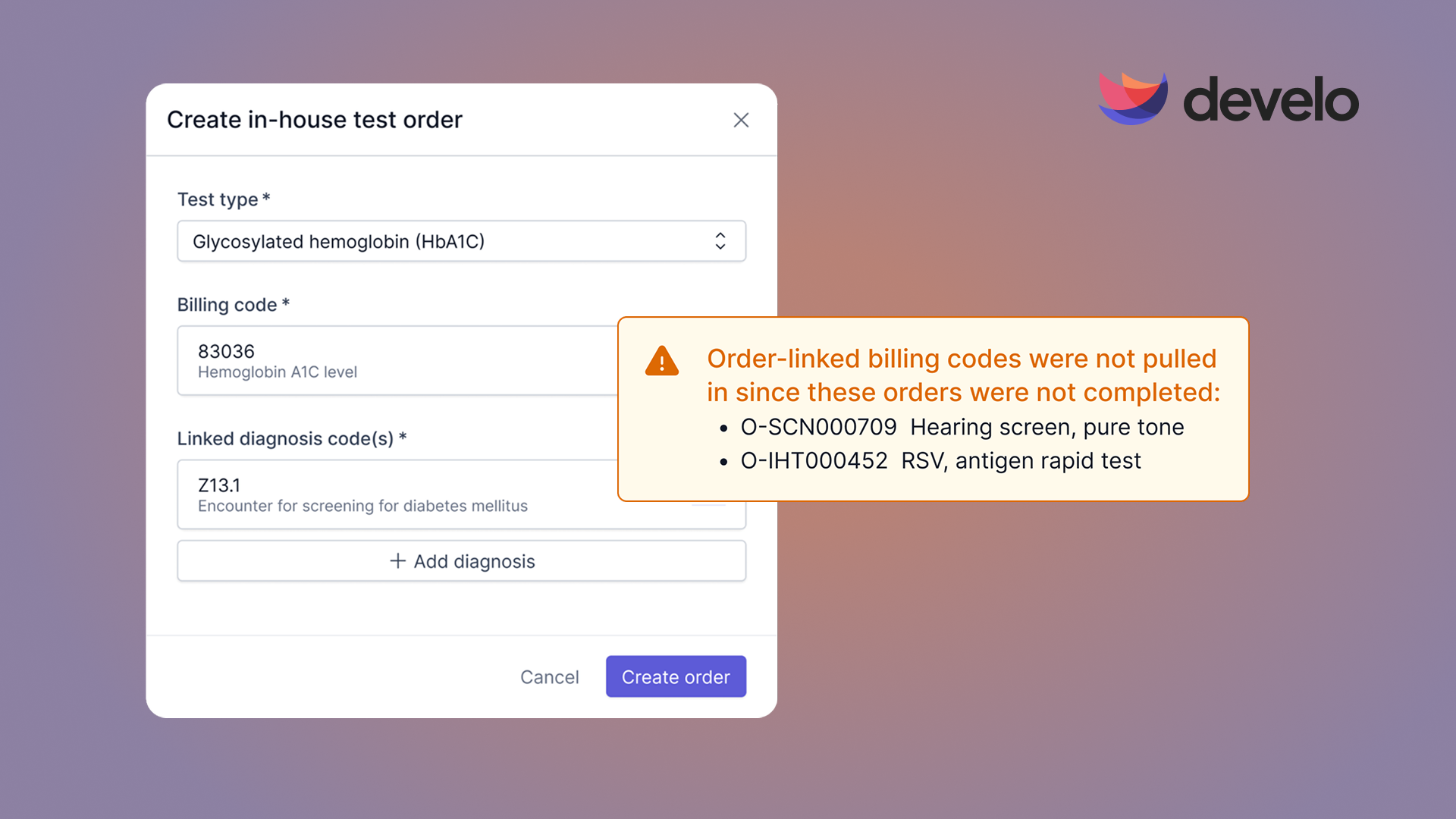
- Automated charge capture automatically applies the correct visit billing code based on patient age, visit type, and new vs. established patient status, thereby reducing both age-band and new vs. established errors
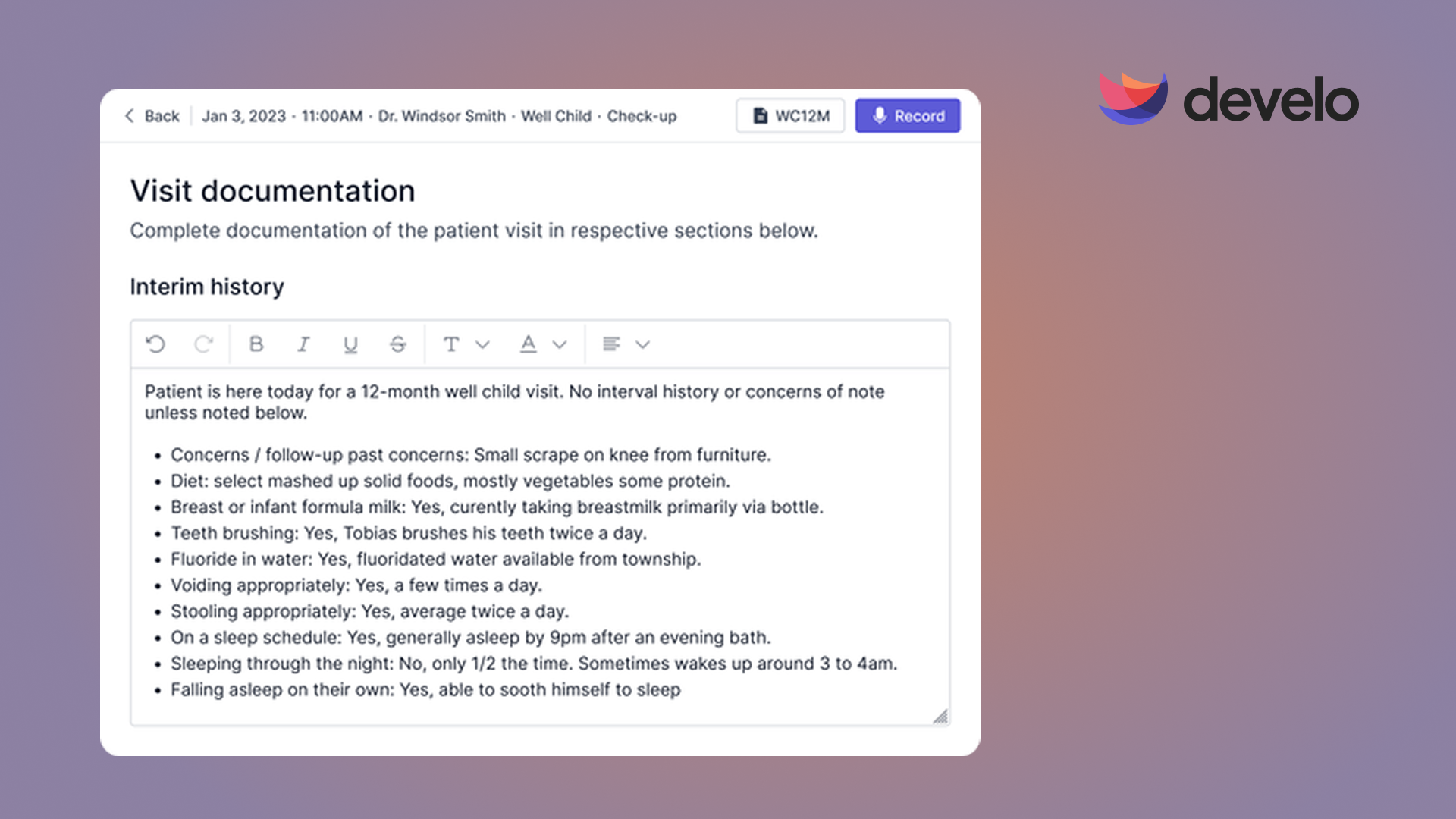
- Pediatric-specific visit templates for each age group (including adolescent well child visits) guide providers through required documentation elements as well as commonly placed orders to ensure the visit note supports the claim on the first pass
- Automated vaccine administration rules add the right admin codes based on the patient's age and health plan type, thereby removing the need for manual coding
- Real-time eligibility checks flag insurance issues before the visit starts, cutting down on preventable denials
- Claims pre-submission checks catch coding mismatches, missing modifiers, and diagnosis-linkage gaps before claims leave your office
Your billers shouldn't need to second-guess whether a 16-year-old's well child visit maps to 99394 or 99395. The software should handle it.
Book a free demo and see how Develo takes the guesswork out of pediatric billing, from preventive visit coding to final claim submission.
Frequently Asked Questions
1. What Age Range Does the 99394 CPT Code Cover?
The 99394 CPT code covers established patients aged 12 through 17 years. Age is determined on the date of service, not the date of scheduling or the patient's next birthday.
2. What Is the Difference Between 99394 and 99384?
The difference is whether the patient is new or established. 99394 is for established patients. 99384 is for new patients in the same age group (12-17). The distinction follows the three-year rule. If the patient hasn't been seen by any provider in your group within three years, use 99384.
3. Can You Bill 99394 and an E/M Code on the Same Day?
Yes, if the provider addresses a separately identifiable problem during the preventive visit, you can bill the 99394 CPT code alongside a problem-oriented E/M code (like 99213 or 99214) with modifier 25 on the E/M code. Documentation must support both services.
4. How Much Does the 99394 CPT Code Reimburse?
Reimbursement varies by payer, contract terms, geographic location, and plan design. For the most reliable estimate of payment, practices should refer to their payer contracts and fee schedules rather than generalized benchmarks.
5. Does the 99394 CPT Code Include Vaccine Administration?
No, the 99394 CPT code covers the preventive visit itself. Vaccine administration is billed separately using codes like 90460, 90461, 90471, or 90472. The vaccine product is also billed with its own code (for example, 90651 for HPV).
.png)

.avif)