
.avif)
You know what a normal heart rate looks like in a 3-month-old versus a 12-year-old. But your patients' parents don't. Most after-hours calls come from the gap between their Google search and your clinical judgment.
This article is a quick-reference resource your team can use to stay aligned on current ranges, spot documentation gaps, and give families the context they need to stop second-guessing normal readings.
What Are Pediatric Vital Signs?
Pediatric vital signs are four core measurements: heart rate, respiratory rate, blood pressure, and body temperature. Many practices also track oxygen saturation (SpO2) as a fifth vital sign, particularly for respiratory complaints.
The clinical challenge isn't knowing what these numbers mean. It's making sure they're captured consistently across age groups, documented accurately, and trended over time so that subtle shifts don't slip through during a packed schedule.
The AAP periodicity schedule says that vital signs should be assessed at every well child visit from the first week of life through adolescence. That's a lot of data points across many patients, and how your EMR handles them matters.
Normal Pediatric Vital Signs Chart
Here's a quick-reference table aligned with Pediatric Advanced Life Support (PALS) guidelines and Cleveland Clinic reference data. Print it for your MA station or embed it in your visit templates.
Normal body temperature across all ages: 98.6°F (37°C), with readings between 97 and 100.3°F (38°C) still considered within range.
Normal oxygen saturation (SpO2): 95-100% is typically considered normal for most children, with 95% as a true clinical floor. Some suggest a better range is 97-100% for healthy children at sea level.
Normal Heart Rate in Children by Age
Heart rate is the vital sign most likely to trigger a parent phone call. A caregiver who sees 150 bpm on a home pulse oximeter doesn't know their 4-month-old is completely fine. They just see a number that would be alarming in an adult.
The ranges themselves are straightforward:
- Newborns (0-3 months): 110-160 bpm
- Infants (3-12 months): 90-150 bpm
- Toddlers (1-3 years): 80-125 bpm
- School-age (6-12 years): 60-100 bpm
- Teens (12-18 years): 60-100 bpm (athletes may rest at the lower end)
What to Tell Parents About Heart Rate
The question isn't whether you know what affects heart rate. It's whether your anticipatory guidance gives parents a useful mental framework for when they're home at 10 PM watching their child's chest rise and fall.
Name the common culprits explicitly during visits:
- 🤒 Fever or illness
- 😰 Anxiety or stress (including white coat effect)
- 💧 Dehydration
- 🏃 Recent physical activity
Talking point for families: "If your child's heart rate seems high but they were just running, crying, or have a fever, that's expected. Call us if it stays elevated while your child is resting and calm, or if you can't count individual beats."
Normal Respiratory Rate in Children by Age
Respiratory rate is arguably the most underappreciated vital sign in a busy clinic. It's easy to eyeball rather than count, and that shortcut can mean early respiratory distress gets missed, especially in infants.
- Newborns (0-3 months): 30-60 breaths/min. Periodic breathing (short pauses <20 seconds followed by faster breathing without any cyanosis color change) is normal and a common source of parental anxiety and is worth addressing proactively at the newborn visit.
- Infants (3-12 months): 25-45 breaths/min
- Toddlers (1-3 years): 20-30 breaths/min
- School-age (6-12 years): 14-22 breaths/min
- Teens (12-18 years): 12-18 breaths/min
Red Flags to Teach Your Triage Staff
These signs point to respiratory distress regardless of what the number says, and your front-desk and nursing staff should be trained to recognize them:
- 👃 Nostril flaring with each breath
- 🫁 Retractions (ribs pulling inward) during breathing
- 😮💨 Grunting sounds during exhales
- 😴 A sick child whose breathing is slowing down (can indicate tiring out)
Clinical tip: Teaching parents to look for retractions and nasal flaring, not just count breaths, gives them a far more useful tool for triaging at home. Consider adding this to your newborn and infant visit handouts.
Normal Blood Pressure in Children by Age
Blood pressure is the vital sign that increases with age rather than decreases, making it the one most likely to confuse parents who look up "normal blood pressure" and find adult ranges.
The AAP recommends routine blood pressure screening starting at age 3 during well child visits. Before that, it was only indicated for children with specific risk factors.
Trending Blood Pressure Efficiently
A single elevated reading doesn't tell you much. Stress, anxiety, and activity right before a reading can all cause a temporarily higher number. But it can mean a lot to a worried parent who gets a copy of the visit summary.
Sustained high blood pressure is rare in children, but when it does present, kidney disease is a common underlying cause.
Workflow consideration: If your EMR doesn't automatically flag blood pressure readings against age- and height-adjusted percentiles, your team is either doing that math manually or not at all.
Pediatric-specific systems handle this natively, allowing your providers to focus on clinical decision-making rather than on complex calculations.
Normal Body Temperature in Children
Normal body temperature for any age: Falls in a range of 97 to 100.3°F depending on measurement site (rectal/oral/axillary/temporal), with fever defined as ≥100.4°F (38°C).
Temperature is the vital sign parents are most likely to measure at home and misinterpret. Getting your anticipatory guidance right here directly reduces unnecessary ER visits and after-hours calls.
Common Parent Counseling Scenarios
- "My baby feels warm." Reinforce at every newborn visit: Infants under 3 months with any fever at or above 100.4°F should call immediately and plan for an in-person evaluation. Parents often underestimate how differently neonates handle infection.
- "The thermometer says 104." Above 104°F (40°C), or any fever with lethargy, poor feeding, or signs of dehydration, parents should call. But many panic at 101°F. Normalizing fever as the body's response to infection, not a disease itself, reduces unnecessary visits.
- "The reading seems really low." A temperature below 95°F (35°C) can signal serious infection in infants, though for neonates and young infants, the sepsis-workup threshold is typically <36.0°C (96.8°F). Worth verifying with a second reading, but if it holds, it needs evaluation.
Best Thermometer Types by Age (For Parent Handouts)
- 👶 Under 3 months: Rectal thermometers give the most accurate reading.
- 🧒 3 months to 3 years: Rectal or temporal artery (forehead) thermometers work well.
- 🧑 Over 3 years: Oral, temporal artery, or tympanic (ear) thermometers are all reliable.
Oxygen Saturation (SpO2) in Children
Normal SpO2 for children: 95-100%. Readings consistently below 95% may warrant closer monitoring.
Asthma flare-ups, pneumonia, bronchiolitis, and respiratory infections are the most common causes of low readings in pediatric patients.
For parents with home pulse oximeters: Cold fingers, dark nail polish, and movement can all produce inaccurate readings.
If the number looks low but the child is acting normally, advise repositioning the sensor and retrying before calling. This one piece of guidance can cut down significantly on unnecessary triage calls.
How Pediatricians Track Vital Signs Across Visits
The AAP's Bright Futures guidelines recommend well child visits at: first week of life, 1 month, 2 months, 4 months, 6 months, 9 months, 12 months, 15 months, 18 months, 24 months, 30 months, and then each year from ages 3 through 21.
At each visit, the care team typically measures:
- 📏 Height, weight, and head circumference (plotted on growth charts)
- 💓 Heart rate and respiratory rate
- 🩸 Blood pressure (starting at age 3)
- 🌡️ Temperature
- 📋 Developmental milestones and clinical screeners (like the ASQ-3)
That's potentially dozens of data points per patient per year, multiplied across your entire panel. For independent pediatric practices, accurately tracking normal pediatric vital signs across hundreds of patients requires clinical workflows designed specifically for pediatric care.
When your system auto-plots vitals against age-appropriate ranges and flags outliers, your providers spend less time on data entry and more time on the patient in front of them.
When to Tell Parents to Call
Part of running an efficient practice involves giving families clear, memorable guidance on when a call is warranted, so your triage line isn't flooded with questions that could've been answered at the last visit.
These situations warrant a call:
- 🚨 Temperature exceeds 104°F (40°C)
- 👶 An infant under 3 months has any fever at or above 100.4°F
- 😤 The child is breathing rapidly while resting, or breathing looks labored
- 💓 Heart rate stays elevated without an obvious cause
- 📉 SpO2 drops below 95% on a pulse oximeter
- 😞 The child seems unusually lethargic, floppy, or unresponsive
The framing that works best with families: Vital signs outside normal ranges paired with a child who looks sick are more concerning than a slightly off reading in a child who's running around and acting fine.
Teaching parents to assess the whole child, not just a number, is one of the highest-value things you can do during a well visit.
Track Normal Pediatric Vital Signs With a System Built for Pediatrics
If your practice is looking for ways to improve the patient experience and run smoother clinical workflows, the right technology makes a measurable difference.
Develo is a modern, web-based pediatric operating system built from the ground up for independent pediatric practices.
It replaces the patchwork of largely adult-oriented tools that slow your team down with one platform that extends beyond EMR functionality and is designed around how pediatric care works.
Here's what Develo helps your practice do:
- Document visits faster with pediatric-specific templates and macro phrases built for well child visits, sick visits, and everything in between
- Track growth and vital signs using built-in pediatric growth charts that plot data automatically across visits
- Run age-appropriate clinical screeners (M-CHAT, PHQ-A, and more) digitally, with no paper forms and no manual scoring
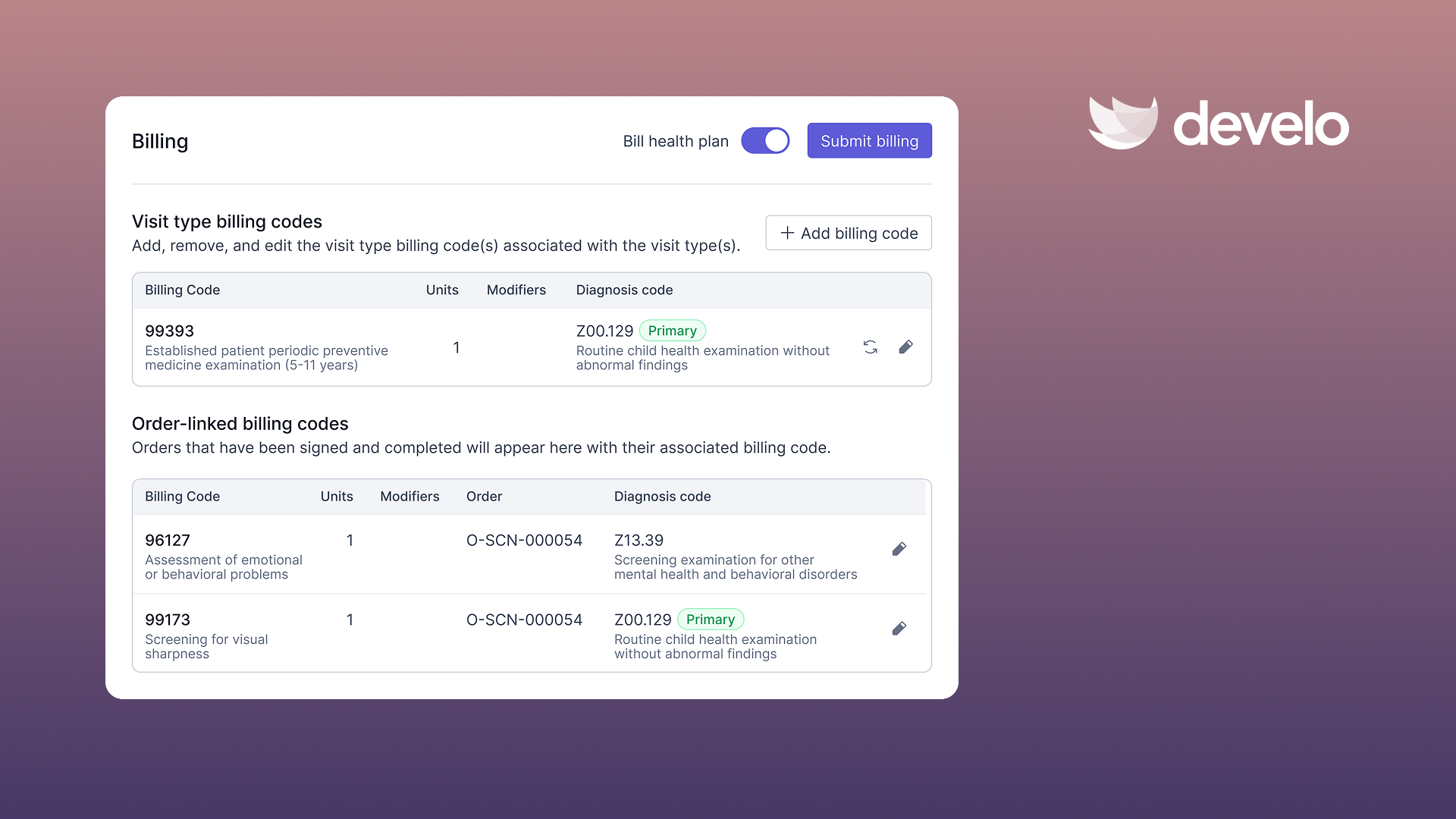
- Automate charge capture with AI that learns the latest billing requirements and drives accurate billing based on pediatric-specific coding rules
- Manage families, not individual patients, with native family relationship tracking that handles siblings, blended families, and multiple guardians
- Reduce front-desk workload with digital pre-visit intake, visit reminders via text, and a family portal for scheduling, payments, and accessing records
Your marketing strategy brings families through the door. Develo makes sure every visit runs the way pediatric care is supposed to.
Book a free demo and see how Develo helps your practice track normal pediatric vital signs, streamline clinical workflows, and keep your focus where it belongs: the kids.
Frequently Asked Questions
1. What Are the Normal Pediatric Vital Signs for a Newborn?
Normal pediatric vital signs for a newborn (0-3 months) include a heart rate of 110-160 bpm, a respiratory rate of 30-60 breaths per minute, blood pressure around 65-85/45-55 mmHg, and a body temperature of 98.6°F (37°C). SpO2 should be 95-100%.
2. How Can I Efficiently Trend Vital Signs Across My Patient Panel?
The most efficient approach is using an EMR that auto-plots vitals against age-specific ranges at each visit. This eliminates manual lookups and lets your team spot trends (like a gradual BP increase over several visits) without extra work.
Systems built for pediatrics handle age- and height-adjusted percentiles natively, which general EMRs typically don't.
3. How Can I Help Parents Understand Normal Vital Sign Ranges?
You can help parents understand normal vital signs with proactive anticipatory guidance during well visits. Give parents one or two specific numbers to watch for (like the 100.4°F fever threshold for newborns) rather than handing them a full chart.
Framing it as "here's when to call us" instead of "here's what's normal" reduces anxiety and unnecessary calls.
4. What Temperature Counts as a Fever in a Child?
A temperature at or above 100.4°F (38°C) is a fever. For infants under 3 months, any fever at or above this threshold warrants an immediate call to the practice.
5. Do Vital Sign Ranges Differ Between Boys and Girls?
Normal pediatric vital signs are similar between boys and girls during childhood. Blood pressure may begin to differ slightly in adolescence due to hormonal changes, but the standard reference ranges used in clinical practice apply to both sexes.
.png)

.png)
.png)
.avif)