
.avif)
Every child grows on their own timeline, but most reach certain skills within a predictable window. Tracking developmental milestones by age helps parents and pediatricians catch concerns early. The stages below run from 2 months through 5 years, drawn from the developmental milestone checklists published by the CDC and the American Academy of Pediatrics.
What Are Developmental Milestones?
Developmental milestones are the skills most children show by a given age, like a first smile, a first step, or a first word. They fall into four areas of development:
- Social and emotional: How a child relates to others, from smiling at caregivers to playing with peers.
- Language and communication: How a child understands and uses words, sounds, and gestures.
- Cognitive: How a child learns, thinks, problem-solves, and plays.
- Movement and physical: Gross motor skills like sitting and walking, and fine motor skills like grasping and drawing.
In 2022, the CDC and the AAP revised the checklists so each milestone reflects what at least 75% of children can do by that age, replacing the 50th-percentile standard in use since 2004 (Zubler et al., Pediatrics, 2022). The same revision added checklists at 15 and 30 months. That threshold is high enough that a missed milestone is worth a closer look rather than a wait-and-see.
Developmental Milestones by Age
The lists below highlight common milestones at each stage. They aren't exhaustive, so use the linked CDC checklists for the full set, and bring any questions to your child's pediatrician.
2 Months
- Calms when picked up or spoken to, and briefly looks at you
- Makes sounds other than crying
- Holds head up during tummy time and moves both arms and legs
- Reacts to loud sounds
4 Months
- Smiles to get your attention and chuckles
- Coos and babbles back when you talk
- Holds head steady without support and pushes up on forearms
- Brings hands to mouth and swings at toys with an arm
6 Months
- Knows familiar faces and enjoys looking in a mirror
- Takes turns making sounds and blows raspberries
- Rolls from tummy to back and props on hands
- Reaches for and mouths objects
9 Months
- Shows several expressions, may be shy with strangers, and responds to their own name
- Babbles strings of sounds and lifts arms to be picked up
- Looks for objects that drop out of sight
- Sits without support and moves things between hands
1 Year
- Plays games like pat-a-cake
- Waves bye-bye, says "mama" or "dada," and understands "no"
- Puts objects into a container
- Pulls to stand and cruises along furniture
15 Months
- Copies other children and shows you affection
- Tries to say a word or two beyond "mama" and "dada"
- Takes a few independent steps
- Points to ask for something or to get help
18 Months
- Points to show you something interesting and moves away, but checks back
- Tries three or more words and follows a one-step direction without a gesture
- Walks without holding on and climbs on and off furniture
- Scribbles, drinks from a cup, and feeds self with fingers
2 Years
- Notices when others are upset and looks to your reaction
- Uses two-word phrases and points to things in a book
- Plays with more than one toy at the same time
- Runs, kicks a ball, walks up a few stairs, and eats with a spoon
30 Months
- Plays alongside and sometimes with other children
- Uses about 50 words and short action phrases
- Follows two-step directions and shows they know at least one color
- Twists things like doorknobs, turns book pages, and jumps off the ground with both feet
3 Years
- Calms within about 10 minutes after you leave and joins other children
- Talks clearly enough that most people understand
- Draws a circle when shown and avoids touching hot objects when warned
- Puts on some clothing, uses a fork, and strings items together
4 Years
- Pretends during play and comforts others who are hurt
- Says sentences of four or more words and answers simple questions
- Names a few colors and tells what comes next in a familiar story
- Catches a large ball, serves their own food, and unbuttons some buttons
5 Years
- Follows rules and takes turns in games
- Tells a simple story and keeps a conversation going
- Counts to 10 and pays attention for 5 to 10 minutes
- Hops on one foot and buttons some buttons
When to Act Early
A child who falls a little behind on one skill usually catches up. The signals worth raising with a pediatrician sooner are a child who misses several milestones for their age, or who loses a skill they once had.
Skill loss in particular, like a toddler who stops babbling or waving, is a reason to call. If you have a concern, talk with your child's doctor and ask about a developmental screening. You don't need to wait for the next well visit.
If your child was born prematurely, use their corrected age — age counted from the due date, not the birth date — when reading these lists, through about age 2. A baby born two months early is expected to look like a 4-month-old at 6 months old. Corrected age is what your pediatrician uses to interpret milestones and screening scores, and it's worth confirming the practice has the gestational age on file.
When development is delayed, early intervention through physical, occupational, or speech therapy works best the sooner it starts. Under IDEA Part C, the early-intervention evaluation is provided at no cost to families, along with service coordination and development of the service plan. Ongoing therapy costs vary by state — often a sliding scale, insurance, or Medicaid — and services cannot be denied because a family is unable to pay. Part C covers birth to age 3; after a child's third birthday, evaluation and services move to the local school district under IDEA Part B, where they are also provided at no cost.
How Pediatric Practices Keep Milestones on Track
For a practice, milestone tracking lives across two workflows: surveillance at every well child visit, and standardized screening at the AAP-recommended ages of 9, 18, and 30 months, plus autism-specific screening at 18 and 24 months.
Both depend on the right tool reaching the right family at the right age, and on the results landing in the chart where they count. Done by hand across a full schedule, screens get missed, scored late, or left unbilled.
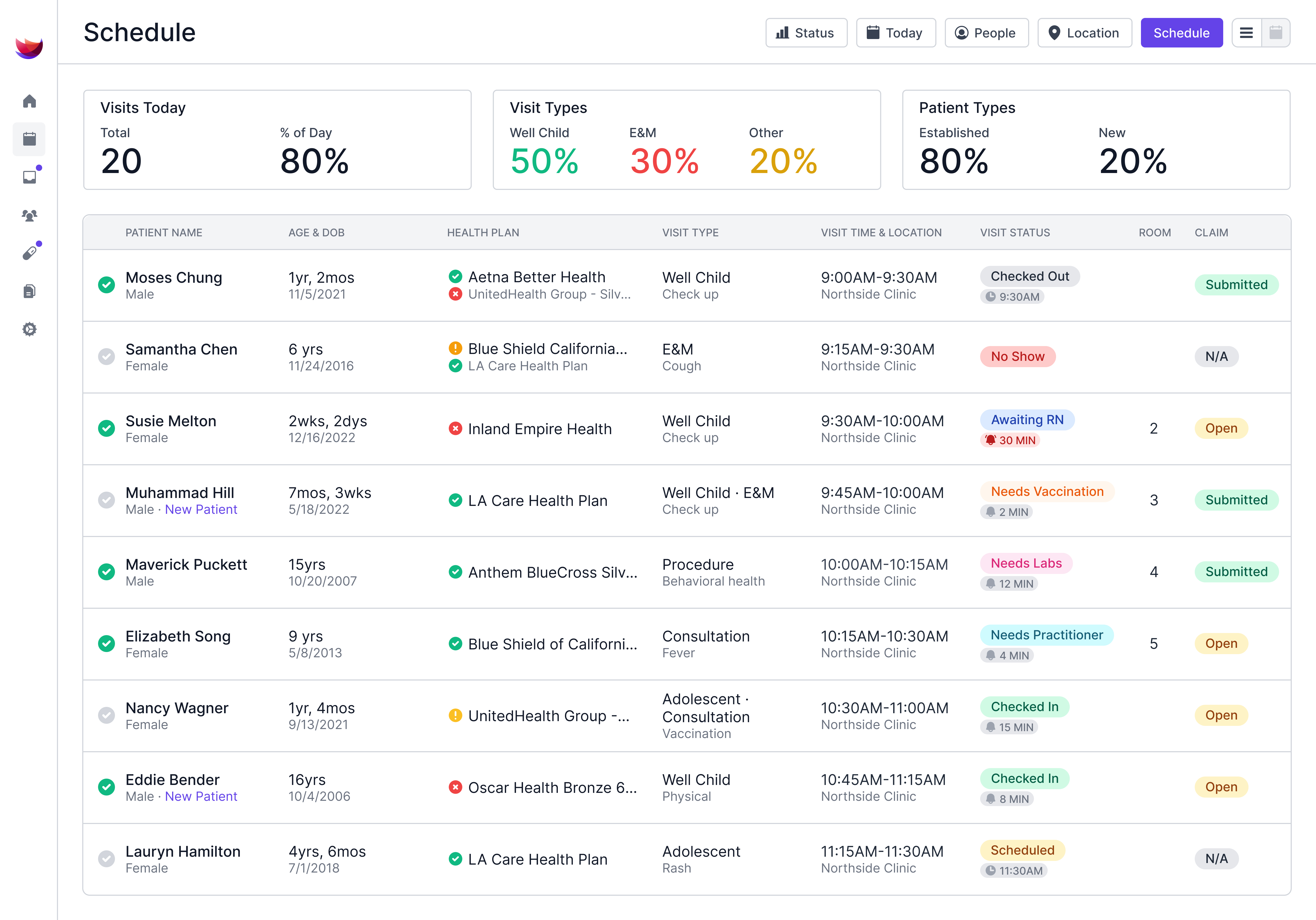
Develo is the AI-native pediatric operating system built solely for independent pediatric practices, unifying charting, billing, practice management, and family engagement in one system. Because it was built for pediatrics rather than retrofitted from an adult platform, developmental surveillance and screening are native workflows — not templates a practice has to build, or a third-party form tool bolted on beside the chart.
For developmental tracking, that means:
- Structured developmental surveillance in the well child visit template, so parent-reported concerns and clinician observations are captured as data that carries forward visit to visit.
- Age-based digital screeners that select the right instrument for the child's age — PEDS or SWYC for general development at 9, 18, and 30 months, M-CHAT for autism screening at 18 and 24 months — and send them to families before the visit through the family portal.
- Automatic scoring that returns results into the chart, so providers review findings during the visit instead of tallying forms.
- Screening tasks that flag concerning results to a provider ahead of the visit, so a positive M-CHAT or a missed-milestone pattern is on the provider's radar before they walk into the room, not discovered while scoring a form during it.
- Billing on completion, so a finished screen becomes a billable 96110 line instead of unbilled work.
- Visit recall tied to the AAP periodicity schedule, so families come back for the well child visits where surveillance and screening happen.
Developmental screening is a required EPSDT component, and 47 state Medicaid programs reimburse CPT 96110 separately from the well child visit — so on a Medicaid-weighted panel, every screen that gets done but not coded is revenue the practice already earned and didn't bill.
If your pediatric practice runs on Develo, most of this happens before the patient arrives. The right screener for the child's age reaches the parent ahead of the visit, comes back scored, lands in the chart, and is captured as a charge automatically — so the pediatrician spends the visit talking with parents about their child instead of tallying a paper form.
Frequently Asked Questions
What Are the Four Areas of Child Development?
The four areas of child development are social and emotional, language and communication, cognitive, and movement and physical. Some sources split the physical area into gross motor and fine motor skills, which gives five categories, but the milestone checklists group them into four.
At What Age Should a Child Start Talking?
Most children say a first word around 12 months, reach several words by 18 months, and use two-word phrases around age 2. Because talking develops on a range, one late marker isn't always a concern. But if there are no two-word phrases by 24 months, check in with a pediatrician.
What Is the Difference Between Developmental Surveillance and Screening?
Developmental surveillance and screening differ in timing and method. Surveillance is ongoing observation at every well child visit, while screening uses a standardized, validated tool at set ages.
When Should I Worry About My Child's Development?
You should talk with your child's doctor if your child misses several milestones for their age or loses a skill they previously had. Skill loss is the more urgent signal, and you don't need to wait for the next scheduled visit to raise it.
Do All Children Reach Milestones at the Same Time?
No, children reach milestones at different rates, and a range of timing is normal. Milestones reflect what most children do by a certain age, so they work best as an ongoing pattern to watch, not a pass-or-fail mark at any single visit.
.png)

.avif)