

The strongest Office Practicum alternatives for independent pediatric clinics are Develo, PCC, and athenahealth, and each one suits a different set of priorities. We compared six EMRs on pediatric workflows, billing automation, support, and pricing models, so you can see what each does well, where it falls short, and which practices it fits.
6 Best Office Practicum Alternatives at a Glance
Pricing correct as of October 2026. Verify with each vendor.
Why Look for Office Practicum Alternatives?
Office Practicum (OP) has a large user community, solid pediatric content, and a broad services menu. For many clinics, it's been a reliable choice for years.
But a few common pain points drive practices to start looking elsewhere:
- Aging technology: OP has served pediatrics for more than 30 years and is now rebuilding its core in stages through the end of 2027, so practices will run some workflows in new screens and others in old ones along the way.
- Costs that add up: OP sells à la carte modules alongside a menu of third-party bolt-ons, so intake, screening, and portal tools can each add a line to the bill.
- Ownership and support: Pamlico Capital, a private equity firm, has backed OP since 2018, and the next year co-founder Greg Anderson stepped down as CEO, handing the role to OP's operations chief. Ask current OP users how support response times have held up before you renew.
- Slower innovation: Newer platforms are delivering AI documentation, automated charge capture, and modern family engagement tools faster than OP, without a core rebuild competing for their engineering time.
- Two notes for one visit: When a well child visit turns up a sick problem, OP requires two separate notes, saved as two separate note files, even though the visit is billed as one claim.
- One person per chart: OP doesn't let multiple staff work in the same chart or the same visit at once, so nurses, providers, and front desk staff take turns adding orders, updates, and documentation.
TL;DR: Which Office Practicum Alternative Should You Choose?
Not sure where to start? Here's a quick breakdown based on what your practice needs most.
- Choose Develo if: You run a pediatric practice of any size, from a solo clinic to an enterprise-scale multi-site group or MSO, and want an AI-native operating system with automation, built-in integrations, comprehensive pricing, and optional billing services from an onshore, pediatric-only team. Not a fit for multi-specialty groups or family practices.
- Choose PCC if: Your practice values a tight-knit user community and long-term vendor stability. Be prepared for manual billing workflows and a three-year standard contract.
- Choose athenahealth if: Your clinic is part of a multi-specialty organization and wants outsourced RCM. Pediatric workflows will need manual configuration.
- Choose eClinicalWorks if: Budget is the primary driver, and your team can work with a general ambulatory platform that needs pediatric customization.
- Choose NextGen if: You run a small practice and want a straightforward cloud-based setup without deep pediatric requirements.
- Choose Greenway Health if: Your organization spans several specialties and needs deep reporting, and you're prepared for the Intergy-to-Novare transition. Pediatric workflows will need configuration.
- Stick with Office Practicum if: Your team relies heavily on OP's user community, mature form-fill tools, and RCM services, and you aren't planning a system change in the next year or two. Expect to run new and old screens side by side as OP's rebuild rolls out through 2027.
What OP's Reimagination Initiative Means for Your Practice
Office Practicum has told its existing customers it is rebuilding its EMR in stages over about 24 months, from early 2026 through the end of 2027. OP calls it the Reimagination Initiative, a move to a "fully cloud-native" platform, and in September 2026 it named a new chief medical officer to help guide how its technology develops for pediatric practices. Staged rebuilds are a sensible way to modernize, but they make the timeline as important as the feature list. Whether you're renewing with OP or comparing it against other systems, here are the questions we'd bring to the table.
Start with the order of the rollout
OP's roadmap begins with the front desk and sick visits. Well child visits, the core of most pediatric schedules, follow. Charge entry runs into mid-2027, and payment entry and supporting workflows aren't scheduled until the second half of 2027.
Ask OP: Which reimagined workflows are live for every customer today, not just pilot practices? Which dates are committed in writing, and do any of them land after your contract renews?
Plan for a period of overlap
OP has said there will be "no big bang." Each practice chooses when to adopt each new workflow, and the new platform runs alongside OP Cloud on the same database. That means a sick visit may run in the new screens while a well child visit stays in the old ones, and your staff move between the two.
Ask OP: If you move to OP now, will you go live in the old screens, the new ones, or a mix of both? How long would your team work in both before every workflow you use is in the new platform? Is training for each stage included?
Understand how the pieces connect
Like many long-established EMRs, OP works with partners for several patient-facing tools. Its own portal is powered by BridgeInteract, and InteliChart runs the portal, reminders, and digital intake for more than 1,000 OP providers. Intake also runs through Phreesia, and pre-visit questionnaires through CHADIS. Its AI scribe, Opie AI, is a third-party add-on: "a white-labeled version of Insight Health's AI scribe technology," in the companies' own words. That means more than one support line and release schedule behind your day-to-day workflow.
Ask OP: Which of these tools does your quote include? How will each connection be kept working as the core changes, and who is your first call when one breaks: OP or the third-party vendor?
See the daily work in a demo
OP says the reimagined platform is "not refactored legacy software," and it reads from the same database as OP Cloud. Slides and roadmaps can't show what that means for your team. A demo built around your own visits can.
Ask OP to show you:
- How a well child visit that turns up a sick problem is documented
- How several team members work in the same chart during a visit
- How age-based screening and billing codes flow into the visit
Ask where you'd be hosted, and whether you'll move again
OP has told on-premises customers to start planning their move to OP Cloud, because new features will reach only cloud customers, and the reimagined platform comes after that. A practice joining OP during the rollout could face a second move soon after go-live: onto OP Cloud first, then onto the reimagined platform.
Ask OP: If you sign now, where will you be hosted: OP Cloud, the reimagined platform, or both? Will you need to migrate again shortly after you move to OP, and who covers the data migration, downtime, and training for that second move? If you're on OP today with an on-premises server, can both moves happen as one transition? If not, why not, and who pays for hardware and technical support in between?
Ask every vendor on your shortlist the same questions, and get the answers, dates, and pricing in writing. Comparing what each system does in your workflows today is the most reliable way to decide.
The 6 Best Office Practicum Alternatives
1. Develo
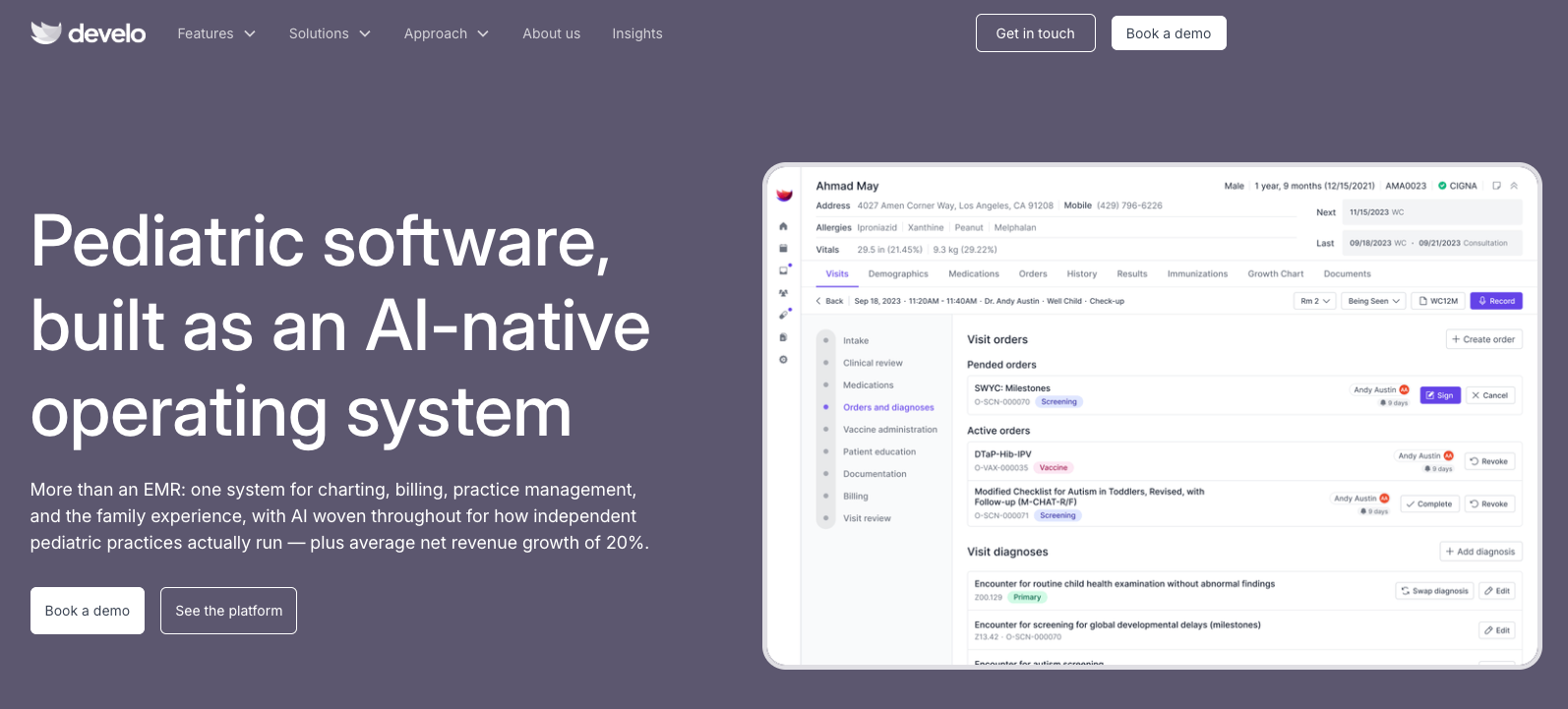
Develo is the AI-native operating system for pediatrics, unifying charting, billing, practice management, and family engagement in a single platform built from day one for outpatient pediatric care. Develo was founded in 2022 by Aaron Sin, MD, and Han Ke, who still run the company.
It replaces decades-old legacy EMR systems and the patchwork of generic tools that slow down documentation. It runs fully in the browser with no on-site server, it's ONC-certified and built on the Fast Healthcare Interoperability Resources (FHIR) standard, and siblings and guardians are linked natively in the record. Multiple staff can work in the same chart, or the same visit, at once, adding orders, updates, and documentation side by side. E-fax, e-prescribing, e-lab, text messaging, and state immunization registry connections are built in.
Key Features
- AI suite: Develo provider scribe and Develo intake scribe write straight into the visit note using context beyond the transcript, and the provider scribe suggests diagnosis codes and the E/M billing level for the clinician to review. AI eligibility checks verify each family's insurance coverage, Ask Develo catches you up on any patient, Develo doc intel files e-faxes and uploads to the right chart, Develo reports Q&A answers data questions in plain English, and Develo AI forms digitizes practice forms.
- Automated charge capture: Applies pediatric-specific billing codes, including vaccine administration codes tied to patient age and insurance type, so billers review exceptions instead of coding every visit by hand. A combined well-sick visit is one note, with separate preventive and problem-oriented sections, and modifier 25 is applied automatically for the provider to confirm.
- Built-in digital screeners: Developmental, behavioral health, and autism screeners auto-populate by patient age per the AAP periodicity schedule, score automatically, and trigger billing codes without additional steps.
- Complete vaccine workflow: A forecasting engine that flags what each child is due for, inventory tracked by funding source with Vaccines for Children eligibility checks, and bi-directional state registry reporting.
Pros
✅ Pediatric-only platform, so every workflow, template, and automation is purpose-built for child and adolescent care
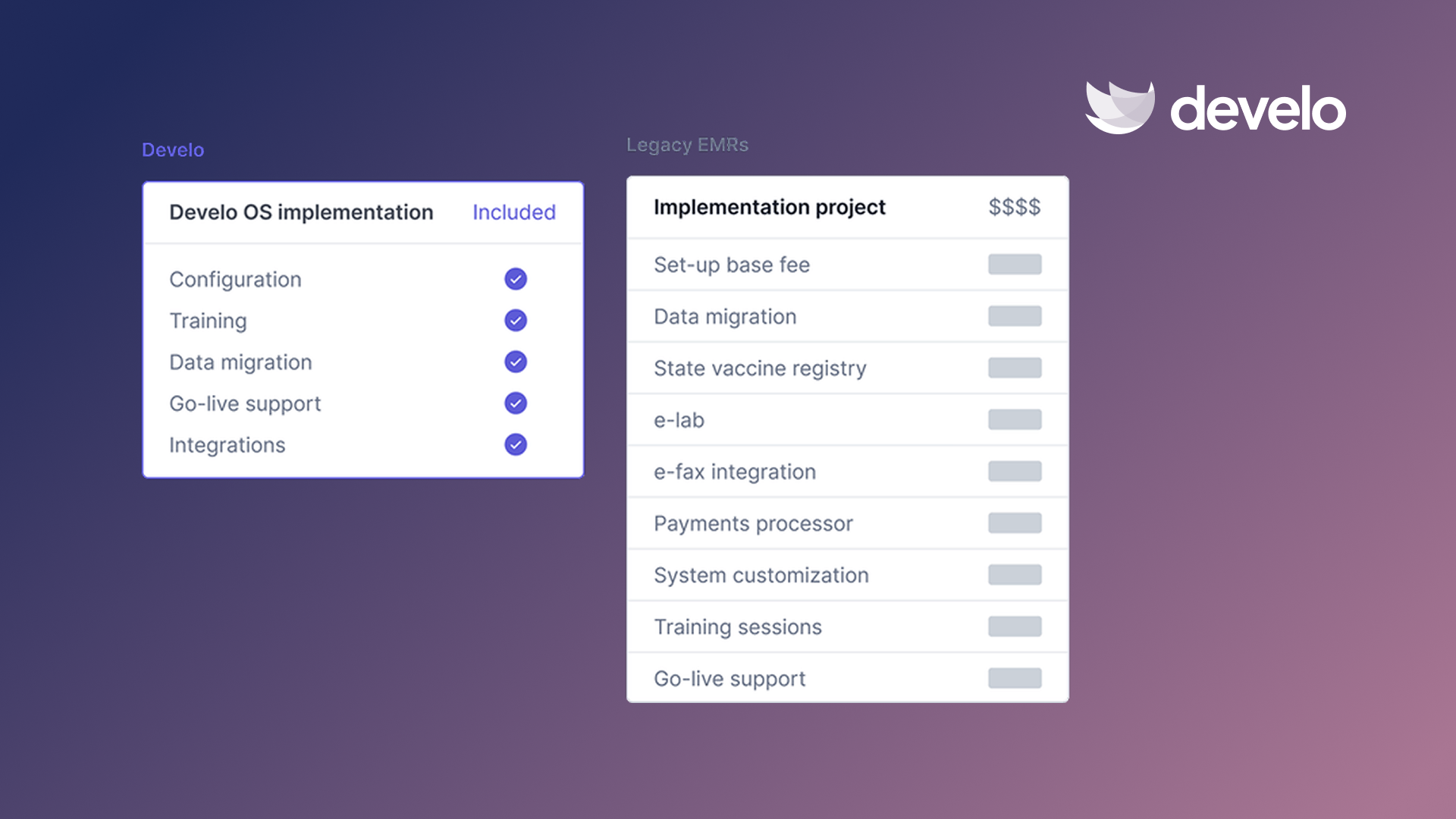
✅ Comprehensive pricing with no implementation fee, since data migration, configuration, and training are bundled into the per-provider monthly fee
✅ Minor releases weekly and major releases every two weeks, plus an onshore support team in the US and Canada, with a dedicated customer success manager for every practice
Cons
❌ Smaller user community than legacy pediatric vendors
❌ Fewer legacy third-party integrations than long-established systems
❌ The Develo AI scribe is priced separately from the per-provider monthly fee
Best For
- Pediatric practices replacing OP or PCC, from solo clinics to multi-site groups and MSOs
- Practices looking to reduce provider burnout through automation
- Clinics that want one per-provider fee instead of à la carte modules
Pricing
Develo uses comprehensive pricing built on a per-provider monthly fee. That fee covers digital intake, screeners, and the family portal rather than selling them as modules, plus a 24/7 on-call engineer for critical issues. The Develo AI scribe is currently the only AI capability priced separately, and optional billing services from an onshore, pediatric-only team are priced as a percentage of insurance collections.
Contact Develo to request pricing for your practice size.
2. PCC (Physician's Computer Company)
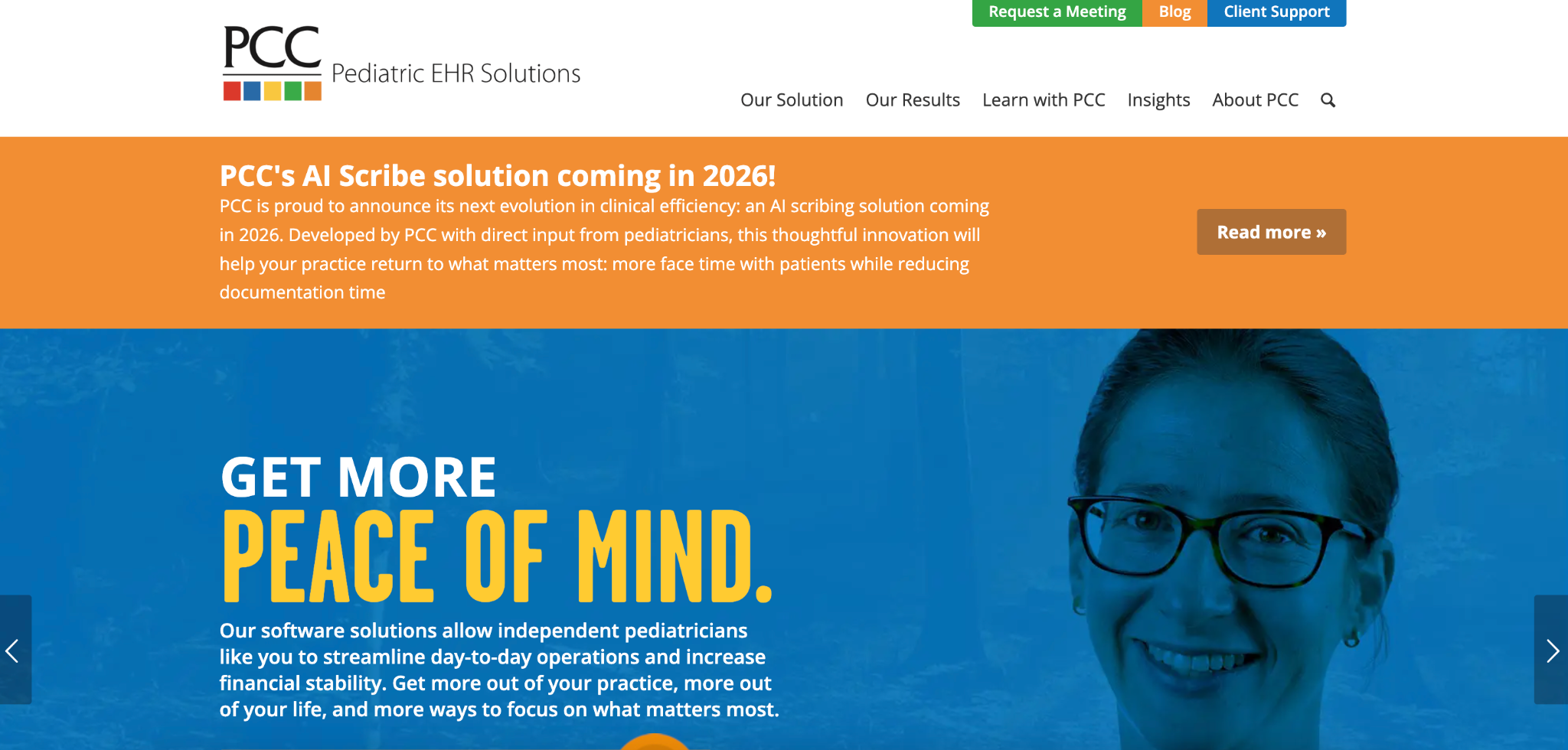
PCC is a pediatric-dedicated EMR with a track record of customer support, deep clinical content, and a tight-knit user community. It covers scheduling, charting, billing, and engagement tools in one platform.
The tradeoff is a technology foundation that predates modern cloud-native architecture. Billing workflows are highly manual, and the EMR runs as a client program installed on each workstation rather than fully in the browser. PCC Scribe, announced in November 2025, is a monthly add-on with its own implementation fee.
Key Features
- Growth charts and well child visit frameworks: Pediatric-specific clinical content built into daily workflows.
- Vaccine forecasting: Built into the clinical workflow to manage the full immunization lifecycle.
- Peer benchmarking: Performance data compared against anonymized peer practice data.
- Inclusive software as a service (SaaS) pricing: Marketed as a single monthly fee, with $0 startup costs and $0 data conversion.
Pros
✅ Strong customer support and tight-knit user community
✅ Deep pediatric-specific clinical content
✅ pocketPCC mobile app for EMR and billing data, e-prescribing, and document signing
Cons
❌ Some advanced billing tasks still run in Partner, the older practice management system users call the "dark side"
❌ Standard three-year contract term, with an early termination fee
❌ Slower pace of innovation than modern platforms
Best For
- Practices that value peer community and long-term vendor relationships
- Clinics that are not yet prioritizing modern automation or AI-powered documentation
Pricing
PCC markets an inclusive SaaS model, with software, training, and support covered by one monthly fee and no startup fees or data conversion charges. In practice, the per-provider monthly fee rises in tiers with claim volume, and some tools sit outside it: digital screeners run through CHADIS on a separate subscription, and PCC's new Luma Health partnership for reminders and two-way messaging hasn't disclosed pricing. Ask whether claim submission and clearinghouse costs are included or also tied to claim volume.
3. athenahealth
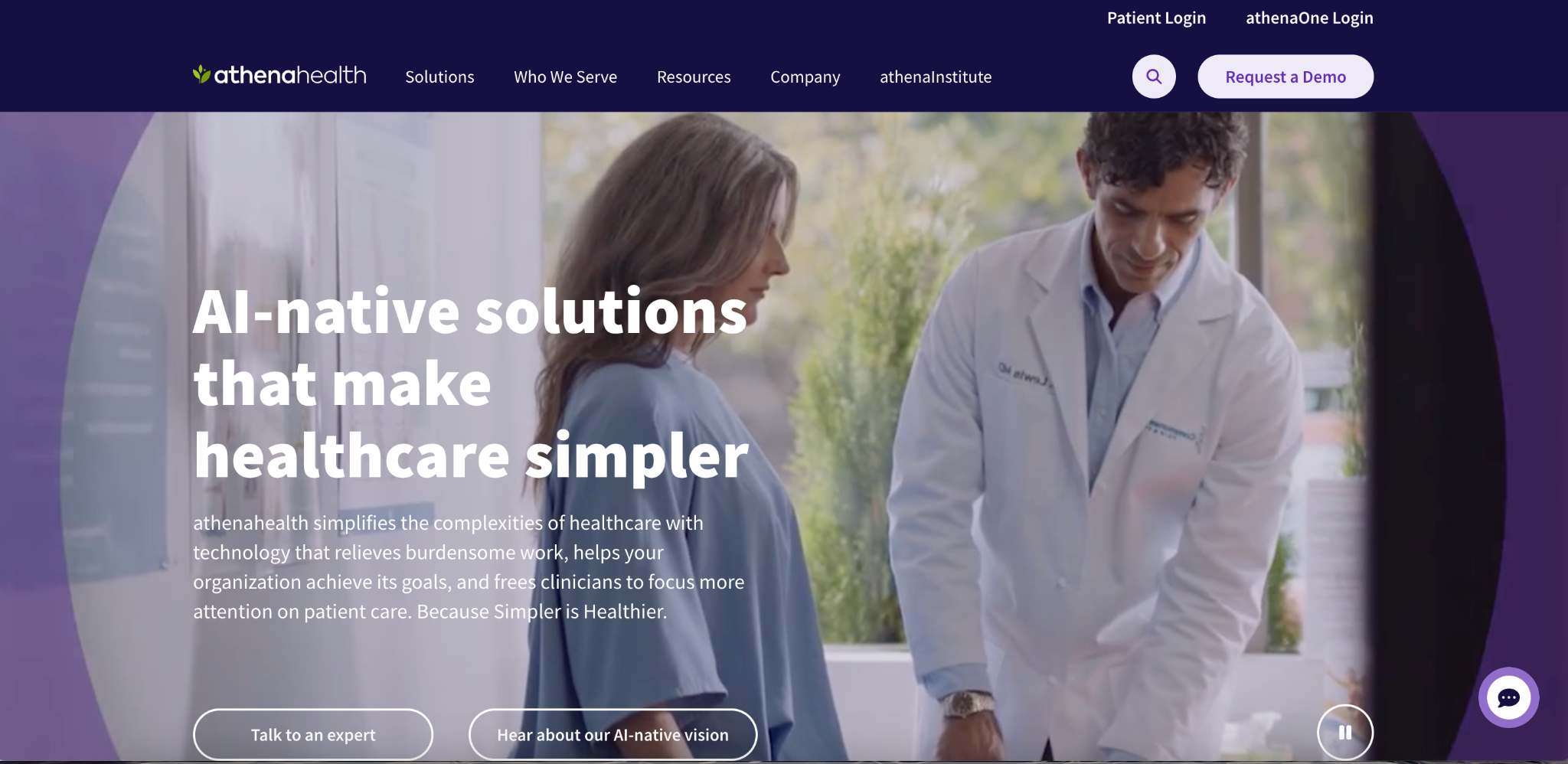
athenahealth is a cloud-based EMR and practice management platform designed for ambulatory care across multiple specialties, with pediatric workflows available but not at the center of its design.
For independent pediatric practices, family relationship structures and adolescent confidentiality settings often need extra configuration before they match a pediatric workflow.
Key Features
- Network-scale clinical insights: Care gap alerts surfaced at the point of care using data from across the athenahealth network.
- Broad interoperability: Connections with labs, pharmacies, and other EMR systems.
- RCM services: Billing support, including claim preparation, submission, and denials management.
Pros
✅ Strong fit for multi-specialty organizations on a single platform
✅ Solid RCM tooling and billing support services
✅ Cloud-based with regular updates
Cons
❌ Not pediatric-native, so it trails dedicated pediatric EMRs on child-specific workflows
❌ Pricing tied to collections rises with revenue, so costs grow as the practice does
Best For
- Pediatric providers within multi-specialty groups
- Practices prioritizing network-scale RCM over pediatric-specific features
Pricing
athenahealth uses a collections-based pricing model and publishes no rates. Most practices pay 6% to 8% of collections, according to our athenahealth pricing breakdown. Contact athenahealth for a practice-specific quote.
4. eClinicalWorks

eClinicalWorks is a broad cloud-based EMR and practice management platform with wide feature coverage across ambulatory care.
Like most general ambulatory platforms, eClinicalWorks wasn't designed with pediatrics as its priority. Its pediatric package markets growth charts, a Family Hub, and adolescent proxy access, which sit on top of a general ambulatory core.
Key Features
- healow platform: Engagement tools covering scheduling, check-in, telehealth, and records access.
- Population health tools: Care gap tracking and quality measure reporting across patient populations.
- Broad clinical and billing functionality: Documentation, billing, labs, imaging, and e-prescribing in one platform.
Pros
✅ Publishes its rates, unlike most pediatric-specific platforms
✅ Wide feature coverage across ambulatory care
✅ Large footprint with established integrations
Cons
❌ Pediatric workflows need setup before they match a pediatric clinic's day
❌ The AI scribe is a separate per-user subscription on top of the platform fee
❌ Progress notes lock to one user at a time, so other staff can't edit until the first user closes the encounter
Best For
- Practices where budget is the primary deciding factor
- Clinics in mixed-specialty settings where pediatric depth is less critical
Pricing
eClinicalWorks published pricing starts at $499/provider/month for EHR only, or $599/provider/month with practice management included. Those are base rates, and add-ons such as the Sunoh.ai scribe cost extra. RCM services are available as a separate add-on at 2.9% of collections with no startup costs across all tiers.
5. NextGen
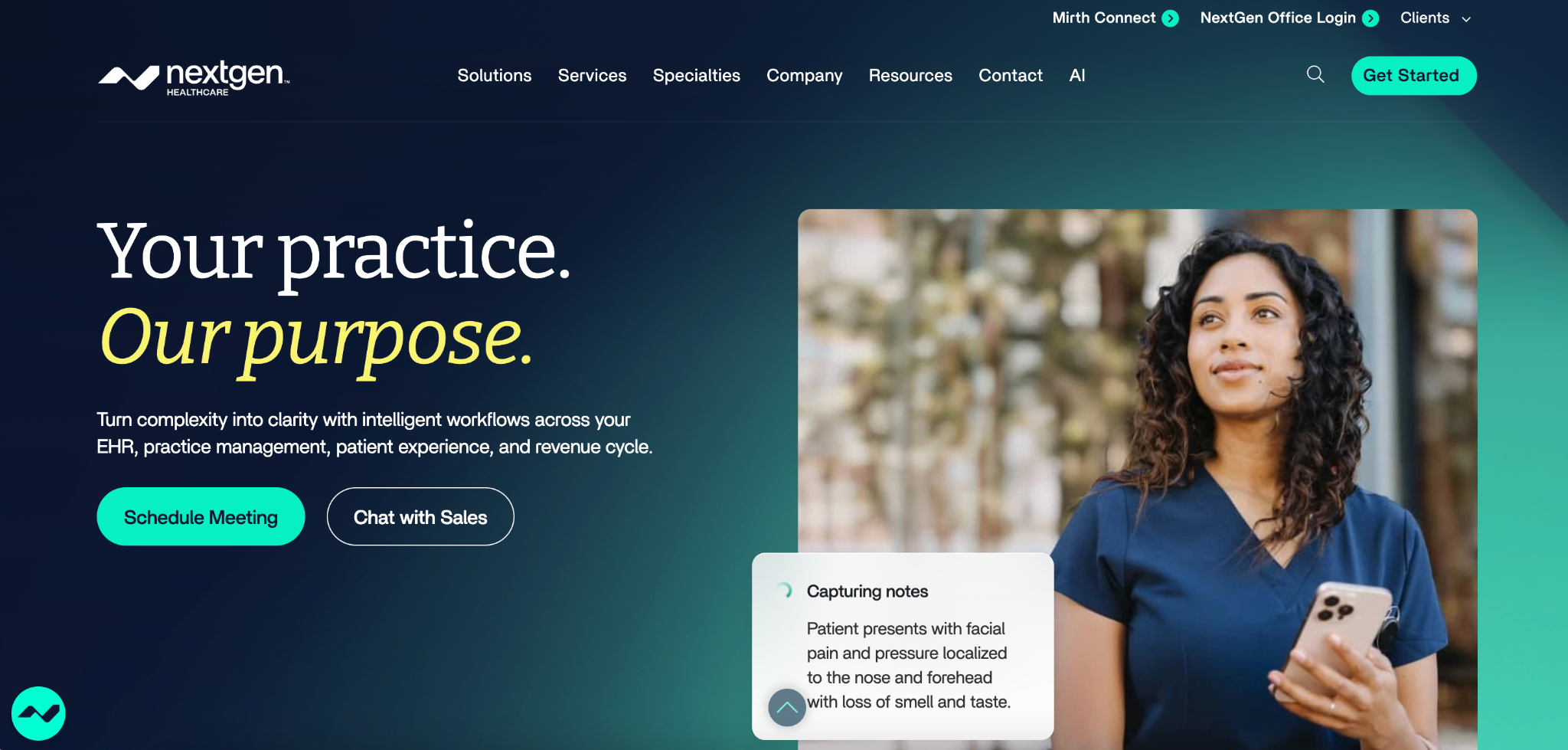
NextGen sells EMR and practice management software with two product tiers: NextGen Office for independent practices under 10 providers, and NextGen Enterprise for practices with 10 or more.
Pediatric tools such as growth charts and immunization forecasting are available but configured on top of a multi-specialty core, so pediatric depth depends on how much setup your team takes on before go-live.
Key Features
- Customizable templates: Specialty-specific options across many specialties.
- Integrated billing and practice management: Built-in workflows covering scheduling, documentation, and claims.
- NextGen Ambient Assist: Ambient listening tool that automatically converts conversations into structured clinical notes.
Pros
✅ Simple setup for small teams
✅ NextGen Office runs in the cloud with no server installation
✅ Works across mixed-age practices
Cons
❌ Pediatric content, including immunization forecasting and growth charts, needs setup on top of a multi-specialty core
❌ Encounters lock to one user at a time, so other staff can only view them read-only until that user closes out
❌ Lab and immunization registry interfaces each carry their own license and implementation fees
Best For
- Small to mid-sized practices wanting a straightforward cloud-based EMR
- Clinics where pediatric-specific depth is secondary to simplicity
Pricing
NextGen uses custom pricing based on practice size and features. Third-party estimates put it at about $300 to $550 per provider per month before add-ons, and lab and immunization registry interfaces each carry their own license and implementation fees. Contact NextGen for a quote.
6. Greenway Health
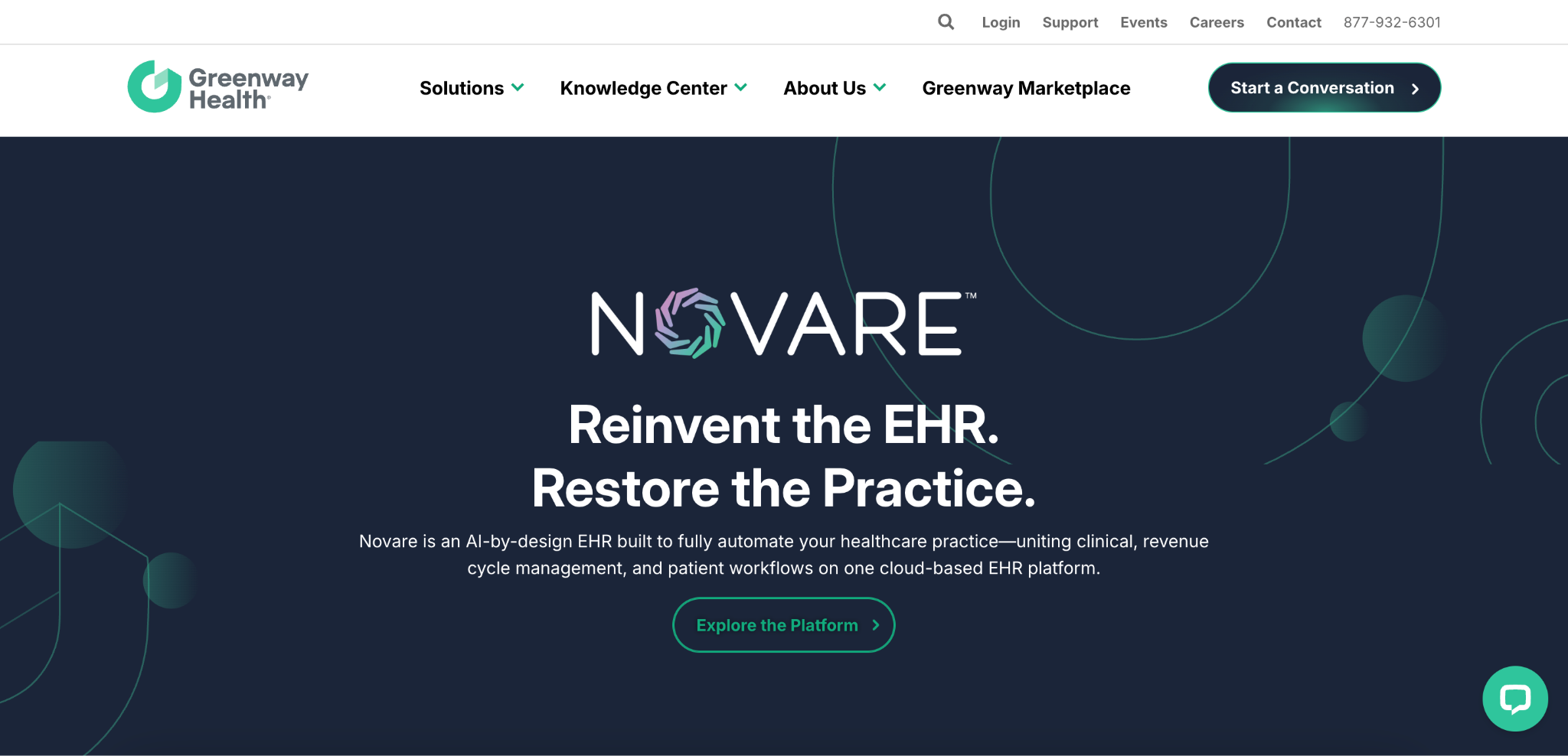
Greenway Health offers cloud-based EMR solutions for multi-specialty ambulatory organizations, with advanced reporting capabilities and IT support services. Its EMRs are Intergy and Prime Suite, and in March 2026 it launched Novare, which its own Intergy page calls "the next evolution of Intergy EHR."
Pediatric workflows exist but require configuration, so it works best where pediatrics is one of several specialties rather than the primary focus.
Key Features
- Advanced reporting tools: In-depth operational reporting for analytics-driven teams.
- Multi-specialty support: A single system covering multiple provider types across one organization.
- Greenway Clinical Assist: AI-powered clinical documentation tool to reduce manual charting and after-hours work.
Pros
✅ Strong reporting depth for analytics-driven organizations
✅ Useful for complex multi-specialty structures
Cons
❌ Pediatric workflows need configuration before go-live
❌ No published Novare pricing, release date, or migration schedule yet for Intergy and Prime Suite customers
❌ Encounter notes lock to the user who is documenting, so other staff wait their turn to add orders or documentation
Best For
- Multi-specialty organizations that include pediatric providers
- Practices where reporting depth is the primary requirement
Pricing
Greenway uses custom pricing that varies by contract. Novare pricing isn't published. Contact Greenway for a quote.
How to Evaluate Office Practicum Alternatives
Choosing the right Office Practicum alternative starts with understanding what your practice actually needs to run well.
Here's what to look for:
- Pediatric fit: Not all EMRs are built for pediatrics. Check whether features like vaccine workflows, developmental screeners, and family-level data management are native to the platform or bolted on.
- Architecture and update pace: Older platforms tend to move slowly. Ask how often the vendor ships updates and whether the system is fully browser-based.
- Automation depth: Look at how much of your documentation and billing happens automatically versus manually. Every step that requires human input is a potential bottleneck.
- Concurrent charting: Ask whether nurses, providers, and front desk staff can work in the same chart or the same visit at once, or whether the note locks to one user until they close out.
- Support model: Check who owns the platform, how support is delivered, and what happens when something breaks during a busy clinic day.
- Total cost: Get a full picture of costs before signing anything. Some platforms look affordable until you add the modules your practice actually needs.
Manage Your Entire Pediatric Practice From One Platform
Many pediatric EMRs, including OP and PCC, run on older client-server foundations. Office Practicum is rebuilding its foundation in stages through 2027, but until that finishes, slower updates, add-on modules, and a growing list of third-party tools are limitations that add up over time.
Develo, the AI-native operating system for pediatrics, brings automated charge capture, an AI scribe that writes into your visit note for a clinician to approve, and a family-first data model into one platform. Practices have moved to Develo from Office Practicum, and our data migration page maps what comes over from a typical OP stack, including the third-party tools it replaces.
If your current EMR is holding your practice back, book a demo to see how Develo runs in a real pediatric clinic.
Frequently Asked Questions
What Is the Best Office Practicum Alternative for Independent Pediatric Clinics?
The best Office Practicum alternative for independent pediatric clinics depends on why you're leaving OP. Develo fits practices that want an AI-native operating system built only for pediatrics, with the family portal, digital screeners, and integrations as part of the platform. PCC fits practices that put a long-standing pediatric user community first.
Why Do Pediatric Clinics Switch Away From Office Practicum?
Pediatric clinics switch from Office Practicum due to an aging user interface, rising costs from per-module pricing, and a slower pace of innovation. Practices wanting AI-powered documentation, automated billing, and modern family engagement tools can find OP's older foundation limiting. Day-to-day friction adds up too: a combined well-sick visit takes two separate notes, and only one staff member can work in a chart at a time. OP is also rebuilding its platform in stages through the end of 2027, so practices that stay will run new and old workflows side by side until the rollout finishes.
Is Office Practicum Cloud-Based?
Yes. OP Cloud is a managed, hosted version of OP's client-server software, run on AWS so practices don't maintain their own servers. Hosted isn't the same as browser-based, so ask how the software runs on each workstation. OP's reimagined platform is billed as "fully cloud-native," but it runs on the same database as OP Cloud, and OP has told on-premises customers to move to OP Cloud first because new features will reach only cloud customers.
What Is OP Reimagined?
OP Reimagined is Office Practicum's staged rebuild of its pediatric EMR, which OP calls the Reimagination Initiative. It rolls out over about 24 months, from early 2026 through the end of 2027, starting with the front desk and sick visits, with well child visits after them, charge entry running into mid-2027, and payment entry in the second half of 2027. Practices adopt each new workflow on their own schedule, while the rest stays in OP Cloud on the same database.
What Should I Look for When Switching Pediatric EMR Systems?
When switching pediatric EMR systems, look for native pediatric workflows, automated charge capture, cloud-native architecture, and pricing that includes integrations and the portal in the base fee. Also, check whether several staff can work in the same chart at once, how frequently the vendor ships updates, and how accessible its support team is.