

Looking for TriMed EHR alternatives that match how your pediatric practice runs? The strongest picks for 2026 are Develo, Office Practicum, and PCC.
I spent hours comparing pediatric software with practice managers who've migrated off legacy systems. Below, you'll find what each tool does well, where it falls short, and the type of clinic it's built for.
6 Best TriMed EHR Alternatives at a Glance
Pricing correct as of September 2026. Most pediatric EMR vendors publish pricing only on request, so verify directly with each one.
Why Look for TriMed EHR Alternatives?
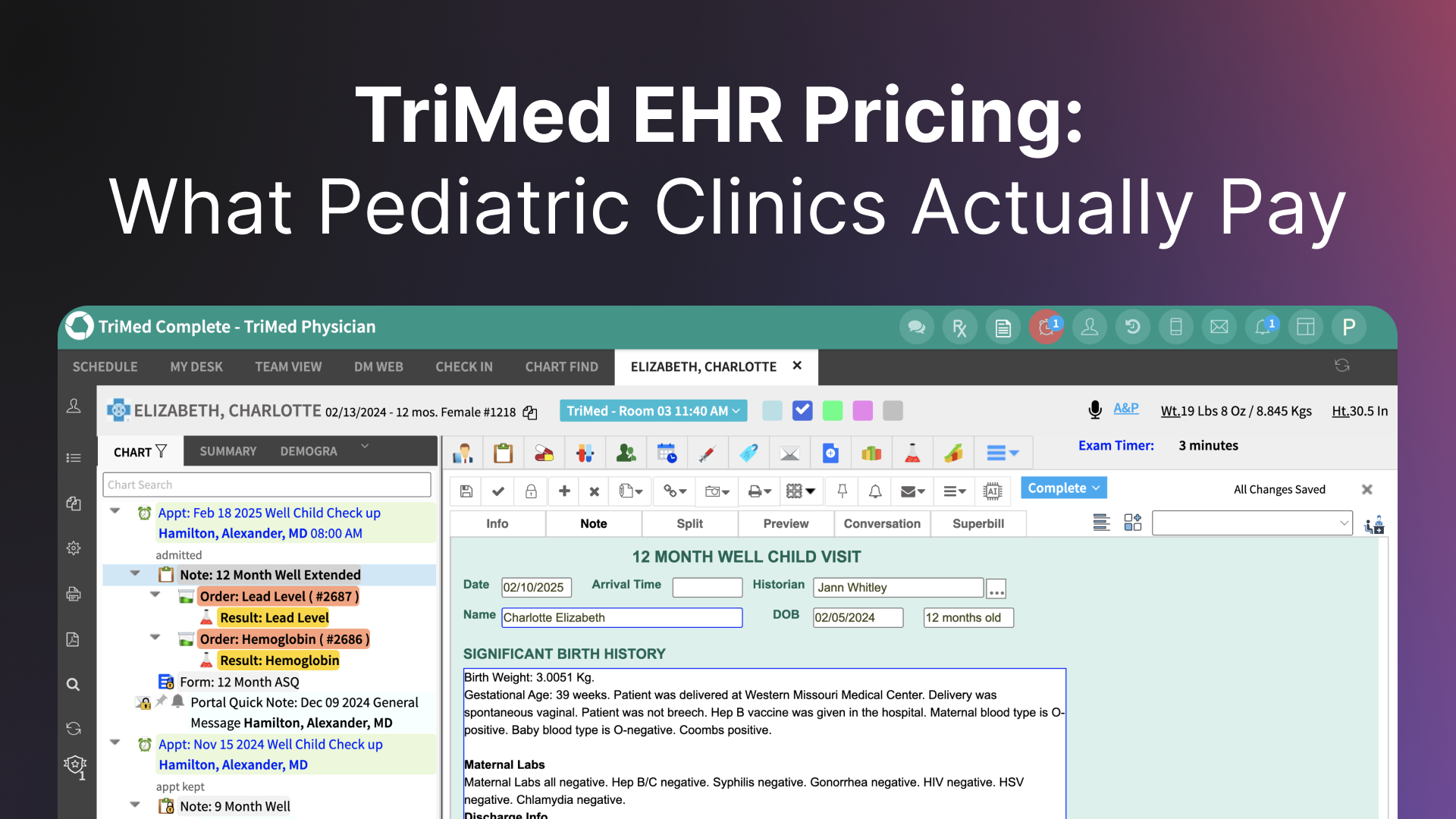
TriMed is a cloud-based EMR and practice management platform serving outpatient practices across multiple specialties — cardiology, pain management, ophthalmology, podiatry, dermatology, urgent care — with pediatrics as one configuration among them. Our full TriMed EHR review goes deeper on what that means day to day. The product covers the basics: scheduling, charting, billing, and patient records.
But many independent pediatric practices outgrow what TriMed offers. Here's what we hear most often from teams shopping for a switch:
- Disconnected family engagement: Pediatric care is family-driven. You need workflows for sibling charts, multiple guardians, and adolescent confidentiality that don't require manual rebuilding for every visit.
- Limited billing automation: Pediatric clinics process huge volumes of claims under shifting payer rules. Without automated claim scrubbing and reimbursement posting, billers spend hours on tasks that should run in the background.
- Patchworked patient experience: Front desk teams often layer in Phreesia, CHADIS, or similar tools to handle intake, screenings, and reminders. That patchwork creates gaps from the front door to the waiting room and can add real cost.
TL;DR: Which TriMed EHR Alternative Should You Choose?
- Choose Develo if you want a single AI-native operating system that handles charting, billing, practice management, and family engagement, built specifically for pediatrics, with one customer success manager who configures the practice, runs the launch, and stays on your account afterward.
- Choose Office Practicum if you value the largest pediatric EMR community and want a la carte modules to manage what is in the system vs. in a third party add-on or a manual workflow.
- Choose PCC if you want a long-established pediatric vendor with strong phone support and a tight customer community.
- Choose athenahealth if you run a multi-specialty group and value a percentage-of-collections billing service. Less ideal for solo pediatric clinics where flat-rate pricing usually wins.
- Stick with TriMed if your team is content with current workflows, you've already invested in deep customization, and your billing volume doesn't justify the cost of migration.
The 6 Best TriMed EHR Alternatives
1. Develo
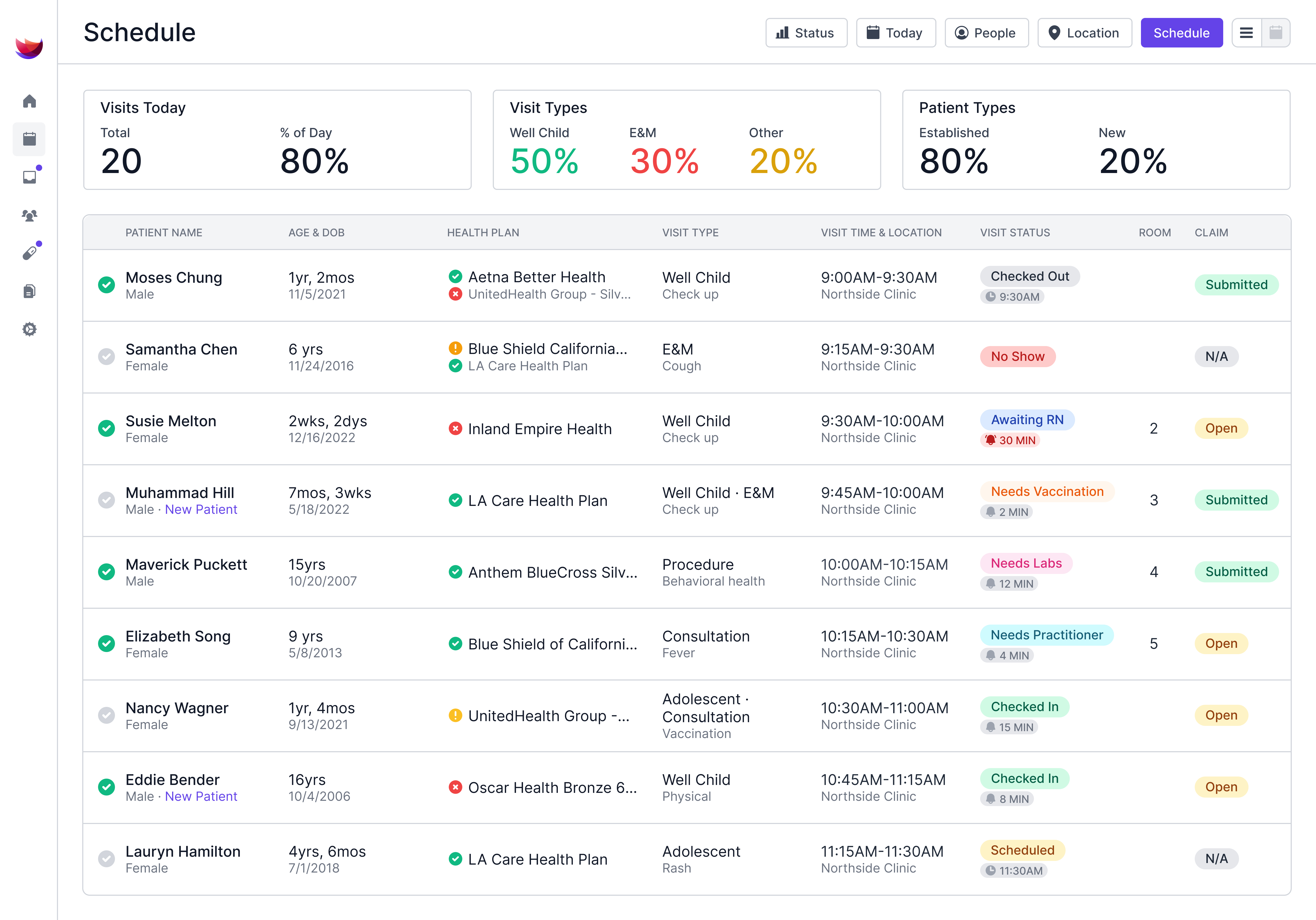
Develo is the AI-native operating system for pediatrics. It unifies charting, billing, practice management, and family engagement in one modern system, built from day one for outpatient pediatric care.
The team works exclusively with independent pediatric practices, which keeps the product focused on AAP guidelines, pediatric coding nuances, and family workflows that adult-focused EMRs treat as edge cases.
Key Features
- Develo provider scribe: Generates visit notes inside the documentation flow using full patient and visit context, not just the audio, in roughly 100 languages.
- A suite of AI, not one scribe: Develo intake scribe drafts the intake, Ask Develo catches you up on a patient before the visit, Develo AI forms auto-digitizes your practice and patient forms, Develo doc intel auto-tags inbound e-faxes to the right patient and practitioner, and Develo reports Q&A answers questions about your data in plain English.
- Automated charge capture: Powered by visit context and optimized for pediatric coding rules, reducing undercoding and biller burden.
- A family portal, not a patient portal: one caregiver login that follows guardian and guarantor relationships across siblings, with adolescent confidentiality handled as a child ages in, plus self-scheduling, messaging, and payments.
- Integrated digital intake: Pediatric-specific intake before visits, with developmental screeners and forms pre-populated by age.
- End-to-end claims workflow: Real-time eligibility, pre-submission checks, automated submission, and reimbursement posting in one stack.
Pros
✅ Built only for pediatrics, with no compromise to serve adult specialties
✅ Cloud-native architecture and onshore customer support
✅ Comprehensive pricing covers implementation, training, support, and upgrades
✅ Modern interface designed for fewer clicks per visit
✅ Replaces multiple third-party vendors for intake, screens, payment reminders, and the family portal, with established migration templates for moving your data off each one
Cons
❌ Newer player, so the community footprint isn't as deep as 30-year-old traditional vendors
❌ Fewer legacy integrations and third-party connectors than systems that have been in market for decades
Best For
- Independent pediatric practices ready to consolidate vendors
- Practice owners who want a modern, AI-native platform future-proofed for changes
- Teams that want predictable comprehensive pricing instead of a la carte add-ons
Pricing
Custom comprehensive pricing per practitioner per month, bundled with implementation, training, and ongoing support. Book a demo for a tailored quote based on your provider count.
2. Office Practicum (OP)
Office Practicum is a pediatric-focused EMR that serves solo practices through multi-location pediatric groups across the US.
The product has a deep set of pediatric-specific tools, an active user community, and an ecosystem of integrations built over two decades. OP also offers add-on services such as RCM and marketing support.
Key Features
- Pediatric clinical content: Templates, immunization management, and growth charts tuned for pediatric care.
- Modular pricing: Practices can purchase specific modules to fit their needs and scope.
- Educational ecosystem: Frequent webinars, training resources, and an established user community.
- Third-party integrations: Connections to clearinghouses, intake vendors, and RCM partners.
Pros
✅ Long track record handling pediatric workflows
✅ Vaccine forecasting and growth tracking are mature
✅ Modular setup lets smaller practices start lean
Cons
❌ Older architecture means some workflows feel click-heavy
❌ Add-on charges for upgrades, training, and modules
❌ Portal and integration quality has been inconsistent across releases
Best For
- Practices that want an established pediatric brand with a wide community
- Clinics that prefer choosing modules rather than buying a full platform
- Owners who value access to RCM, marketing, and other add-on services
Pricing
Custom pricing based on practice size and modules selected. Contact OP to request a quote.
3. PCC (Physician's Computer Company)
PCC is a privately owned, pediatric-dedicated EMR that serves independent pediatric practices that want a long-term vendor relationship.
PCC is often praised for proactive customer service, peer benchmarking reports, and an annual user conference. The platform is available as on-premise and cloud-hosted software.
Key Features
- Pediatric-optimized clinical content: Templates, screeners, and reporting built for pediatric workflows.
- Performance benchmarking: Practice-level reporting compared against anonymized peer data.
- Comprehensive pricing model: Platform fee plus per-practitioner fee that includes clearinghouse access.
Pros
✅ Strong onshore phone and web support
✅ Deep pediatric expertise across the team and content
✅ Tight customer community and annual user events
✅ Predictable pricing for medium and large practices
Cons
❌ Slower to ship modern capabilities like AI documentation than newer alternatives, on an older technical foundation
❌ Pricing is premium and may be high for solo practices
Best For
- Practices that prioritize support quality and stability
- Teams that value peer benchmarking and community
- Larger pediatric groups with billing maturity
Pricing
Custom pricing with a platform fee plus per-practitioner monthly fee. Contact PCC for a tailored quote.
4. Athenahealth
athenahealth is a cloud-based platform for multi-specialty practices and health systems. It's used widely across primary care and specialty groups, including some pediatric clinics, with a focus on revenue cycle services and integrations.
athenahealth's strength is the breadth of its ecosystem and scheduling experience. It's not pediatric-specific, but it can support pediatric practices that need multi-specialty flexibility.
Key Features
- Cloud-based platform: Browser-based with regular updates and no on-premise hardware.
- Billing services: Optional claim preparation and denials management run by athena.
- Large integration ecosystem: Connects with many third-party tools and hospital systems.
- Patient and family portal: Self-scheduling, messaging, and online payments.
Pros
✅ Strong scheduling and patient-facing experience
✅ Established cloud-based SaaS with regular updates
✅ Useful for multi-specialty groups beyond pediatrics
Cons
❌ Percentage-of-collections pricing can cost more than flat-rate models
❌ Limited pediatric-specific innovation since the platform serves many specialties
Best For
- Multi-specialty groups that include pediatrics
- Practices that want outsourced billing services
- Clinics willing to trade pediatric specificity for breadth
Pricing
athenahealth uses a percentage-of-collections model. Contact them for a quote based on your practice.
5. AdvancedMD
AdvancedMD is a cloud-based EMR and practice management system for small to mid-size practices. It supports multiple specialties, including pediatrics, with billing flexibility and a long feature list built over decades.
The platform offers modular pricing where practices can buy EMR, practice management, and billing services in different combinations. AdvancedMD is owned by Francisco Partners (acquired from Global Payments in 2024) and has an active partner ecosystem.
Key Features
- Modular product suite: EMR, practice management, and patient experience modules sold separately.
- Integrated payments: Online and in-office payment processing tied to the EMR.
- Reporting library: Pre-built reports and a custom report builder for clinical and financial data.
- Telehealth and patient portal: Standard features for remote care and family communication.
Pros
✅ Cloud-based with mobile apps for providers
✅ Flexible commercial model for smaller practices
✅ Active integration partner network
Cons
❌ Not pediatric-specific, so pediatric workflows often need customization
❌ Feature breadth can create a steeper learning curve
Best For
- Small to mid-size practices with mixed pediatric and family medicine workflows
- Clinics that want modular pricing flexibility
- Owners comfortable customizing a general ambulatory EMR
Pricing
Custom pricing based on modules and provider count. Contact AdvancedMD to request a quote and get a demo.
6. Tebra
Tebra is the product of the Kareo and PatientPop merger, built for independent practices. It combines EMR, practice management, billing, and patient acquisition tools in a single cloud platform.
Tebra targets small clinics that want a budget-friendly path to digital workflows. It's not pediatric-specific, so practices often layer in pediatric screeners or growth tracking from other vendors.
Key Features
- All-in-one platform: EMR, billing, practice management, and patient acquisition in one product.
- Patient acquisition tools: Reputation management, website builder, and online booking, useful for pediatrician marketing on a budget.
- Telehealth: Built-in video visits and secure messaging.
- Insurance billing: Real-time eligibility and claims submission tools.
Pros
✅ Approachable for small and solo practices
✅ Patient acquisition tools come bundled with practice management
✅ Cloud-based with no on-premise infrastructure
Cons
❌ Lacks pediatric-specific clinical content
❌ Reporting is general rather than pediatric-focused
Best For
- Solo and small clinics on a tighter budget
- Practices that want patient acquisition tools in the same stack
- Clinics that aren't deeply pediatric-specialized
Pricing
Custom pricing per provider per month. Request a quote from Tebra for current rates.
How to Evaluate TriMed EHR Alternatives
Switching EMRs is a major decision, and the wrong call can cost a practice years of productivity. Here's how to evaluate TriMed EHR alternatives without losing your weekends to endless demos:
- Pediatric depth: Does the platform handle siblings, multiple guardians, AAP-aligned vaccine schedules, and developmental screeners out of the box?
General ambulatory EMRs treat pediatrics as a sub-specialty, which forces workarounds that drain front-desk time. Tools designed for the full pediatric office workflow save real hours every week.
- Family engagement experience: A modern family portal should handle self-scheduling, messaging, payments, and forms in one mobile flow.
If your team is still chasing parents for paperwork, your current system is leaking time. Strong family engagement also supports better recall and lower no-show rates.
- Billing automation: Charge capture should be automated from visit context, so billers skip the manual superbill.
Pediatric coding rules change often. A good system applies vaccine admin codes, BMI Z-codes, and counseling codes automatically. Pair that with a pediatric billing cheat sheet and you'll watch denial rates fall.
- Screener coverage: Pediatric workflows depend on developmental and behavioral screeners across well child visits.
Look for systems that auto-assign age-appropriate tools (such as CRAFFT screening for adolescents) and score them automatically inside the chart.
- Vaccine operations and VFC: Most pediatric panels run a Vaccines for Children workflow alongside private stock, so every dose has to be tracked to a funding source and a lot, borrowed and paid back correctly when a child's eligibility changes between the order and the visit, and pushed to the state registry.
Ask any vendor to walk you through its vaccine workflows live, not on a slide. A system that gets this wrong loses doses and loses VFC standing, which costs more than any difference in the monthly per-provider price.
- Implementation and ongoing support: Ask about data migration, training, and what's included after go-live.
Comprehensive pricing models tend to align incentives because the vendor isn't billing you for every update.
- Total vendor consolidation: Count how many separate tools your team logs into today. The right alternative should shrink that number.
A platform that includes intake, screens, scheduling, billing, and the family portal eliminates several vendor relationships at once.
Stop Settling for Legacy Pediatric Software
When evaluating TriMed EHR alternatives, the real question is which platform was built for how independent pediatric practices run in 2026.
Develo is the AI-native operating system for pediatrics, unifying charting, billing, practice management, and family engagement in one modern system, built from day one for outpatient pediatric care.
It replaces decades-old legacy systems and the patchwork of generic tools that slow down documentation and create gaps in clinical data. Here's what your practice can do with Develo:
- Run the Develo provider scribe, which drafts visit notes using full patient and visit context rather than the audio alone, with templates for well child visits, sick visits, and chronic care
- Apply automated charge capture based on visit context to assign pediatric-specific codes (vaccine admin, BMI Z-codes, counseling codes) and cut undercoding
- Manage family structures, sibling charts, and adolescent confidentiality in a system designed for pediatrics from the ground up
- Run native digital screeners that auto-assign by age, score inside the chart, and flag concerning results to a provider ahead of the visit, with the completed screen billing as a 96110 line
- Forecast every patient's due and overdue vaccines against their full history, flag invalid vaccine doses, match doses to VFC eligibility and funding source, and push administrations to your state registry bi-directionally within a comprehensive immunizations module
- Replace stand-alone vendors for intake, screeners, forms, payment reminders, and the family portal with one connected workflow
- Simplify the full revenue cycle with real-time eligibility, pre-submission claim checks, automated submission, and reimbursement posting
Independent pediatric practices shouldn't have to juggle five vendors and a legacy EMR to deliver modern care. Book a free demo to see how Develo handles the workflows other TriMed EHR alternatives are still patching together.
Frequently Asked Questions
What Is TriMed EHR Used For?
TriMed EHR is a cloud-based electronic health record and practice management system used by outpatient practices for scheduling, charting, immunization tracking, and billing. It serves multiple specialties and markets a pediatric configuration, rather than being built for pediatrics from the ground up.
Why Are Pediatric Practices Looking for TriMed EHR Alternatives?
Practices searching for TriMed EHR alternatives are usually after modern architecture, automated charge capture, an embedded AI scribe, or stronger family engagement tools.
Many are also tired of patching together third-party intake, screening, and messaging vendors to fill gaps in their EMR.
How Much Does a Pediatric EMR Cost?
Most pediatric EMRs use custom pricing based on provider count, practice size, and modules selected. Flat per-provider-per-month models (Develo, PCC) make budgeting predictable, while percentage-of-collections models (athenahealth) scale with revenue. TriMed doesn't publish pricing either, though third-party trackers estimate roughly $389 to $589 per provider per month — our breakdown of TriMed EHR pricing walks through what that includes.
What Is the Best Cloud-Based Alternative to TriMed?
For pediatric practices, Develo is the most modern cloud-based alternative, with an AI-native architecture built specifically for pediatrics. Office Practicum and PCC also offer cloud-hosted versions, while athenahealth, AdvancedMD, and Tebra are cloud-native multi-specialty options.
Can I Switch EMRs Without Disrupting My Practice?
Yes, with the right migration plan. Strong vendors handle data migration, training, and go-live as part of implementation.
Plan for a few weeks of parallel workflows, give your team time to learn the new system, and prioritize a vendor that bundles support into ongoing pricing rather than charging hourly.

.avif)