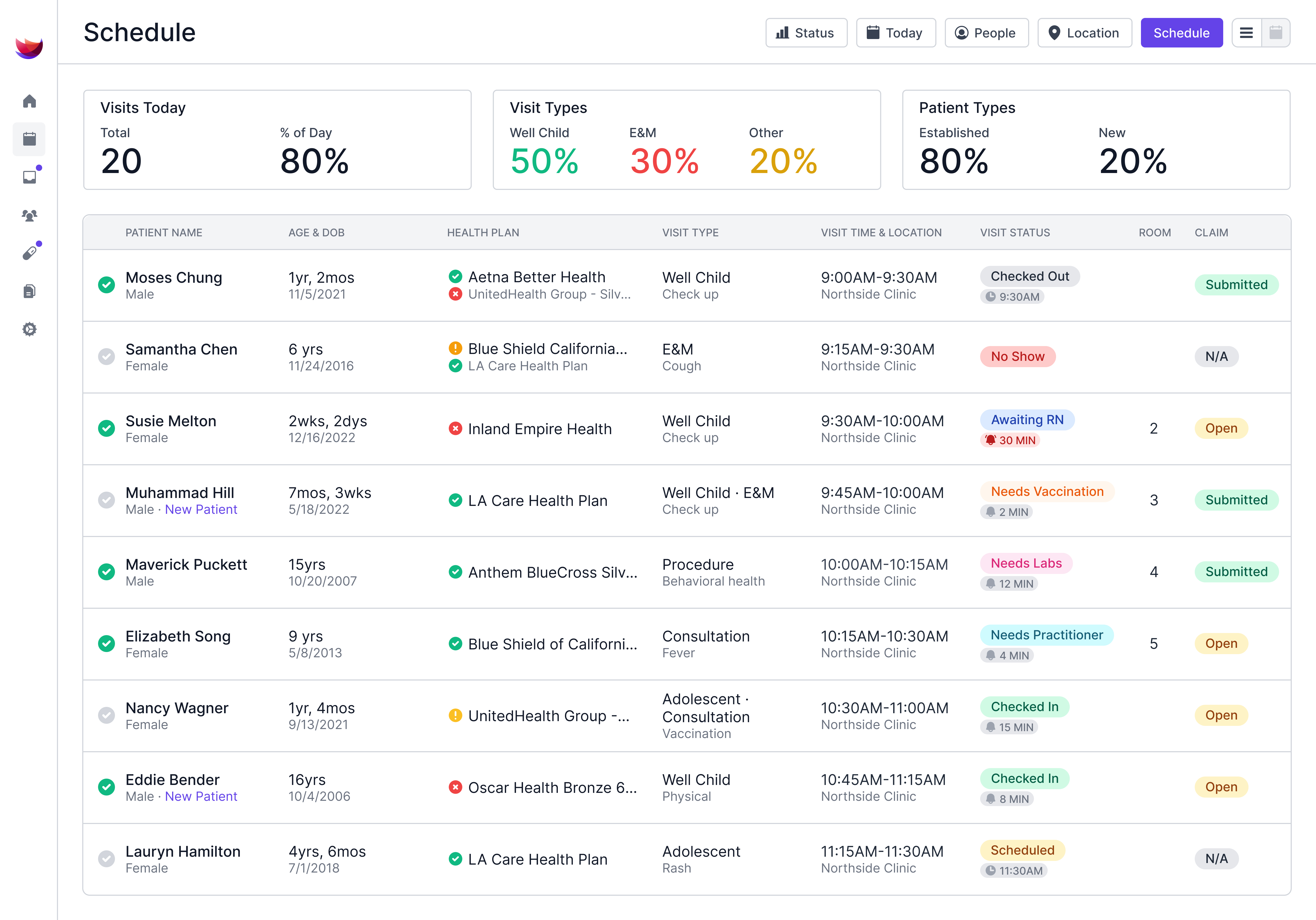


After testing intake and practice management tools used by independent pediatric clinics, the best IntakeQ alternatives are Develo for all-in-one pediatric automation, Office Practicum for established vaccine workflows, and PCC for practices that want deep clinical specialization and hands-on support.
Here's what each one does well, where it falls short, and who it's actually built for.
5 Best IntakeQ Alternatives for Pediatric Clinics: At a Glance
Pricing correct as of September 2026. Contact each vendor for a personalized quote.
Why Look for IntakeQ Alternatives?
IntakeQ is a capable digital intake tool. It handles HIPAA (Health Insurance Portability and Accountability Act)-compliant online forms, e-signatures, document sharing, and automated reminders.
The forms-only plan starts at $54.90/month, and the full practice management tier starts at $84.90/month.
But for pediatric clinics specifically, here’s what’s missing:
- No pediatric specialty support: IntakeQ's listed specialties are counseling, lactation, physical therapy, primary care, psychiatry, psychology, and occupational therapy. Pediatrics isn't included, and there are no AAP-aligned screeners or age-based form logic built in.
- No pediatric auto-scoring: PracticeQ — IntakeQ's practice management tier — offers an auto-scored assessments library, but it doesn't include pediatric instruments like M-CHAT-R.
- No clinical charting in IntakeQ: The forms-only IntakeQ plan has no Electronic Medical Record (EMR) functionality. Intake data doesn't connect to a clinical record.
TL;DR: Which IntakeQ Alternative Should You Choose?
Every clinic's situation is different. Here's a quick guide to help narrow it down:
- Choose Develo if: You want one platform to handle intake, clinical documentation, billing, and family engagement without stitching together separate tools.
- Choose Office Practicum if: Vaccine workflow management is your clinic's top priority and your team is comfortable with an older interface.
- Choose PCC if: You want a pediatric-dedicated vendor with a strong support model and don't mind highly manual coding and billing workflows for visits.
- Choose athenahealth if: You're part of a larger or multi-site group that needs wide network connectivity and strong revenue cycle management (RCM).
- Choose eClinicalWorks if: You're working with a tight budget and your team can configure pediatric workflows manually.
- Stick with IntakeQ if: Your existing EMR already covers clinical and billing needs and you just need a standalone forms tool.
The 5 Best IntakeQ Alternatives for Pediatric Clinics
1. Develo
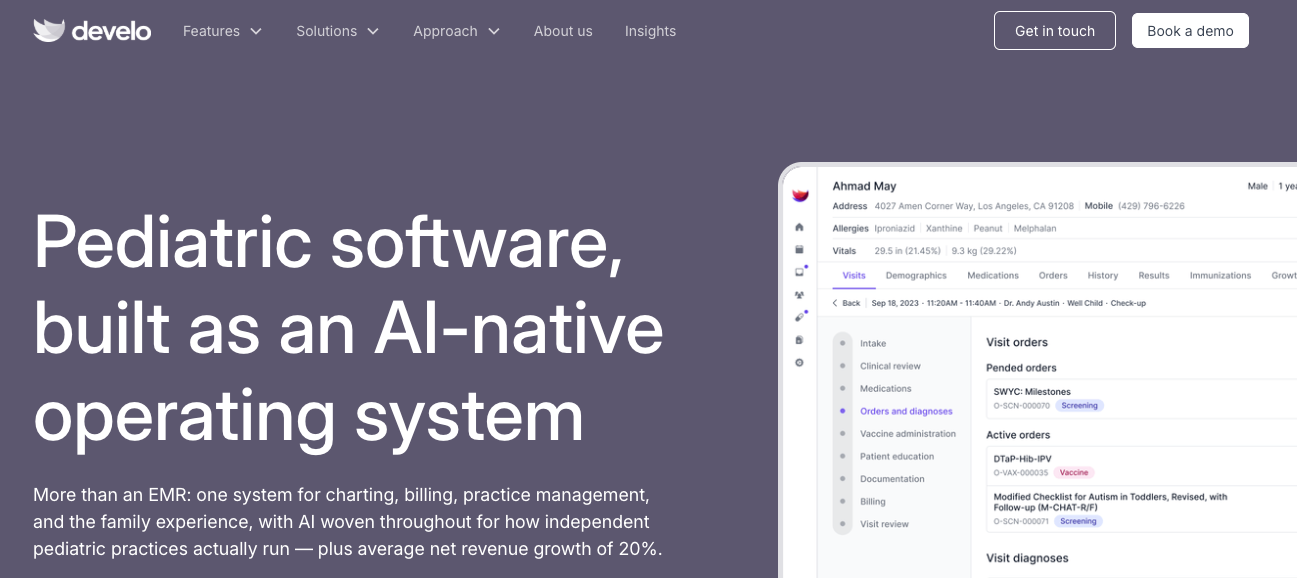
Alt text: Screenshot of the Develo homepage showing the platform's main navigation and hero section.
Develo is the AI-native pediatric operating system built solely for independent pediatric practices, going beyond the traditional EMR to unify charting, billing, practice management, and family engagement in one modern system.
Most pediatric clinics using IntakeQ are there because their EMR doesn't handle digital intake well.
Develo tackles that problem differently: intake, screening, scheduling, charting, billing, and family communication all live in the same system. Data collected before a visit flows directly into the clinical record and the billing workflow, with no manual transfers required.
We've migrated pediatric practices off dozens of alternative systems onto Develo, and the fields that break in a pediatric migration are always the same set: clinical screener results buried in static PDFs, immunization histories with no VFC eligibility details, growth and vitals series, and patient-caregiver links.
Key Features
- Digital intake and pediatric screening: Caregivers get forms and well child screens by text before the visit — PEDS or SWYC at 9, 18, and 30 months, M-CHAT at 18 and 24 months, plus behavioral health instruments like PHQ-9-A, GAD-7, and Vanderbilt. Each one scores itself, lands in the chart as discrete data, and carries its screening code on completion: 96110 for developmental screens, 96127 for brief behavioral and emotional assessments.
- Screening tasks that flag concerning results: A concerning score routes directly to the ordering provider as a task ahead of the visit, so a critical screen result never sits unread.
- Family-centered architecture: Siblings, blended households, and multiple guardians are managed natively, with insurance, demographics, and balances linked across family members.
- Automated charge capture: Billing codes generate from visit documentation using pediatric-specific coding rules, reducing underbilling and errors.
- Adolescent confidentiality controls: Confidential visit summaries generate automatically for teen visits, so adolescent content stays out of caregiver-facing views without anyone remembering to suppress it.
- A suite of AI, not one scribe: Develo AI forms digitizes any practice or patient form with the right variable and dynamic fields wired in. Develo intake scribe captures intake in the family's own language. Develo provider scribe documents the visit using the full patient and visit context, not just audio — pediatric-optimized, in around 100 languages.
Pros
✅ Replaces both your intake tool and EMR with one pediatric-specific platform, with no bolt-on tools needed for intake, billing, or family communication
✅ Screens auto-score and populate the clinical record without staff input
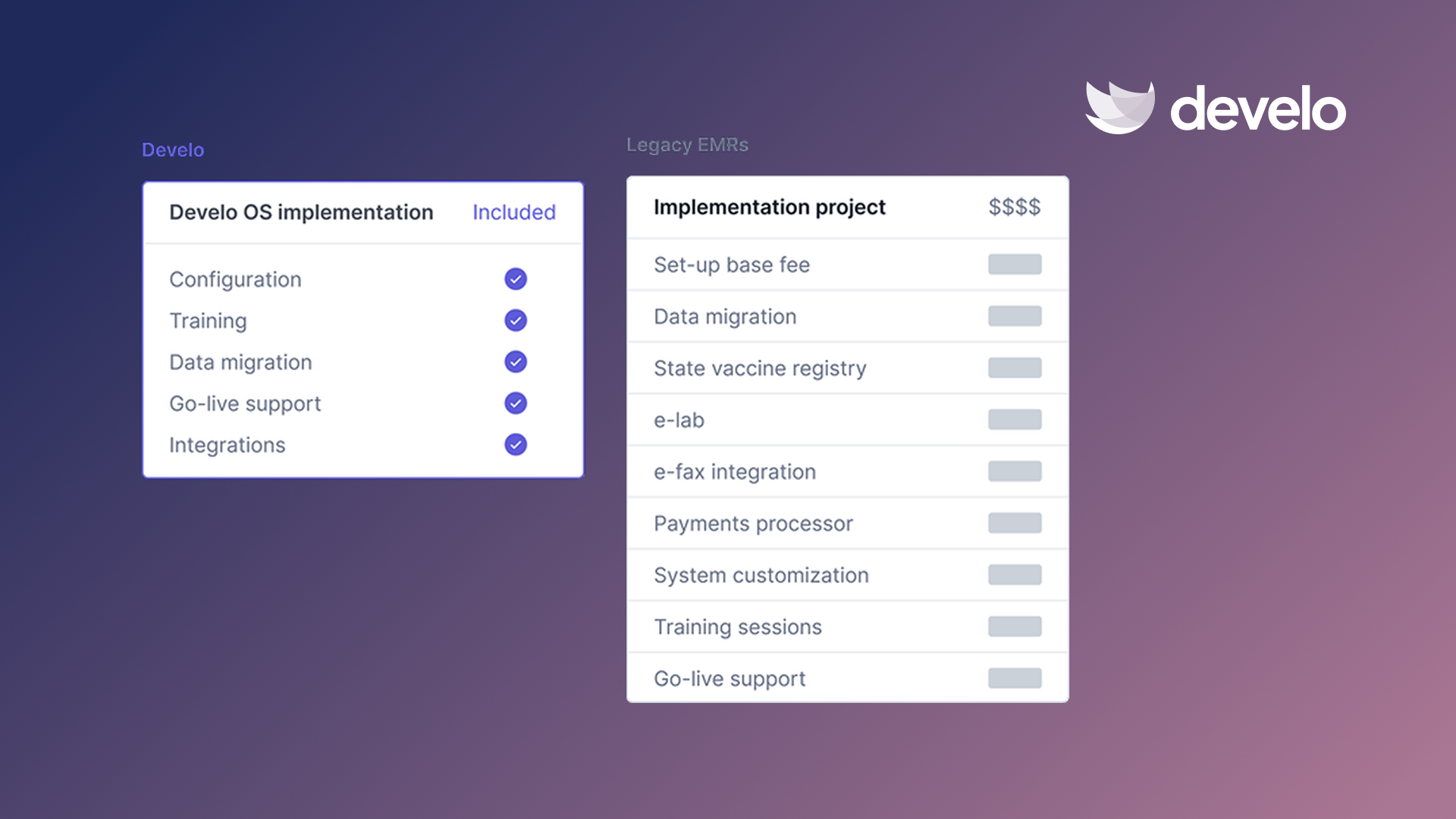
✅ Implementation, data migration, training, onshore support, and ongoing product upgrades are in the subscription rather than priced as add-ons
✅ ONC-certified and FHIR-native, backed by a $14M Series A led by Blueprint Equity
Cons
❌ Outpatient pediatrics only: no inpatient, multi-specialty, or family medicine
❌ A newer platform, so the peer user community is smaller
❌ Not the right fit if you only want to replace forms and keep your current EMR
Best For
- Independent pediatric clinics wanting one platform to replace both their intake tool and their EMR
- Practices dealing with disconnected intake, clinical, and billing workflows
- Clinics managing complex family structures across siblings and multiple caregivers
- Multi-location groups running a centralized back office across sites
Pricing
Develo uses per-provider, per-month pricing that includes software, implementation, data migration, training, and ongoing support.
Contact Develo for a custom quote.
2. Office Practicum (OP)

Alt text: Screenshot of the Office Practicum homepage showing the platform's main navigation and hero section.
Office Practicum is a pediatric-specific EMR (Electronic Medical Record) with clinical tools built around vaccine management, family structure, and behavioral health workflows.
Its standout feature is VacLogic+, which forecasts immunization schedules and tracks VFC (Vaccines for Children) and private vaccine inventory.
For practices coming from a lightweight tool like IntakeQ, OP is a significantly larger commitment in terms of setup and learning curve.
Key Features
- VacLogic+ immunization forecasting: Automates vaccine scheduling and tracks inventory across VFC and private stock.
- Automated school, sport, and camp forms: Over 200 state and national forms auto-populate from patient records.
- Family structure management: Handles blended families, adoption, and multiple caregivers natively.
- Behavioral health tools: Built-in screening and documentation for behavioral health workflows.
- Opie AI: AI-assisted documentation built into the platform.
Pros
✅ Deep vaccine management matched only by pediatric-specific systems
✅ Large, active user community built over 30 years
✅ Form-fill functionality with over 200 auto-populated state and national forms
Cons
❌ Currently undergoing a major reimagination initiative to rebuild the system
❌ Interface is less modern than newer cloud-native platforms
❌ Clearinghouse fees are separate from platform pricing
Best For
- Established pediatric practices looking for a full EMR with deep pediatric specialization
- Clinics where vaccine workflow management is a top clinical priority
Pricing
Office Practicum uses subscription-based pricing that varies by practice size and selected modules. Clearinghouse fees are separate. Contact Office Practicum directly for a custom quote.
3. PCC (Physician's Computer Company)
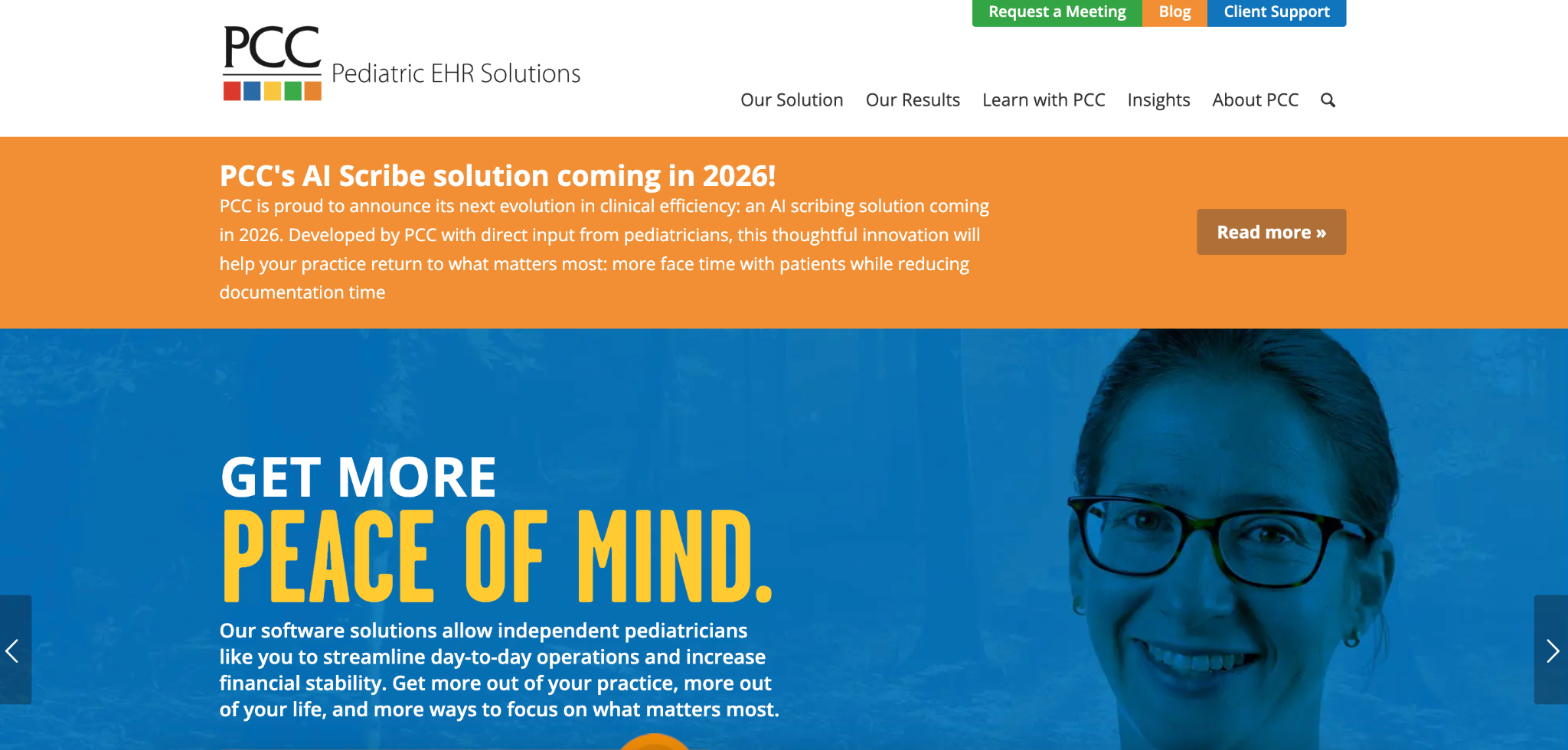
Alt text: Screenshot of the PCC homepage showing the platform's main navigation and hero section.
PCC is a pediatric-dedicated EMR built exclusively for independent pediatric practices.
As a full EMR, PCC is a significantly bigger commitment than a standalone intake tool like IntakeQ. The standard contract term is three years with an early termination fee.
Key Features
- Clinical workflow tools: Pediatric-specific documentation, immunization forecasting, and growth charts built for pediatric workflows.
- Dedicated Client Advocates: Personalized onboarding and ongoing coaching included in the monthly fee.
- Practice Vitals Dashboard: Clinical and financial performance data compared against anonymized peer practices.
- Active peer community: PCCTalk forum and annual Users' Conference included in pricing.
- Mobile app (pocketPCC): EMR, billing data, and e-prescribing accessible on mobile
Pros
✅ Pediatric-exclusive focus with over 40 years of specialization
✅ Best in KLAS 2026 for Ambulatory Pediatric EMR (8th consecutive year)
✅ One monthly fee with no startup costs or data conversion fees
Cons
❌ Standard contract term is three years with an early termination fee
❌ Clunky portal setup and a dated experience for parents with limited access controls
❌ Some functions, including intake-related capabilities, rely on third-party providers with limited integration depth
Best For
- Established independent pediatric practices replacing a full EMR, not just an intake tool
- Clinics that prioritize hands-on vendor support and a strong peer community
Pricing
PCC charges a custom monthly fee covering the EMR, billing software, family portal, mobile app, data conversion, training, 24/7 support, and clearinghouse fees. No startup costs. Contact PCC for a personalized quote.
4. athenahealth
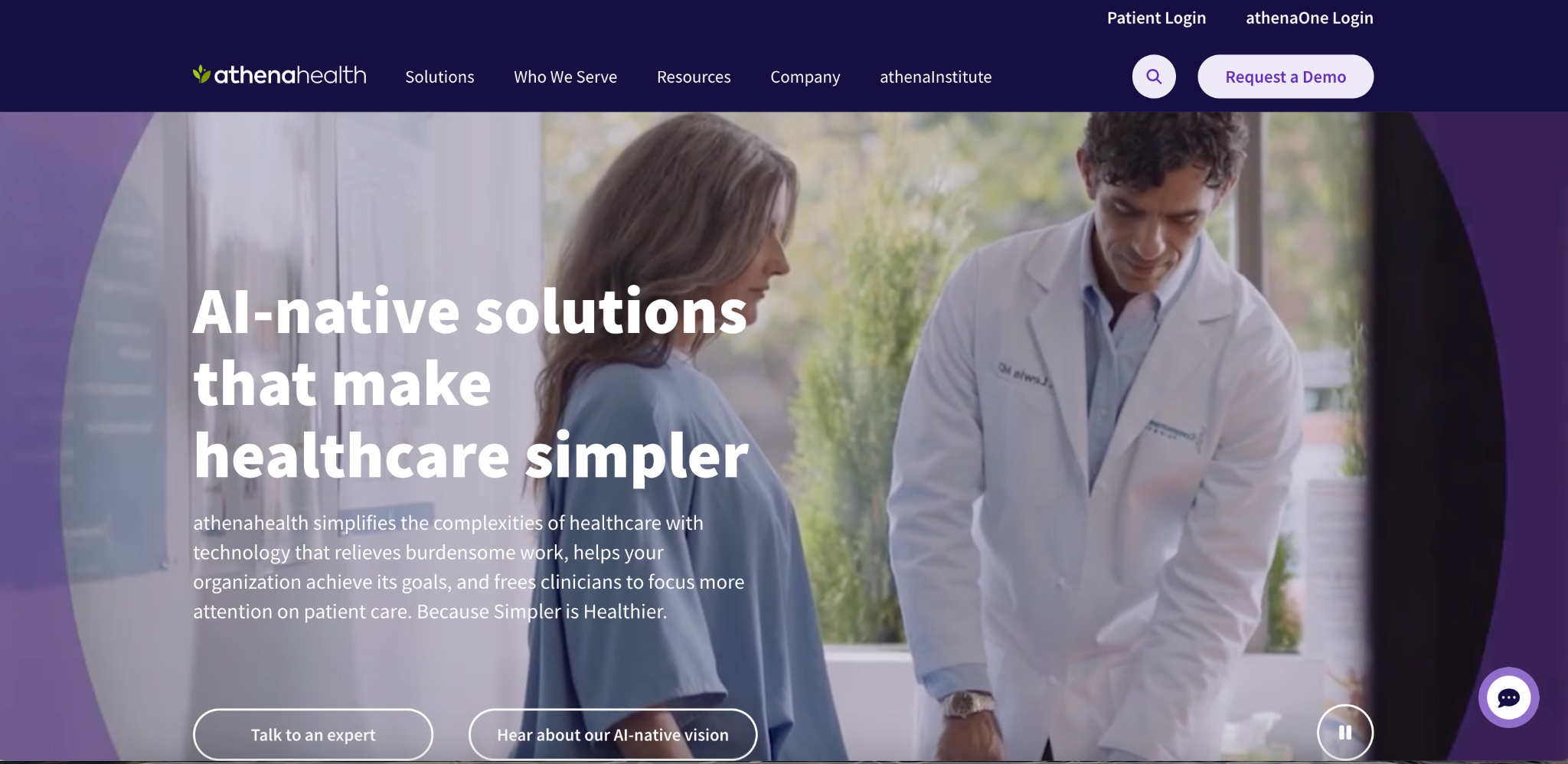
Alt text: Screenshot of the athenahealth homepage showing the platform's main navigation and hero section.
athenahealth is a multi-specialty ambulatory EMR built for outpatient care, with AI layered onto the existing platform, serving over 170,000 clinicians across its network.
Pediatrics is one of the specialties it serves, but it's a generalist platform at its core, and pediatric-specific workflows like immunization management and family structure will need configuration.
Pricing is collections-based rather than a flat per-provider fee, which can escalate for higher-revenue practices.
Key Features
- AI-assisted documentation: Configurable clinical documentation with AI tools added to the existing EMR.
- Practice management and medical billing: Automated claim workflows with RCM services available.
- Patient engagement tools: Self-scheduling, messaging, and digital intake.
- Broad interoperability: Connectivity with labs, pharmacies, hospitals, and specialist networks.
Pros
✅ Covers EMR, billing, and patient engagement in one platform
✅ Strong network interoperability for multi-site or hospital-affiliated practices
✅ No long-term contracts required
Cons
❌ Generalist platform. Pediatric-specific workflows require manual configuration
❌ Collections-based pricing can escalate for higher-revenue practices
❌ Built for multi-specialty ambulatory care, not exclusively for pediatrics
Best For
- Larger pediatric groups or multi-site practices that need broad network connectivity
- Practices already within an athenahealth-connected hospital or health system
Pricing
athenahealth's pricing is collections-based. Contact athenahealth directly for a personalized quote.
5. eClinicalWorks

Alt text: Screenshot of the eClinicalWorks homepage showing the platform's main navigation and hero section.
eClinicalWorks is a broad-specialty EMR covering scheduling, charting, billing, telehealth, and patient engagement.
Pricing is transparent and published on their website, starting at $499/month per provider. eClinicalWorks does publish a pediatric template and forms package, but it sits on a generalist multi-specialty core — the pediatric layer is content, not architecture.
Key Features
- EMR and practice management: Scheduling, charting, document management, and referral management included across plans.
- Telehealth: Built-in virtual visit capabilities.
- AI scribe (Sunoh.ai): Ambient documentation tool integrated with the EMR, sold as a separate add-on product.
- RCM services: Available as a standalone 2.9% of collections plan with full billing management included.
Pros
✅ Transparent, published pricing with no startup costs for practices with up to 9 providers
✅ Telehealth included across plans
✅ Free data migration from existing EMR systems
Cons
❌ Pediatric support is a template and forms package on a multi-specialty core, not a pediatrics-first design
❌ Click-heavy experience across administrative and clinical workflows
❌ No immunization forecasting or VFC inventory management
Best For
- Budget-conscious practices that want a published price and can live with pediatric depth that stops at templates and forms
- Clinics already using eClinicalWorks across other departments
Pricing
eClinicalWorks offers three plans: EHR Only at $499/month per provider; EHR with Practice Management at $599/month per provider; RCM as a Service at 2.9% of collections.
How to Evaluate IntakeQ Alternatives for Pediatric Clinics
Replacing your intake tool is a chance to fix more than just your forms workflow. If you're earlier in the process, our digital patient intake playbook and our roundup of pediatric patient intake software cover the ground before the vendor shortlist.
Before committing, consider these:
- EMR integration or replacement: If patient demographics, screener results, and insurance updates don't flow automatically into your EMR, staff are still doing manual data entry after every visit.
- Pediatric screener automation: Look for a platform that sends age-appropriate screeners automatically and scores them without staff involvement, rather than requiring manual calculation after each visit.
- VFC eligibility capture: Vaccines for Children eligibility has to be screened and documented at every immunization visit, and it decides which stock the dose comes out of. If intake doesn't capture eligibility and pass it to the chart, staff re-ask at the front desk and the answer never reaches the vaccine record, which is exactly where an audit looks for it. Ask whether eligibility is a field in the intake flow or a sticky note on the visit.
- Family relationship management: Pediatric intake covers multiple siblings, blended households, and different caregivers. A tool built around individual patient profiles can add friction for every subsequent child in a family. A newborn is the hardest case. The baby arrives before there's a member ID and sometimes before there's a legal name, so the record has to open against the mother's policy, with coverage generally back-dating to the date of birth once the infant's own ID comes through. Ask how the platform registers a patient who can't yet be identified on their own — a tool that requires a complete identity to create a record means your staff register every newborn by hand.
- Adolescent confidentiality: Teen patients have specific privacy rights. Your platform needs to separate adolescent records from parent-facing views without manual management to stay compliant with applicable privacy laws.
- Total cost of ownership: The intake subscription isn't the cost. Add your EMR fee, any separate screener or reminder tool, the clearinghouse, and the staff hours spent re-keying intake data into the chart after every visit. A $54.90 forms tool sitting on top of a $500-per-provider EMR, plus the staff time to move data between the two, is a different number than it looks like on the invoice.
Why Independent Pediatric Clinics Are Replacing IntakeQ With Develo
IntakeQ handles digital tools well, but a forms tool can’t cover the families, screeners, billing, and clinical documentation that a pediatric clinic runs every day.
Develo takes a different approach entirely. It's an AI-native operating system that brings charting, billing, practice management, and family engagement together in one platform, purpose-built for independent pediatric practices.
Here's what that looks like day-to-day:
- Intake runs before the patient arrives: Pre-visit forms, consent documents, and age-appropriate screeners go out via SMS at booking. Screeners score automatically and flow straight into the clinical record.
- Family relationships are built into the platform: Siblings, multiple caregivers, and blended households are managed at the system level.
- Billing is tied directly to clinical documentation: Pediatric-specific coding rules apply at the point of care, so billers spend time reviewing exceptions rather than building every claim manually.
- One login for your whole team: Intake, clinical documentation, and billing all run in the same system, with no manual data transfers between tools.
- Develo provider scribe reduces after-hours charting: The scribe documents the visit as it happens, using the full patient and visit context, so providers aren't finishing charts at the end of the day.
- Adolescent confidentiality is handled automatically: Teen records are separated from caregiver-facing family portal views at the system level, so staff aren't managing visibility visit by visit.
If managing intake, clinical documentation, and billing across separate tools is slowing your clinic down, book a free demo to see what Develo can do for your practice.
Frequently Asked Questions
What Is the Best IntakeQ Alternative for Pediatric Clinics?
The best IntakeQ alternative for pediatric clinics is Develo, because it replaces a standalone forms tool with a fully integrated pediatric platform. Develo connects pre-visit intake, clinical documentation, screener scoring, billing, and family communication in one system built for outpatient pediatric care.
Does IntakeQ Work With Pediatric EMRs?
IntakeQ offers API and integration options, but the questions that decide whether staff still re-key data are specific: does a completed form update patient demographics in your EMR, and does a scored screener land in the chart as data rather than a PDF? Ask both before assuming intake is connected.
What's the Difference Between IntakeQ and a Pediatric EMR?
IntakeQ is a standalone forms tool that handles digital intake and basic patient communication, but doesn't include clinical charting, immunization management, or billing. A pediatric EMR covers all of those workflows in one system.
How Should Pediatric Intake Handle Insurance That Changes Between Visits?
Pediatric panels are weighted toward Medicaid and CHIP, and that coverage can lapse at redetermination between two well child visits with no notice to the practice. Intake that only collects insurance from new patients will keep billing a plan the family no longer has, and the practice finds out at the denial. Look for pre-visit intake that re-verifies coverage for established patients as well as new ones, and surfaces the change before the visit rather than after the claim.
Can I Replace IntakeQ With an All-in-One Pediatric Platform?
Yes, you can replace IntakeQ with an all-in-one pediatric platform like Develo. Develo includes intake as part of a broader pediatric practice management system, with no third-party add-on required. Develo’s pre-visit screeners score automatically and flow directly into the clinical record.
What Happens to My Existing IntakeQ Forms if I Switch?
You don't rebuild them from scratch. Develo AI forms takes a practice's existing forms — consents, registration packets, practice-specific paperwork — and auto-digitizes them, wiring in the variable and dynamic fields so they pull from the chart instead of asking the family to re-type what you already know. The forms you spent a year refining in IntakeQ come across as the starting point, not as a blank slate.
Should I Just Switch to a Different Intake Tool Instead?
You can, but the ceiling is the same. Any standalone forms tool sits outside the clinical record, so a scored screener still arrives as a document rather than as data, demographics still get re-keyed, and nothing captured at intake reaches the claim. The pediatric-specific gaps — age-based screening logic, VFC eligibility, family relationships, adolescent confidentiality — aren't pure form problems, so a better forms tool never solves them.
.png)


.avif)