

Plenty of EMR vendors market their systems to pediatric practices, but some weak spots only surface after go-live. Staff may find that the system can't track Vaccines for Children doses apart from private stock, link sibling charts, or keep teen notes out of a parent's view.
An EMR request for proposal (RFP) asks each vendor to put its pediatric claims in writing before you sign a contract. The template below borrows the structure that public agencies use for EMR bids and adds the child-specific needs those bids aren't built around.
This way, you can send your own EMR RFP this week and score every reply against weighted criteria that your own team has set.
What's an EMR RFP?
An EMR RFP is a formal document that asks software vendors how their system will meet your practice's needs and what it will cost.
Practices, health systems, and public agencies send RFPs so they can compare bids on equal terms. Each vendor fills in the same structure, so a clinic can line up answers about features, fees, and support one row at a time.
RFI vs RFP vs RFQ
An EMR search can involve three procurement documents, and each one fits a different stage:
- RFI (request for information): A short survey about each company's product, customers, and pricing model, used to cut down a long list.
- RFP (request for proposal): A detailed request for a proposed system, rollout plan, and itemized price, sent only to shortlisted vendors.
- RFQ (request for quotation): A request for cost alone, which suits add-ons like scanners better than a full EMR choice.
Sending a quick RFI to a wide field, then a full RFP to three or four finalists, keeps the workload manageable for a small team.
How to Write an EMR RFP in 6 Steps
To write an EMR RFP, start with a selection team and end with scripted demos.
1. Build a Small Selection Team
Your selection team needs one person from each area the EMR will touch. Good picks include a provider lead, the practice manager, and a nurse or medical assistant. Add someone from the front desk and your billing lead, too.
Bringing in staff before you choose a vendor can head off common EMR implementation challenges. Daily users can spot workflow issues that a sales demo won't show.
2. Map Workflows and Set Requirements
Requirements start with how your clinic works today. Walk through a typical visit from check-in to billing, and note every paper form and workaround along the way.
Put pediatric needs, such as vaccine inventory, linked sibling charts, and adolescent privacy, near the top of the must-have list. An EMR designed for pediatrics should handle each piece without add-ons or manual steps.
3. Screen Vendors With a Short RFI
A one- or two-page RFI sent to a handful of vendors can show which ones fit your basic needs. Shortlist three or four, then look up each one on the federal Certified Health IT Product List (CHPL).
ONC runs the CHPL, which shows whether the exact version on offer holds current certification.
4. Send the RFP With Clear Rules
Clear rules keep replies easy to compare. Give every bidder the same due date a few weeks out, one contact person, and a numbered format that matches your requirement list.
A line saying written answers may become part of the contract gives each vendor a reason to stay specific.
5. Score Responses With Weighted Criteria
Weighted scoring means your team decides how many points each area carries, such as clinical fit, billing, and support.
Setting up an EMR comparison matrix before bids arrive keeps a polished pitch from winning on looks alone.
6. Run Scripted Demos With Your Staff
Scripted demos make each finalist walk through your own visit scenarios, in your chosen order, while your staff watch.
Pediatric scripts can test the visits a general system may struggle with:
- A 4-month well child visit with Vaccines for Children and privately bought doses
- A sick visit for a sibling brought in by a different guardian
- A confidential visit for a 16-year-old
- A weight-based prescription for a toddler
- A newborn's first visit, registered before the baby has a member ID or a legal name
Give dosing extra time. In a 2018 study of 9,000 pediatric safety reports from three health care systems (Ratwani et al., Health Affairs), each likely tied to EMR use, 36% involved a usability problem that contributed to a medication event. Improper dosing was the most common type of error.
Have clinicians drive part of each demo, too. When 870 U.S. physicians rated their EMRs on a standard usability scale (Melnick et al., Mayo Clinic Proceedings, 2020), the average score was 45.9 out of 100, a grade of F. Each one-point rise in that score was linked to 3% lower odds of burnout.
EMR RFP Template: Sections and Sample Wording
Every section in an EMR RFP template should give vendors enough facts to quote accurately and give your team a fair basis for comparison.
Adapt this sample wording to your clinic:
- Practice overview: "Our independent pediatric practice has four providers at one location, and our current EMR contract ends next June."
- Goals: "We want to cut after-hours charting, lower claim denials, and move intake forms and screeners off paper."
- Instructions: "Answer each numbered item in order and send your response as one file to our practice manager by the due date. All vendor questions and answers will be shared with every bidder."
- Functional requirements: "Mark each requirement Yes (standard), Yes (needs configuration), Third-party, or No, and explain any answer other than Yes (standard)."
- Technical and security: "Describe your hosting model, uptime commitment, and access controls. Confirm you'll sign a business associate agreement."
- Pricing: "List every one-time and recurring fee on one pricing sheet. Fees left off this sheet won't be accepted after signing."
- Implementation and support: "Provide a week-by-week plan to go-live, and written support response times by severity."
- References and contract: "Share three references from pediatric practices that went live on your system within the past two years, and explain how we'd export our data if we leave."
- Evaluation: "Responses will be scored against five weighted criteria our team has set in advance, from clinical fit to total cost."
A focused template is easier for vendors to answer and faster for your team to score.
EMR RFP Questions to Ask Vendors
Good vendor questions ask for proof, such as screenshots, timelines, or itemized fees. Grouping them into the ten areas below lets each team member score the part they know best. The last three look past features to who does the work, who owns the company, and how the software runs. Those three shape the system you'll use five years from now.
Clinical Features
Start by testing pediatric depth. A 2021 AAP policy statement noted that some EMRs still lacked child-specific tools, such as immunization decision support, weight-based dosing, and pediatric blood pressure percentiles. Include questions like these:
- "Show how the system forecasts vaccines due under the AAP immunization schedule, and tracks Vaccines for Children and private stock separately."
- "How do you link siblings, guardians, and the guarantor across family charts?"
- "How are confidential teen notes kept out of the family portal?"
Ask vendors to list the cost of any third-party add-on a feature needs to function.
Billing and Revenue Cycle
Pediatric claims follow rules that general billing tools often leave to staff memory. Ask each vendor to show these on screen:
- "How are vaccine administration codes added when a child gets a combination vaccine and two single vaccines, with counseling, in one visit?"
- "How does a well child visit that also addresses a sick problem get billed, including modifier 25?"
- "When a developmental screener is completed, how does it become its own 96110 line?"
- "How is VFC eligibility captured at each visit, and how do VFC doses bill without charging for the vaccine itself?"
Implementation and Data Migration
A clear rollout plan names who does the work, how long it takes, and which records arrive in usable form. Ask each vendor:
- "What's your typical timeline from signing to go-live for a practice our size?"
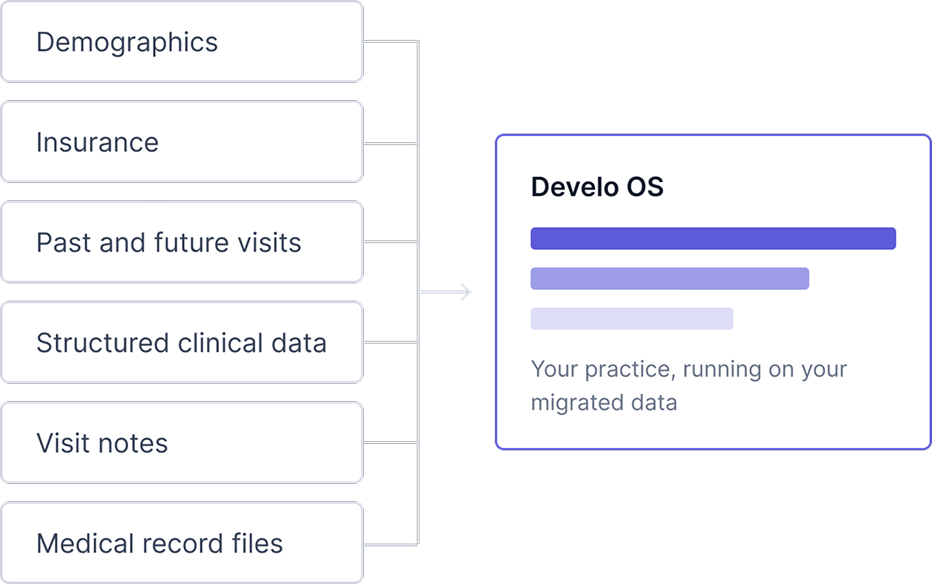
- "Which records move as structured data, and which arrive as scanned files?"
Your current EMR also plays a part once you start migrating patient records. Certified EMRs must create a computable export file of all the electronic health information they can store, with a publicly accessible link to the file's format.
Interoperability and Technical Requirements
Every outside connection an EMR lacks can leave staff typing data in by hand. Put these questions in the RFP:
- "Which state immunization registries do you connect to, and do those connections send and receive data?"
- "Which lab, eFax, and clearinghouse connections are built in?"
Request the list of current connections in writing, since a planned interface may not be ready by your go-live date.
Security and Certification
Patient data protection starts with HIPAA and current federal certification. Cover both with questions like:
- "What's the CHPL listing for the version we'd use?"
- "Will you sign a business associate agreement?"
- "Do you support role-based access and multi-factor authentication for every user?"
A summary of the vendor's most recent security risk assessment can round out this part of the response.
Pricing and Invoicing
Fee questions should uncover every charge behind your EMR implementation cost, plus the monthly subscription. Get answers to these in writing:
- "How do you count providers, and how are part-time providers billed?"
- "Are data migration, configuration, and training included in setup or billed separately?"
- "Which fees are one-time, which recur, and how much notice do you give before a price increase?"
- "Will you share your full fee schedule, including services not in this proposal, and hold those rates for the length of the contract?"
A full fee schedule shows what you could be charged later for work outside the proposal, such as an added interface or extra training, and locks in those rates before you sign. A three-year total for each vendor puts every bid on the same yardstick.
Training and Support
Support answers show who fixes problems once the sales team moves on. Ask each vendor:
- "Who answers our first call for help, and where is that team based?"
- "During which hours can we reach a live person, including evenings and weekends?"
- "Who stays with our practice after go-live, and how much training is included?"
Check every answer with reference calls, and hold each vendor's promises up against an EMR support evaluation checklist.
Staffing Model
Many EMR vendors manage implementation, support, and even development for cost rather than quality, often by outsourcing the work offshore or to third parties. When work passes between contractors, it gets harder to tell who is accountable when something breaks. Ask each vendor:
- "Who writes and maintains your software: your own employees or contractors, and in which countries?"
- "Are the people who implement our system and answer our support calls your own employees, and where are they based?"
- "If you offer billing services, who works our claims: your staff, a subcontractor, or an offshore team?"
Get an answer for each function in writing, since a vendor can keep development in-house while outsourcing support.
Company Ownership and Stage
A vendor's owners shape its priorities, and most traditional EMR vendors are now owned or backed by private equity firms. Examples include athenahealth (Bain Capital and Hellman & Friedman, 2022), NextGen (Thoma Bravo, 2023), Greenway Health (Vista Equity Partners, 2013), and Office Practicum (Pamlico Capital, 2018). Buyouts are often financed partly with debt, which pushes owners to cut costs. The typical private equity investment is now sold after about six years, so a practice on a five-year contract may see its vendor change hands before the contract ends.
Founder-led and physician-led vendors often keep product decisions closer to the clinicians who use the system. Earlier-stage vendors have a shorter track record, but they usually reinvest heavily in product, implementation, and support. Ask each vendor:
- "Who owns your company, and when did ownership last change?"
- "Is the company founder-led, and are physicians involved in product decisions?"
- "If you're owned by a private equity firm, when did that investment close, and what happens to our contract and pricing if the company is sold?"
- "How many pediatric practices are live on your system today?"
Technology Platform
Hosting and release practices decide how fast fixes reach you and whether staff lose access during upgrades. Start with the setup your practice would get. Ask each vendor:
- "Would our practice be hosted on-premises, in a private cloud, or on a modern public cloud?"
- "How often would we receive updates, and would they require downtime?"
- "Do updates ship through continuous integration and delivery, or roll out to practices in waves?"
Then ask about the vendor's whole customer base. Legacy EMRs often run a wide mix of software versions, hosting setups, and update processes, and maintaining that mix is what slows their releases down. Count every product the vendor sells, since some sell more than one EMR, such as Veradigm EHR and Practice Fusion from Veradigm (formerly Allscripts), or NextGen Enterprise and NextGen Office. Ask each vendor:
- "Across all of your products and customers, how many software versions are in use today, how many hosting setups do you support, and how many different update processes do you run?"
Common EMR RFP Mistakes
An EMR RFP can fall short before any vendor replies. Check for these blind spots in your RFP before you send it off:
- Copying a public-agency bid: Public bids from counties and universities can include insurance clauses and procurement rules written for those settings, so a clinic still has to add its own pediatric needs.
- Asking yes-or-no questions: A question like "Do you support immunizations?" is easy for any vendor to answer with a yes. A walkthrough of each workflow gets more useful replies.
- Letting vendors format their own pricing: Quotes laid out in different ways are hard to compare and easy to misread. One shared pricing sheet puts every bid in the same format.
- Skipping exit terms: Ask each bidder how you'd get your data back if you leave, including file format, any fees, and how long read-only access lasts. Your leverage drops once the contract is signed.
How to Right-Size an EMR RFP for a Small Practice
A small practice can right-size an EMR RFP by keeping only its must-have requirements and sending the RFP to a shortlist of finalists. A roundup of the best EMRs for small pediatric practices can help you build that list. Scripted demos cover what a written reply can't show, such as how quickly staff move through a visit.
For an independent clinic, aim for a short RFI and an RFP of about 5 to 10 pages. Clinics paying with federal grant funds must follow federal procurement methods that require sealed bids or formal proposals above a set dollar threshold.
Larger or publicly funded organizations may need a full formal process with legal sections and bid rules. Groups tied to a health system may also have internal purchasing policies that call for a formal bid.
Start Your EMR RFP Shortlist With Develo
An EMR RFP works best when each finalist can show its written answers in action during a scripted demo built on your clinic's own visits.
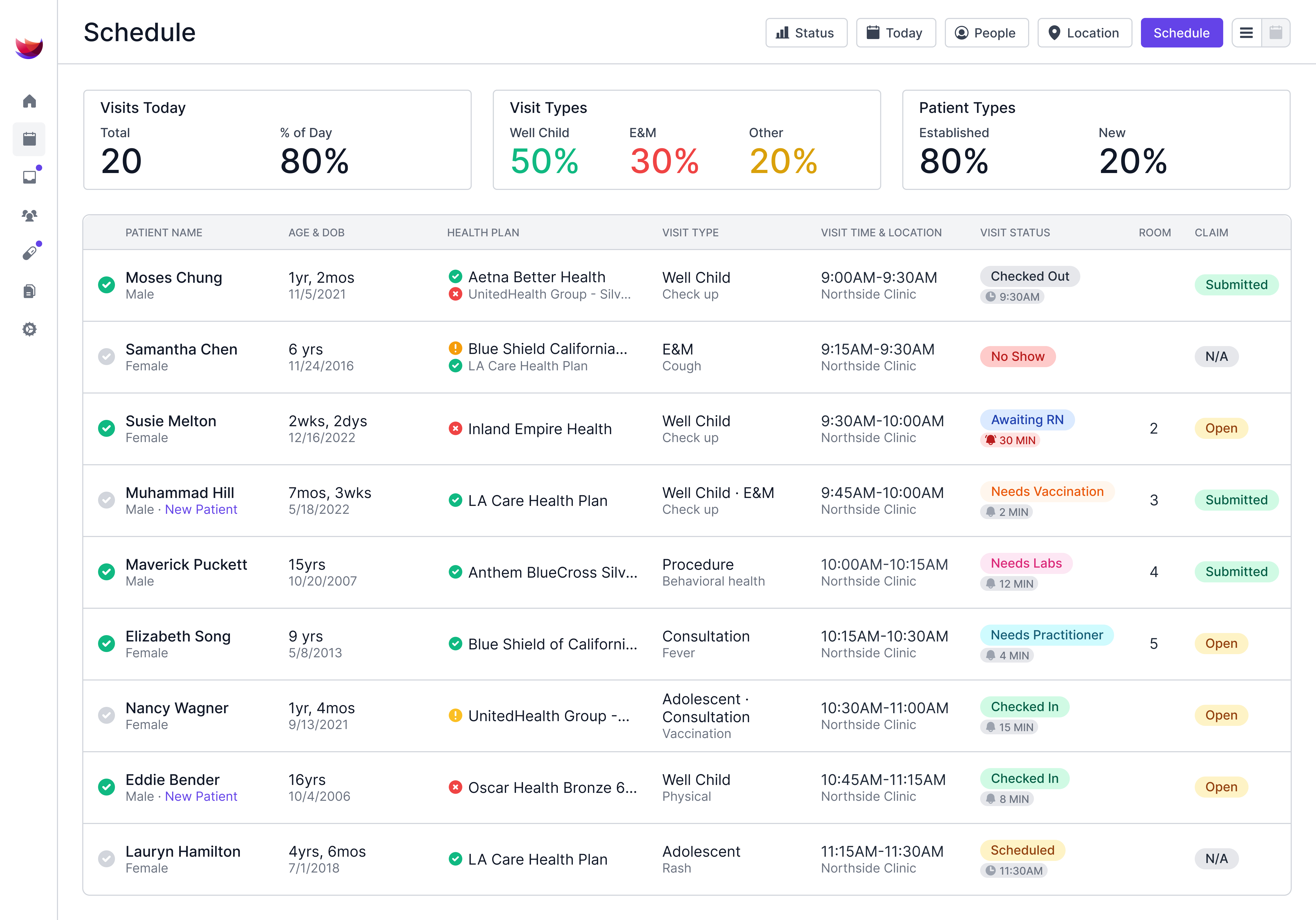
As the AI-native operating system for pediatrics, Develo unifies charting, billing, practice management, and family engagement in a platform built from day one for outpatient pediatric care.
Here's what Develo offers across the main RFP sections:
- Pediatric workflows: Immunization forecasting checks each child's history against the AAP schedule, inventory is tracked by funding source with each dose's VFC eligibility auto-checked against the lot, and supported state registries connect bi-directionally in real time. Family records follow guardian and guarantor ties across siblings, and each prescription pulls in the child's latest recorded weight so the dose is checked before it's sent.
- Adolescent confidentiality: Adolescent visits get a dedicated, confidential section of the note. Teens get their own family portal login, and they see confidential visit summaries while caregivers see a more limited version.
- Billing: Automated charge capture adds vaccine and vaccine administration codes for every shot, counting components and injections, with the child's age, Medicaid or commercial coverage, and VFC eligibility taken into account. Completed screeners drop their billing and diagnosis codes onto the visit, and the Develo AI scribe proposes adding an E&M code when a well child visit also addresses a sick problem.
- Documentation: The Develo AI scribe drafts the visit note from the conversation and pertinent chart data, and a clinician approves every section.
- Implementation: Develo configures the system before your first login, offers live and on-demand training, and moves your data with migration templates built for each source system.
- Integrations: Lab orders go out electronically with results returning as tasks linked to the order, and Develo doc intel tags each incoming e-fax by patient and document type.
- Certification: Develo EHR v3 holds ONC certification, including the criteria for electronic health information export, access control, and multi-factor authentication, and Develo signs a business associate agreement with every customer.
- Pricing: Comprehensive pricing with a per-provider monthly fee and no implementation fee: data migration, configuration, and training are part of the package, and there's no separate clearinghouse charge. Routine work like faxes, visit reminders, and support tickets doesn't add cost. The Develo AI scribe is priced separately.
- Support: Practices reach a fully onshore team based in the U.S. and Canada. Pediatric experts answer clinical, practice operations, and billing questions during business hours in your time zone. The customer success manager who configured your practice stays with you after go-live, and an on-call engineer covers critical issues around the clock.
- Staffing: Develo's own employees, based in the U.S. and Canada, build the software, implement and support each practice, and staff the optional billing services team.
- Ownership: Develo is founder-led and physician-led, founded in 2022 by CEO Aaron Sin, MD, and CTO Han Ke.
- Technology: Develo runs cloud-native on AWS, with every practice on the same version, configured to its own workflows. Updates ship through continuous integration and delivery, with minor releases weekly and major releases every two weeks, in the background with zero downtime.
Book a demo to see how Develo can handle the scenarios in your EMR RFP script.
Frequently Asked Questions
What Does RFP Stand For in Healthcare?
RFP stands for request for proposal, a document that invites companies to bid on a defined project or purchase. For a medical practice buying an EMR, the RFP comes after the vendor shortlist and before the contract.
What Does ONC Certification Mean for an EMR?
ONC certification means that an EMR has been tested and certified under a federal program that checks software against technical, functional, and security requirements adopted by HHS. The program only sets a baseline, so pediatric workflows still deserve their own test in a scripted demo.
What's a Business Associate Agreement?
A business associate agreement is a written contract that HIPAA requires between a practice and any vendor handling its protected health information, like an EMR company. It sets the permitted uses and disclosures of patient data and requires the vendor to put safeguards in place.