

The cost of EMR implementation runs from a recurring per-provider subscription to tens of thousands of dollars upfront, and the quote you're handed rarely captures all of it.
Setup, data migration, and the weeks your team spends learning the system instead of seeing patients are where the budget really goes. For an independent pediatric practice, those are the costs worth planning for first.
The Real Cost of EMR Implementation
The real cost of EMR implementation comes in two parts: a one-time bill to get set up, and a monthly subscription you pay for as long as you use the system. Published estimates vary widely, so treat them as rough anchors rather than final quotes.
- Upfront implementation: for vendors that publish it, anywhere from nothing to a few thousand dollars. eClinicalWorks lists no start-up costs for practices with 1 to 9 providers, and AdvancedMD lists setup from free to $1,000 for smaller practices and data migration from $800 to $2,000. Many vendors publish nothing and quote these fees separately, often after you have already committed.
- Ongoing subscription: traditional EMR systems usually price on a per-provider, per-month basis, with exact pricing dependent on the selected system and the size of your practice.
Treat published prices as the floor, not the total. They leave out staff time, the productivity dip, add-on professional services, and the interface fees covered below, which is where most practices go over budget.
The Cost Components at a Glance
EMR costs fall into a handful of line items, each landing either upfront or as an ongoing fee. The table below shows what every component typically runs for a small to mid-sized practice, and when you pay it.
Pediatric practices carry interfaces most cost guides miss: bi-directional state immunization registry (IIS) connections and electronic lab interfaces can each add their own per-interface fee, so a pediatric stack often has more integration lines than a general practice.
These are cross-market industry estimates for a small to mid-sized practice in 2026, not figures from a single authoritative source. The one public benchmark, ONC's cost data, is aggregate and predates cloud delivery, which has since compressed the hardware and support lines. Treat the ranges as planning anchors and confirm each with your vendor, since deployment model, specialty, and practice size swing the total widely. Published vendor rates sit at the low end; the upper end reflects quote-based vendors and custom builds.
What Are the Upfront Costs of EMR Implementation?
Upfront costs are the one-time fees you pay before and during go-live. The ranges below are typical 2026 estimates for a small practice and shift with your vendor and how much you customize.
- Software setup and configuration: $5,000 to $20,000 to stand up your environment, set up your user accounts, and manage key system admin and clinical configurations.
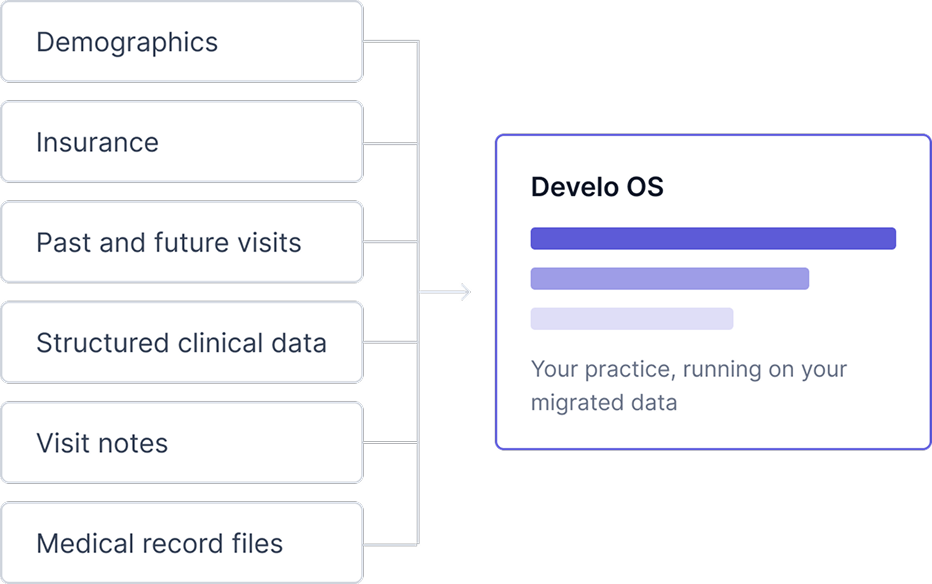
- Data migration: $2,000 to $10,000, rising with the volume, age, and format of your records. In pediatrics, ask whether immunization histories come across as structured data with lot numbers and VFC eligibility, and whether growth and vitals series arrive as plotted data rather than scanned PDFs. A migration that flattens them into documents costs less upfront and more at every well child visit after.
- Training: $1,000 to $5,000 per team, and one of the costs practices most often underestimate, especially when training beyond the initial package is billed hourly as professional services.
- Hardware and devices: $5,000 to $20,000 for servers and workstations, mostly on-premise, which cloud systems largely remove.
Ongoing Costs of an EMR
Ongoing costs are the fees that recur for as long as you use the system. After go-live, the meter keeps running.
- Software subscription: usually priced per provider per month, and the biggest long-run number once you multiply it across every provider over multiple years.
- Support and maintenance: usually folded into the cloud subscription, but a separate annual cost for on-premise practices carrying their own IT staff, security updates, and backups.
- Add-on modules: features you turn on later, each with its own monthly fee.
- Extra user licenses: a per-seat cost as your team grows. Check if you are buying licenses for an entire term, or worse, named licenses tied to a specific pediatrician that stay billed even after that provider leaves the practice.
- Interface fees: an ongoing charge for each outside system you keep connected.
- Bolt-on software: filling in gaps in your traditional EMR system with additional software, such as those for digital intake, portal access, payments processing, and AI scribe. Each comes with additional cost and integration shortfalls.
The Hidden Costs Practices Forget
The invoice is only part of the bill. Three costs seldom show up in a vendor quote.
- Productivity loss during the switch: visit volume drops while staff learns the system, and the dip can outlast go-live. A 2015 study of 30 ambulatory practices (Howley et al., JAMIA) found productivity fell by about 18 patients per physician per quarter, though revenue rose because practices billed roughly 94 more ancillary procedures per quarter, with no sign of upcoding.
- Ongoing retraining: staff turnover, system updates, and payer rule changes mean training recurs well past go-live. ONC's Health IT Playbook covers the optimization work that continues after implementation.
- Customization and integrations over time: the lab feed, the billing connection, and the family portal tie-in each carry their own fee, and they add up as your stack grows.
The rollout timeline drives the productivity dip directly. A cloud rollout for a small practice usually takes several weeks to a few months from contract to go-live, and the drop in visit volume tracks that window, especially in the first two to three weeks after go-live.
A longer implementation means a longer stretch of reduced throughput, so a migration with clean data and a fixed cutover date costs less than an open-ended one. Most of what stretches a rollout shows up in the nine most common EMR implementation challenges.
What Does a First-Year EMR Budget Look Like?
A realistic first-year budget for a three-provider cloud practice runs about $12,000 in one-time implementation costs, on top of the subscription. That covers setup, migration, training, and devices, broken out below.
Treat these as planning figures. Your total will shift with your vendor and how much onboarding your team needs. Training here sits at the low end of the range, so build in more if go-live will be heavy. Devices sit below the hardware range above because a cloud practice buys no servers.
On top of that, budget for the temporary dip in visit volume during the switch, which can cost more than any single line above. Time the switch to the pediatric calendar: summer runs into back-to-school physicals and the fall vaccine push, winter into respiratory season, and late spring is usually the only stretch with real slack.
Your total also depends on how many providers you have. Cost per provider falls as you add clinicians, because setup, migration, and training grow more slowly than headcount. A solo pediatrician carries the highest cost per head, because those startup costs spread across fewer providers.
How an EMR Pays for Itself
When the rollout goes well, an EMR can pay for itself within a few years, and the return arrives through three channels.
- Higher reimbursement per visit: practices bill more ancillary procedures, like immunizations, blood draws, and wound care, for work they already perform.
- Fewer denials: cleaner front-end claims and eligibility checks cut the rework that ties up billing staff. That matters more in pediatrics, where visit values are low and volume is high.
- Reclaimed provider hours: time on paperwork returns to seeing patients or to leaving on time, hours your current system quietly costs you.
A 2022 systematic review of 58 EMR value studies, published in JMIR Medical Informatics, found most but not all pointed to a return: of the 21 that measured financial outcomes, 17 found a positive association with adoption and 4 a negative one.
The difference comes down to the rollout itself. A practice that trains its staff and migrates clean data breaks even far sooner, while one that rushes the switch can spend a year in the red first.
For a vaccine-heavy pediatric practice, the ancillary-procedure point matters most. Immunization administration is exactly the kind of procedure that lifts reimbursement per visit.
What Makes EMR Costs Go Up or Down?
Four things push EMR costs up or down: whether you run cloud or on-premise, how many providers you have, your specialty, and how much you customize. Deployment moves the number most, so no two practices pay quite the same.
Cloud keeps the upfront cost low and predictable. On-premise front-loads the spend and keeps adding cost after go-live, from in-house IT and maintenance to a server refresh every few years.
- Practice size: cost per provider falls as you add providers, so a solo practice pays the most per head and a large group the least.
- Specialty: complex documentation, imaging, or heavy integrations push the price up compared with a simple workflow.
- How much you customize: every custom template, report, and interface adds build time and fees, so a mostly out-of-the-box setup costs far less.
How Can You Lower EMR Costs?
Four moves lower EMR costs without cutting corners: go cloud, buy all-in-one, pick a vendor that bundles onboarding, and weigh the five-year total.
- Choose cloud: skip the servers, IT staff, and hardware that on-premise setups demand.
- Go all-in-one: pick a platform where scheduling, records, and billing come connected, so you avoid the per-integration fees that pile up when you stitch separate tools together.
- Pick vendors that bundle onboarding: training and data migration are real one-time costs, so a vendor that includes them can save you thousands. Ask for the professional services rate card up front: hourly training, template builds, and report requests are where post-signing costs hide.
- Weigh the five-year total: a low monthly rate with expensive add-ons can cost more across five years than a higher upfront price, and in pediatrics every add-on lands on a payer mix weighted toward Medicaid rates rather than commercial ones.
Fewer denials save on the rework that ties up billing staff, another way the right system lowers your total. Our guide to pediatric revenue cycle management covers that side in detail.
How Develo Affects the Cost for Pediatric Practices
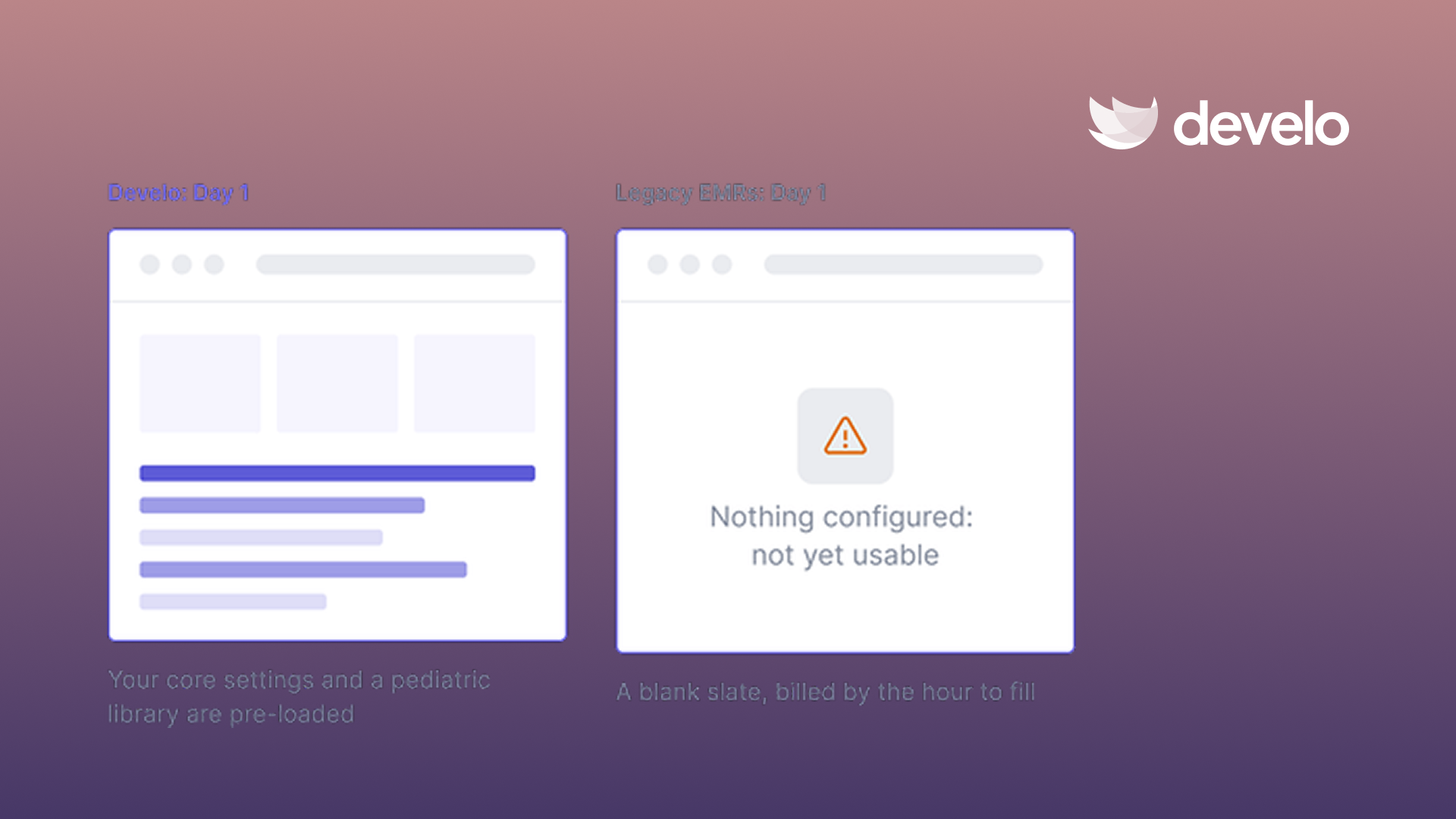
Develo lowers the total by replacing several separate systems with one. Develo is the AI-native pediatric operating system built solely for independent pediatric practices, running charting, billing, practice management, and family engagement on a single platform, so you're not paying for three or four tools and the integrations between them. Against the budget above, Develo removes most of the one-time lines: no separate implementation, migration, or training invoice, no servers, and little or no new hardware.
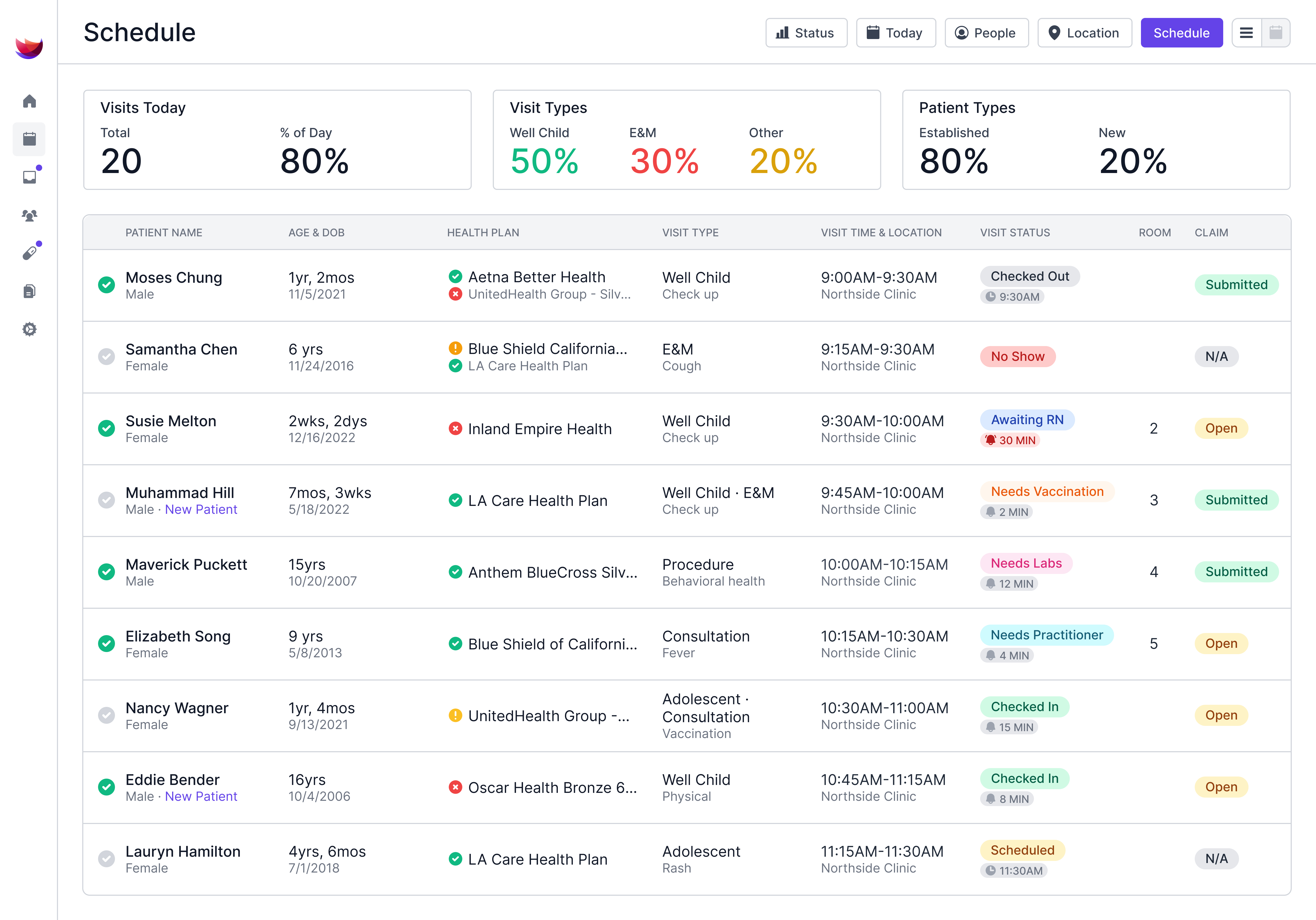
- No servers or new hardware: Develo runs in the cloud, so there are no on-premise servers, maintenance contracts, or in-house IT to budget for, and flexible device requirements mean most practices need few or no new computers, peripherals, or other hardware to go live.
- One connected system: removes the per-integration fees of wiring separate scheduling, records, and billing tools together.
- Implementation bundled in: data migration, configuration, training, and go-live support are bundled into your Develo subscription. There is no professional services rate card, so the setup, migration, and training lines in the budget above aren't separate invoices.
- Pediatric from day one: Develo pre-loads a pediatric library of templates, macro phrases, orders, and charge capture automation rules before go-live, and connects to your state vaccine registry bi-directionally, the interface the table above flags. Pediatric practices have already moved to Develo from dozens of legacy systems.
- Support and upgrades included: the customer success manager who configures and launches your practice stays with you, backed by a US- and Canada-based team and pediatric billing experts, and platform upgrades ship weekly, with major releases every other week, at no extra charge.
Develo uses custom, quote-based pricing with implementation bundled in, so the real number depends on your practice. Book a demo to get pricing built around your provider count and a full first-year estimate.
Frequently Asked Questions
What Is the Highest Cost in EMR Implementation?
The software subscription is usually the highest cost over the life of the contract, because it recurs every month while setup is paid once. The most underestimated cost is the productivity dip during the switch, so budget for that temporary revenue loss too.
Is a Cloud or On-Premise EMR Cheaper?
A cloud EMR is cheaper, both to start and over time. On-premise systems carry ongoing maintenance, support, and in-house IT costs, plus the capital expense of replacing servers and other hardware every few years. That gap is likely to widen as cloud infrastructure keeps gaining scale and technology advantages that on-premise systems can't match.
What Hidden Costs Should I Budget For?
The productivity dip at go-live, ongoing retraining, and interface fees are the costs that rarely show up in a vendor quote. Ask each vendor for a written breakdown of every fee beyond the base subscription.
How Long Until an EMR Pays for Itself?
A practice with a clean rollout can reach breakeven within a few years, then run net positive. The system itself matters most: a platform that drives more financial and operational return pays for itself much faster. Weaker systems tend to fall short on both fronts, with a harder implementation and a smaller return after go-live. A clean data migration and proper training shorten the payback further, while a rocky rollout stretches it out.
.avif)