

EMR implementation challenges are among the toughest a practice will face, and most of the pain is predictable. The challenges below come up in nearly every rollout, so knowing them ahead of time is the difference between a rough quarter and a managed transition.
Why EMR Implementations Are So Hard
Most implementations struggle because of decisions made before the system runs a single note. How data is migrated, how staff are trained, and whether workflows are mapped all shape the outcome more than the software does.
In KLAS Arch Collaborative research, only about 38% of organizations say their recent implementation hit the mark. Rollouts commonly run three to 12 months, with the range driven by practice size, data volume, and how many integrations have to be built.
For an independent practice with thin margins and no dedicated IT team, a poorly planned transition hits scheduling, billing, and patient communication all at once.
The Main EMR Implementation Challenges
1. Data Migration
Moving records from the old system is the step that needs the most planning. Old data tends to carry quirks: duplicate patients, inconsistent formats, and incomplete fields that are easier to clean before the move than after.
Good migration comes down to a few decisions made early. Choose which fields contain structured data and which are scanned, check medication and allergy fields against the source, and run reconciliation reports before cutover so the new system starts with data the team can trust.
2. The Productivity Dip
Productivity often drops sharply in the early weeks. In a 2012 Medical Economics survey of 30 physicians implementing an EMR, the 23 who reported productivity data saw a median 40% drop in patient visits, and solo practitioners reported the steepest declines.
Staff are learning the system mid-visit, so each visit takes longer than the week before.
Small pediatric practices tend to feel this most, since thin staffing leaves less capacity to absorb the slowdown, and solo practices have the least cushion of all.
Plan for reduced patient volume in the first month, build it into the budget, and ramp back up gradually. Most practices return to their old pace within the first few months, though the timeline varies by size and planning.
3. Staff Training
Training is where the productivity dip is won or lost, and it's the step most often rushed to the end. A system nobody knows how to use efficiently stays slow long after go-live. KLAS Arch Collaborative research shows that onboarding is where long-term satisfaction gets set.
Three hours of initial training is the floor, and the clinicians who report the highest EMR satisfaction receive at least eleven hours of onboarding training. Budget for the eleven across a mix of live training sessions, self-guided onboarding, and reference guides.
4. Workflow Disruption
A new EMR forces a practice to rethink how work flows, and friction shows up wherever the system doesn't match daily reality. When software is configured without input from the people who use it, staff invent workarounds or revert to paper.
Map your real workflows before configuration, and involve clinicians and front-desk staff in the design. A staged rollout surfaces problems early, while configuring around how the practice already works keeps the disruption contained.
5. Cost and Hidden Fees
The quoted price rarely covers the full cost. Implementation, data migration, training, interfaces, and the revenue lost during the productivity dip all add to the total, and several of those line items are easy to miss in a quote.
Ask vendors to itemize implementation, migration, training, and per-interface fees, and budget explicitly for the early revenue dip. The contract is also where to confirm support scope, uptime, and data portability terms before signing.
6. Staff Resistance
People resist a change that threatens routines they rely on, especially when the current system works well enough. Resistance that isn't addressed early hardens into low adoption. Bring staff in before selection, so the system reflects how they work.
Name the specific problem the new EMR solves for the team, whether that's fewer clicks or less after-hours charting, and they have a concrete reason to engage with the change.
7. Interoperability and Integrations
A new EMR has to integrate with labs, imaging, billing, registries, and the other tools a practice already uses. Connections that don't work cleanly create manual workarounds that drain the time the system was supposed to save.
Confirm during evaluation that the platform connects to your specific labs, clearinghouse, and registries, ideally natively. Test every integration before go-live, since problems found after patients are in the system can be the costly kind to fix.
8. Security, Privacy, and HIPAA Compliance
Migration is a risky moment for patient data: two systems run in parallel, records move between them, and questions open up around who owns the data in flight and who can access it. If something goes wrong with the switch, the practice is usually the one held accountable.
Sign a business associate agreement (BAA) with the vendor before any data moves, confirm the platform offers role-based access and audit logging, and agree up front on who owns patient data while both systems are live.
9. Technical Infrastructure and IT Readiness
A cloud EMR leans on the connection and devices behind it. Practices short on bandwidth, running older workstations, or without IT support can run into trouble at go-live when a slow system meets a full waiting room.
Check bandwidth, device count, and browser requirements against the vendor's specs before signing, and determine who will provide IT support: the vendor, a contractor, or someone on staff.
Ask whether the system runs in a browser or needs software installed on each workstation. A per-workstation install turns every new device, every replacement laptop, and every remote day into an IT task, and it is the difference between a go-live that needs a technician on site and one that needs a login.
How to Avoid the Most Common EMR Implementation Problems
A few habits separate the practices that transition smoothly:
- Plan the phases: If the timeline doesn't work, move the go-live date instead of shortening migration or training.
- Clean data before it moves: Deduplicate and standardize at the source, then validate after migration.
- Train by role, on real cases: Concentrate the hours where they matter most for each team.
- Budget for the dip: Expect reduced volume in the first month and plan your finances accordingly.
- Test integrations before going live: Confirm labs, billing, and registries connect before patients are in the system.
Pediatric EMR Implementation Challenges
Pediatric practices face everything above, plus a few challenges unique to how pediatric data is structured.
- Immunization history migration: Vaccine records are dense and date-sensitive, and a single gap can break VFC reporting or create clinical risk. This data needs field-by-field validation before it moves. Two things a vendor timeline won't cover: VFC and private stock are separate inventories that must be reconciled at cutover by funding source and lot, and a new state registry connection needs onboarding and test messages on the state's schedule.
- Family and sibling linkage: A pediatric chart is family-centered, with siblings, multiple guardians, and a guarantor who may not be the parent present. Migrating those relationships cleanly is harder than moving individual adult charts.
- Age-based templates and screeners: Pediatric workflows run on age-specific well child visit templates and developmental screeners. Rebuilding those mid-implementation is work a generalist rollout doesn't plan for.
- Registry connections: The system has to connect to state immunization registries from day one, or vaccine documentation stalls.
- Go-live timing: Pediatric volume is seasonal in a way general ambulatory care is not. A summer go-live lands in back-to-school physicals and the fall vaccine push; a winter one lands in respiratory season. Late spring is usually the only stretch with enough slack to absorb a productivity dip.
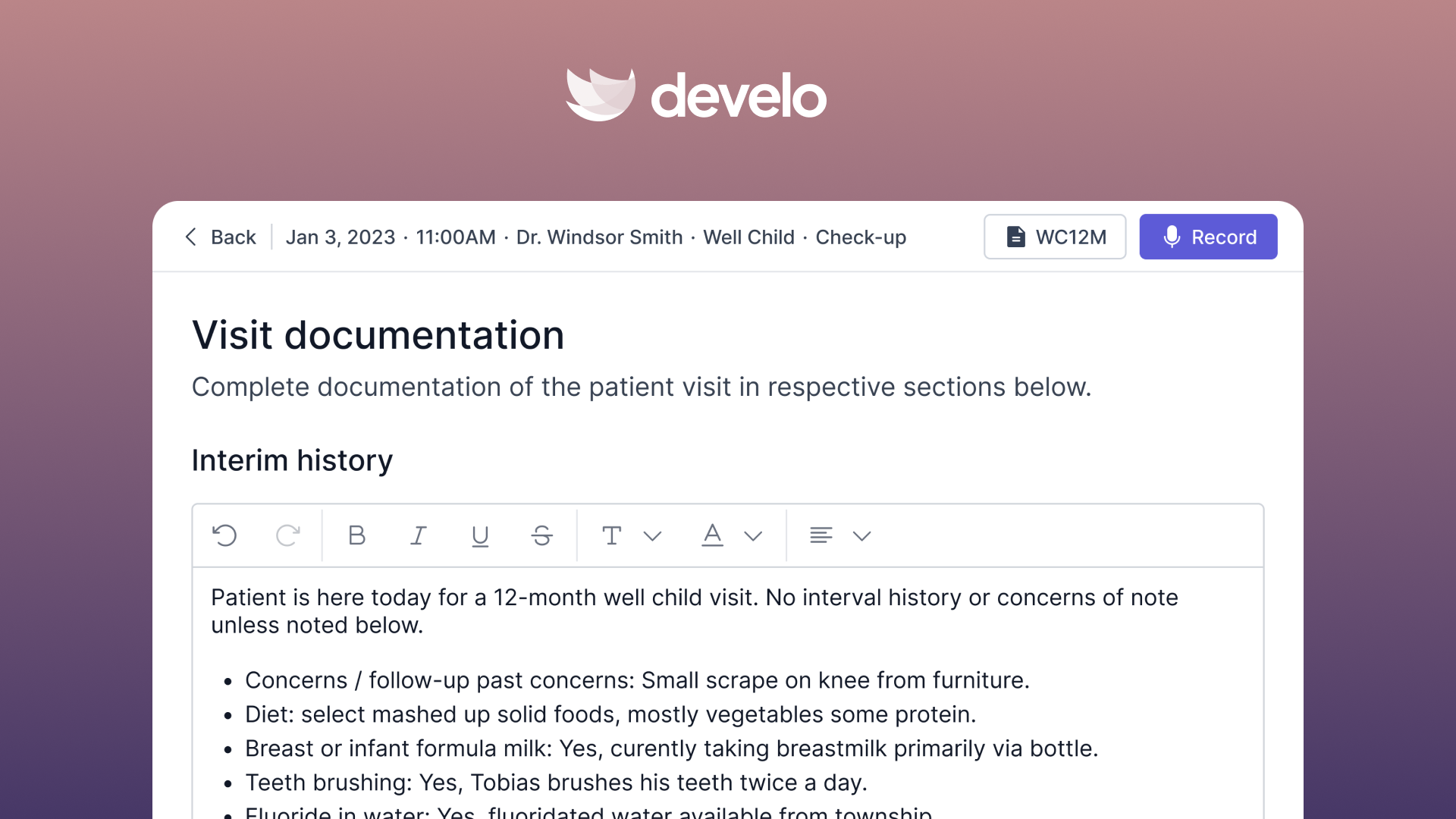
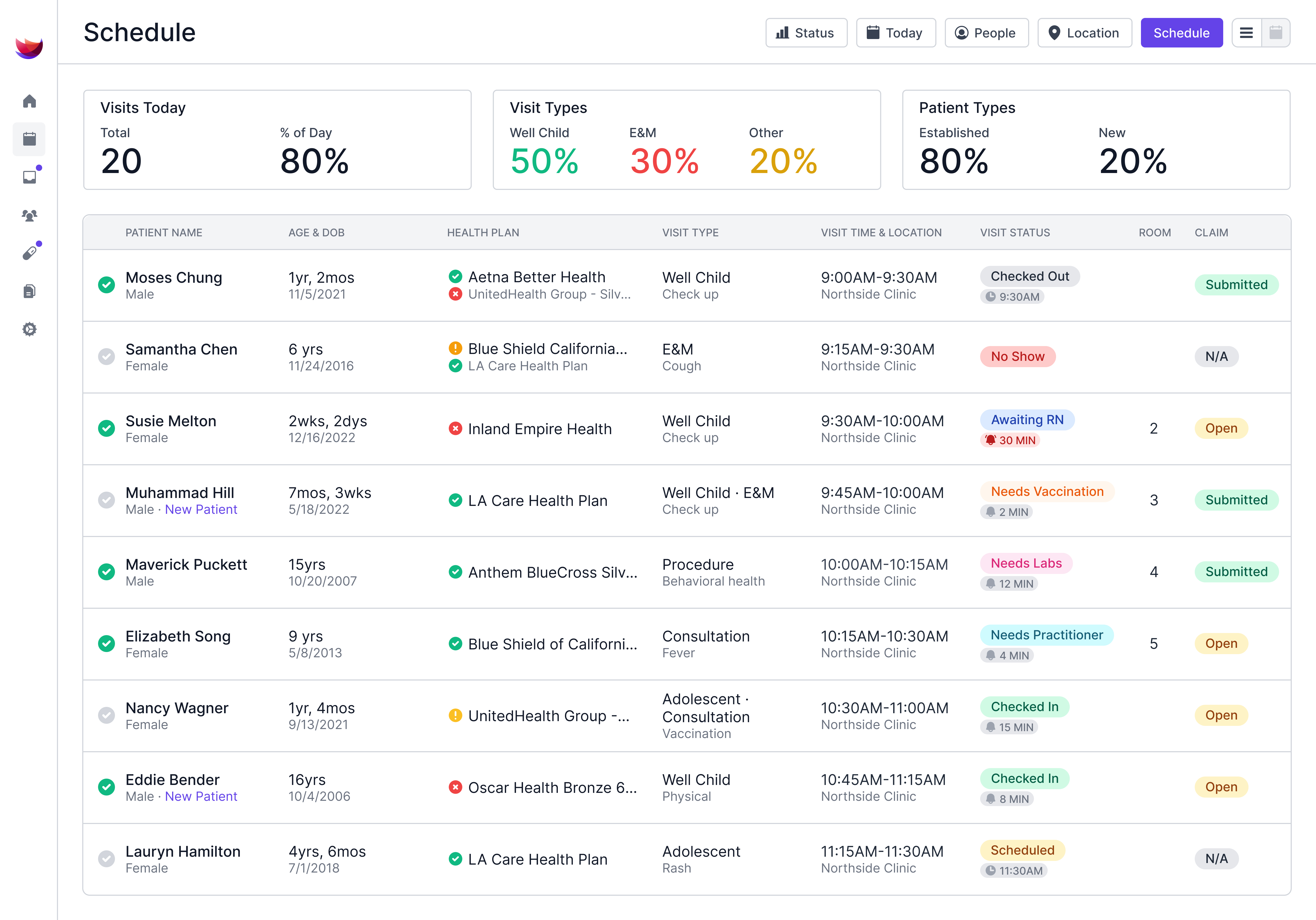
Most of the work in an EMR implementation is rebuilding pediatric configuration a general-purpose system never had. Develo is the AI-native pediatric operating system built solely for independent pediatric practices, unifying charting, billing, practice management, and family engagement, so the pediatric part arrives already built:
- Immunization data crosses as structured data. Develo connects to state vaccine registries bi-directionally in real time, pushing administrations up and pulling historical records down, so gaps found during migration get reconciled against the registry instead of re-keyed.
- Configuration, training, data migration, and go-live support are bundled into the subscription — no separate five-figure implementation project — and one customer success manager runs the rollout and stays with you after go-live.
- Established migration templates by source EMR bring across demographics, insurance, visits, structured clinical data, and medical record files. Pediatric practices have already moved to Develo from dozens of legacy systems.
- Pediatric configuration is loaded before your first login — templates, macro phrases, orders, charge capture automation rules, and the pediatric billing rules that slow a generalist rollout.
- Develo runs in any browser. Hosted on AWS with enterprise-grade security and HIPAA compliance, with no on-prem or private-cloud setup — a new workstation or a remote day needs a login, not an IT visit.
- Minor releases ship weekly and major releases biweekly with zero downtime, so the system keeps moving after go-live instead of waiting on a quarterly upgrade cycle.
Book a demo to see what a pediatric-specific implementation looks like for your practice.
Frequently Asked Questions
What Are the Biggest EMR Implementation Challenges?
The biggest EMR implementation challenges are data migration, training, and workflow disruption, plus the post-go-live productivity dip. Cost overruns, staff resistance, and integration problems round out the list. Most trace back to planning decisions made before the software goes live.
What Data Transfers When You Switch EMRs?
A standard migration brings across demographics, insurance, visits, structured clinical data, and medical record files. What varies between vendors is how much arrives as structured data rather than scanned images, so confirm that split in writing before signing — anything scanned stops being searchable or reportable. Ask which source systems the vendor has actually migrated from; Develo publishes its list of source systems and has moved pediatric practices off dozens of them.
How Long Does an EMR Implementation Take?
An EMR implementation usually takes three to six months from contract to full go-live, depending on practice size, data volume, and integrations.
Why Do EMR Implementations Fail?
EMR implementations usually fail because of poor planning, not the software. Rushed timelines, poor data migration, inadequate training, and configuring the system without staff input are the most common causes. In KLAS Arch Collaborative research, only about 38% of healthcare organizations say a recent implementation hit the mark.
What Makes Pediatric EMR Implementation Different?
Pediatric EMR implementation differs due to immunization, family, and age-based data. Vaccine data, sibling and guardian linkage, age-specific templates, and state registry connections all add complexity that a generalist implementation plan doesn't account for.

.avif)