
.avif)
Pediatric care plan examples all do the same job: they structure how a clinic documents problems, sets goals, and tracks outcomes across every visit. When that structure holds, the same documentation supports the clinical handoff and the claim; when it doesn't, both suffer.
What Is a Pediatric Care Plan?
A pediatric care plan is a structured clinical document that outlines a child's health problems, treatment goals, nursing interventions, and measurable outcomes, updated as the child's needs change.
Most pediatric care plans share six core components: assessment, nursing diagnosis, expected outcomes, interventions, rationale, and evaluation.
You'll see these across care settings, from well child visits to managing a child with chronic illness. How specific and actionable each section is determines how useful the plan is in practice — and in an outpatient pediatric clinic, how much of it the chart captures as structured data rather than narrative determines whether the next provider, the next visit, and the claim all see the same picture.
- Assessment captures both subjective data (what the child or caregiver reports) and objective data (vitals, lab results, physical findings). For a pediatric visit, this also includes developmental stage, family structure, and age-specific screening results.
- Nursing diagnosis identifies the clinical problem using the NANDA-I format: problem + related factor + defining characteristics. Example: Ineffective Airway Clearance related to bronchospasm, as evidenced by SpO2 below 92% and bilateral expiratory wheeze.
- Expected outcomes are SMART goals (Specific, Measurable, Achievable, Relevant, and Timebound). A weak outcome looks like "patient will feel better." A stronger one would be "patient will report decreased dyspnea within 8 hours."
- Interventions are the specific nursing actions tied to each outcome, such as administering prescribed diuretics, elevating the head of the bed, and repositioning to prevent skin breakdown.
- Rationale explains why each intervention is evidence-based, citing guidelines and research to justify clinical decisions.
- Evaluation documents whether outcomes were met, partially met, or not met, and what revisions are needed.
Pediatric Care Plan Examples by Visit Type
Pediatric care plan examples vary by clinical scenario. Here are three common types.
1. Well Child Visit Care Plan
Well child visits follow the AAP (American Academy of Pediatrics) Bright Futures periodicity schedule, which outlines screenings and assessments recommended at each visit from birth through age 21 (2025 Recommendations for Preventive Pediatric Health Care, Pediatrics, 2025).
A well child care plan typically includes:
- Assessment: Growth measurements (height, weight, BMI), developmental milestone review, age-appropriate behavioral health screening, immunization status.
- Diagnosis: Entries often include Risk for Developmental Delay or Health-Seeking Behavior when families need education.
- Interventions: Administering due vaccines, completing developmental screeners, counseling caregivers on nutrition, safety, and anticipated milestones.
- Evaluation: Whether screenings were completed, vaccines administered, and follow-up scheduled.
For pediatric clinics seeing high daily patient volumes, scoring screeners by hand, transcribing paper forms, and tracking down past vaccine records slows throughput and increases the chance of something being missed.
Corrected age changes the whole assessment. For a child born preterm, milestones, growth percentiles, and screening scores are interpreted against age counted from the due date, not the birth date, through roughly the second birthday. A care plan built on chronological age for a 28-weeker will flag delays that aren't there and set goals the child can't meet. The plan should record which age the assessment used.
2. Acute/Sick Visit Care Plan
A sick visit care plan responds to a presenting problem, such as a child presenting with cough and increased work of breathing:
- Assessment (subjective): Caregiver reports cough and fast breathing since the prior evening.
- Assessment (objective): O2 sat 91% on room air, respiratory rate 40 breaths/min, expiratory wheeze bilaterally.
- Nursing diagnosis: Ineffective Airway Clearance related to bronchospasm, as evidenced by SpO2 below 92% and bilateral expiratory wheeze.
- Goal: Patient will maintain O2 saturation at or above 94% within 1 hour of initiating treatment.
- Interventions: Bronchodilator per order, upright positioning, reassessment every 20 minutes.
- Evaluation: Wheeze reduced, O2 sat improved to 96%, goal met; continue monitoring.
3. Chronic Condition Care Plan
Children with conditions like asthma, type 1 diabetes, or cerebral palsy need ongoing care plans that evolve with each visit.
Comprehensive care plans are considered a core component of effective care coordination for children with medical complexity, so families and providers can make consistent decisions across care settings.
A chronic condition care plan for a child with impaired mobility might include:
- Diagnosis: Impaired Physical Mobility related to cerebral palsy, as evidenced by limited range of motion and muscle spasms.
- Short-term goal: Child will participate in prescribed range of motion (ROM) exercises within 24 hours.
- Long-term goal: Improve lower extremity strength and ROM over 3 months.
- Interventions: Daily ROM exercises, rest periods to preserve energy, caregiver education on maintaining gains at home.
- Evaluation: Child participates in ordered exercises; caregiver verbalized understanding of home program.
How the Family Fits into a Pediatric Care Plan
Family involvement is a core component of pediatric care planning.
The AAP describes family-centered care as a genuine partnership between clinicians and caregivers, where both contribute to care decisions. Care plans should reflect caregiver goals and concerns alongside clinical findings.
A well-structured plan documents what the family has reported, what they've been taught, and what they've agreed to do between visits. That record is useful if a child returns with a complication or a different provider picks up the case.
Clinics with complex family structures (multiple guardians, blended families, shared custody) face an added layer. The care plan needs to reflect who receives which communications, who has decision-making authority, and who the primary contact is for follow-up.
Communication routing and primary contact need to surface automatically at check-in and at every clinical touchpoint, and stay visible throughout the visit.
Documenting the family structure and documenting legal authority are two different things. Separated parents, foster and kinship placements, standby guardianship, and adolescent confidential services all mean the adult completing intake or sitting in the room may not be the person who can consent to the plan. Ask what your system does when a form is completed or a goal agreed by someone who isn't a legal guardian — whether it flags it, blocks it, or records it silently.
What Happens When Care Plan Documentation Falls Short
Incomplete or poorly structured care plans create problems on both the clinical and administrative sides of a pediatric practice.
On the clinical side, incomplete care plan documentation weakens care coordination in outpatient pediatrics (AAP, Patient- and Family-Centered Care Coordination, Pediatrics, 2014). That shows up when a provider documents a follow-up, but the care plan isn't updated to reflect it, or when a screening result isn't linked to an intervention.
On the billing side, incomplete documentation can contribute to claim denials. Vaccine administration codes are particularly vulnerable to undercoding when visit notes don't fully capture what was done.
Practices can end up under-reimbursed when documentation doesn't support the bill, even though services were delivered.
Care plan templates that auto-populate based on the child's age and visit type, screener results that flow directly into the chart, and charge capture tied to clinical documentation rather than manual superbills all reduce documentation and billing errors.
Structure Care Plans More Effectively with Develo
If your team is still manually scoring screeners, transcribing paper forms, or reconciling documentation with billing afterwards, there's a more efficient way to work.
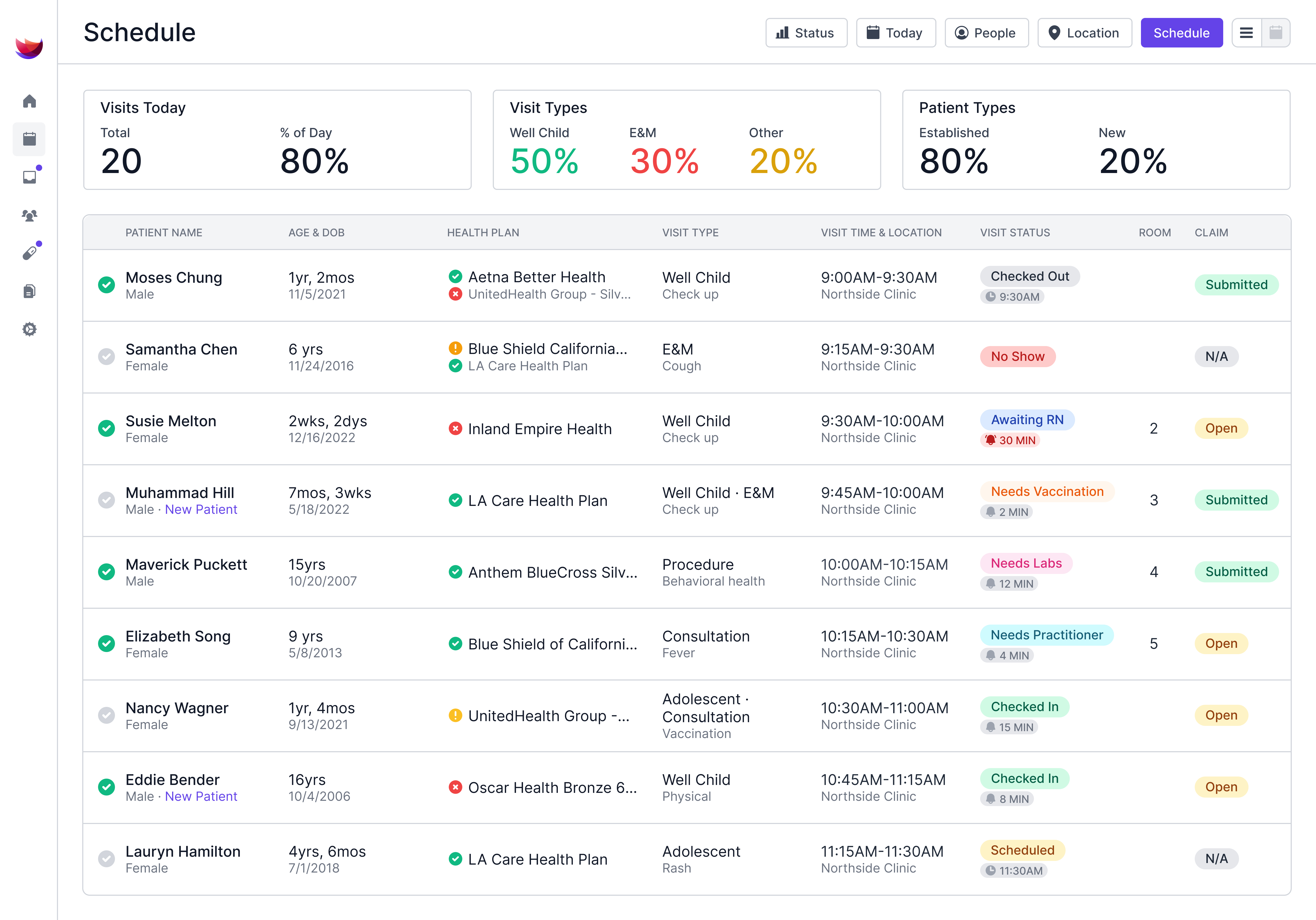
Develo is the AI-native pediatric operating system built solely for independent pediatric practices, from solo offices to multi-site groups.
Unlike general-purpose Electronic Medical Records (EMRs) that rely on third-party tools, it unifies clinical workflows, billing, practice management, and family engagement in one system designed around how pediatric practices actually operate.
Here's how it supports care planning:
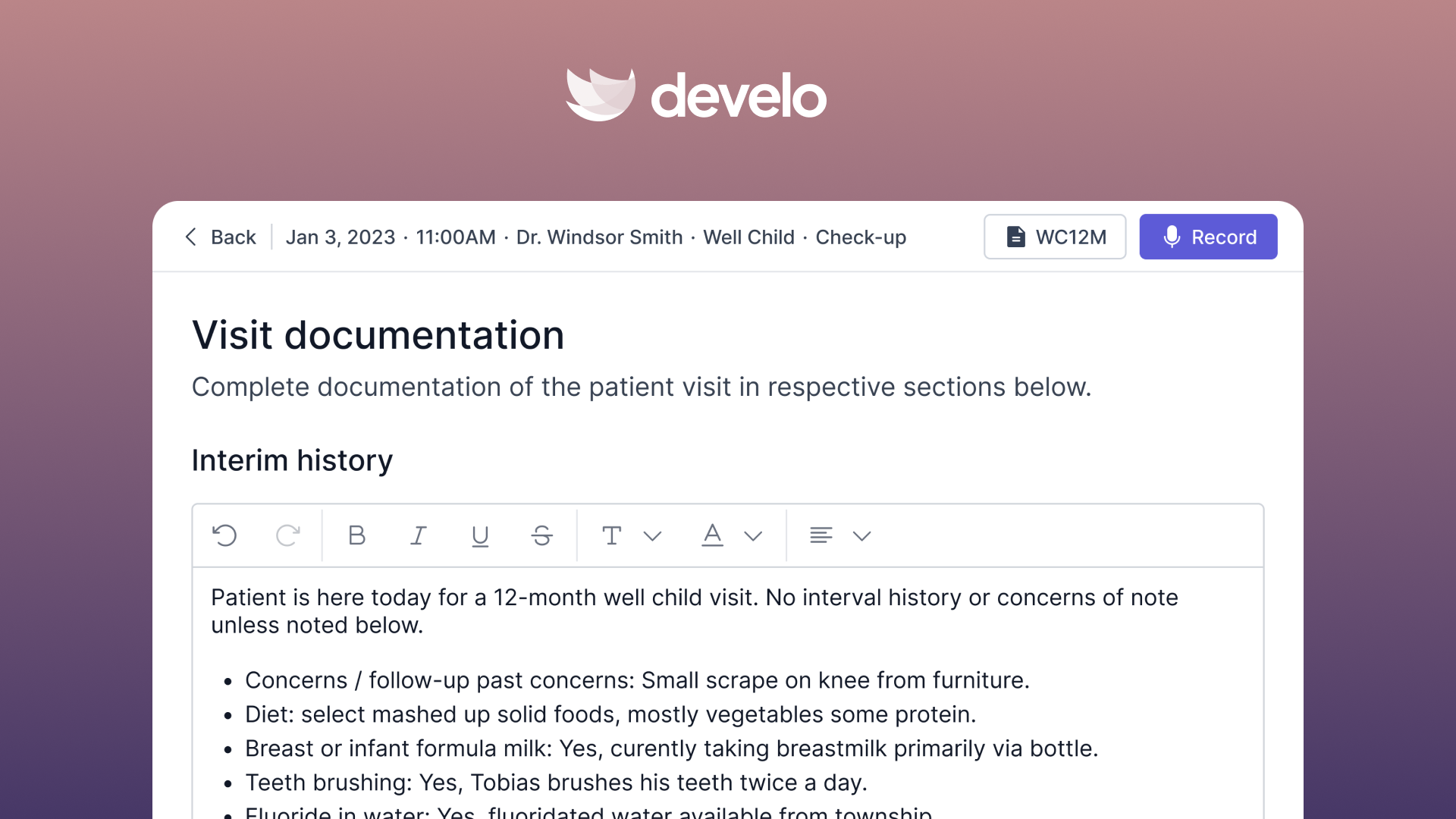
- Visit templates that go beyond the note: Develo's visit templates carry the orders, diagnoses, and billing codes for that age and visit type, with template-driven pre-pended orders already in place before the visit starts.
- Macro phrases and a shared content library: Configurable macro phrases let a provider drop a full care plan section into the note without retyping it, and the same content library is available to every staff member — so a plan can be written or revised outside the visit, not just during it.
- Digital screeners: Develo sends developmental and behavioral health screens ahead of the visit for caregivers to complete on their phones. Scores post into the visit note with integrated scoring, a concerning result raises a screening task that flags it to the provider before the child is seen, and a completed developmental screen bills as a 96110 line.
- Develo provider scribe: Clinical conversations are captured during the visit and written straight into the note, powered by visit context beyond the transcript rather than audio alone. That cuts the after-hours charting that burns out so many pediatric providers — and it is one of six native AI capabilities in Develo, alongside Develo intake scribe, Ask Develo, Develo doc intel, Develo reports Q&A, and Develo AI forms.
- Automated charge capture: Billing codes are generated from clinical documentation rather than manual superbills, which helps prevent undercoding and missed charges.
- Immunization registry sync: Develo connects to state immunization registries bi-directionally in real time — pushing administrations up and pulling records down — so immunization histories stay accurate without manual reconciliation.
- Family structure management: Multiple guardians, blended households, and sibling relationships are modeled as data rather than free text, so the right adult receives the right communication — including auto-generated confidential visit summaries for adolescents and limited summaries for their parents.
- Family portal: Intake forms and screeners are completed digitally before the visit, so caregivers arrive pre-registered and front desk staff aren't transcribing paperwork by hand.
Book a demo to see how Develo supports documentation and care coordination across your whole practice.
Frequently Asked Questions
What Are the Main Components of a Pediatric Care Plan?
A pediatric care plan includes six components: assessment, nursing diagnosis, expected outcomes, interventions, rationale, and evaluation. Each section builds on the last, moving from identifying the clinical problem through to documenting whether goals were achieved.
How Is a Pediatric Care Plan Different from an Adult Care Plan?
A pediatric care plan differs from an adult care plan by treating the whole family unit as part of the clinical picture. It also includes developmental milestone tracking, age-specific screenings, immunization management, and caregiver education in a way that adult documentation doesn't.
What Is a SMART Goal in a Pediatric Care Plan?
A SMART goal is Specific, Measurable, Achievable, Relevant, and Timebound. For example, in a pediatric care plan this could look like: "Patient will maintain O2 saturation at or above 95% within 4 hours of initiating supplemental oxygen."
How Often Should a Pediatric Care Plan Be Updated?
A pediatric care plan should be updated at every visit and whenever the child's clinical status changes. For children with chronic conditions, that includes revising goals, medications, and management strategies at each encounter.
How Do Pediatric Care Plans Connect to Billing?
Pediatric care plans support billing by documenting the medical necessity and complexity of services delivered. Assessment findings, diagnoses, interventions, and time spent all map to CPT codes and medical decision-making levels used for reimbursement.