

The PHQ-A is a depression questionnaire with nine scored items that teens complete on their own, rating how often each symptom has bothered them over the past two weeks for a total from 0 to 27.
It's adapted from the adult Patient Health Questionnaire-9 (PHQ-9), and pediatric practices use it for the yearly adolescent depression screening that the AAP recommends from age 12.
This guide draws on published scoring guidance and the original validation studies to cover all 13 questions on the standard form, plus how to read the score and what comes after, from follow-up care to billing with CPT 96127.
What Is the PHQ-A?
PHQ-A stands for Patient Health Questionnaire for Adolescents. The version that the American Academy of Child and Adolescent Psychiatry (AACAP) publishes is titled "PHQ-9: Modified for Teens," and it has nine scored items, each rated from 0 (not at all) to 3 (nearly every day).
The PHQ-A questionnaire also includes four unscored questions about low mood over the past year, how much the symptoms affect daily life, and past suicidal thoughts or attempts.
The name comes from a 2002 study by Jeffrey G. Johnson and colleagues in the Journal of Adolescent Health, which tested a broader PHQ-A that screened for four groups of mental disorders, depression among them.
The nine-item depression form came later. The footer on the AACAP version credits the team behind the Guidelines for Adolescent Depression in Primary Care (GLAD-PC), who built it from the adult PHQ-9, Johnson's revised PHQ-A, and the Columbia Depression Scale.
The American Psychiatric Association labels its adapted version of the form for ages 11 to 17.
The PHQ-A is free to use, and the adult PHQ-9 form states that no permission is required to reproduce, translate, or distribute the PHQ screeners.
Who Should Get the PHQ-A and When?
The AAP's periodicity schedule recommends a depression and suicide risk screening at every yearly well child visit from ages 12 to 21. It also asks clinicians to make every effort to preserve the adolescent's confidentiality during that screening. Our guide to Bright Futures screening follows the same timing.
The 2018 GLAD-PC guidelines, which the AAP periodicity schedule cites, also call for annual universal screening of youth 12 and older, and the U.S. Preventive Services Task Force recommends screening adolescents ages 12 to 18 for major depressive disorder.
The task force found the evidence insufficient to weigh the benefits and harms of suicide risk screening, so its position differs from the AAP's.
The PHQ-A stops at 17 while the AAP schedule runs to 21, so patients ages 18 to 21 can take the adult PHQ-9, which covers the same nine symptoms on the same 0 to 27 scale.
The AAP schedule doesn't call for a routine depression screen at age 11. GLAD-PC covers youth from age 10, however, and recommends identifying depression in high-risk youth, so the PHQ-A is still an option for an 11-year-old at high risk.
PHQ-A Questions
Every scored PHQ-A item asks about the past two weeks and offers the same four answers: not at all (0), several days (1), more than half the days (2), and nearly every day (3). The wording below comes from the AACAP version of the form:
| # | Question | Answers | Counts Toward Total |
|---|---|---|---|
| 1 | Feeling down, depressed, irritable, or hopeless? | 0–3 | Yes |
| 2 | Little interest or pleasure in doing things? | 0–3 | Yes |
| 3 | Trouble falling asleep, staying asleep, or sleeping too much? | 0–3 | Yes |
| 4 | Poor appetite, weight loss, or overeating? | 0–3 | Yes |
| 5 | Feeling tired, or having little energy? | 0–3 | Yes |
| 6 | Feeling bad about yourself, or feeling that you are a failure, or that you have let yourself or your family down? | 0–3 | Yes |
| 7 | Trouble concentrating on things like school work, reading, or watching TV? | 0–3 | Yes |
| 8 | Moving or speaking so slowly that other people could have noticed? Or the opposite: being so fidgety or restless that you were moving around a lot more than usual? | 0–3 | Yes |
| 9 | Thoughts that you would be better off dead, or of hurting yourself in some way? | 0–3 | Yes |
| Extra | In the past year have you felt depressed or sad most days, even if you felt okay sometimes? | Yes / No | No |
| Extra | If you are experiencing any of the problems on this form, how difficult have these problems made it for you to do your work, take care of things at home or get along with other people? | Not difficult at all to extremely difficult | No |
| Extra | Has there been a time in the past month when you have had serious thoughts about ending your life? | Yes / No | No |
| Extra | Have you ever, in your whole life, tried to kill yourself or made a suicide attempt? | Yes / No | No |
How the PHQ-A Differs From the Adult PHQ-9
The PHQ-A keeps the nine symptoms of the adult PHQ-9, but it rewords three items and swaps the order of two pairs:
| Symptom | Adult PHQ-9 | PHQ-A |
|---|---|---|
| Low mood | Item 2: "Feeling down, depressed, or hopeless" | Item 1, with "irritable" added |
| Loss of interest | Item 1 | Item 2, same wording |
| Appetite | Item 5: "Poor appetite or overeating" | Item 4, with "weight loss" added |
| Energy | Item 4 | Item 5, same wording |
| Concentration | Item 7: "such as reading the newspaper or watching television" | Item 7: "like school work, reading, or watching TV" |
The PHQ-A adds "irritable" because diagnostic criteria let youth meet the mood criterion for major depression with irritability instead of depressed mood. In a 2010 study in Pediatrics, Laura Richardson's team noted that the adult PHQ-9 has no irritability item, and they kept the adult wording so that one form could serve both teens and adults.
Because the PHQ-A also changes the item order, check how your EMR stores the answers. If it maps PHQ-9 responses by item number, confirm that each PHQ-A answer is saved to the right symptom, especially the two swapped pairs.
Where to Get a Free PHQ-A PDF
These sources publish ready-to-use versions you can print or load into your EMR:
| Source | What It Includes | Format |
|---|---|---|
| Boston Children's Health Physicians | Nine scored items plus all four extra questions | |
| AACAP (GLAD-PC) | Nine scored items, four extra questions, and a scoring page with the severity bands | |
| National Institute of Mental Health (NIMH) | Nine scored items, the past-year and difficulty questions, and the Ask Suicide-Screening Questions in place of the two GLAD-PC suicide questions | Web page |
For Spanish-speaking families, the AIDS Education and Training Center program posts a Spanish PHQ-A. Check its wording and credit line before you use it.
Whichever version you choose, keep its attribution on every copy, including the credit to Johnson's 2002 modification of the Patient Health Questionnaire.
How to Score the PHQ-A
To score the PHQ-A, add the answers to items 1 to 9 for a total between 0 and 27. The four extra questions stay out of the total, although the past-year, difficulty, and suicide answers will shape the clinical picture.
For PHQ-A score interpretation, AACAP's scoring page sorts the total into five severity bands:
| Total Score | Depression Severity |
|---|---|
| 0–4 | None or minimal |
| 5–9 | Mild |
| 10–14 | Moderate |
| 15–19 | Moderately severe |
| 20–27 | Severe |
A severity band describes how much distress a teen reports and doesn't confirm a diagnosis, so read it alongside the clinical interview.
Which Cutoff Should You Use?
AACAP's scoring page says a total of 10 or more has good sensitivity and specificity for major depressive disorder.
Richardson's 2010 study found that a slightly higher cutoff worked best when 442 youth ages 13 to 17 took the standard adult PHQ-9. A score of 11 or more identified 89.5% of those with major depression on a structured diagnostic interview, with 77.5% specificity and an area under the curve of 0.88.
For the PHQ-A itself, 10 is the cutoff printed on the form's scoring page, while Richardson's team tested the adult wording.
Whichever number your practice picks, write it into your screening protocol so every clinician acts on the same score.
Using the PHQ-A as a Diagnostic Aid
AACAP's scoring page lists three conditions that together point toward major depressive disorder:
- Core symptom: Item 1 or item 2 is scored 2 or 3.
- Symptom count: Five or more symptoms are positive, meaning a 2 or 3 on items 1 to 8, or any score of 1 or more on item 9.
- Impairment: The teen rates the difficulty question at least "somewhat difficult."
According to the same page, a "yes" to the past-year question points toward dysthymia, which current diagnostic criteria call persistent depressive disorder.
The Item 9 Rule
Any answer of 1, 2, or 3 on item 9, or a "yes" to either suicide question, must be followed up with a clinical interview whatever the total, according to AACAP's scoring page. A teen who totals 6 can still mark "several days" on item 9, so review that item on every form during the visit.
A negative answer on item 9 doesn't rule out suicide risk. The AAP's Blueprint for Youth Suicide Prevention reports that the PHQ-9 missed 36% of pediatric patients who screened positive for suicide risk, and that item 9 alone missed 56%.
For that reason, the Blueprint calls for a validated suicide risk screen for every patient 12 and older, and it notes that the GLAD-PC suicide questions were written by consensus rather than tested in research. NIMH's Ask Suicide-Screening Questions are one free, validated option.
If a teen is in crisis, call or text 988 or chat at 988lifeline.org to reach the 988 Suicide and Crisis Lifeline, and call 911 for immediate danger. NIMH's online PHQ-A still lists the Lifeline's old 1-800-273-TALK number, so put 988 on any handout you give families.
When to Use the PHQ-2 Instead
The Patient Health Questionnaire-2 (PHQ-2) uses the first two PHQ-A items, low mood and loss of interest, scored from 0 to 6. Some practices give it as a quick first-stage screening and direct only teens who score highly to the full PHQ-A.
In a second 2010 study in Pediatrics, Richardson's team analyzed results from 444 youth ages 13 to 17. A PHQ-2 score of 3 or more had 74% sensitivity and 75% specificity for major depression on a structured interview, and 96% sensitivity and 82% specificity against probable depression on the full PHQ-9.
A teen who scores 3 or more should complete the full PHQ-A, ideally at the same visit. The authors added that practices worried about missing depressed teens can lower the cutoff to 2 and follow up with a longer screening, trading some specificity for higher sensitivity.
A low PHQ-2 score doesn't rule out depression when a teen's history or presentation raises concern. The PHQ-2 also has no suicide item, so it still needs the separate suicide risk screen that the AAP recommends.
When teens complete screeners digitally before the visit, giving the full PHQ-A up front avoids the need for a second form after a positive PHQ-2.
What to Do After a Positive PHQ-A Screen
A positive PHQ-A screen starts a clinical assessment, and GLAD-PC's Part I and Part II guidelines describe how to assess, treat, and monitor adolescent depression.
Those steps depend on honest answers, so confirm that the teen filled out the form privately, with no parent watching.
- Check suicide risk first: Deal with any positive suicide answer before the depression workup (the AAP Blueprint recommends a brief suicide safety assessment after any positive suicide risk screen). On the Ask Suicide-Screening Questions, any "yes" leads to one more question about whether the teen is thinking of suicide right now.
- Confirm the diagnosis: GLAD-PC calls for a systematic assessment that combines a reliable depression scale, interviews with the teen and caregiver, and the criteria in the DSM-5.
- Set up a safety plan and support: GLAD-PC Part I includes establishing a safety plan, educating the teen and family about depression, and connecting them with community mental health resources.
- Match the response to severity: Part II recommends active monitoring for mild depression, evidence-based medication or psychotherapy for moderate or severe depression, and consultation or co-management with mental health specialists.
- Rescreen at follow-up: GLAD-PC calls for ongoing tracking of outcomes, so repeat the PHQ-A at follow-up visits, record each score, and read a falling score alongside how the teen is functioning.
Decide before the screen how you'll involve parents. Our CRAFFT screening guide suggests telling teens up front that their answers stay confidential unless you're concerned about their immediate safety, and the same guidance works for the PHQ-A.
Our guide to pediatric proxy access covers the portal settings that control what parents can see in a teen's record.
How to Bill the PHQ-A
Bill the PHQ-A with CPT 96127, which the AAP's coding fact sheet describes as a brief emotional or behavioral assessment "with scoring and documentation, per standardized instrument."
At the yearly well child visit, it's reported with the 99394 preventive visit code for established patients ages 12 to 17, or 99384 for new patients in that age band.
For patients ages 18 to 21 on the adult PHQ-9, the preventive code is 99395 for established patients or 99385 for new patients.
The same fact sheet gives an example for a 12-year-old with a normal screen: 99394 with modifier 25, plus 96127 linked to Z13.31 (encounter for screening for depression).
Check these rules before the PHQ-A goes into your standard workflow:
- Modifier 25: The AAP says to append modifier 25 to the preventive or office visit code when 96127 is reported with it, to show that the E/M service was distinct. Some payers set their own modifier rules, so confirm each plan's requirement.
- Units: Report one unit of 96127 for each instrument. When a teen completes the PHQ-A and the Pediatric Symptom Checklist at the same visit, report two units.
- Daily limits: Medicare's medically unlikely edit for 96127 is four units per date of service in the table effective October 1, 2026. State Medicaid programs set their own limits, and some are tighter: Maryland's 2026 Healthy Kids manual caps 96127 at two units per visit and doesn't allow billing for the PHQ-2.
- Who gives the screen: The AAP fact sheet notes that Medicare's relative values for 96127 include no physician work, because clinical staff usually give the screen. When a physician administers it, the AAP says not to count that time toward the E/M visit.
- Explanation of benefits: The 96127 line and its diagnosis code can appear on the parent's explanation of benefits from the insurer, so tell teens up front that billing may show a screen was done, even when their answers stay private.
Document the instrument and total score, any positive item 9 or suicide answer, and your interpretation and plan.
How Develo Handles PHQ-A Screening
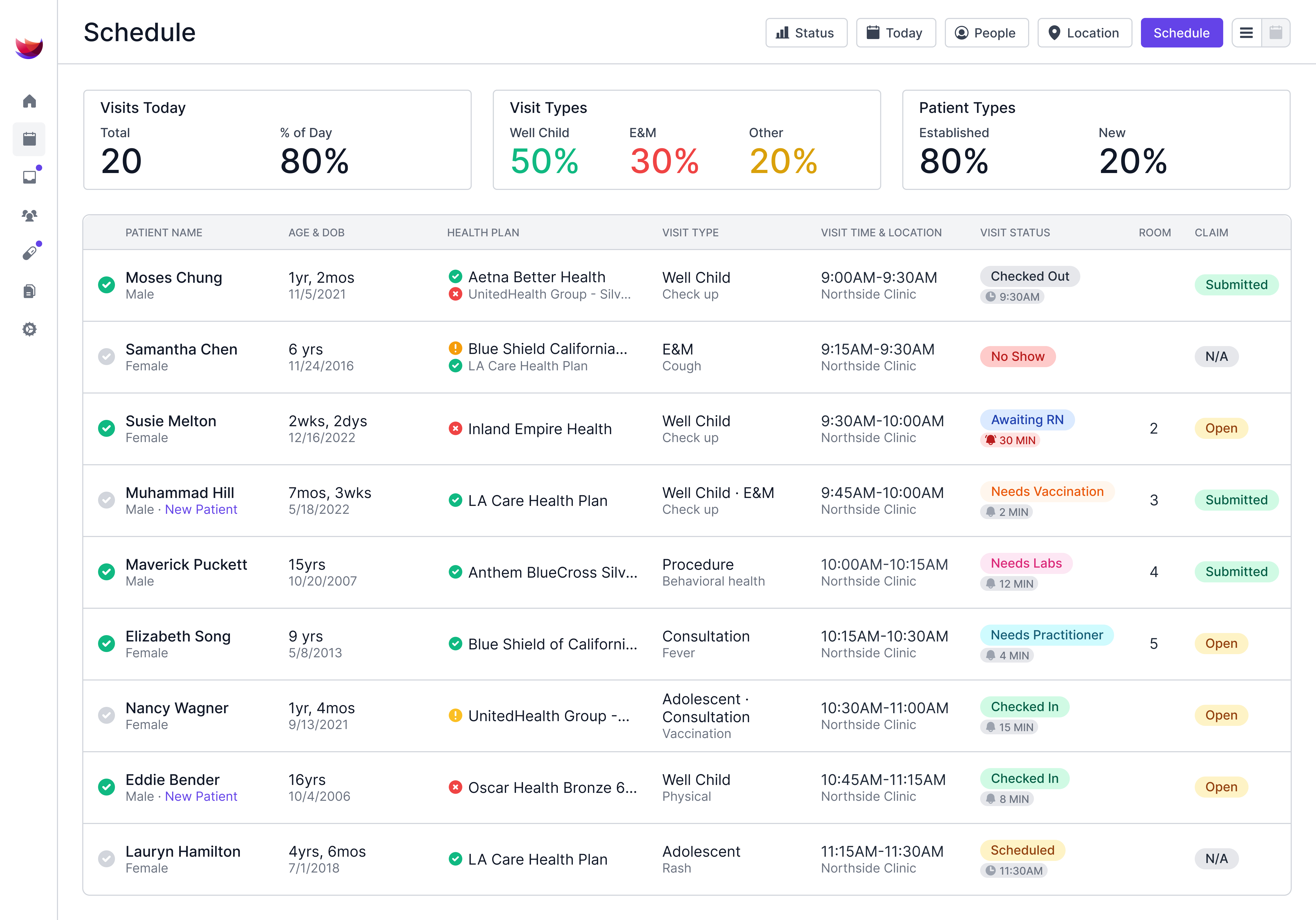
Develo is the AI-native pediatric operating system built solely for independent pediatric practices, unifying charting, billing, practice management, and family engagement. A PHQ-A screen in Develo moves through one system, from the first text message to the claim:
- Sent ahead or done in the room: Develo texts the PHQ-A ahead of every teen well child visit, straight to the teen's own phone, with no app or portal login. Staff can also send it before or during any visit, and a teen can complete it privately on a tablet in the exam room.
- Run every year, not from memory: Screeners are built into well child visit templates and run automatically at every well child visit, automated recall brings teens back for the yearly visit, and completion-rate reporting shows how many screens actually got done.
- Scored and flagged early: The PHQ-A is its own digital screener, so each answer is saved to the right symptom despite the reordered items. Results arrive scored, and a critical answer, such as suicidal ideation, triggers an instant alert for pediatrician review. Clinicians can correct a response in the room and re-score the form.
- Suicide risk screen alongside it: The Ask Suicide-Screening Questions are digitized too, so a teen can complete them with the PHQ-A ahead of the well child visit, or staff can send them before or during any visit, and a positive answer is flagged for pediatrician review like any critical result.
- Tracked over time, alongside other screeners: The PHQ-A is one of many digital behavioral health screeners in Develo, including the Pediatric Symptom Checklist and the Ask Suicide-Screening Questions. Results are saved in their own area of the chart, where clinicians can trend PHQ-A scores across visits and see them over time next to other behavioral health and clinical screeners. Each result is summarized automatically in the visit note and can be saved and shared as its own PDF.
- Confidential where it counts: The Develo AI scribe reads screening results from the chart and writes sensitive content into the note's adolescent confidential section for the clinician to approve. The family portal gives parents a limited visit summary.
- Automated charge capture: A completed PHQ-A is scored, its screening order is marked complete, and 96127 drops in with the right diagnosis code, while rules set units and modifiers by visit type and the provider makes the final coding call.
Interpreting the score and planning follow-up stay with your clinicians. Book a demo to walk through a PHQ-A screen with your own clinical team.
Frequently Asked Questions
What's a Normal PHQ-A Score?
A normal PHQ-A score is a total of 0 to 4, the none-or-minimal band on AACAP's scoring page. That total still needs a clinical interview if the teen marks any answer above 0 on item 9 or says yes to a suicide question.
What PHQ-A Score Is Concerning?
A PHQ-A total of 10 or higher is concerning. It's where the moderate band starts and where AACAP's scoring page places its screening threshold for major depression. A positive item 9 or suicide answer is also concerning, with any total.
Does the PHQ-A Screen for Suicide Risk?
No, the PHQ-A doesn't screen for suicide risk on its own. Item 9 and the GLAD-PC suicide questions catch some at-risk teens, but from age 12 the AAP also wants a validated suicide risk tool, such as NIMH's Ask Suicide-Screening Questions.
How Is the PHQ-A Different From the PHQ-9?
The main difference between the PHQ-A and the PHQ-9 is teen-specific wording: the PHQ-A adds "irritable" to the low-mood item and "weight loss" to the appetite item, and it asks about school work instead of the newspaper. It also reverses two pairs of items, while scoring and the 0 to 27 scale stay the same.
Is the PHQ-A Free to Use?
Yes, the PHQ-A costs nothing to use and needs no permission request. The PHQ screeners' developers released them for free use, and AACAP, NIMH, and Boston Children's Health Physicians all post free copies.
Should Parents See Their Teen's PHQ-A Answers?
No, a teen's PHQ-A answers stay confidential by default, since the AAP asks clinicians to protect adolescent confidentiality during depression and suicide risk screening. Immediate safety concerns are the exception you explain up front. Caregiver access to the record also depends on minor consent and confidentiality laws, which vary by state, so check your portal's proxy settings against your state's rules. Once a patient turns 18, they control their own record, so any parent access set up for their earlier visits should end on their birthday.
When Should You Use the PHQ-2 Instead of the PHQ-A?
Use the PHQ-2 when you need a two-question first step, such as a sick visit where a full screen doesn't fit, and give the full PHQ-A to any teen who scores 3 or more. Because its two items skip suicide entirely, add a separate suicide risk tool.