

Pediatric practice management is the business side of running a children's clinic: staffing, payer contracts, and compliance. Most of that work happens between visits, and it decides whether a clinic can keep its medical assistant roles filled and its vaccine fridge stocked.
This guide draws on the AAP's practice management resources, 2025 and 2026 polls of medical practice leaders, and the federal rules that apply to independent clinics. It walks through seven core areas, the numbers to review each week and month, and where owners and managers can find outside help.
What Is Pediatric Practice Management?
Pediatric practice management covers the nonclinical work that keeps a clinic open and paid. Those tasks fall into three groups:
- Operations: Staffing, scheduling, and the tech that teams use every day.
- Finances: Billing, payer contracts, and vaccine purchasing.
- Risk and planning: Compliance and long-range plans, such as adding partners or selling the practice.
The AAP's Section on Administration and Practice Management (SOAPM) is the academy's home for practice management information and advocacy.
Medical practice management is the broader term for running operations across outpatient specialties. Private practice management refers to physician-owned practices, where the owners carry the financial risk.
Pediatricians are less likely to work in private practice than physicians overall. In the AMA's 2024 Physician Practice Benchmark Survey, 38.1% of pediatricians worked in physician-owned practices, compared with 42.2% of all physicians.
Pediatric clinics also carry costs and duties that adult practices mostly don't. They buy and store vaccines before payers reimburse them, and they schedule preventive visits around the AAP's Bright Futures schedule.
They also keep records for whole families while protecting teenagers' confidential care under state minor-consent laws.
How to Manage a Pediatric Practice in 7 Core Areas
The seven areas below follow topics in the AAP's practice management hub, starting with staffing and ending with practice transitions. Each area pairs practical steps with the rules and figures behind them.
1. Hire, Train, and Keep Your Staff
Turnover has eased since the post-pandemic peak, though more than a quarter of practices still report it rising. In a May 2026 poll by the Medical Group Management Association (MGMA), 29% of medical groups reported higher staff turnover than in 2025. Another 39% said it was about the same, and 30% said it was lower.
Groups with rising turnover most often highlighted medical assistants (MAs), nurses and other clinical support staff, and front-desk employees.
MAs are the hardest of those roles to replace. In a May 2025 MGMA poll, 47% of practice leaders named MAs as their hardest hire, far ahead of nurses at 15%. By May 2026, 56% said hiring MAs had gotten harder over the past year.
In a pediatric clinic, MAs often room patients, give vaccines where state scope-of-practice rules allow it, and count vaccine stock. One open MA position can slow visits and inventory at the same time.
You can lower that risk before the next resignation:
- Benchmark pay once a year: In a June 2025 MGMA poll, 64% of practice leaders reviewed staff pay benchmarks annually. MGMA's 2026 staff pay report found that practices compete with retailers, restaurants, and call centers for front-desk staff, so compare front-desk wages with those local employers, too.
- Cross-train clinical staff: Train at least two qualified team members on each MA task that their roles permit, so one absence doesn't stop a clinic session.
- Put policies in writing: The AAP's employee handbook guide includes a sample table of contents checklist, and its staff training guide covers onboarding.
- Decide who manages operations: The AAP's sample organizational charts note that very small practices may have neither a practice manager nor an administrator. Our comparison of the practice administrator and manager roles explains what each one handles and when a practice might need both.
2. Plan the Schedule Around Well and Sick Visits
Well child visits follow the Bright Futures periodicity schedule, so a practice can forecast preventive visit demand from its patients' birthdates. Sick visits are harder to predict, and they rise during respiratory season.
Book the next well child visit before checkout, and run a monthly recall list of overdue patients. Hold back same-day sick visit slots in proportion to the season's demand, so urgent requests don't keep pushing preventive visits off the schedule.
For room-by-room fixes, such as pre-visit chart prep and clear MA and nurse roles, see our article on pediatric office workflow.
3. Choose and Manage Your Health IT
In many pediatric clinics, staff chart, schedule, and bill in the EMR. Replacing it means migrating data, rebuilding templates, and retraining every role, so the choice sticks for years. Before you compare features, watch for two hidden costs:
- Systems stitched together: A portal, intake tool, payment processor, or texting service sold alongside the EMR is often a separate system underneath, even when the EMR vendor sells it as one package. Each handoff is a place where a demographic update, a payment, or a form doesn't carry over, and your staff end up reconciling the gaps instead of helping families.
- Cheap IT paid for in staff time: A busy pediatric clinic doesn't slow down when its software falls short. Staff fill the gap by hand by re-keying data, chasing faxes, and tracking work in spreadsheets. That manual work takes more time than the software it was meant to replace, it falls on the same MAs and front-desk staff that practices struggle most to hire, and every re-keyed field is a chance for an error that surfaces later as a denied claim or a wrong record.
When you compare systems, test pediatric workflows like well child visits and vaccine ordering first. Our roundup of the best pediatric practice management systems compares the main options.
Before you sign, run two technical checks:
- Confirm that you can take your data with you: Certified EMRs must support EHI export, an electronic copy of the full record, for a single patient and for the whole patient population. Ask the vendor how a full-panel export works and whether it carries a fee.
- Check the immunization registry connection: Reporting requirements differ by state and program. Ask whether the system sends administered doses to your state immunization information system and pulls in immunizations recorded elsewhere. Then confirm which reporting rules apply to your practice.
4. Manage Payers, Fee Schedules, and Vaccine Costs
Payer mix sets much of what a pediatric practice collects. About 37% of U.S. children had Medicaid or CHIP coverage in 2024, according to the Medicaid and CHIP Payment and Access Commission's February 2026 data book. That year, Medicaid fee-for-service fees for primary care averaged 66% of Medicare's, according to the Urban Institute's fee index. They ranged from 47% in Illinois to 132% in Montana.
Commercial insurers pay more. They paid physicians an average of 129% of Medicare rates in the studies the Congressional Budget Office reviewed for its 2022 report.
A 2026 study in Health Affairs notes that most Medicaid enrollees get coverage through managed care plans, whose rates can differ from the state's fee schedule. States can require those plans to raise provider payments through state-directed payments, and the study found that most of these payments for primary care raised plan payments toward Medicare rates.
A May 2026 proposed federal rule from the Centers for Medicare and Medicaid Services would tighten limits on those payments. Before you budget around a plan's rates, ask whether a state-directed payment applies to your services.
Then look at both sides of the ledger:
- Set your charges above your best contract: A payer that pays 100% of your charge on a code is a sign your fee schedule may be too low, according to MGMA. Set each code's charge above your highest-paying contract rate.
- Keep credentialing current: CAQH requires providers to re-attest every 120 days, and Priority Health's provider manual warns that a missed re-attestation can block recredentialing and put the payer contract at risk. Check each payer's recredentialing cycle as well.
- Price vaccines with their overhead: Purchase price is only one cost. An AAP guide to pediatric vaccine costs lists storage, administration, and spoilage as overhead each dose carries. In a June 2026 fact sheet, the AAP reported that nearly 1 in 4 pediatricians has considered dropping vaccine delivery because of the financial burden. Compare each commercial contract's product and administration payments with your invoices.
- Lower your purchase price: Practices can join pediatric vaccine buying groups that negotiate manufacturer pricing, and some manufacturers offer prompt-pay discounts.
- Check eligibility at every visit: Medicaid and CHIP coverage can end between two well child visits when a family misses a renewal, and the practice often finds out only when the claim denies. Run an eligibility check before every visit, not just at registration.
Track vaccine inventory the way you track cash: watch stock value and expiration dates, and count the days between buying a dose and getting paid for it. Our guide to vaccine inventory management goes deeper on inventory audits and keeping public and private stock apart.
5. Market the Practice and Talk With Families
A prenatal visit introduces a family to the practice before the baby arrives, but few families use it. An AAP clinical report in Pediatrics cites survey results showing that 78% of pediatricians offer a prenatal visit, while only 5% to 39% of first-time parents attend one.
The report suggests that pediatricians discuss prenatal visits with referring obstetricians and family physicians and promote them on the practice website and social media.
The AAP also treats office hours as part of the practice's marketing plan, since families weigh availability alongside quality of care and insurance participation.
Post hours, accepted plans, and new-patient forms on the practice website, and use the AAP's welcome letter template for new families. Ask incoming families how they found the clinic, then check which referral sources bring families who stay.
6. Stay Ahead of Liability and Regulation
Pediatric practices answer to the same federal rules as other medical practices, plus vaccine program rules and special malpractice filing rules for minors.
These seven areas need regular attention:
- HIPAA risk analysis: In June 2026, the HHS Office for Civil Rights announced a $450,000 settlement with a health plan that hadn't done an accurate risk analysis before a ransomware attack. Document your own analysis and update it after major system changes.
- Workplace safety: The Occupational Safety and Health Administration's bloodborne pathogens standard requires a written exposure control plan reviewed at least once a year, plus annual staff training.
- In-office testing: Rapid strep and other waived tests need a certificate of waiver under the Clinical Laboratory Improvement Amendments (CLIA). Practices apply on Form CMS-116, and CLIA certificates are valid for two years.
- Vaccines for Children (VFC) compliance: State VFC programs require a trained primary and backup vaccine coordinator at each site, plus annual training and re-enrollment. Wisconsin's VFC rules, for example, can suspend a site's vaccine ordering when it misses annual training or re-enrollment. They also bar one person from serving as the primary coordinator for more than one location.
- Records access and teen privacy: Information blocking rules limit unreasonable restrictions on access to EHI, with exceptions for privacy and preventing harm. Set family portal permissions with your state's minor-consent laws in mind, so confidential adolescent care isn't shown to parents.
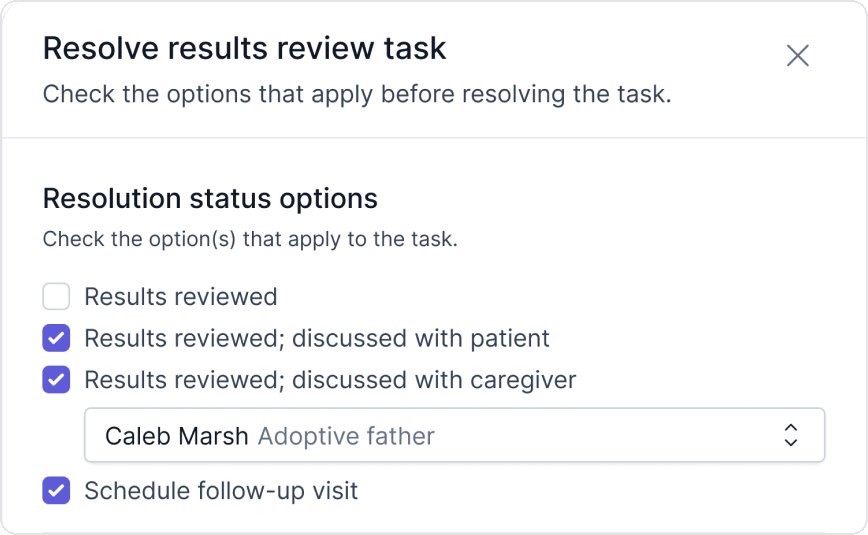
- Caregiver authority: In split custody, foster, and kinship placements, the adult at the front desk isn't always the one who can consent to care or see records. Record each caregiver's relationship to each child, and check it before booking, sharing records, or taking consent.
- Malpractice exposure for minors: Most states set a separate filing deadline or special timing rules for malpractice claims involving minors. Review your state's statute with counsel, and if the practice carries claims-made coverage, price tail coverage before a sale or retirement.
7. Plan Practice Transitions Early
Practice transitions run from adding a partner to selling or closing. In the same AMA benchmark survey, physicians in practices that had been sold most often rated three reasons as important: negotiating higher payment rates with payers (70.8%), getting access to costly resources (64.9%), and managing payers' regulatory and administrative requirements (63.6%).
The AAP's practice aggregation guide describes the options between staying fully independent and selling. Practices in an independent practice association keep separate tax IDs, so they're limited in how they can negotiate with payers, and the guide recommends legal advice before forming or joining one.
A group without walls shares a tax ID, which allows joint fee negotiation while each office keeps some control over clinical and staffing decisions.
If you plan to close or retire, start early. The AAP's closing checklist says practices must provide emergency care for 30 days before closing. It suggests giving families at least 90 days' notice, and payer contracts can add their own notice requirements.
The same checklist recommends keeping a staff member on for about 90 days after closing to reconcile accounts before balances go to collections. Plan for records retention and payer notification, too.
Know Your Numbers
Pick a short list of measures and review them on a fixed schedule. The table below sets how often to check each one and what to compare it against.
| Metric | What it tells you | How to track it | Review |
|---|---|---|---|
| Days in A/R | How long insurance and patient balances stay unpaid | Compare by payer and against your own 12-month trend | Monthly |
| Net collection rate | Share of allowed amounts the practice actually collected | Track the monthly trend and investigate shortfalls | Monthly |
| Initial denial rate | Share of claims denied on first submission | Use the same denominator each month and track by payer | Weekly |
| Charge lag | Days from the visit to charge entry | Track by provider and investigate any upward trend | Weekly |
| Overhead ratio | Operating expenses divided by collections | Compare with budget and your own 12-month trend | Monthly |
| Visits per provider per day | Whether capacity matches demand and staffing | Compare by provider, visit type, and season | Weekly |
| Vaccine payment per dose | Whether payment covers acquisition and program costs | Compare product and administration payments with actual costs | At contract renewal |
Break revenue measures out by payer. Days in A/R blends every payer into one average, so a healthy overall figure can hide one payer that's running far behind. Check the payer breakdown before you blame a change on staffing or collections.
Our article on pediatric RCM KPIs gives the formula for each revenue cycle metric, with 2026 benchmarks.
4 Ways to Take Work Off the Front Desk
Administrative jobs are hard to fill. In a November 2026 MGMA poll, about 4 in 5 medical groups had an open administrative position, and front-office roles such as receptionists and schedulers made up about 2 in 5 of the jobs respondents named.
The four changes below cut routine calls and data entry, so your staff can focus on families who need their attention:
- Online scheduling: Let families book routine well child and follow-up visits online, and keep same-day sick visits for staff triage.
- Digital intake: Collect insurance card details, consent forms, and age-based screeners before the visit, so staff only need to confirm what families have submitted. Our digital patient intake playbook describes how to roll it out.
- Automated payment collection: Send payment links or use an approved card on file for balances that families owe. Apply payer rules first: Medicaid exempts most children from cost sharing, and states can't impose cost sharing on well baby and well child care in CHIP.
- Text reminders and secure messaging: In a 2022 randomized study at Kaiser Permanente Washington, a second text reminder lowered the chance of a no-show by 7% for high-risk primary care visits. Two-way secure messaging in a family portal also lets families ask questions and send photos or forms without calling the front desk.
Where to Get Help With Pediatric Practice Management
Practice owners and managers can turn to these groups for peer advice, payer advocacy, and coding help:
- SOAPM: The section has 1,500-plus members and runs a real-time listserv, as well as business practice webinars and conference sessions. It also hosts the practice managers' alliance below.
- Pediatric Practice Management Alliance: This SOAPM group connects almost 250 practice managers through an online community. Managers join as SOAPM affiliates, and they must work with a pediatrician who's an AAP fellow.
- State chapter pediatric councils: These councils meet with payers about coverage and claims policies that affect children. They don't negotiate contracts or fees, but councils are the place to raise a payer policy that leads to repeated denials of a pediatric service.
- AAP Coding and Payment Hotline: AAP members can send coding and payment questions to the hotline, which typically answers within 3 to 5 business days. It can't review patient documentation or code services for you.
- Consultants and conferences: The Pediatric Management Institute, listed in the AAP's coding and revenue cycle resource list, offers consulting, financial assessments, and practice valuations, and it hosts an annual Pediatric Practice Management Conference. Its Certified Pediatric Office Executive program includes 20 online core courses.
State AAP chapters also share local guidance, so check your chapter's site for state Medicaid and payer updates.
How Develo Supports Pediatric Practice Management
Develo is the AI-native operating system for pediatrics, unifying charting, billing, practice management, and family engagement in one system.
Built from day one for outpatient pediatric care, it puts front-desk, billing, and vaccine work in the same system where providers chart, instead of spreading it across an EMR, a scheduling add-on, a payments vendor, and a separate portal.
Its practice management tools include:
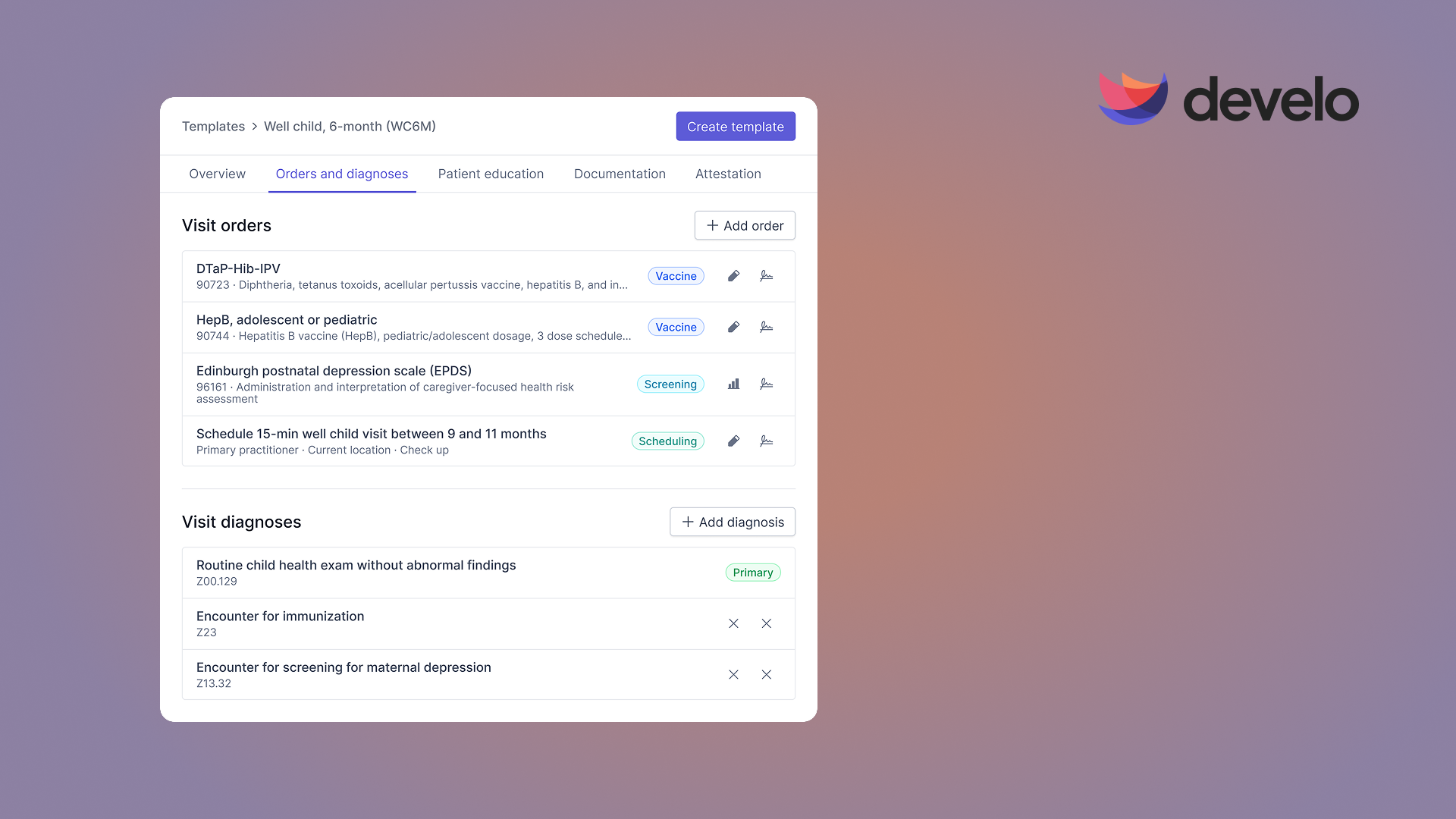
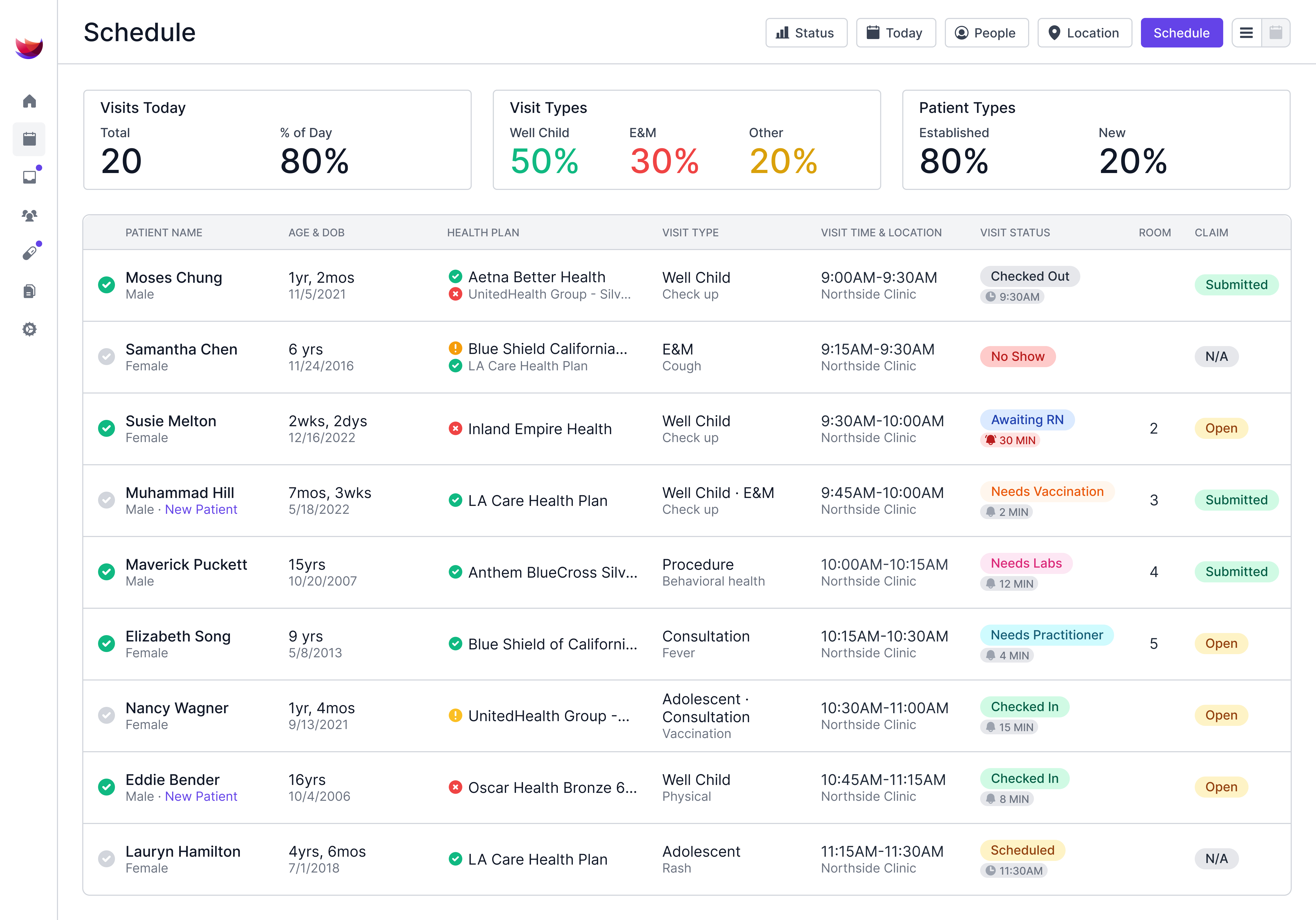
- Task queues: Develo builds work queues for well child recalls, provider scheduling orders, and family reschedule requests. Develo doc intel auto-tags incoming e-faxes for one-click filing into patient charts.
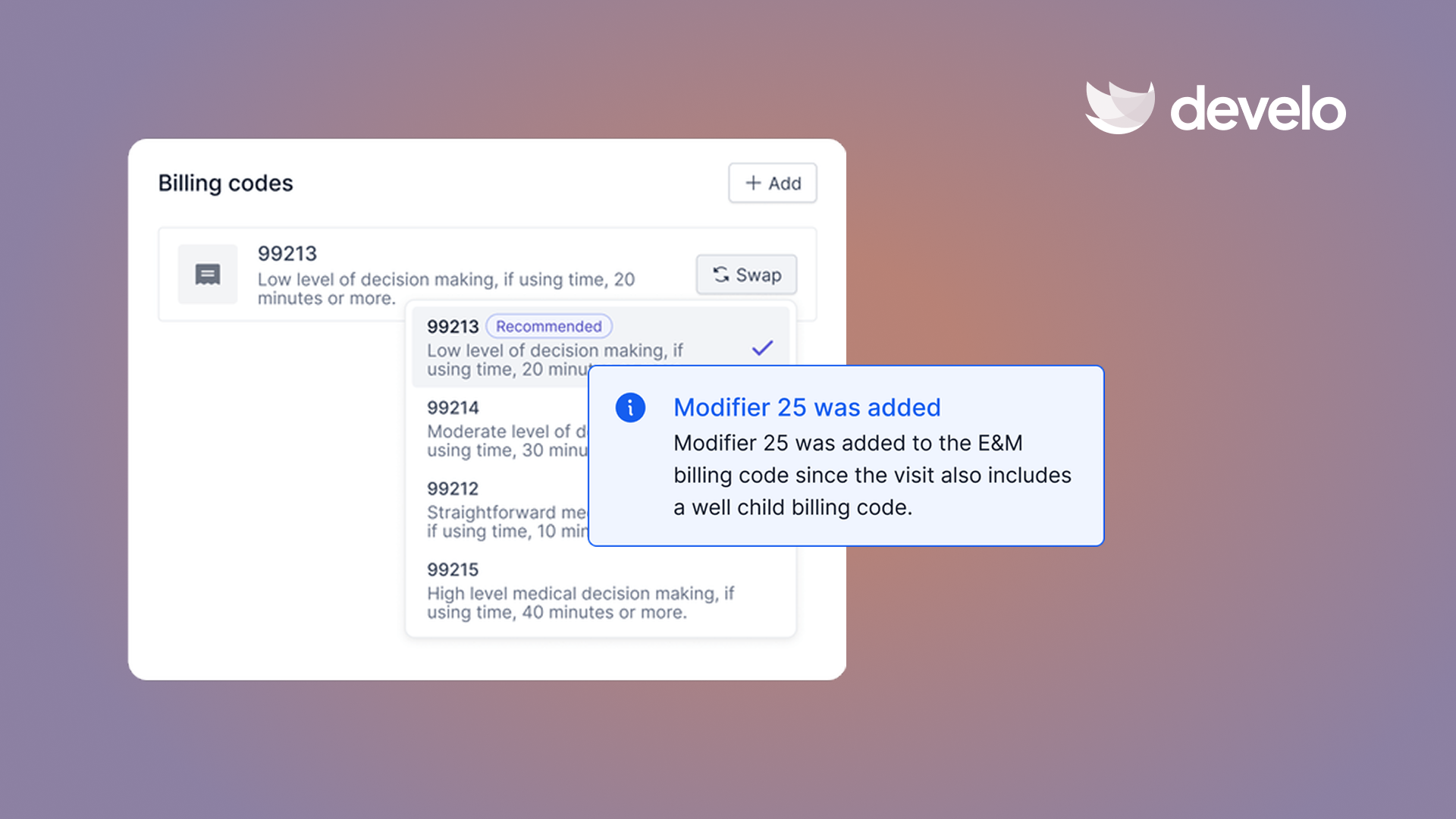
- Automated charge capture: Pediatric rules set codes, units, and modifiers by visit type, and alerts flag possible underbilling for the provider, who makes the final coding call. With your fee schedule entered, Develo also flags payments that come in below your contracted rates. Real-time eligibility checks run at check-in, and claim scrubbing runs at submission.
- Optional billing services: Practices that want billing handled for them get an onshore, pediatric-only billing team inside Develo. The team works claims, denials, and A/R follow-up in priority order, and the service is priced as a percentage of insurance collections.
- Vaccine workflows: Develo checks VFC eligibility against each dose's funding source and tracks inventory by lot expiry. It connects bi-directionally to state immunization registries, uploading administered doses and downloading immunization histories, and it connects with VaxCare and Canid.io for vaccine inventory.
- Family engagement: Families can book the visit types a practice opens for self-scheduling, get visit reminders and payment reminders by text, and complete intake and screeners on their phones with no app or login. Payment links cover balances across siblings, and two-way secure messaging in the family portal lets families send questions, photos, and files without calling.
- Teen privacy: The family portal generates adolescent confidential visit summaries for teenagers and limited summaries for their parents. Develo also tracks each caregiver's relationship to each child, so only an authorized caregiver can book for that child.
- Reporting: Develo reports Q&A answers plain-English questions about clinical and administrative data in real time, as text or graphs, so a billing lead can check days in A/R and A/R aging without building a report.
Develo uses comprehensive pricing based on a per-provider monthly fee, with no implementation fee: data migration, configuration, and training are bundled in. Each practice gets a dedicated customer success manager, an onshore support team, and a 24/7 on-call engineer for critical issues.
Book a demo to see how Develo fits the way your practice works today.
Frequently Asked Questions
What Is DPC Pediatrics?
Direct primary care (DPC) pediatrics is a membership model in which families pay a fixed monthly or annual fee for primary care, and the practice doesn't bill insurance for that care. Since January 2026, families with a health savings account can use it for qualifying DPC fees, up to $150 a month for one person or $300 for an arrangement covering more than one person. Develo supports direct primary care, concierge, and hybrid practices with membership plans, tiers, and family-level billing.
What Does a Pediatric Practice Manager Do?
A pediatric practice manager runs the clinic's daily operations, such as staffing, billing, and VFC compliance. Larger groups may also have a practice administrator who handles payer strategy and multi-site work.
How Often Should You Review a Pediatric Practice's Finances?
You should review a pediatric practice's finances weekly for fast-moving measures like denials and monthly for slower ones like days in A/R. Vaccine payments need a separate check at each contract renewal; the AAP's June 2026 fact sheet describes wide payer-to-payer differences in what practices are paid for vaccines.
Is Medical Practice Management Different for Pediatrics?
Yes, pediatric practice management differs mainly in vaccines, payer mix, and family records. Clinics finance vaccine stock up front, rely heavily on Medicaid and CHIP, and set portal access around parents, siblings, and teens' confidential care.