
.jpeg)
Pediatric practices can lose hours each week to retyped family details and reworked claims. EMR practice management puts scheduling, charting, and billing in one system, so staff enter information once. For pediatric clinics, that system has to fit whole families, well child visits, and vaccines.
What Is EMR Practice Management?
EMR practice management is the use of one software system to run both the clinical and administrative sides of a medical practice.
It combines the electronic medical record, which stores visit notes, orders, and clinical history, with practice management functions such as scheduling, registration, and billing.
For years, these have been two separate products. A practice would license an EMR for charting and a standalone practice management system for the business side. Staff would have to manually move information between the two.
This can work well enough for daily use, but small mismatches will show up quickly, such as a scheduling change that doesn't make it into the chart or a diagnosis code that never reaches the biller.
In a time-and-motion study of 57 physicians in family medicine, internal medicine, cardiology, and orthopedics, nearly half of the office day (49.2%) went to EHR and desk work, against 27% on direct face time with patients.
Every re-entry between disconnected systems adds to that desk work.
An EMR practice management platform brings those workflows together in one place. So, when a nurse checks a family in, the front desk, the provider's chart, and the biller's claim queue all pull from the same information. And nobody has to re-enter data that's already sitting in the system.
Core Features of EMR Practice Management Software
Most of these systems are built around four core areas: scheduling and intake, clinical documentation, billing, and family communication.
Scheduling and Patient Intake
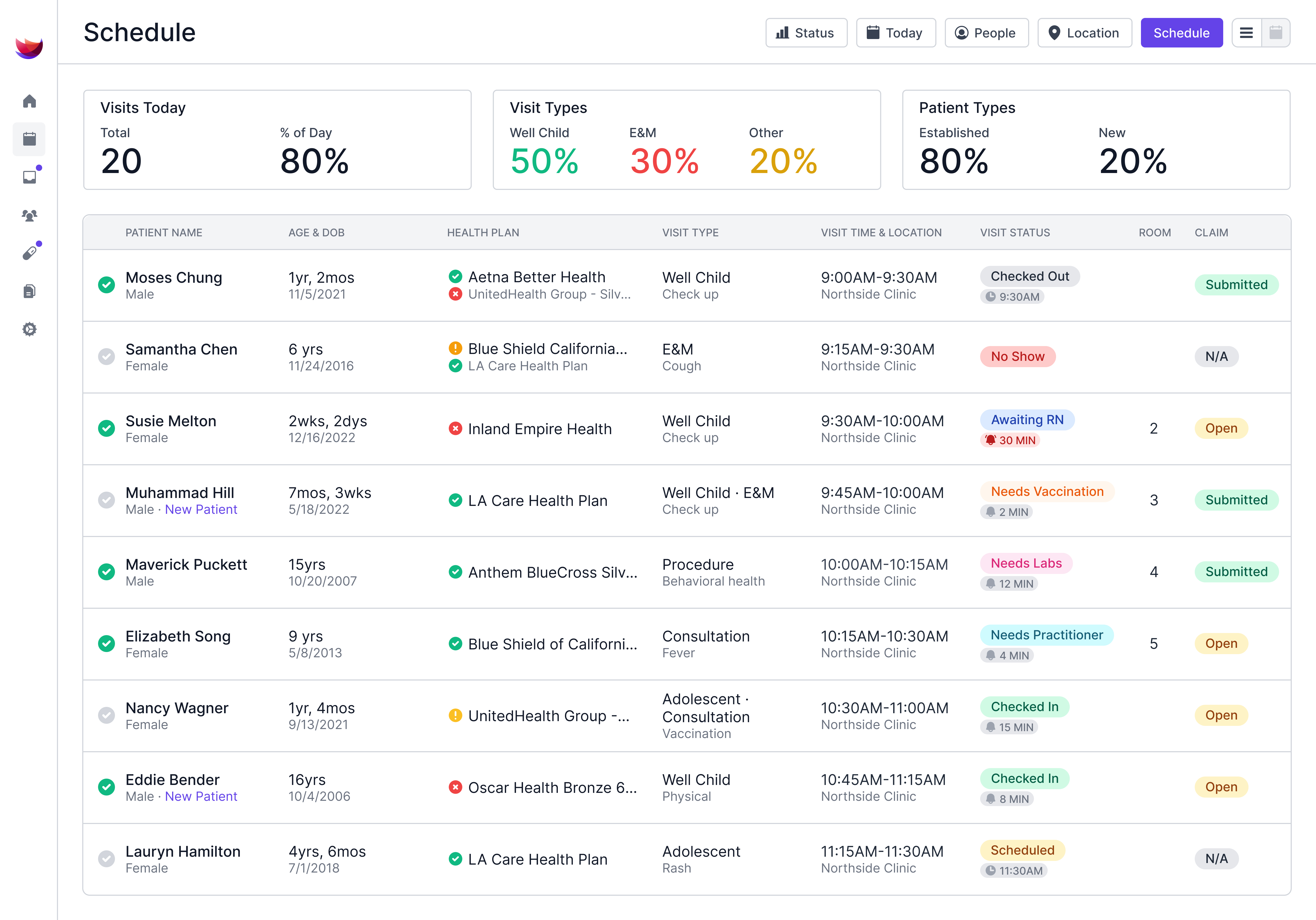
Scheduling tools handle visit booking, reminders, and intake in one connected workflow.
Families book online or by phone, the system sends automated text reminders, and intake forms go out ahead of the visit instead of on a clipboard in the waiting room.
For pediatrics specifically, intake has to cover whole households: siblings, multiple guardians, and blended families. Systems built for adult care usually handle one patient at a time, so those relationships get lost.
A system built for pediatrics links brothers and sisters, tracks who's authorized to make decisions for each child, and lets a parent handle paperwork for every child on their account in one go.
Newborns add one more wrinkle. A baby's first visit often happens before there's a member ID, sometimes before there's a legal name, so the system has to register the child under a parent's policy until the newborn's own coverage posts.
Clinical Documentation and Charting
Clinical documentation tools let providers record visit notes, vitals, and orders directly in the same record the front desk and billing team already use.
Many platforms now include an AI scribe that listens to the visit and drafts the note for the provider to review, so the provider isn't typing while trying to make eye contact with a nervous 7-year-old.
There's no exporting, no need to scan documents, and no lag between what happened in the exam room and what shows up in the chart.
Well child visit templates, growth charts, and immunization tracking against the AAP immunization schedule are standard in most pediatric-focused systems.
Multiple staff members can also work in the same chart at the same time, such as a nurse rooming a patient while a physician finishes a note from an earlier visit.
Billing and RCM
Billing tools automatically turn a documented visit into a claim, so a biller doesn't have to retype what the provider already wrote.
Automated charge capture pulls the diagnosis and procedure codes straight from the encounter, and claim scrubbing checks for errors before the claim ever reaches the payer.
At one large academic health system that already ran a certified EMR, billing and insurance-related work cost $20.49 per primary care visit, or 14.5% of that visit's professional revenue (Tseng et al., JAMA, 2018).
Much of that cost comes from payer rules no software removes, but billing that runs as a separate process from documentation adds rework on top.
A system in which charge capture and claim submission are integrated into the same record as the chart removes many manual steps.
Family Portal and Communication
A family portal gives caregivers one place to schedule visits, pay bills, and complete screening forms for every child in the household.
Instead of logging into a separate app for each child, a parent manages the whole family's visits and payments in a single session.
Automated payment reminders include a direct payment link, and caregivers can pay for multiple children in a single transaction.
Access has to change as children grow, too. Once a patient reaches adolescence, parts of the visit become confidential, so a pediatric family portal needs to give the teen their own summary and the parent a limited one.
How to Run an EMR Practice Management Workflow
Running this workflow means letting one system carry information through the front-desk, clinical, and billing steps, so staff don't have to move it by hand.
Think of a well child visit as five connected steps:
- Before the visit: A text goes out with intake forms and the age-appropriate screeners for the child's visit.
- Check-in: The front desk confirms only the insurance and contact details the system flags as out of date, so families aren't asked the same questions every visit. For Medicaid and CHIP patients, that check matters most because coverage can lapse at renewal between two well child visits.
- During the visit: The provider documents in a chart that already has expected vaccines, orders, and growth data queued up.
- After the visit: Billing codes generate from the documentation automatically, and the claim is scrubbed and submitted without a biller manually transcribing anything.
- Follow-up: The system schedules the next well child visit and automatically sends reminders.
In a practice that runs separate systems, each of those five steps can involve someone manually re-entering data that already exists elsewhere, one screen at a time. Constant repetition, multiplied across a full day of visits, is what an integrated system is built to remove.
EMR vs. Practice Management Software: What's the Difference?
An EMR handles clinical documentation, while standalone practice management software handles scheduling and billing without any clinical charting.
Because neither tool covers both sides on its own, practices historically needed one of each: an EMR for the clinical record and a separate practice management system for the business side.
Some still run it that way today, usually because they added a practice management system before adopting an EMR, or because a billing vendor requires its own software. Either way, those practices still live with the double entry described earlier.
Family engagement is the weak spot in both categories, and for the same reason: most standalone EMR and practice management products are legacy software built decades ago, many before the web existed. Family portals, visit reminders, payment reminders, and digital intake were added later, if at all, which is why practices increasingly fill the gap with bolt-on software. Those add-ons bring their own limits: they rarely integrate cleanly with the core system, and few have workflows built for siblings, guardians, and other family nuances.
Why Do Pediatric Practices Need EMR Practice Management Built for Their Workflows?
Pediatric practices need EMR practice management systems designed from the start around family structures, immunization schedules, and well child visit volume.
Well child visits and sick visits both make up a large share of a typical pediatric schedule, and both follow patterns that general ambulatory EMRs weren't built to anticipate.
Generalized systems often push clinics to bolt on third-party software for intake, screening, or immunization tracking, which adds cost and another system that doesn't integrate with the EMR.
For a small pediatric practice choosing between vendors for the first time, each added system takes up a bigger share of a tight budget.
Simplify EMR Practice Management for Your Clinic With Develo
Disconnected scheduling, charting, and billing tools can wear down clinicians and staff, and the software behind that disconnect is often adapted from adult care rather than built for pediatrics.
Develo is the AI-native operating system for pediatrics, built solely for independent pediatric practices. It unifies charting, billing, practice management, and family engagement in one platform, including:
- Develo AI scribe: Writes into the visit note using the conversation and pertinent chart data (problem list, growth data, immunizations, and screening results), with a provider approving every section. It supports dozens of languages, returns notes in English, and suggests both diagnosis codes and visit E&M level. The AI scribe is also available for visit intake for use by nurses and medical assistants.
- Develo AI suite beyond the scribe: Ask Develo turns 15 minutes of chart review into 60 seconds, with answers linked back to the patient's record. Develo doc intel auto-tags incoming e-faxes and uploads for single-click filing into the chart, Develo AI forms turns any practice or patient form into a live digital one, and Develo reports Q&A answers plain-English questions about clinical and administrative data, with no report builder needed.
- Visit templates for pediatrics: Load the right orders and codes automatically, based on whether it's a well child visit or a sick visit, in addition to core visit documentation and patient education content.
- Automated charge capture: Orders carry billing and diagnosis defaults, and rules set pediatric codes, units, and modifiers by visit type, so staff rarely key codes by hand and claims get checked before they go out.
- Family portal: Let caregivers pay balances across siblings, message the practice, and pull immunization records and growth charts themselves, with adolescent confidential summaries handled automatically.
- Visit reminders and text intake: Send automated visit reminders to patients and caregivers, and let families confirm visits, update demographics and insurance, sign forms, and complete clinical screens on their phone, with no app or portal login required.
- Sibling and guardian tracking: Keep blended families, multiple guardians, and sibling relationships connected in one place instead of siloed by patient.
- Immunization registry connections: Connect bi-directionally, in real time, with state immunization registries, and auto-check Vaccines for Children eligibility against the right funding source, so staff don't re-enter data.
With one shared record, staff hand off less work, and providers see a clearer picture of each child. Book a demo to see how Develo runs scheduling, charting, billing, and family communication for your practice.
Frequently Asked Questions
What Does EMR Practice Management Software Do?
EMR practice management software integrates clinical charting with scheduling, registration, and billing into a single system. Front-desk, clinical, and billing staff all work from the same patient record instead of moving data between separate tools.
What's the Difference Between an EMR and Practice Management Software?
An EMR stores clinical documentation, such as visit notes and orders, while practice management software runs the business side of a practice, including scheduling and billing. When people pair EMR and practice management today, they usually mean the two combined under one system.
Does EMR Practice Management Software Reduce Claim Denials?
Yes, EMR practice management software can lower claim denials by catching errors, such as mismatched codes or outdated insurance information, before a claim is submitted. That improvement comes from automated charge capture and claim scrubbing working directly off the clinical documentation.
Can EMR Practice Management Software Work for a Small Pediatric Practice?
Yes, EMR practice management software works well for small pediatric practices, where staff often cover scheduling, charting, and billing without dedicated specialists for each role. An integrated system keeps those overlapping responsibilities working from a single shared record.
Is Patient Scheduling Included in EMR Practice Management Systems?
Yes, patient scheduling is a standard part of EMR practice management systems, typically including online booking, automated reminders, and digital intake sent in advance of the visit. Those scheduling tools connect to the same record used for charting and billing.
.avif)

.avif)