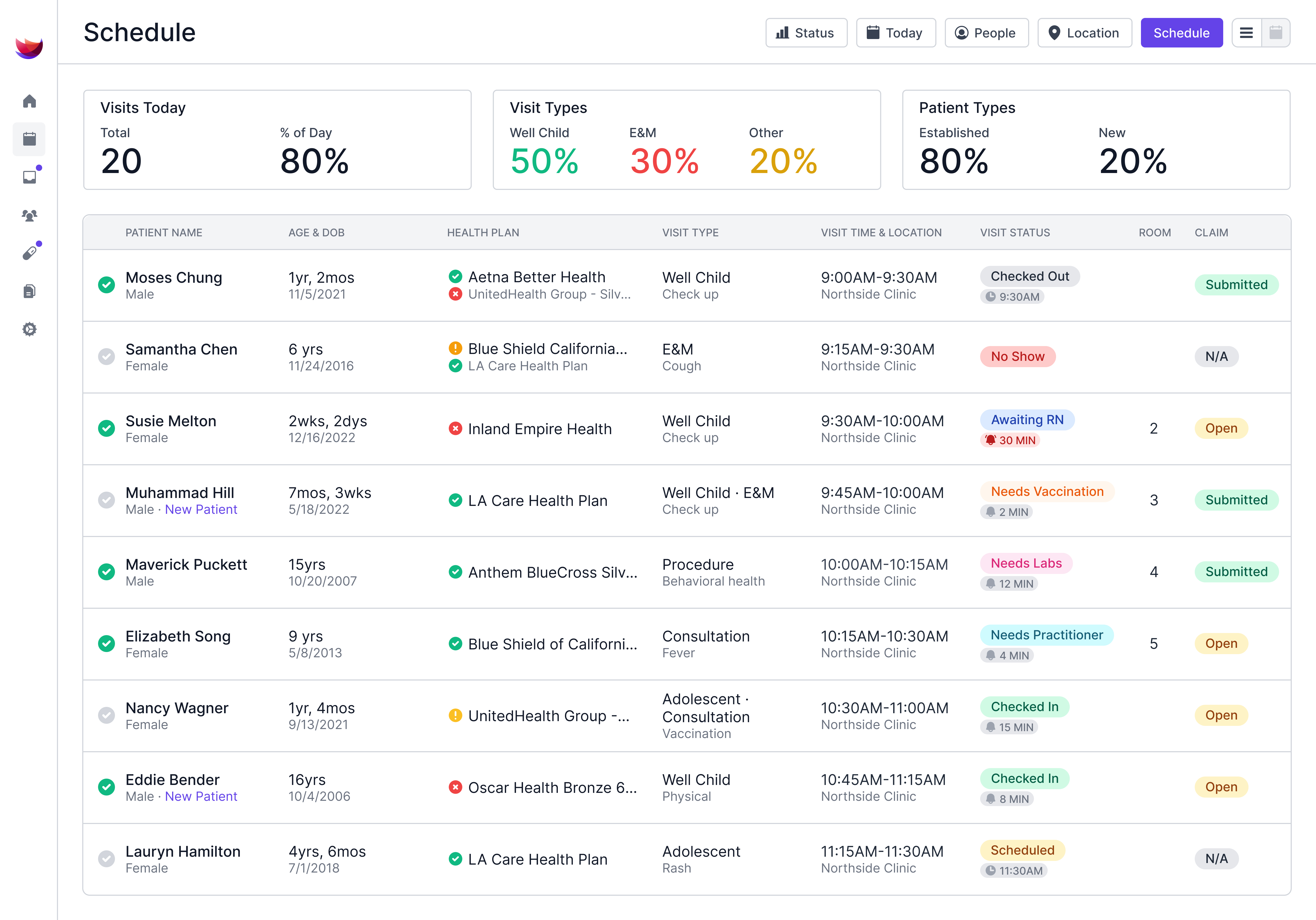


Automated charge capture turns documented care into a billable charge as the visit happens, so services don't get missed, delayed, or underbilled. For independent pediatric practices, that often means an unbilled vaccine, a missed screener, or a sick visit billed alongside a well child visit that never makes it onto the claim.
What Is Automated Charge Capture?
Automated charge capture is the process of recording the billable services, procedures, and supplies from a visit directly from clinical documentation, rather than entering them by hand afterward.
The system pulls charges from what the clinician documents during care, so the bill reflects the visit without a separate data-entry step. In a manual process, a provider sees the patient, then later checks off codes on a superbill or types charges into the billing system from memory or notes.
Each handoff is a chance for a charge to be missed, delayed, or entered incorrectly. Automation removes most of those handoffs by capturing charges at the point of care.
Manual vs. Automated Charge Capture
The difference between the two comes down to where and when charges are recorded.
Manual capture works, but it leans on people remembering and re-entering charges, which is where missed charges and charge lag accumulate. Automated capture records the charge as part of documenting the visit, so it's complete before the patient leaves. Automation also changes what your billers spend the day on: instead of re-keying charges, they work the complex claims where their expertise actually moves money.
Charge Capture vs. Coding: What's the Difference?
These two steps get used interchangeably, but they're separate parts of the revenue cycle. The main difference between charge capture and coding is sequence and purpose. Charge capture records the services delivered; coding assigns standardized CPT, HCPCS, and ICD-10 codes that make the claim accurate.
A charge can be captured correctly and still be coded wrong, and a perfect code is worthless if the charge was never captured. Automated systems help both capture the charge from documentation and suggest the codes and modifiers that match it.
Where Revenue Leaks Without It
Missed charges are easy to overlook. When a charge is never entered, nothing flags it, so the loss can go unnoticed. For pediatric practices, this usually looks like omitted vaccine administration or developmental screening codes during well child visits.
On a pediatric panel this compounds faster than it looks: one well child visit can carry a preventive code, several vaccine administration components, and a screener — so a visit that's documented but incompletely charged loses four or five line items, not one. The common failure points:
- Missed charges: A service is delivered and documented, but never appears on the bill.
- Charge lag: The charge is entered days after the visit, slowing cash flow and raising the odds it's wrong or forgotten.
- Undercoding: The visit is billed at a lower level than the documentation supports, so you collect less than you earned.
- Documentation mismatches: The charge doesn't line up with the note, which invites denials and audit risk.
All four share one cause. What happens during the visit doesn't fully reach the billing system, and the less the documentation and the bill match, the more revenue you lose.
How Automated Charge Capture Works
A capable system follows the visit rather than waiting for it to end. The basic flow:
- The clinician documents the visit in the EMR as usual.
- The system reads that documentation and identifies the billable services.
- It suggests the matching codes and modifiers based on what was recorded.
- It flags anything missing or inconsistent before the claim is built.
- The completed charge moves into billing without manual re-entry.
The better systems use the full context of the visit, the patient, the documentation, and the payer, rather than a single trigger, so the charge reflects what happened in the room.
Benefits of Automated Charge Capture
The payoff shows up across the revenue cycle in several ways:
- Fewer missed charges: The charge is captured at the point of care rather than reconstructed later.
- Faster cash flow: Charges enter billing the same day.
- Cleaner claims: Codes are matched to documentation upfront, which reduces claim denials.
- Less administrative load: Staff spend less time on manual entry and end-of-day reconciliation.
- Better compliance: Audit exposure is minimized when charges and documentation remain aligned.
How to Evaluate a Charge Capture System
Not every system marketed as automated does the same work. Here's how to judge one before you buy.
- Where the charge comes from: A capable system builds the charge from the clinical note itself. If it only gives staff a faster way to key charges in by hand, that’s charge entry with a new label.
- Whether it codes or just records: The stronger systems suggest the codes and modifiers that match the visit. One that records the charge and leaves all coding to staff does half the job.
- How much context it uses: A system that reads the full visit, including patient and payer, catches more than a tool that only looks at a single code or order.
- Whether it checks its own work: Look for one that flags missing or mismatched charges before the claim goes out, while you can still fix them.
- Where it lives: Built into the EMR workflow, the charge never leaves the system. A separate tool means one more integration to maintain and one more handoff where a charge can go missing.
Weigh the first two most heavily. A tool that captures charges from the documentation and suggests the matching codes is doing the real work; the rest is refinement.
Automated Charge Capture in Pediatrics
Pediatric billing runs on rules that a general charge-capture tool wasn't built for, and each one is a charge that slips off the claim:
- Immunization administration: For patients 18 and younger, administration is billed per component, not per shot — 90460 for the first component of each vaccine plus 90461 for each additional one. A five-component combination vaccine carries five administration charges, so it's easy to bill the vaccine itself and miss most of them. Exceptions are everywhere — no counseling, patients over 18, oral and intranasal doses all code differently — so automation has to go well beyond 90460 and 90461.
- VFC vs. private stock: The same vaccine bills two different ways depending on which fridge the vial came from. A VFC dose is state-supplied, so only the administration is billable — bill the product code too and it's not a missed charge, it's a recoupment. Ask any vendor what its charge capture does when the vaccine given and the eligibility category on file disagree.
- Screeners: A developmental screener done at a well child visit is separately billable under 96110 (96127 for brief behavioral or emotional instruments), and 47 state Medicaid programs reimburse 96110 separately from the preventive visit — but it often never makes it onto the bill.
- Same-day modifiers: When a sick visit and a well child visit happen on the same day, the preventive code bills as usual and the problem-oriented E/M carries modifier 25. Without it the sick visit is denied and the practice collects for half the work it did.
- Age-based selection: Preventive codes are age-banded — 99381–99385 for new patients, 99391–99395 for established — so a birthday between visits changes the code, and the wrong band means the visit is billed at the wrong level.
- In-house tests and screens done by staff: Visual acuity (99173), pure-tone hearing (92551), and rapid strep (87880) are usually performed by a medical assistant or nurse and documented outside the provider's note — so a tool that only reads the provider's note never sees them, and the charge is silently lost.
A pediatric-built system applies that logic on its own. Automated charge capture tuned to pediatrics catches each one straight from the documentation.
The Charge You Miss Is Revenue You Earned
For a pediatric practice running on thin margins and high visit volume, every charge that goes unbilled is revenue already earned. Catching it as the visit happens is how it stays on the claim.
Develo is the AI-native pediatric operating system built solely for independent pediatric practices, unifying charting, billing, practice management, and family engagement in one modern system.
Develo's charge capture was built against all five of those evaluation criteria, and against the pediatric rules a general ambulatory tool was never written for:
- The charge starts in the order, not a superbill. Orders carry customizable billing and diagnosis code defaults that flow through to charge capture when the order is completed.
- It codes, it doesn't just record. A configurable rule library sets pediatrics-specific billing codes, units, modifiers, and visit diagnoses by visit, with E/M level guidance inside the provider's charge capture workflow.
- It reads the visit and the payer, not a single trigger code. Rules are customized to both your practice and your health plans, so a well child visit with vaccines and a screener charges differently from a same-day sick add-on — and the same visit charges differently from one payer to the next.
- It checks its own work. Intelligent notifications flag orders and visit activities normally billed with well child and sick visits, and automated coding adjustments stay reviewable before biller submission.
- It lives where the chart does. Charting, charge capture, and billing are one system — no interface to maintain, no handoff for a charge to fall through.
Practices weighing a move can book a demo to see it on their own visit mix.
Frequently Asked Questions
How Does Automated Charge Capture Reduce Revenue Leakage?
Automated charge capture reduces revenue leakage by recording charges at the point of care and flagging missing or mismatched ones before the claim is built. This closes the distance between services delivered and services billed, where missed charges and undercoding cost practices revenue.
Is Charge Capture Part of an EMR?
Charge capture can be built into an EMR or run as a separate tool, but the former, when available, is a more seamless experience. When it's built in, charges flow from clinical documentation to billing without re-entry, eliminating a handoff. When it's bolted on, the charge often has to transfer between products, which reintroduces the risk of missed charges.
Why Is Charge Capture Important for Small Practices?
Charge capture matters for small practices because they have less margin to absorb lost revenue and fewer staff to catch errors. A single well child visit can carry a preventive code, several vaccine administration components, and a screener, so one incompletely charged visit loses several line items — and a small practice often has no dedicated revenue-integrity team to find them, so automating the capture protects revenue the practice already earned.
Why Is Charge Capture Important for Large Practices?
Charge capture matters at scale for a different reason than it does at a single site: the losses compound quietly and get harder to find. One provider dropping a vaccine administration component or a 96110 a day is invisible on that provider's numbers, but across dozens of providers and several locations the same gap becomes a standing revenue loss that never surfaces in a denial report — because a charge that was never entered never generates a denial. Multi-site and multi-state groups also carry more variation to get wrong, since Medicaid fee schedules, VFC program administration, and immunization registry requirements all differ by state, so the same well child visit charges differently depending on where it happened. By the time the gap shows up as a per-provider or per-location variance in a report, months of claims have already gone out, which is why capture has to happen at the point of care.

%20(1).png)

.avif)
.png)