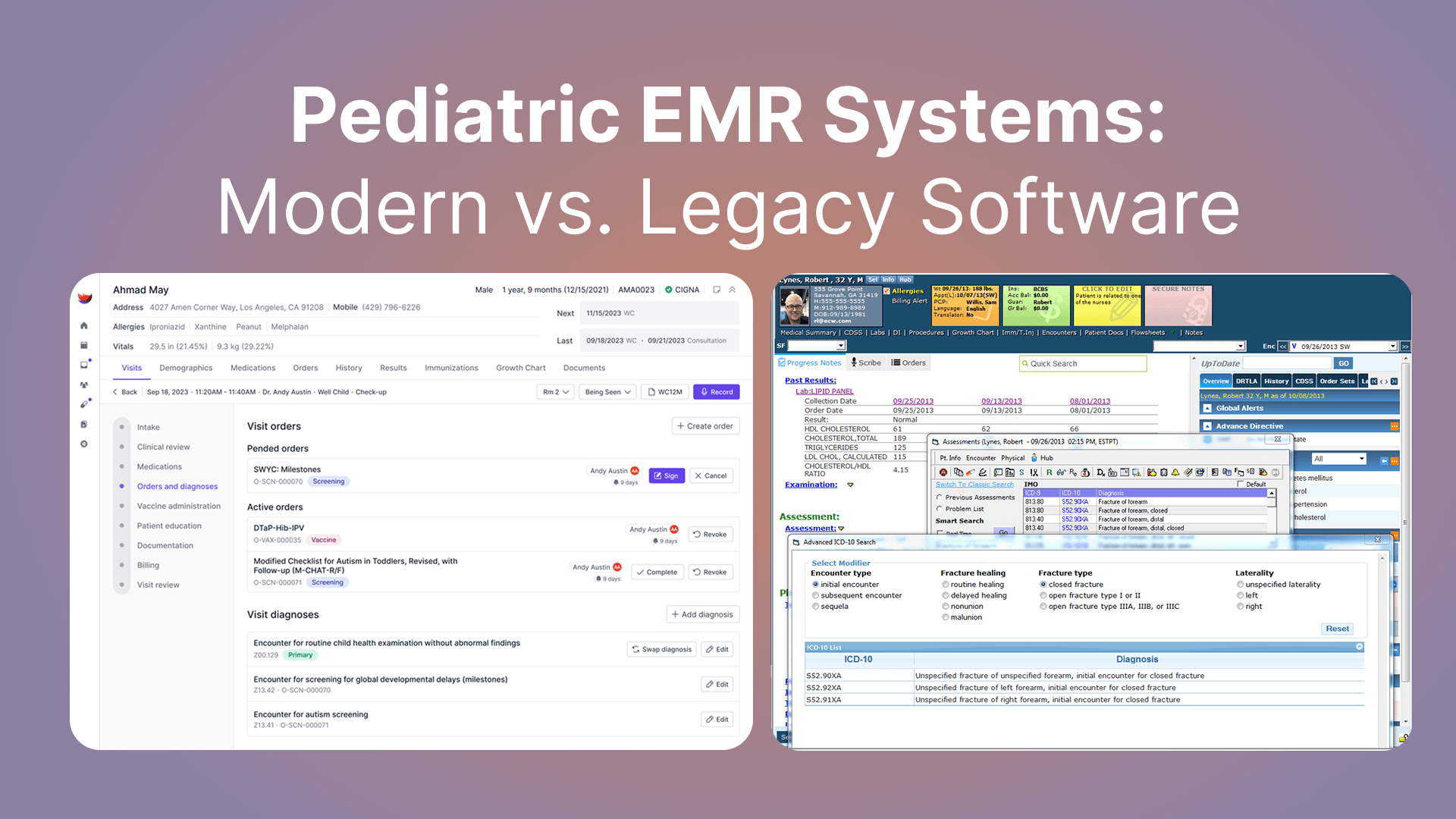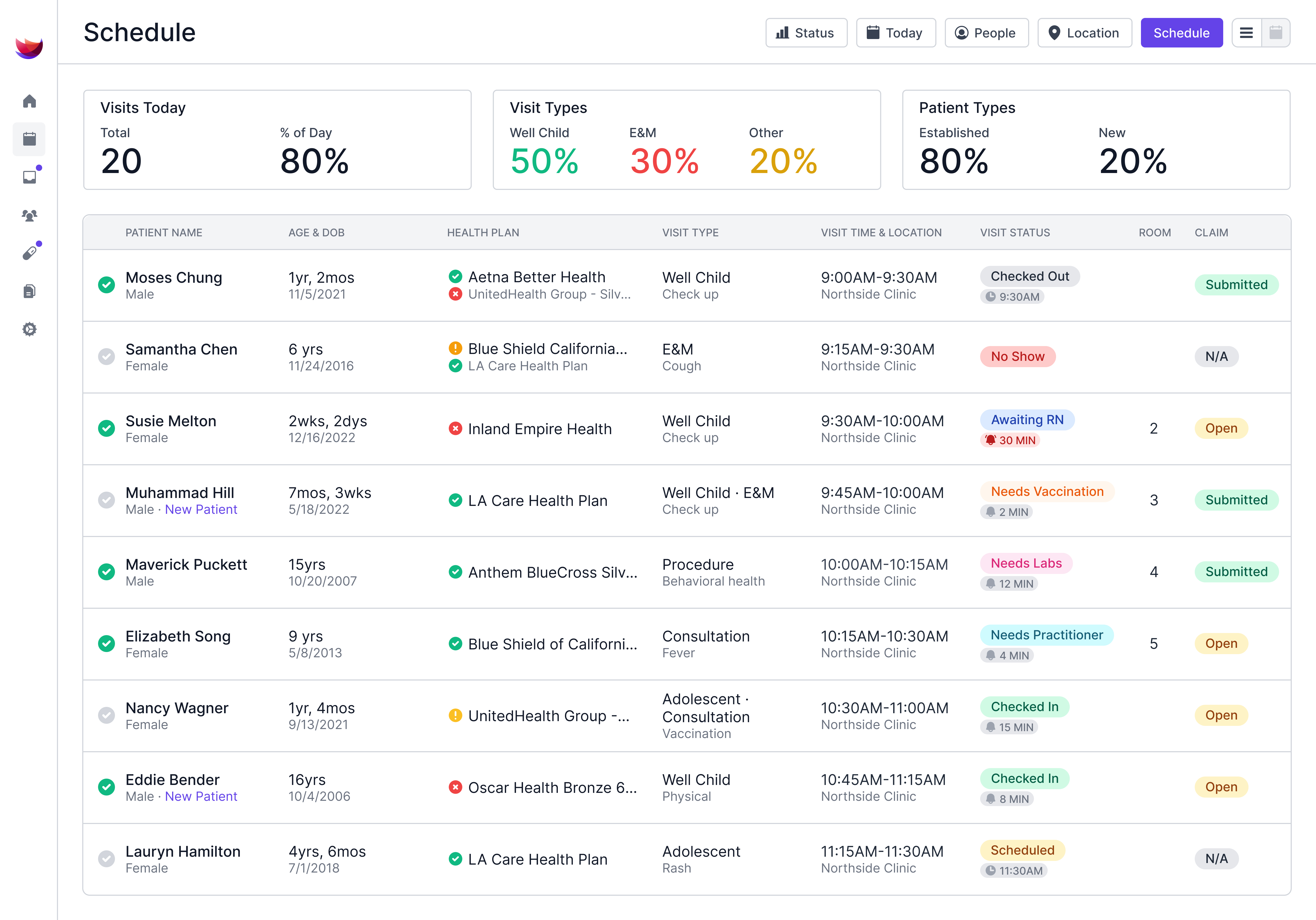


A pediatric therapy EMR is documentation and billing software built for pediatric physical, occupational, speech, and ABA therapy — goal banks and treatment plans instead of problem lists, unit-based therapy CPT codes instead of E/M levels, and authorization tracking against finite visit blocks. Fusion by Ensora and Raintree lead the 2026 pediatric therapy EMR market, with WebPT for PT-anchored groups and SimplePractice for solo providers. We compared seven platforms across documentation, PT/OT/SLP/ABA coverage, billing, and support, to help you find the right fit. If you run a pediatric medical practice rather than a therapy clinic — or one that does both — you're looking at a different category of software, and Develo is built for it.
7 Best Pediatric Therapy EMR Platforms: Quick Comparison
How We Evaluated Each Pediatric Therapy EMR
This roundup draws on vendor documentation, official pricing, and verified user reviews. Each platform was weighed on the factors that decide whether an EMR fits a pediatric therapy practice:
- Therapy documentation: Goal banks, treatment plans, session notes, and standardized pediatric outcome measures.
- Discipline coverage: Whether it supports PT, OT, SLP, and ABA, and how natively.
- Billing and authorizations: Unit-based therapy CPT codes, Medicaid, early intervention, and authorization tracking.
- Pricing and value: What the published or quoted cost covers.
- Support and stability: Service quality and ownership history, drawn from real user feedback.
7 Best Pediatric Therapy EMRs, Reviewed
1. Fusion by Ensora: Best for Pediatric-Focused Therapy Clinics
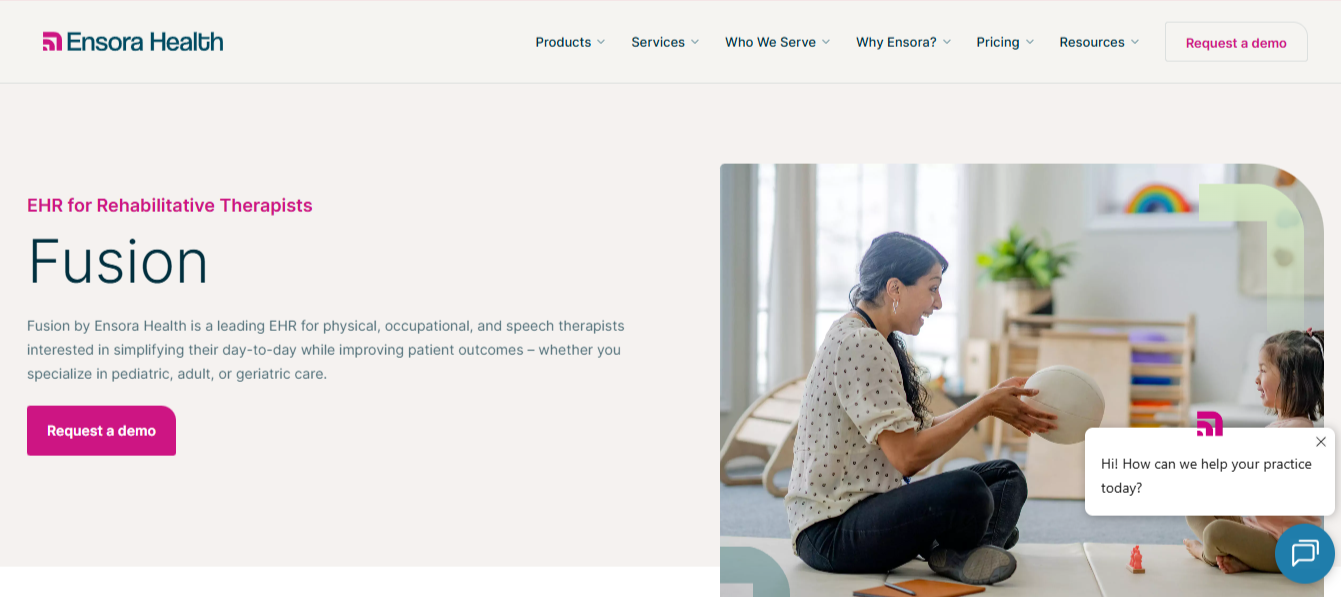
What it does: Fusion (now Fusion by Ensora Health) is a therapy EMR built specifically for pediatric OT, PT, and SLP practices.
Best for: Pediatric therapy clinics that want the deepest library of child-specific documentation.
Fusion is a pediatric-focused therapy EMR. Its templates, goal tracking, and caregiver portal are built around child therapy, so OT, PT, and SLP clinics spend less time bending the system to fit. It runs scheduling, documentation, billing, and family communication in one place, and is now part of the Ensora Rehab Therapy Suite.
Key Features
- Pediatric templates: One of the largest libraries of child-specific therapy documentation.
- Goal tracking: Goal banks and home-program delivery built for therapy plans.
- Caregiver portal: Family-facing scheduling, messaging, and home resources.
Pros
✅ Built specifically for pediatric OT, PT, and SLP, so evaluations, goal banks, and progress notes match how pediatric therapists already work instead of needing heavy customization.
✅ Connects scheduling, documentation, billing, and the caregiver portal in one place, which removes the handoffs between separate tools where pediatric clinics usually lose time.
✅ Long history in pediatric therapy means the templates and workflows have been tested across years of real clinic use, not built to a spec.
Cons
❌ Fusion's Essentials tier is a single-user plan, and the billing and claims tools a busy clinic needs sit in the pricier Advanced and Premier tiers, so a fully staffed practice is priced per additional user on top of a $159 or $229 first-user rate.
❌ Fusion has no dedicated mobile app, so documenting in schools or on home visits means working through the mobile browser rather than a purpose-built app.
❌ Since Fusion was acquired and folded into the multi-product portfolio now branded Ensora Health, support responsiveness and add-on pricing have become a common frustration for long-tenured clinics.
What Users Say
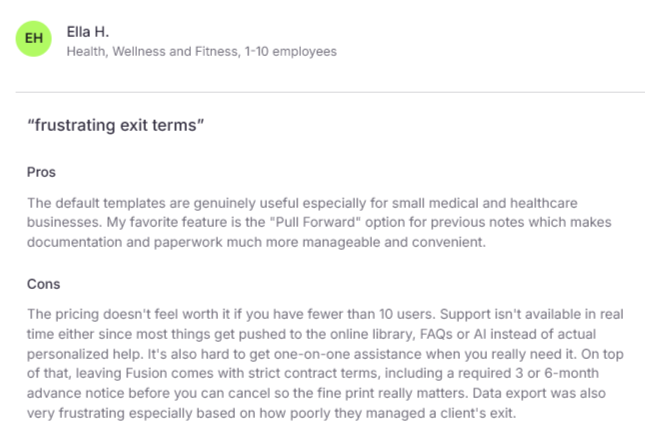
Ella H. liked the default templates and the "Pull Forward" option for prior notes, but flagged that the pricing is hard to justify for fewer than 10 users and that canceling requires 3 to 6 months' notice.
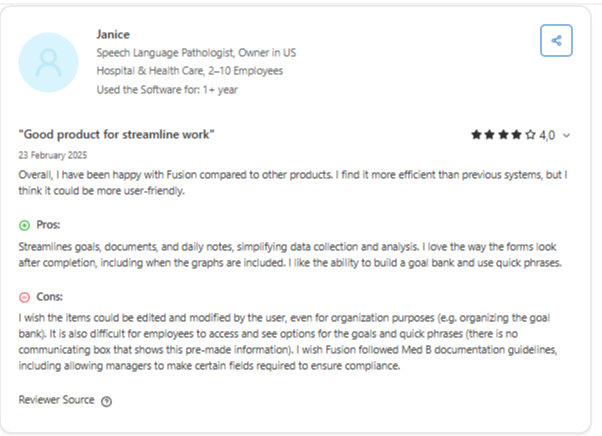
Janice B., a speech-language pathologist and practice owner, said that Fusion made goals, documents, and daily notes more efficient than her previous system, and she valued building a goal bank with reusable quick phrases.
Amelia M., a speech-language pathologist, praised Fusion's scheduling, highlighting the drag-and-move calendar and an easy setup that needed little explanation. Her main gripe was performance: in a shared environment, the calendar gets crowded and occasionally freezes during peak hours.
Pricing
- Essentials $99/user/mo
- Advanced $159 first user/mo, $45/additional user
- Premier $229 first user/mo, $75/additional user
Pricing verified September 2026.
Bottom Line
Fusion is the best fit for a dedicated pediatric therapy clinic seeking child-specific depth out of the box. Practices wary of post-acquisition pricing and the lack of a dedicated mobile app should weigh those against the clinical strengths.
2. Raintree: Best for Multidisciplinary Practices at Scale
What it does: Raintree is an enterprise practice management and EMR platform for rehabilitation and therapy organizations.
Best for: Larger multidisciplinary practices running PT, OT, SLP, and ABA under one system.
Raintree's strength is operational depth, including revenue cycle, billing analytics, authorization tracking, and patient engagement, all integrated at an enterprise scale. It supports ABA alongside traditional therapy, making it suitable for combined programs. That power comes with a steep learning curve.
Key Features
- Multidisciplinary support: PT, OT, SLP, and ABA in a single platform.
- ABA data tools: Behavior tracking and data collection for ABA programs.
- Custom goal banks: Shared goal libraries across therapists and disciplines.
Pros
✅ Runs ABA alongside PT, OT, and SLP in one platform, so multidisciplinary clinics manage behavior data, therapy notes, and billing without stitching two systems together.
✅ Revenue cycle and authorization tracking are built for complexity, holding up across Medicaid, commercial, and early-intervention payers at high claim volume.
✅ Configurable across multiple sites and large provider counts, which is where lighter therapy tools start to break down.
Cons
❌ Implementation is long, and the system is deep, so clinics without dedicated admin staff tend to underestimate the setup effort.
❌ Pricing is quote-based and varies widely, making it hard to budget before a sales process.
❌ Day-to-day documentation is less intuitive than newer platforms, which lengthens the ramp for new therapists.
What Users Say
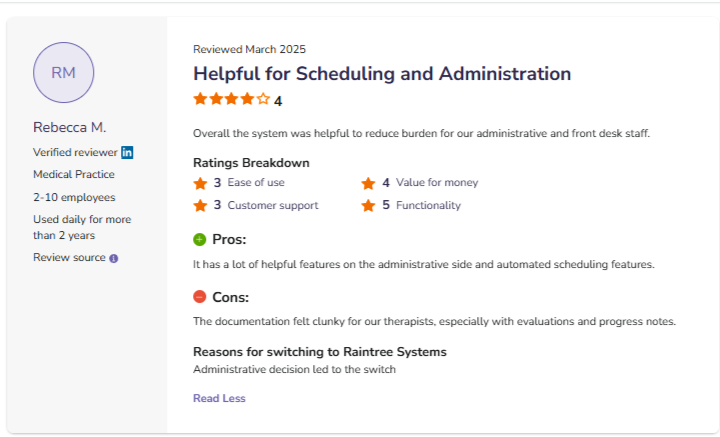
Rebecca M., a reviewer at a small medical practice that has used Raintree daily for over two years, said it reduced the workload on front-desk and administrative staff through automated scheduling. The trade-off was clinical: documentation felt "clunky" for her therapists, especially evaluations and progress notes.
Shawna C., a billing manager, liked that medical records print alongside billing and that smart search pulls patient and insurance details fast. Her frustration stemmed from workflow rigidity: corrections often require an amendment rather than a direct edit, and print options require a custom profile.
Shawnalee K., an office manager who trialed Raintree, called it a system with features most EMRs lack, including billing integration, patient texting, birthday reminders, and voice-to-text evaluation writing for therapists. Her reservations were the dated look of the interface and the cost, which she said was high enough that her practice ultimately didn't move forward.
Pricing
- Raintree uses custom pricing, depending on configuration.
Bottom Line
Raintree fits large or multidisciplinary pediatric therapy organizations that need enterprise billing and ABA support. Small practices will likely find it more system than they need.
3. WebPT: Best for PT-Rooted Multidisciplinary Groups

What it does: WebPT is a cloud rehab-therapy EMR supporting PT, OT, and SLP, including pediatric therapy clinics.
Best for: Multidisciplinary groups whose practice is anchored in physical therapy.
WebPT brings scale, integrating documentation, billing, outcomes tracking, telehealth, and patient engagement. It offers pediatric modules like developmental history and standardized outcome measures, though its roots are in PT, so pediatric OT and SLP workflows feel less native than in a pediatric-first system.
Key Features
- Rehab documentation: Therapist-designed notes with pediatric outcome measures.
- Integrated suite: Scheduling, billing, telehealth, and engagement together.
- Ecosystem maturity: A large support network and broad integrations.
Pros
✅ One of the most established rehab platforms, with a deep integration network across billing, clearinghouses, and outcome tools that a PT-led practice rarely outgrows.
✅ Strong documentation and compliance safeguards, which matter for clinics carrying mixed adult and pediatric caseloads.
✅ Large training library and support organization that shortens onboarding for multi-therapist groups.
Cons
❌ Designed around physical therapy first, so pediatric OT and SLP workflows feel adapted rather than purpose-built.
❌ Tiered pricing and add-ons climb quickly, pricing out many solo and small pediatric practices.
❌ The feature breadth comes with a learning curve, so small teams may end up paying for and navigating more than they use.
What Users Say
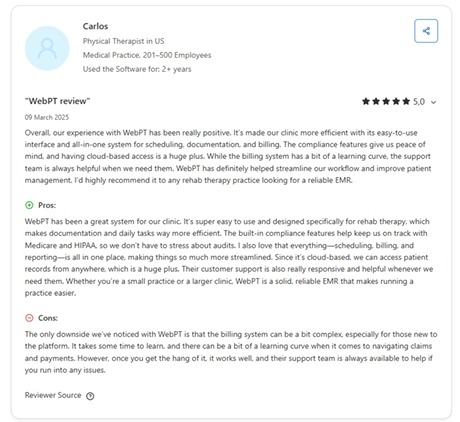
Carlos D., a physical therapist, credited WebPT’s all-in-one scheduling, documentation, and billing, plus cloud access and built-in Medicare and HIPAA compliance, which ease audit worries. Though he found the billing system "a bit complex" to learn, it eventually clicked.
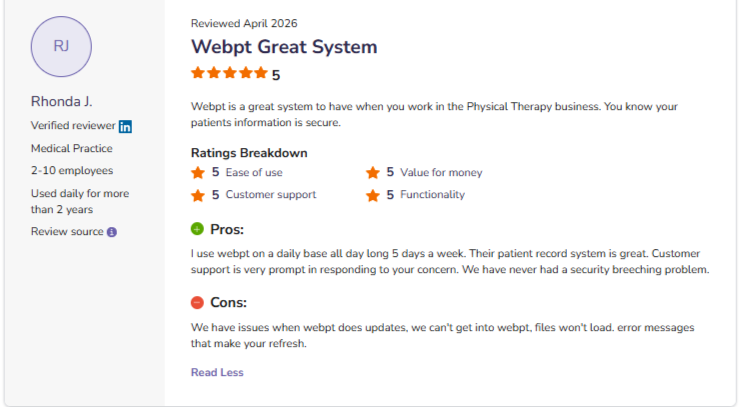
Rhonda J., from a small medical practice, said “WebPT is a great system” for patient records, quick support, and no security breaches. Her drawback was update reliability, including loading issues and “error messages that make you refresh.”
Dr. Jeanette D., a physical therapist, said that WebPT meets physical therapy documentation needs well. Her criticism was cost and structure: the platform was expensive with most features à la carte, and its PT focus made it hard to bring personal training and massage providers onto the system.
Pricing
Pricing is custom-quoted; WebPT offers three plans:
- Starter: For smaller cash-pay practices.
- Enhanced: For growing insurance-based clinics.
- Ultimate: For larger teams needing automation and advanced reporting.
Bottom Line
WebPT is a solid choice for multidisciplinary groups already centered on PT. SLP- or OT-only pediatric practices may prefer a platform built around their discipline.
4. Prompt Health: Best for Analytics-Focused Group Practices

What it does: Prompt is a therapy EMR known for reporting, KPI dashboards, and operational analytics.
Best for: Pediatric group practices that want deep visibility into productivity and revenue.
Prompt is a modern therapy EMR built for PT, OT, and SLP groups that run on data. It has earned a following among growing, multi-location practices that want their clinical, scheduling, and billing operations tracked closely rather than spread across separate tools.
Key Features
- Reporting suite: KPI dashboards and operational analytics.
- Revenue cycle visibility: Payer-mix and productivity tracking.
- Therapy workflows: Documentation and scheduling for PT, OT, and SLP.
Pros
✅ Built recently on a fast, modern interface, so therapists move through documentation and scheduling with fewer clicks than legacy therapy software demands.
✅ Billing automation cuts the manual claim follow-up that piles up as a group practice adds providers and locations.
✅ Frequent product updates and hands-on client success support, so new features ship often and onboarding has real guidance behind it.
Cons
❌ The analytics depth is built for group practices, so a solo or small clinic pays for capabilities it won’t fully use.
❌ Pricing is quote-based with no public rates, so budgeting requires a sales conversation up front.
❌ Getting full value means investing time to configure dashboards and reports to the practice's specific metrics.
What Users Say
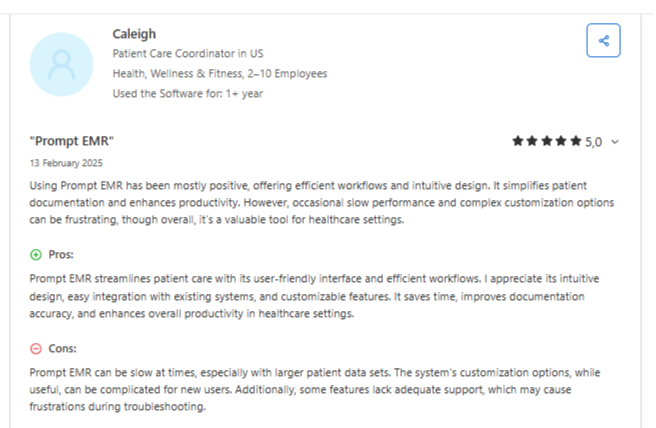
Caleigh, a patient care coordinator who used Prompt for over a year, found the workflows efficient and the interface easy to navigate, with more accurate documentation and easy system integration. Her drawback was speed, as it can lag on larger datasets.
Kathy D., a co-owner and physical therapist, said that a single platform for all clinic operations enabled her to bring billing back in-house, with precise reporting and minimal downtime. Her one downside was pricing, since added services come "à la carte."
Kallie S., a director of clinical operations, said Prompt ships updates and new features more often than most EMRs and stays closely connected to its clients. The flip side of that pace is that frequent updates require a dedicated operations team to implement changes and maintain best practices.
Pricing
- Prompt uses custom, quote-based pricing.
Bottom Line
Prompt suits group practices that run on data and want operational intelligence alongside documentation. Smaller clinics may not use analytics enough to justify the cost.
5. TheraOffice: Best for Practices Wanting Operational Reporting
What it does: TheraOffice, offered by Netsmart, is a therapy EMR that supports OT, PT, and SLP and features an extensive reporting library.
Best for: Practices that want operational reporting tied to clinical documentation.
TheraOffice is an EMR and practice management platform for physical, occupational, and speech therapy clinics, offered by Netsmart. It brings clinical documentation, scheduling, billing, intake, and reporting together in one system.
Key Features
- Report library: 175+ prebuilt operational and clinical reports.
- Flexible documentation: Customizable templates and flowsheets for PT, OT, and SLP.
- Scheduling and billing: Integrated calendar, claims, and patient payments in one workflow.
Pros
✅ Deep prebuilt reporting gives managers productivity and visit visibility without building custom queries from scratch.
✅ Netsmart ownership adds long-term stability and ties into a broader healthcare network that standalone tools can't match.
✅ Configurable documentation templates and flowsheets let a clinic shape notes to its own workflows rather than work around fixed forms.
Cons
❌ The interface is dated compared with newer therapy software, which can slow down daily documentation.
❌ The reporting tools carry a learning curve, and the depth is more than small practices need.
❌ Pediatric-specific content is thinner than on child-first platforms, so pediatric clinics customize more to fit.
What Users Say
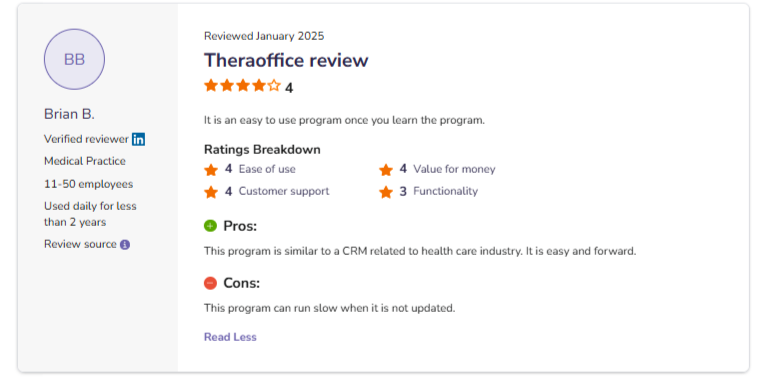
Brian B., a daily TheraOffice user for under two years, said the platform is straightforward once learned and works like a healthcare CRM. His drawback was speed: it can run slowly when not updated.
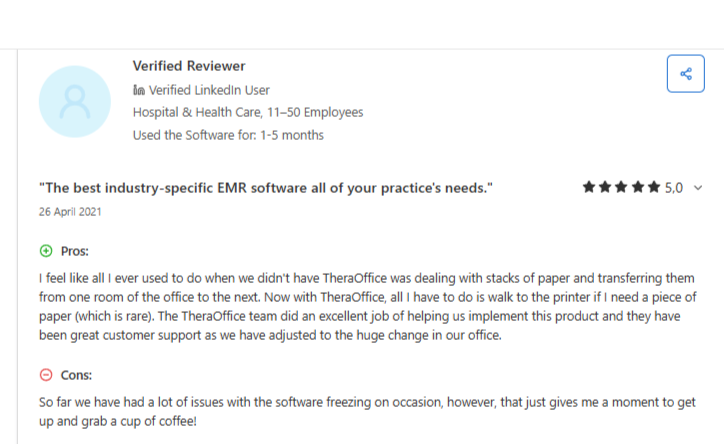
A verified reviewer from a small hospital said TheraOffice helped move the office away from paper-heavy workflows, making daily operations more efficient. They also praised implementation support and customer service, with the only con being that the software occasionally froze during use.
Pricing
TheraOffice uses quote-based pricing.
Bottom Line
TheraOffice works for practices that want operational reporting alongside documentation. Clinics prioritizing a modern interface may prefer a newer platform.
6. SimplePractice: Best for Solo and Small Practices
What it does: SimplePractice is an all-in-one EMR for small health and wellness practices, including pediatric therapy providers.
Best for: Solo practitioners and small pediatric therapy practices that want simplicity.
SimplePractice centralizes documentation, scheduling, billing, and family communication in a single interface. It isn't pediatric-therapy-specific, but for a solo or small practice, the simplicity and price are the draw.
Key Features
- All-in-one basics: Scheduling, notes, billing, and a client portal.
- Telehealth: Built-in video visits.
- Ease of use: A clean interface with a short learning curve.
Pros
✅ Publishes per-clinician pricing, which is low enough for a solo provider to start without a sales call or contract negotiation.
✅ Fast to launch with minimal training, so a small practice can get on scheduling, documenting, and billing within days.
✅ Supports many wellness specialties in one account, useful for providers whose caseload extends beyond therapy alone.
Cons
❌ Not built for pediatric therapy, so goal banks and standardized outcome measures are generic rather than discipline-specific.
❌ Billing and authorization tools are thin for complex multidisciplinary or ABA workflows.
❌ Growing clinics tend to outgrow it, moving to a therapy-specific platform when they need deeper documentation, billing, and reporting.
What Users Say
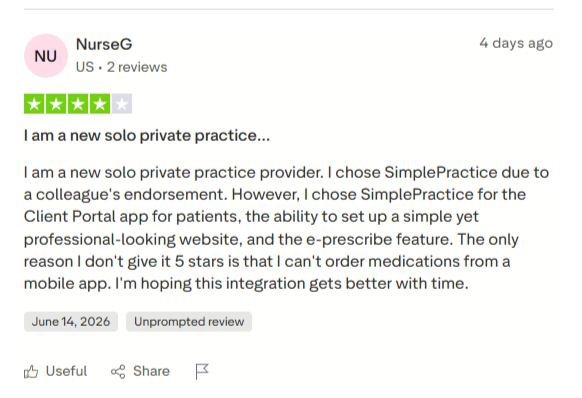
NurseG, a new solo private practice provider, chose SimplePractice for the client portal app, simple professional website, and ePrescribe. Their one limitation was mobile prescribing, since they couldn’t order medications from the mobile app.
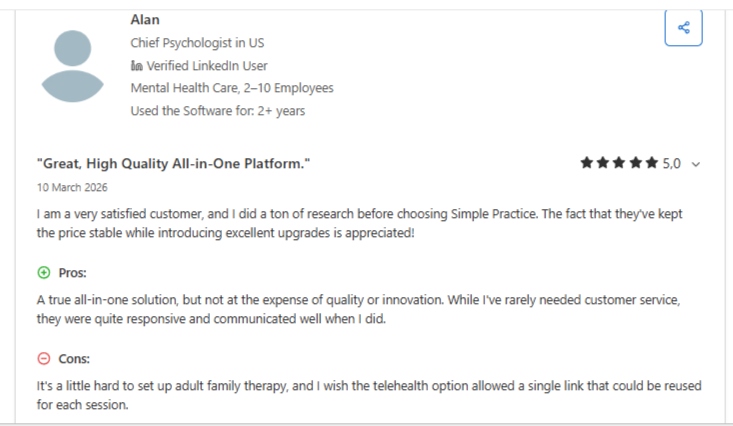
Alan J, a chief psychologist who has used SimplePractice for 2+ years, called it a high-quality “all-in-one solution,” praising its stable pricing, upgrades, and responsive support. He found the adult family therapy setup somewhat difficult and wished that telehealth offered a reusable session link.
Sarah Rosencrans, a small business owner with 12 years in practice, ccalled SimplePractice the most efficient EMR she's used, praising its note-taking support and treatment plan tools for saving time and energy.
Pricing
SimplePractice pricing is tiered, each with a 30-day free trial:
- Starter at $49/month
- Essential at $79/month
- Plus at $99/month
Bottom Line
SimplePractice fits solo and small pediatric therapy practices that value simplicity over discipline-specific depth. Multidisciplinary clinics will likely need more.
7. ClinicSource: Best for Small to Mid-Size Pediatric Therapy Clinics
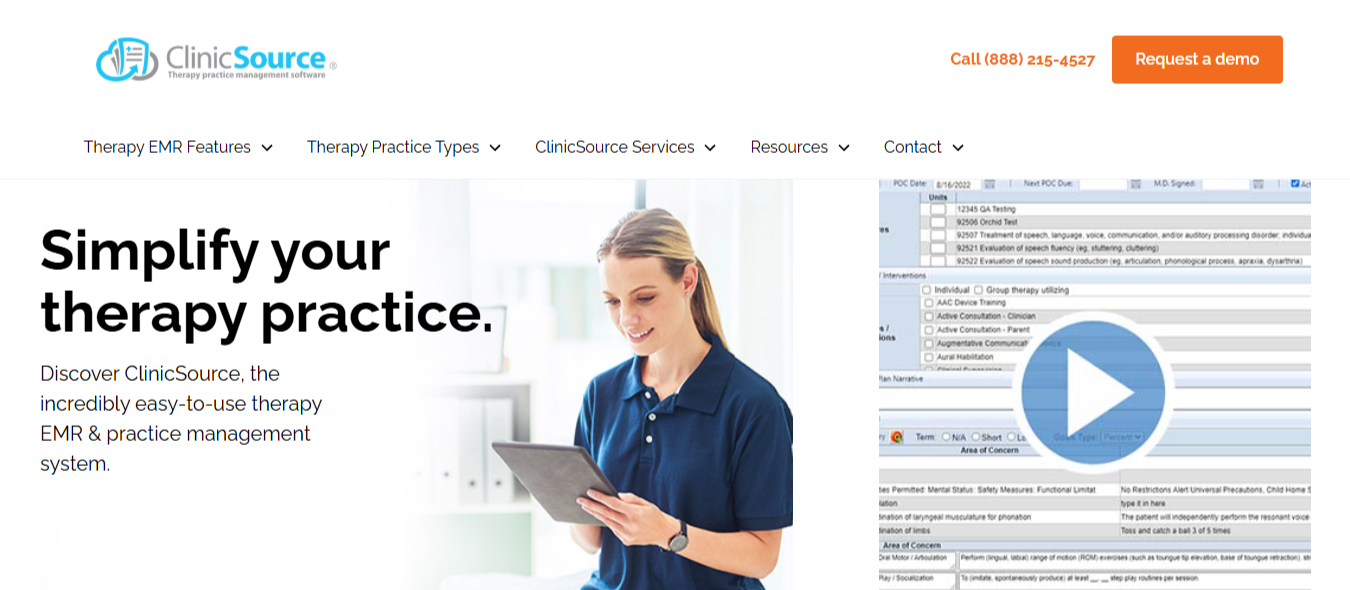
What it does: ClinicSource is a therapy practice management and EMR platform for PT, OT, and SLP, with therapy-specific documentation.
Best for: Small to mid-size pediatric therapy clinics wanting therapy templates without enterprise complexity.
ClinicSource focuses on therapy documentation with prebuilt templates and integrated scheduling and billing. It sits between simple all-in-one tools and enterprise platforms, making it a reasonable middle option for a growing clinic.
Key Features
- Therapy templates: Prebuilt documentation for PT, OT, and SLP.
- Integrated billing: Scheduling, notes, and billing in one place.
- Family scheduling: Online scheduling and reminders.
Pros
✅ Purpose-built for PT, OT, and SLP documentation, so therapy notes and plans need far less setup than a general EMR bent to fit.
✅ Positioned between simple all-in-one tools and enterprise platforms, a practical step up for a clinic outgrowing basic software but not ready for enterprise cost.
✅ Pricing scales to practice size, keeping it within reach for small and mid-size pediatric therapy clinics.
Cons
❌ Analytics and reporting are lighter than enterprise platforms like Raintree or Prompt, so data-heavy groups will want more.
❌ The interface and feature set feel dated next to newer entrants.
❌ Performance can slow down during high-volume periods, which busy clinics feel at peak scheduling times.
What Users Say
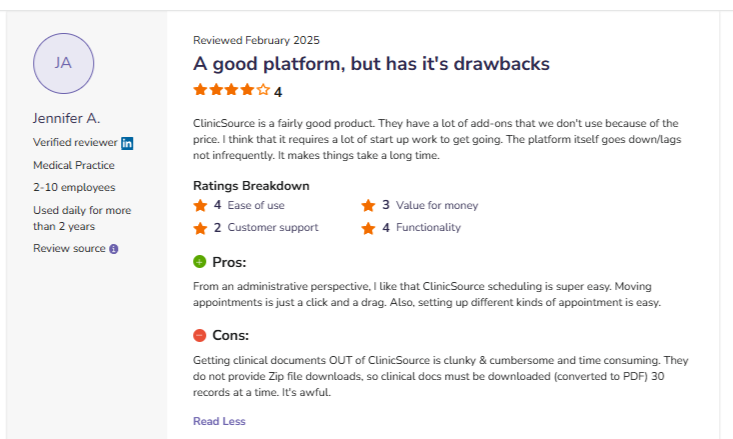
Jennifer A., a daily ClinicSource user for 2+ years, liked the “super easy” scheduling and drag-and-drop appointment changes. The downside for her was pricey add-ons, heavy setup, lagging and downtime, and clunky document downloads.
Stephanie V., a speech-language pathologist, said ClinicSource gave her an easier overview of daily appointments, check-ins, and cancellations.
Pricing
- ClinicSource uses per-user subscription pricing that scales with the number of providers. It does not publish rates on its site, but Software Advice lists it at $79.95 per user per month.
Bottom Line
ClinicSource is a workable middle option for small to mid-sized pediatric therapy clinics. Larger or ABA-heavy practices will want a deeper platform.
Which Pediatric Therapy EMR Should You Choose?
The right fit depends on your size and disciplines.
Choose Fusion by Ensora if you:
- Run a dedicated pediatric OT, PT, or SLP clinic
- Want the deepest library of pediatric therapy templates
- Can work around add-on fees and the lack of a dedicated mobile app
Choose Raintree if you:
- Operate a large or multidisciplinary practice, including ABA
- Need enterprise billing and authorization tracking
- Have the staff to manage a steeper learning curve
Choose WebPT if you:
- Are a multidisciplinary group anchored in physical therapy
- Want a mature ecosystem with strong compliance tools
Choose Prompt or TheraOffice if you:
- Run a group practice that makes decisions from reporting and KPIs
- Want deep operational analytics alongside documentation
Choose SimplePractice or ClinicSource if you:
- Are a solo or small practice that values simplicity and price
- Don't need enterprise analytics or ABA depth
Final Verdict
Fusion by Ensora is the strongest pick for dedicated pediatric therapy clinics because it’s built around child-specific documentation, goals, and therapy workflows. Raintree is better for large or ABA-inclusive organizations.
WebPT works well for PT-led rehab groups, and SimplePractice or ClinicSource can work well for smaller teams. The right choice depends on your disciplines, clinic size, and billing complexity.
If you run a pediatric primary care practice instead, the system to look at is Develo, the AI-native operating system for pediatrics — built for well child visits, immunization forecasting and inventory, pediatric billing, and the family-facing workflows a primary care panel runs on. The criteria are different enough from therapy that it's worth starting from what to look for in a pediatric EMR rather than a therapy checklist.
Frequently Asked Questions
What Is the Best EMR for Pediatric Therapy?
Fusion by Ensora is the strongest choice for dedicated pediatric OT, PT, and SLP clinics. Raintree is better for large or ABA-inclusive organizations, WebPT fits PT-led groups, and SimplePractice or ClinicSource can work well for smaller practices. None of these is built for pediatric primary care. A practice doing well child visits, immunizations, and pediatric billing needs a pediatric medical platform instead — Develo is the one built natively for that side.
What Features Matter Most in Pediatric Therapy EMR Software?
Look for goal tracking, treatment plans, pediatric documentation templates, PT/OT/SLP workflows, unit-based CPT billing, authorization tracking, Medicaid or early intervention support, and a caregiver portal. ABA practices should also look for behavior data collection.
How Is Pediatric Therapy EMR Software Different From Pediatric Medical EMR Software?
Therapy EMRs support PT, OT, SLP, and ABA workflows, including goals, session notes, progress tracking, and therapy billing. Pediatric medical EMRs support primary care needs like well child visits, growth charts, vaccines, and medical billing.
Most systems do one or the other, which is why a pure therapy clinic and a pure primary care practice usually buy different software. The practices that get squeezed are the ones doing both — a primary care panel also running behavioral health and therapy visits in-house, ending up with two systems and one child's chart split across them. Develo is built for exactly that practice: well child visits, immunizations, behavioral health and therapy visits, and pediatric billing in one operating system.
Do Pediatric Therapy EMRs Support ABA?
Some do, but many focus mainly on PT, OT, and SLP. Raintree is one of the stronger options for organizations that need ABA alongside other therapy disciplines, while other clinics may need dedicated ABA software.


.png)
.avif)