
.jpeg)
The right pediatric practice management software runs the operational side of a clinic: scheduling, intake, billing, and family communication, tuned for how pediatric care works. The five platforms below range from pediatric-specific systems to generalists with strong billing.
The 5 Best Pediatric Practice Management Software: At a Glance
How These Platforms Were Evaluated
This roundup draws on vendor documentation, official pricing pages, KLAS and industry data, and verified user reviews. Each platform was weighed across the factors that decide whether software fits a pediatric practice:
- Pediatric depth: Family relationship management, vaccine and VFC workflows, growth charts, and age-based screening.
- Billing and RCM: Handling of pediatric coding, well child visit rules, and Medicaid and EPSDT.
- Workflow and usability: Click load, scheduling, and family engagement across a high-volume day.
- Integrations: State immunization registries, labs, e-prescribing, and third-party connections.
- Pricing and value: What the published or quoted cost actually covers.
- Support: Whether the team understands pediatrics, drawn from real user feedback.
The 5 Best Pediatric Practice Management Software
1. PCC: Best for Pediatric-Specific Support and Longevity
What it does: PCC is a pediatric-only practice management and EMR platform for independent practices, sold as a single bundled monthly fee.
Best for: Practices that prioritize hands-on support and a long pediatric track record over the newest interface.
PCC (Physician's Computer Company) is a pediatric-only EMR and practice management vendor serving independent practices nationwide. It focuses on the clinical, billing, and operational needs of pediatric clinics.
Key Features
- Bundled monthly model: One recurring fee covers software, support, training, and upgrades.
- Pediatric billing and RCM: Practice management built around pediatric coding and Medicaid workflows.
- Growth and immunization tracking: Pediatric growth charts and vaccine inventory management with VFC handling.
- Unlimited support: Assigned client advocates and training included in the fee.
Pros
✅ External validation is unmatched, with eight consecutive Best in KLAS wins for ambulatory pediatric solutions in 2026.
✅ Predictable budgeting, since the bundled fee carries no startup or data conversion charges.
✅ Deep pediatric community gives practices a mature peer network and consulting support.
Cons
❌ Older interface conventions can mean more manual steps than newer platforms on high-volume days.
❌ Three-year agreement with an early termination fee limits flexibility.
❌ AI arrives one capability at a time, so what's on the vendor's roadmap isn't always what's live in a given practice, with rollout taking months.
What Users Say
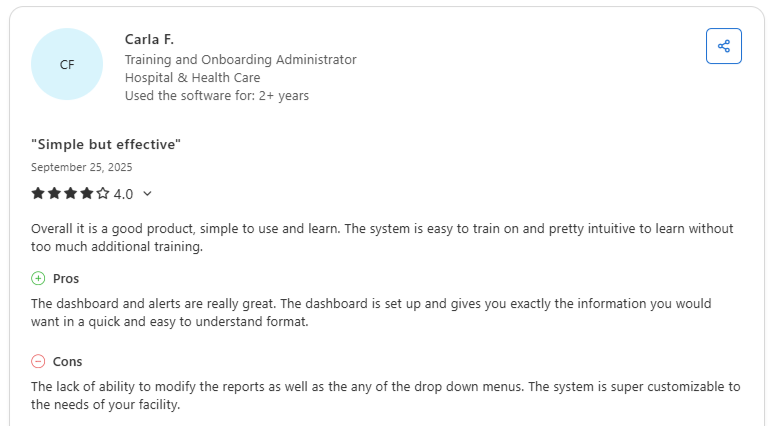
Carla F., a training and onboarding administrator with more than two years on the system, called it "simple but effective," crediting a clear dashboard and useful alerts that staff learn without much training. Her main critique was limited flexibility to modify reports and drop-down menus.
Christoph D., a reviewer at a pediatric practice using it daily for over two years, said its "support has to be experienced to be believed," recalling that staff worked nights and weekends through a payer crisis.
He credited pediatric-specific tools like preterm and Down syndrome growth charts and VFC versus private vaccine tracking. The drawback he mentioned was a missing ability to auto-generate three months of ADHD prescriptions, which he noted was being fixed.
Pricing
PCC charges a single flat monthly fee covering the EMR, billing, patient portal, support, training, and data conversion, with $0 startup and $0 data conversion costs. The standard term is 3 years with an early termination fee, and EPCS enrollment carries a small one-time token fee.
PCC isn't the cheapest option, but the model is predictable, with no per-request or add-on charges.
Bottom line
PCC suits practices that value support and pediatric pedigree above interface polish. Practices set on modern, automation-first software may find it dated, but few competitors match its service.
2. Develo: Best for Modern, AI-Native Pediatric Practices
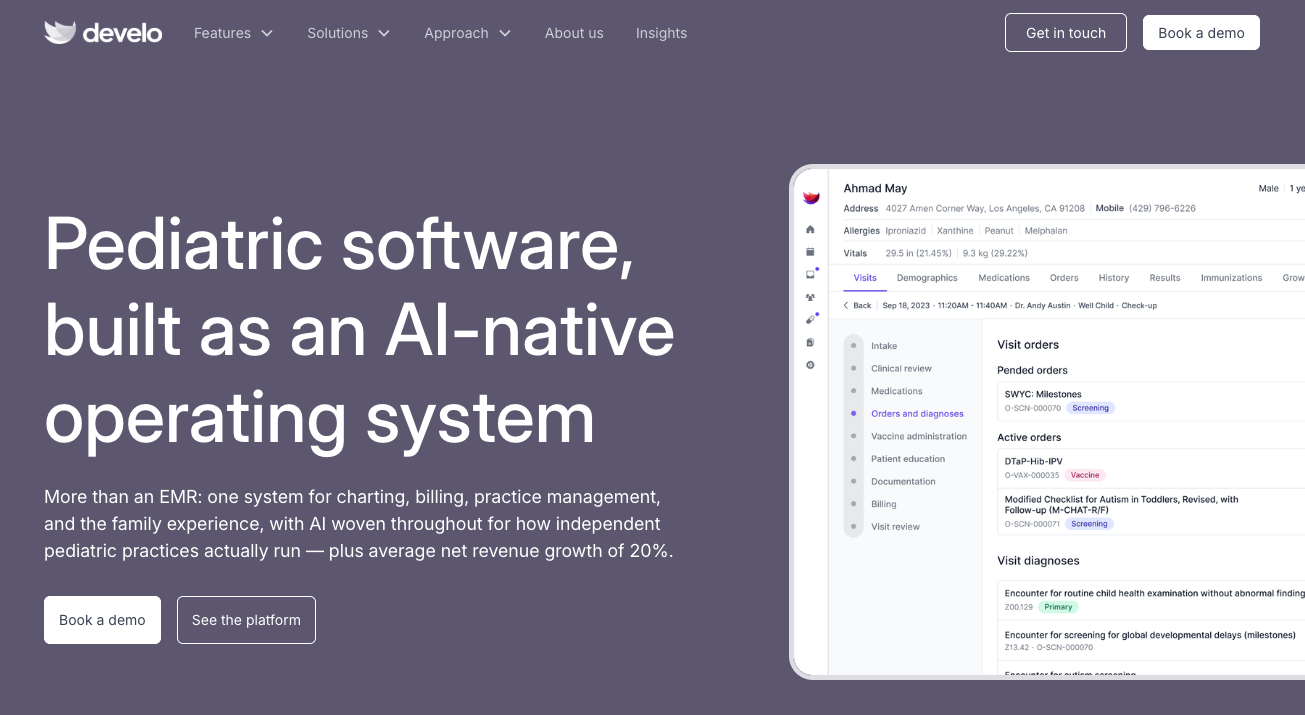
What it does: Develo is the AI-native pediatric operating system built solely for independent pediatric practices, unifying charting, billing, practice management, and family engagement in one modern system.
Best for: Independent pediatric practices that want pediatric depth on modern technology with automation built in.
Develo is a pediatric platform built around AI from the start. It runs on cloud architecture, ships product updates every week, and was founded in 2022 in Los Angeles by pediatrician Aaron Sin, MD (CEO) and Han Ke (CTO).
Key Features
- Automated charge capture: Pediatric billing codes apply from visit documentation by patient age and insurance type.
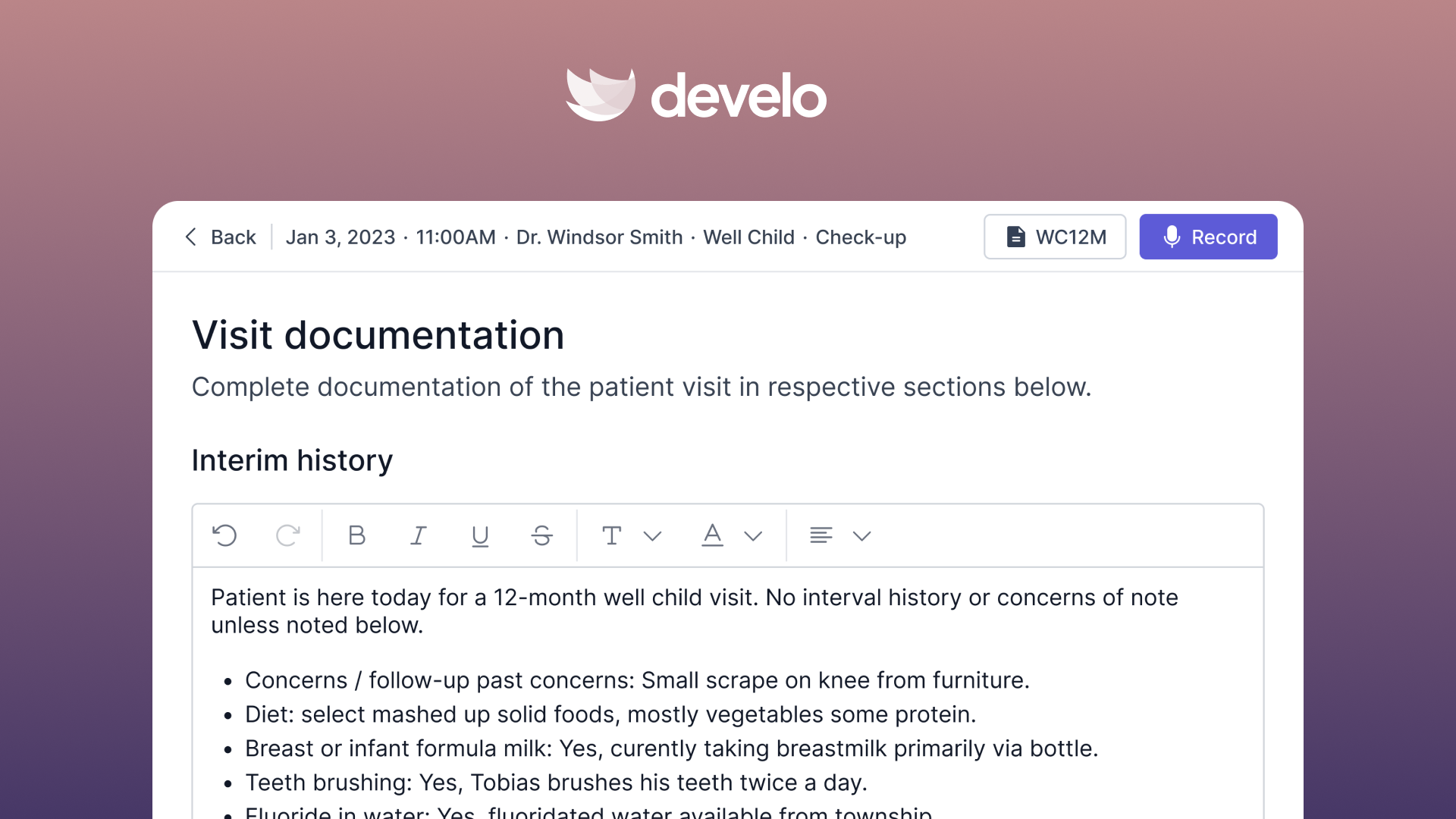
- Develo AI scribe: Notes are generated during the visit from pertinent patient and visit context beyond the audio transcript, with no copy and paste, and support for roughly 100 languages. Develo intake scribe brings the same multilingual, context-backed experience to visit intake.
- AI suite beyond scribe: Ask Develo answers questions about a patient from the whole record, Develo doc intel auto-tags inbound e-faxes and uploaded files for single-click filing, Develo reports Q&A covers plain-English reporting, and Develo AI forms auto-digitizes both patient and practice forms.
- Family portal: Caregivers self-schedule, complete digital screeners, and pay balances across siblings from their phones.
- Family relationship management: Siblings, multiple guardians, and adolescent confidentiality handled natively.
- Growth and screening as structured data: CDC, WHO, and Down syndrome plots with integrated percentiles and Z-scores, corrected-age plots for preemies, and mid-parental height estimates. Developmental surveillance and screening results are captured as discrete data that carries forward visit to visit, and a concerning result raises a screening task automatically to the pediatrician ahead of the visit.
- Vaccines end-to-end: Bi-directional state registry integration in real time, forecasting that flags doses due and invalid doses inside the ordering workflow, inventory tracked by funding source with an automatic VFC-eligibility-to-funding-source check, and vaccine administration codes billed with Medicaid status, age, and visit type accounted for.
- E-prescribing and labs, centrally integrated: Develo builds and maintains its e-prescribing and lab connections directly and centrally, so practices aren't standing up or maintaining interfaces one connection at a time.
Pros
✅ One platform replaces several, folding intake, screeners, and scribe tools into a single system and cutting vendor count.
✅ Fast pace of change, with weekly releases delivering automation faster than legacy or private-equity-owned roadmaps.
✅ Pediatrics-only support, so practices work with a team that knows the specialty instead of a general queue.
Cons
❌ Shorter operating history than 30-plus-year incumbents, with fewer public case studies to point to.
❌ Fewer third-party integrations, which can require workarounds for niche tools.
❌ Smaller peer community than the 30-year incumbents, so there's a thinner network of reference practices to learn from.
What Users Say
As a platform founded in 2022, Develo doesn't yet carry the third-party review volume of the legacy vendors, so there's less public feedback to weigh. The feedback that exists comes from customers, shared by Develo.
Dr. Rachel Rogers of Mountain View Pediatrics calls it "all-around impressive," adding that "ease-of-use is off the charts—after a week I am more comfortable with Develo than with other EMRs that I have used for 10+ years."
A practice owner in Illinois points to consolidation: "Not only has Develo brought together multiple partner tools into one experience, they are already delivering on features that no other EMR has."
A practice owner in North Carolina frames the differentiator as being built around the family: "As the sole system built around the family, Develo uniquely handles adolescent confidentiality and automates family engagement."
There's an independent signal on design too: a Medplum case study describes the product as carefully built, with close attention to the nuances of independent pediatric practices.
Pricing
Develo offers comprehensive pricing in a single quote that covers charting, billing, practice management, family engagement, and AI, sized to practice volume. Book a demo for pricing.
Bottom Line
Develo fits practices ready to replace legacy systems and the patchwork around them with one modern platform. Practices that weight decades of references heavily may hesitate, but for automation and pediatric fit it's a strong option.
3. Office Practicum: Best for Established Pediatric Clinical Depth
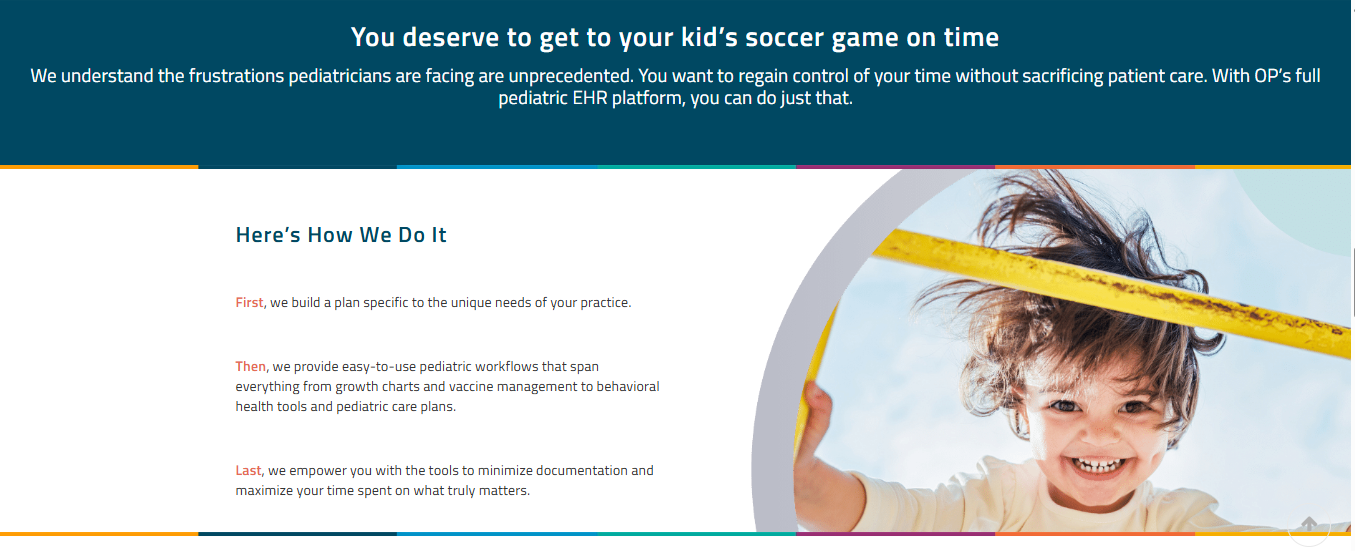
What it does: Office Practicum (OP) is a pediatric-specific practice management and EMR platform owned by Connexin Software.
Best for: Established pediatric practices that want deep clinical content and a large peer community.
Owned by Connexin Software, Office Practicum (OP) is a pediatric practice management and EMR platform with one of the widest footprints among independent pediatric practices. Its reputation rests on pediatric clinical depth and a sizable peer community.
Key Features
- Pediatric templates: A large library of prebuilt pediatric documentation and order sets.
- Vaccine management: Immunization forecasting aligned to the AAP schedule with VFC tracking.
- Integrated billing: Pediatric practice management and revenue cycle tools.
- Patient engagement add-ons: Online portal and messaging available across the suite.
Pros
✅ Pediatric depth built over three decades suits practices that want established clinical content.
✅ Large user base gives a wide network of peers and reference customers.
✅ Billing and consulting are available through a service menu for practices that want to outsource part of the work.
Cons
❌ À la carte pricing means add-on modules and services raise the total beyond the base fee.
❌ Pre-cloud architecture shows in interface speed, pace of modern feature delivery, and an ongoing OP Reimagined initiative for iterative rebuild and launch of the system.
❌ Private equity ownership means product decisions are secondary to cost management, with development and support increasingly outsourced.
What Users Say
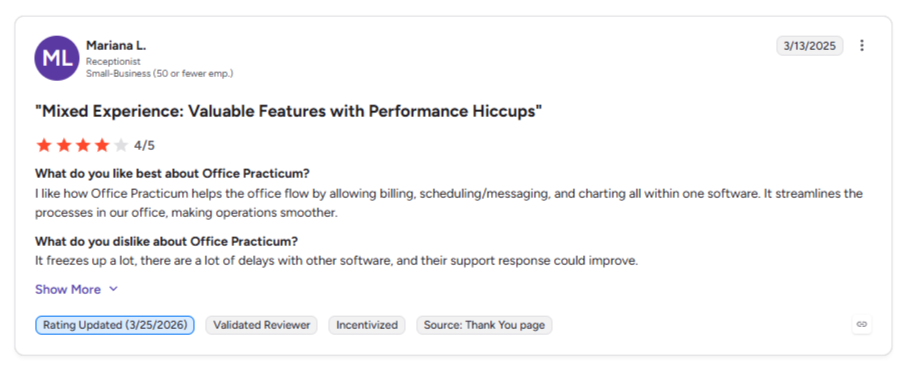
Mariana L., a receptionist at a small practice, said she valued having billing, scheduling, messaging, and charting in one system, which keeps office operations smoother. Her criticisms were frequent freezing, delays with other software, and slower support response.
Cyndi K., a population health manager whose practice has used OP for 14 years, called it "wonderful pediatric software," crediting the platform for actively seeking feedback and building the features practices ask for.
The downside, she noted, was that update releases occasionally have unintended consequences, though she noted the company addresses them quickly.
Pricing
Office Practicum does not publish pricing. It uses a custom-quote model, and third-party estimates vary widely, so the real figure depends on your practice size, modules, and services.
Bottom Line
OP is a strong pick for practices that want established pediatric depth and a peer community. Those prioritizing modern architecture and a predictable all-in cost may prefer a newer platform.
4. athenahealth: Best for Network-Scale Revenue Cycle
What it does: athenahealth (athenaOne) is a cloud platform combining EMR, practice management, and revenue cycle for ambulatory practices across specialties.
Best for: Multi-site or multi-specialty groups that prioritize revenue cycle over pediatric-specific design.
athenahealth is a large, cloud-based platform spanning practice management, EMR, and revenue cycle for ambulatory practices. Its strength is the revenue cycle, backed by a nationwide provider network. Pediatrics is one of the many specialties it serves.
Key Features
- Network-powered RCM: Claims scrubbing built on payer rules from a large provider network.
- Practice management suite: Scheduling, eligibility, and billing on one platform.
- Patient engagement: Self-scheduling, reminders, and an online portal.
- Reporting: Network benchmarking against comparable practices.
Pros
✅ Strong revenue cycle tooling suits multi-site groups with dedicated billing staff.
✅ Scales across specialties, so pediatrics can sit alongside other departments on one system.
✅ Frequent cloud updates reach all users without local deployment work.
Cons
❌ General ambulatory design means pediatric workflows need configuration and workarounds.
❌ Cost rises with collections under the percentage model as a practice grows.
❌ Onboarding weight falls hardest on smaller independent practices.
What Users Say
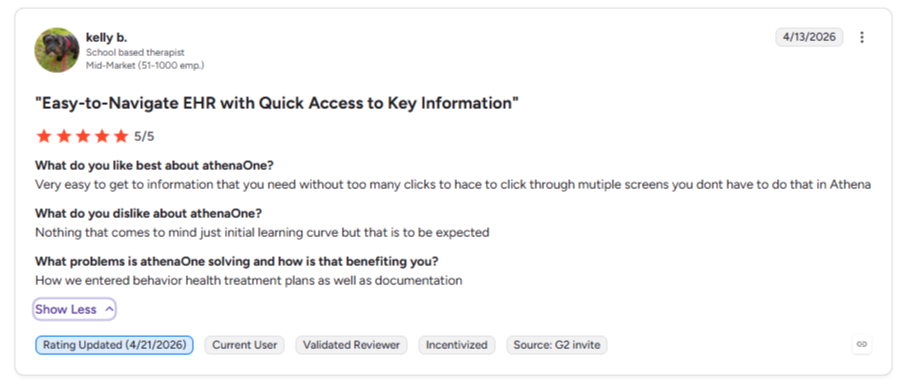
Kelly B., a school-based therapist at a mid-market organization, praised it as an "easy-to-navigate EHR," noting she can reach the information she needs without clicking through multiple screens. Her only critique was the initial learning curve, which she described as expected.
Lynda N., a director of patient care, called it "very supportive when we need assistance." The most common complaint is financial: reviewers report that as a practice collects more, athenahealth's cut grows, which stings smaller offices.
Pricing
athenahealth doesn't publish set rates. It describes its pricing as success-aligned, built on a percentage of collections, so the cost rises as the practice collects more and can get expensive at higher volumes.
Confirm the per-provider minimum, the percentage, and what sits outside it in a quote — under a collections-based model the line item grows with the practice rather than staying fixed.
Bottom Line
athenahealth fits multi-site groups that prioritize network-scale RCM. Dedicated pediatric clinics usually want more pediatric-specific depth than its generalist design provides.
5. AdvancedMD: Best for Configurable Billing and RCM

What it does: AdvancedMD is a cloud practice management and EMR platform for independent outpatient practices, owned by Francisco Partners.
Best for: Practices that prioritize billing and revenue cycle depth and want modular control over features.
AdvancedMD is a cloud-based platform combining practice management, EMR, and billing for independent multi-specialty practices. Its strength is billing and revenue cycle across many specialties. Pediatric practices can run on it, but the pediatric workflows need to be set up.
Key Features
- Modular per-provider pricing: Practices license only the modules they use.
- Billing and RCM depth: Automated claim scrubbing and AR aging by payer, provider, and location.
- Practice management: Scheduling, eligibility, and reporting in one system.
- Engagement tools: Reminders, messaging, and an online portal.
Pros
✅ Billing strength fits practices that bill across many commercial and government payers.
✅ Modular control lets a practice pay for only the capability it needs.
✅ Managed RCM option is available for practices that want to outsource billing.
Cons
❌ Modular costs stack well beyond the base rate as features are added.
❌ Generalist design requires configuration for family management, screeners, and VFC tracking.
❌ Private equity ownership sets roadmap priorities across a large multi-specialty base, so pediatric requests are one of many.
What Users Say
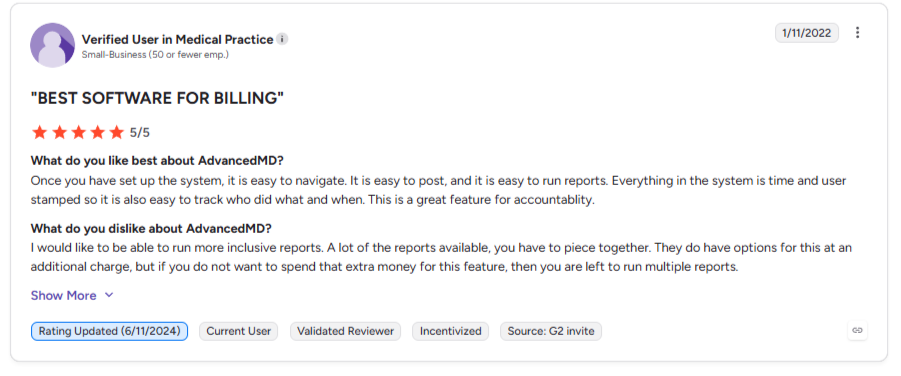
A verified medical practice user called it the "best software for billing," praising easy posting, reporting, and time-and-user stamps that aid accountability. The substantive critique lines up with a recurring theme: a more complete report means piecing several together, or paying extra for the feature.
Shannon M., a management consultant, described a "positive experience," praising the security and reliability, including password-protected, provider-admitted virtual visits. Her one request was a dial-out phone option for joining meetings instead of computer audio.
Pricing
AdvancedMD lists published pricing of $429 to $1,070 per provider per month for medical specialties, on a modular model, as of September 19, 2026. Bundling EMR, practice management, and patient engagement can cut up to 40%. Managed RCM is priced separately at 4 to 8% of collections.
Bottom Line
AdvancedMD is a fit for practices that put billing depth first and don't mind configuring pediatrics themselves. Clinics wanting native pediatric workflows will get more from a purpose-built platform.
Which Pediatric Practice Management Software Should You Choose?
The best fit depends on what a practice values most.
Choose PCC if you:
- Want a pediatric-only vendor with hands-on, pediatrics-aware support
- Prefer predictable bundled pricing with no startup fees
- Accept a more dated interface in exchange for a long track record
Choose Develo if you:
- Want charting, billing, practice management, and family engagement unified on modern technology
- Want automated charge capture and pediatrics-optimized revenue cycle services
- Want to future-proof your practice with native AI capabilities built for pediatrics
- Are ready to replace legacy systems and the tools stacked around them
- Run one site or a multi-site pediatric group, MSO, or care network on a shared back office
Choose athenahealth or AdvancedMD if you:
- Operate across multiple specialties and prioritize revenue cycle depth
- Have billing staff to run a generalist platform
- Accept configuring pediatric workflows that don't come natively
Skip a generalist platform entirely if your practice is pediatric-only and wants family management, vaccine workflows, and pediatric billing to work without setup, in which case a pediatric-specific system fits better.
Final Verdict
For a dedicated pediatric practice, the pediatric-specific platforms lead: PCC for support and track record, Develo for modern, AI-native workflows, and Office Practicum for established clinical depth.
athenahealth and AdvancedMD earn their place for billing-heavy or multi-specialty groups, with the honest caveat that pediatric depth is a configuration job. The right call comes down to whether a practice values longevity, modern automation, or revenue cycle muscle most.
Frequently Asked Questions
What Is Pediatric Practice Management Software?
Pediatric practice management software runs the operational side of a pediatric clinic, including scheduling, intake, billing, revenue cycle, and family communication. It usually includes an EMR, and pediatric versions add family management, vaccine tracking, and pediatric-tuned coding.
What Is the Best Pediatric Practice Management Software?
The best pediatric practice management software depends on the practice: PCC leads in pediatric track record, Develo fits practices that want a modern AI-native platform, and Office Practicum suits those after established pediatric content.
How Much Does Pediatric Practice Management Software Cost?
Pediatric practice management software is usually priced per provider per month or as a bundled fee, and most vendors quote custom pricing.
Can Generalist Software Work for a Pediatric Practice?
Yes, generalist software can run a pediatric practice, but it handles pediatric needs through configuration. Family management, vaccine tracking, and pediatric billing rules often need workarounds, so dedicated pediatric clinics frequently prefer a purpose-built platform.

.avif)
.png)
%20(1).png)