

Claims management in healthcare is the work a practice does to get paid for each visit. It starts with the coverage check before the visit and ends when the payer and the family have each paid their share.
For a pediatric practice, that work also covers vaccine administration codes, Medicaid managed care plans that can change between visits, and children covered by two parents' plans. This guide walks through the six stages of a claim from the practice's side, including who on your team owns each stage and the metric that flags a problem early.
What Is Claims Management in Healthcare?
For a provider's office, claims management in healthcare means preparing, sending, and tracking each insurance claim until it's paid in full.
Electronic claims from a provider's office use the X12 837 standard that HIPAA adopted. Each claim lists the patient and the services billed as CPT or HCPCS codes, along with the ICD-10 codes for the diagnoses behind them.
Health plans use the same phrase for their side of the work: receiving a claim, checking it against the member's benefits, and deciding what to pay. That review is called adjudication. Medical claims management for a practice covers everything the office does before, during, and after adjudication.
How Claims Management Fits Into the Revenue Cycle
The revenue cycle covers every financial step of a patient's care, from scheduling the visit to collecting the final balance. Claims management is the slice of that cycle tied to individual claims.
Some revenue cycle work happens outside claims management. Setting fee schedules, negotiating payer contracts, and reporting on practice finances all affect how claims get paid, but none of that work moves an individual claim forward.
The 2025 CAQH Index, an annual report built on health plan and provider data, estimates that the U.S. medical industry spent $75.3 billion on the administrative transactions a claim depends on in its latest reporting year, down from $83.0 billion the year before.
The 6 Stages of Healthcare Claims Management
Most claims pass through six stages, and ownership shifts from the front desk to the provider to the billing team as the claim moves.
1. Registration and Eligibility
The front desk owns this stage. Staff collect the patient's demographic and insurance details, then check eligibility with the health plan. In the 2025 CAQH Index, health plans reported that 96% of medical eligibility and benefit checks were fully electronic.
Errors made at check-in look small, like a member ID with two digits swapped, a policy that ended last month, or a second plan nobody recorded. Each one comes back later as a rejection or denial, and billing then has to trace the error back to the front desk.
Newborns are the hardest registration in pediatrics. A baby often arrives at the first visit before a member ID exists, and sometimes before the legal name is final. A baby born to a mother on Medicaid is deemed eligible for the first year, and the mother's Medicaid ID can be used on the baby's claims until the baby has one. Commercial plans usually require parents to add the newborn within 30 days of birth, with coverage back-dated to the birth date.
If a service needs approval from the plan, the prior authorization process starts at this stage, too. Our guide to insurance verification explores the coverage check in detail.
2. Coding and Charge Capture
The provider documents the visit and selects the codes, and a biller reviews them before the claim is built. Each service needs a CPT code and any required modifiers, with an ICD-10 diagnosis linked to it.
A frequent failure at this stage is a code the note doesn't support. In the 2025 Medicare fee-for-service improper payment data from the Centers for Medicare and Medicaid Services (CMS), incorrect coding caused 62.5% of the improper payments for established-patient office visits billed as 99214 and 72.5% of those billed as 99215.
3. Claim Submission and Scrubbing
A biller handles submission. The practice management system turns the visit's charges into a claim, and a claim scrubber checks it against payer rules. A clearinghouse then forwards the claim to the payer. In the 2025 CAQH Index, health plans reported that 98% of medical claim submissions were fully electronic.
A claim that fails a format or data check before the payer reviews it is a rejection. Since the payer never adjudicated it, billing corrects the data and resubmits.
A rejection that nobody works can push a claim past the payer's filing deadline. For Medicaid, the federal regulation 42 CFR 447.45 requires state programs to set that deadline no later than 12 months after the date of service.
4. Payer Review and Payment Posting
The payer reviews the claim against the member's benefits and the practice's contract, then pays it in full, pays part of it, or denies it. For Medicaid fee-for-service claims, the same regulation requires the state to pay 90% of clean claims from providers in individual or group practice within 30 days of receipt and 99% within 90 days.
On the practice's side, a payment poster owns this stage. Payment usually arrives as an electronic funds transfer, with an ERA that explains how the payer handled each line.
The poster matches the ERA to the claim, records adjustments and the patient's share, and flags any line paid below the contracted rate. Our ERA guide shows how one claim reads on an ERA and on the explanation of benefits that a family receives.
5. Denials and Appeals
The billing team owns denials, and the provider is pulled in when an appeal needs clinical detail. Denials are common: according to KFF, HealthCare.gov insurers denied 19% of in-network claims in 2024.
Administrative issues, such as missing information or late filing, made up 25% of in-network denial reasons. Only unspecified "other" reasons ranked higher, at 36%.
Each denial needs a decision: correct and resubmit the claim, appeal it, or write it off. Appeal deadlines vary by payer and plan type, so every week a denial sits unworked cuts into the time left to appeal it.
6. Patient and Family Billing
The front desk collects the copay at check-in, before the claim goes out. Once the payer's share posts, the billing office bills any remaining deductible or coinsurance to the guarantor, the person financially responsible for the account.
For most children on Medicaid, there's nothing to collect at check-in. Federal rules bar copays and other cost sharing for children under 18 in Medicaid's core eligibility groups, and a practice must accept the Medicaid payment as payment in full, so the rest of a covered service can't be billed to the family. Some CHIP programs charge small copays, though never for well child care, so the front desk needs to know which program the child is in.
Many families already struggle with these bills. In a KFF polling summary updated in October 2026, 22% of adults said they'd had problems paying medical bills in the past 12 months.
How to Track Claims and Measure Each Stage
Tracking a claim starts with the electronic responses a practice receives after submission. Like the 837 claim itself, these are standard X12 transactions named by number.
As explained in a CMS presentation, the 999 implementation acknowledgment reports whether the claim file passed format checks, and the 277CA health care claim acknowledgment reports whether each claim in the file was accepted or rejected.
Once a payer is reviewing a claim, staff can send a 276 claim status inquiry and receive a 277 response.
A CAQH issue brief drawing on 2023 CAQH Index data puts the cost of one manual status check at $15.96. It estimates that medical providers save about 17 minutes per check by moving to fully electronic transactions.
In the same brief, stakeholders said that calling the plan or checking its portal often returns more current information than the electronic response offers.
For open claims, sort by days since submission into aging buckets, starting at 0 to 30 days and moving up in 30-day increments to more than 120 days. That way, the oldest claims get worked before the payer's filing or appeal deadline passes.
Each stage also has one metric worth tracking:
| Stage | Metric to Watch | What a Bad Number Points To |
|---|---|---|
| Registration and eligibility | Share of denials caused by eligibility or registration errors | Coverage that wasn't checked, or was checked and not updated |
| Coding and charge capture | Charge lag (days from the visit to charges entered) | Notes signed late or charges held for review |
| Claim submission | Clean claim rate (claims accepted with no edits on first submission) | Outdated scrubber rules or missing data from the front desk |
| Payer review and posting | First-pass resolution rate (claims paid on first submission) | Payer requirements the practice keeps missing |
| Denials and appeals | Denial rate by reason and by payer | A repeat cause that a front-end fix would stop |
| Patient and family billing | Patient collection rate (patient payments collected ÷ patient responsibility) | Statements sent late or no collection at check-in |
Our guide to RCM KPIs gives benchmarks for clean claim rate, denial rate, and first-pass resolution, along with days in A/R.
Common Challenges in Claims Management
In a January 2026 poll by the Medical Group Management Association (MGMA), medical group leaders named denials and appeals as their biggest source of revenue cycle leakage, at 48%. Front-end issues came next at 23%, followed by billing and collections (14%) and coding (13%).
These problems cut across all four categories:
- Payer rules that differ by plan: Each health plan sets its own claim edits, filing limits, and attachment requirements, so billers track a separate rule set for every plan they bill.
- Handoffs between teams: A claim passes from the front desk to the provider, then to the biller and the payment poster. When those teams work in separate systems, someone re-keys data at each handoff, and every re-keyed field is another chance for a typo that triggers a rejection.
- Hard-to-fill billing roles: In a March 2023 MGMA Stat poll, 34% of medical group leaders named coders as the hardest revenue cycle role to hire, and 26% named billers. Most pediatric practices don't employ a dedicated coder, so the provider or biller absorbs that gap, and every open seat leaves fewer people to work denials before their appeal deadlines pass.
- Underpayments that go unchecked: In a February 2025 MGMA Stat poll, only 48% of medical group leaders said their practice audits payer payments against contracted rates monthly or quarterly. A claim paid a few dollars short doesn't trigger a denial, so the shortfall only gets caught when someone compares the ERA with the fee schedule.
- Clearinghouse outages: The 2025 CAQH Index reports that during the February 2024 cyberattack on Change Healthcare, staff submitted claims manually while electronic connections were restored. In an October 2026 MGMA Stat poll, only 19% of practice leaders said they were very confident they could recover quickly from a cyberattack.
Claims Management in Pediatric Practices
Pediatric claims move through the same six stages, but four situations in children's care change the work at registration, coding, and payer review.
Medicaid, CHIP, and Coverage That Changes
Medicaid and CHIP covered roughly 37% of U.S. children in 2024, according to the Medicaid and CHIP Payment and Access Commission.
Coverage also changes often. A 2025 JAMA study estimated that 61% of U.S. children are enrolled in Medicaid or CHIP at some point before age 18, and 42% have a gap in coverage.
Since January 1, 2024, federal law has required states to give children under 19 in Medicaid and CHIP 12 months of continuous eligibility, so coverage rarely ends mid-year except in cases such as turning 19 or moving out of state. The managed care plan can still change, so for the front desk, that means checking eligibility before every visit and confirming which Medicaid managed care plan the child is in on the day of the visit.
Vaccine Administration Claims
Each vaccine bills as a product code plus an administration code. As the AAP's immunization administration FAQ explains, when a physician or another qualified healthcare professional counsels the family about a vaccine for a patient 18 or younger, 90460 covers the first component of each vaccine and 90461 covers each additional one. An MMR dose therefore bills as 90460 once and 90461 twice.
For doses from Vaccines for Children (VFC) stock, federal rules bar the practice from charging for the vaccine itself and cap the administration fee at the state's regional maximum.
States also differ on how a VFC dose appears on the claim. Under a 2026 ForwardHealth update, Wisconsin Medicaid requires the SL (state-supplied vaccine) modifier on the vaccine product line and doesn't require it on the administration line. Montana Medicaid requires SL on the administration code, with the vaccine product billed at $0.00.
Well Child and Sick Care on the Same Day
When a problem during a well child visit needs its own evaluation, the claim carries both the preventive visit code for the child's age and a problem-oriented E/M code with modifier 25, such as 99392 with 99213-25.
Link the sick diagnosis to the problem-oriented code, and make sure the note shows the separate work.
Two Parents, Two Health Plans
When both parents' plans cover a child, coordination of benefits rules decide which plan pays first. Connecticut's Office of the Healthcare Advocate explains the birthday rule: the plan of the parent whose birthday comes earlier in the calendar year pays first.
For divorced or separated parents, a court order that addresses health coverage can override the birthday rule. Without one, the custodial parent's plan usually pays first.
A claim sent to the wrong plan first comes back denied for coordination of benefits, so the family record needs both plans and the order in which they pay.
Medicaid adds one more rule. It pays after any other coverage the child has, but for preventive pediatric care, federal rules generally require the state to pay first and recover from the other plan later, a method called pay and chase. A well child visit for a child with both commercial coverage and Medicaid can go to Medicaid first, while a sick visit goes to the commercial plan first. Check your state's billing manual for the exact rule.
Improving Claims Management With Technology and Automation
Most claim transactions already move electronically, so the gains from new technology now come from removing the manual steps between them. The 2025 CAQH Index puts the remaining savings opportunity for the medical industry at $18.7 billion.
The index also found that about one-quarter of providers now use AI, mostly for administrative tasks such as eligibility checks, note-taking, and patient communication.
Practices are adding automation of their own. In an October 2026 MGMA Stat poll, 63% of medical group leaders said their revenue cycle operations were leaning toward more automation in 2026. Coding was the area they most often named for automation.
Federal rules also require payers to automate more of this work. Under CMS's interoperability and prior authorization rule, the payers it covers must offer a prior authorization API for items and services other than drugs beginning in 2027. Those payers include Medicare Advantage plans, state Medicaid and CHIP programs with their managed care plans, and insurers that sell plans on the federal Marketplace.
There's no single best claims management system for every practice, because the right one depends on your payer mix, your specialty, and whether billing happens in-house. These six capabilities cover the stages above:
- Charting and billing in one system: Codes and diagnoses come straight from the visit documentation, so nobody has to re-key them for the claim.
- Automatic eligibility checks: The front desk sees a coverage problem before the visit, while the patient or family is still available to fix it.
- Payer rules maintained by the vendor: Scrubbing rules stay current as plans change their edits, so your billers don't have to write and update rules by hand.
- Automatic ERA posting with underpayment flags: Payments post line by line, and any line paid below the contracted rate on your fee schedule goes to a work queue.
- Work queues with an owner and deadline on every claim: Rejections and denials appear in one list showing each claim's owner, status, and deadline, so your team works the claims closest to a filing or appeal deadline first.
- Pediatric rules built in: For pediatrics, that means age-based preventive codes and vaccine administration codes. It also covers VFC stock tracking and modifier 25 logic.
Ask each vendor to show these capabilities on a sample claim from your own practice, such as a well child visit with two vaccines and a sick complaint.
Who Does the Billing Matters as Much as the Software
Software decides how much claim work is automated. The people working the exceptions decide whether a rejection gets fixed this week or ages past the filing deadline. Pediatric practices usually choose among three setups:
- In-house billing: The practice employs its own biller. Most small pediatric practices don't have the claim volume for a full-time biller, so billing often becomes part of a practice manager's job, and experienced pediatric billers are hard to hire.
- Billing bundled with the EMR: Many EMR vendors offer billing services but hand the work to third-party billers, often overseas. Those billers work in software someone else runs, with no direct line to the people who build it.
- A standalone billing company: These companies work across many EMRs, so most of their billers are generalists, and some subcontract the work. Pediatric details like VFC claim formatting and modifier 25 on a same-day well and sick visit are where generalist billing loses money.
Outsourcing doesn't remove the handoffs between stages. It moves them. A billing partner usually takes claim submission, rejections, denials and first-level appeals, payment posting, and insurance A/R follow-up. The practice usually keeps registration and eligibility, coding and E/M level selection, prior authorizations, payer enrollment and credentialing, and collecting from families. Most claims that go wrong do so at those handoffs.
Before you sign with a billing partner, ask:
- Who works your claims? Ask where the billers are based and whether they're employees or subcontractors.
- Do they bill only for pediatrics? Ask how many of their practices are pediatric.
- Who owns each stage? Get a written list of what the partner does and what stays with your practice, with turnaround times on both sides, such as closing visits within five business days.
- Do they work small-dollar claims? Low-dollar vaccine administration and screening denials are easy to write off, and across a pediatric panel they add up.
- What do you see each month? Ask for a report with a target for each KPI in the table above, plus a recurring review call.
- What happens if you leave? Ask whether they keep working open claims after termination, and whether your rules and data stay with you.
Pediatric Claims Management With Develo
For a pediatric practice, claims management gets simpler when one system holds the chart, the claim, and the family ledger, since data moves between stages without anyone retyping it.
Develo is the AI-native pediatric operating system built solely for independent pediatric practices, unifying charting, billing, practice management, and family engagement in one modern system.
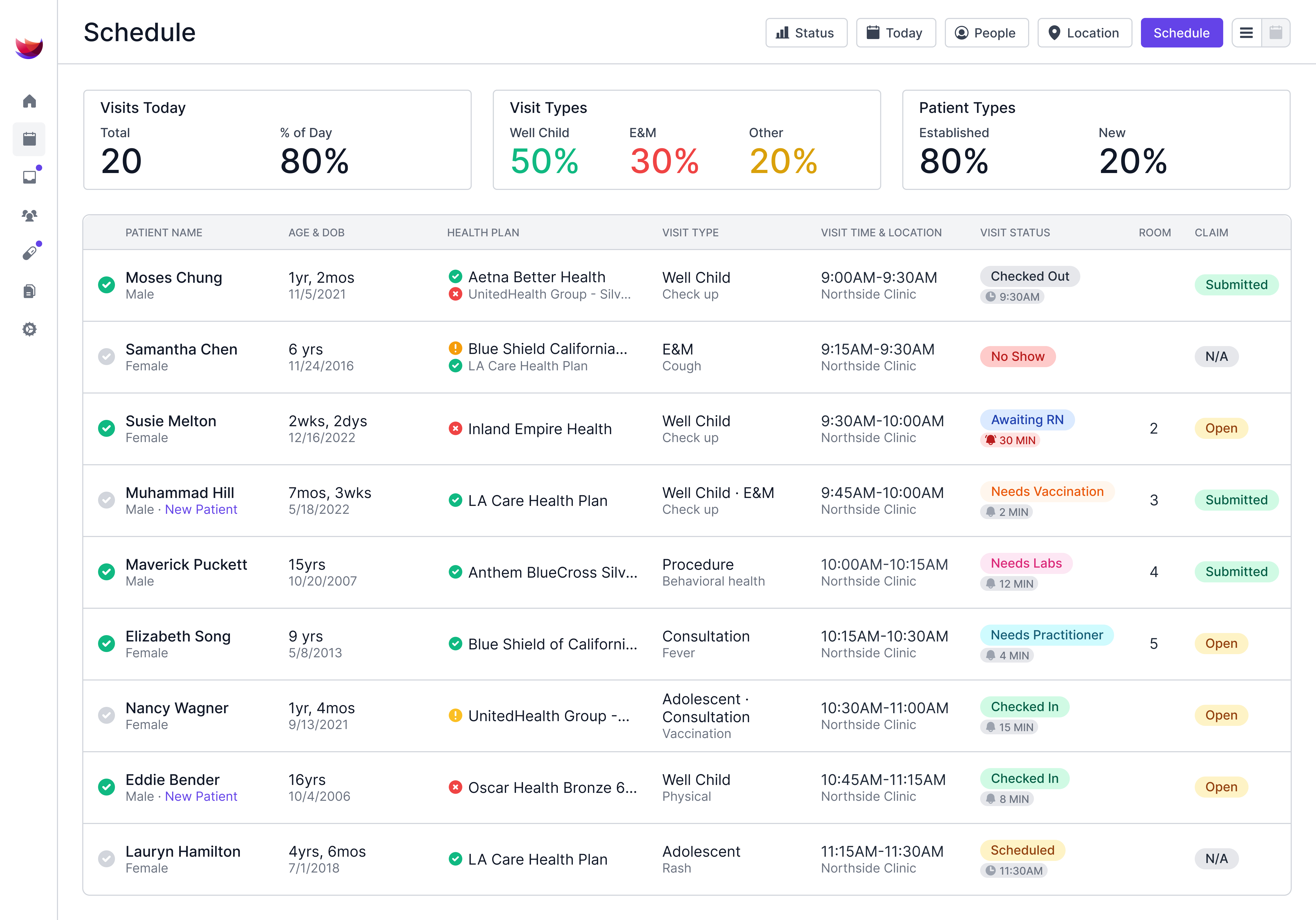
Develo moves claims work to the front and middle of the cycle. Traditional billing leans on the back end, where billers find a lapsed plan or a missing code after the claim is denied and then rework it. That's like maintaining your car only after something breaks down. Develo catches those problems at registration and during the visit, so fewer claims reach denials and appeals at all.
The platform offers:
- Digital intake: Families complete check-in, pediatric screeners, and forms by text before the visit, with no app or portal required.
- AI eligibility checks: Develo reads the insurance card automatically and checks eligibility for every scheduled visit and on demand, running each response through AI-assisted interpretation. Check-in notifications flag outdated demographics or insurance for the front desk.
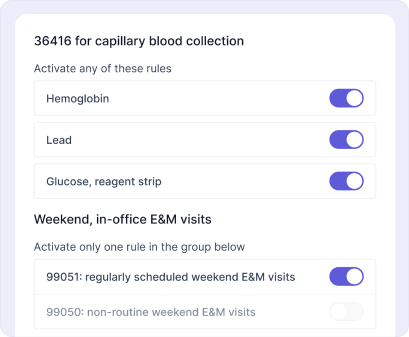
- Automated charge capture: During the visit, rules set pediatric billing codes, units, and modifiers by visit type, and alerts flag likely underbilling for the provider to review. Preventive visit codes follow the child's age on the visit date and new or established status, with the matching Z code, and a well-sick visit gets modifier 25 for the provider to confirm.
- The Develo AI scribe: The scribe suggests diagnoses for the visit, checks that each one is billable, and suggests the E/M level from the visit transcript, so what gets billed traces straight back to what was documented.
- Immunization billing: VFC eligibility is mapped from the patient's health plan, and any mismatch with the vaccine stock chosen for a dose is flagged, or blocked if the practice prefers. Vaccine and administration codes reflect the patient's age, Medicaid status, and visit type.
- Claim scrubbing: Develo maintains its library of pediatric claim rules and rolls updates out to practices, so billers don't write rules by hand. Each rule can fix a claim automatically or route it to a work queue, scoped by payer when needed. Practices pay no separate clearinghouse fee.
- Posting and follow-up: ERA payments post automatically, and with your fee schedule entered, Develo flags payments that come in below your contracted rates. Rejected and denied claims land in work queues that show each claim's owner, status, deadline, and next action, and Develo tracks appeal deadlines by payer.
- Family payments: Automated text reminders include a live balance and a payment link. Families see one balance across siblings and can keep a card on file.
- Optional RCM services: Develo's RCM services team is staffed by pediatric-only billers employed by Develo and based in the U.S. and Canada, never outsourced. One company runs both the software and the billing, so the billers work alongside the engineers who built the system and one partner is accountable from visit to paid. Rules handle routine claims and flag exceptions, and billers review each exception before the claim is finalized, including the small-dollar claims other billers let slide. The team is priced as a percentage of insurance collections.
Providers and billers still make the final coding call on every flagged claim. Book a demo to see how Develo handles a pediatric claim from check-in to the final family payment.
Frequently Asked Questions
Who's Responsible for Claims Management in a Practice?
No single role owns claims management in a practice. The front desk handles registration and eligibility, while the provider handles coding and a biller reviews it. The billing team takes over at submission and stays with the claim until the family's balance is paid.
How Many Steps Are in the Medical Claim Process?
The medical claim process has no official step count, so guides split it differently. This guide uses six stages because each one has its own owner in the practice. Shorter versions usually merge neighboring stages, like claim submission and payer review.
Why Is Claims Management Important?
Claims management is important because a practice gets paid only for claims that are accurate, filed on time, and followed up when something goes wrong.
What's the Best Claims Management System?
The best claims management system is the one that handles your most common claims with the fewest manual steps.
What Does Develo's Billing Service Do?
Develo's billing service runs claims from submission to payment inside the same system the practice uses every day. The team manages the work queues and automation rules, scrubs and submits primary, secondary, and tertiary claims, works rejections, denials, and Level-1 appeals, posts payments from ERAs, and follows up on insurance A/R. It also flags billable services the practice isn't capturing and builds rules to catch them, with the practice's approval. The practice keeps registration and eligibility, coding, prior authorizations, credentialing, and family collections, and gets a monthly KPI report and review call.
How Is Develo's Billing Service Different From a Billing Company?
The main difference is that one company runs both the software and the billing. Standalone billing companies work across many EMRs with mostly generalist billers, and billing bundled with an EMR is often handed to third-party billers, many overseas. Develo's billers work only in pediatrics, are employed by Develo in the U.S. and Canada, and work alongside the engineers who built the system, so one partner is accountable from visit to paid.
Should a Small Pediatric Practice Outsource Billing?
Outsourcing usually makes sense for a small pediatric practice, because most don't have enough claims to keep a full-time biller busy, and experienced pediatric billers are hard to hire. In-house billing often ends up as part of a practice manager's job. A partner priced as a percentage of collections only earns when the practice does.
What's the Difference Between a Rejected Claim and a Denied Claim?
The main difference between a rejected claim and a denied claim is whether the payer accepted the claim for review. A rejected claim failed a format or data check before the payer reviewed it, so the practice fixes the data and submits it as a new claim. A denied claim went through adjudication and was refused, so it needs a corrected claim or an appeal.