
.avif)
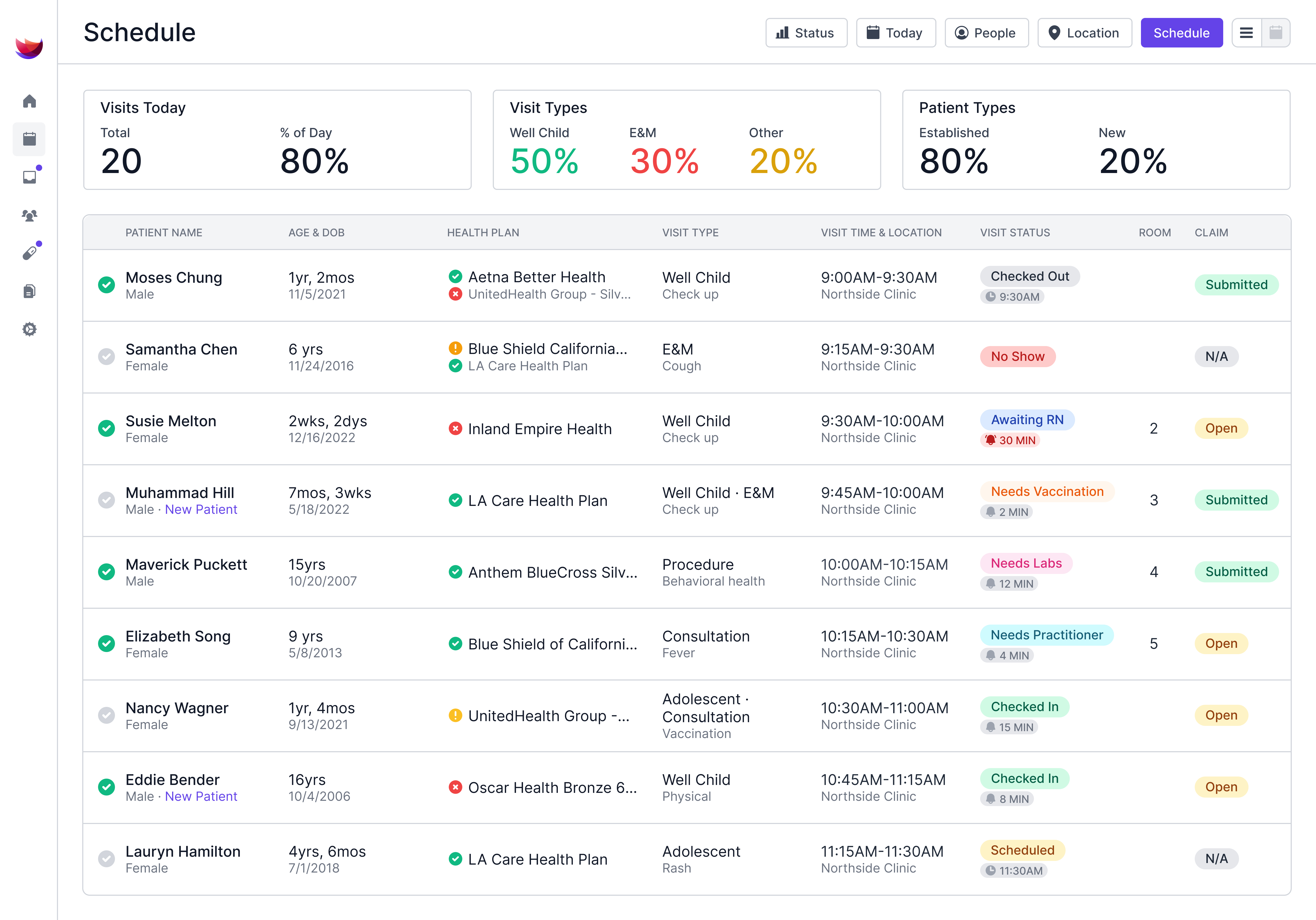
Pediatric practices shopping AdvancedMD alternatives usually want the same three things: simpler pricing, deeper pediatric workflows, or a more modern platform. Develo leads for pediatric-specific clinics, with athenahealth and eClinicalWorks the strongest picks for practices that run beyond pediatrics.
Here's how the top five compare on pricing, pediatric fit, and where each one falls short.
5 AdvancedMD Alternatives: At a Glance
Pricing verified September 2026. Verify with the vendor.
Why Look For AdvancedMD Alternatives?
AdvancedMD is a mid-market platform with strong billing and RCM, modular flexibility, and customizable specialty templates. It reports serving 13,000 private practices and 850 medical billing companies. It works well for general multi-specialty billing. For pediatrics, practices start looking elsewhere.
- Modular pricing adds up: AdvancedMD publishes per-provider rates by specialty — $429 to $1,070 per provider per month for medical specialties — plus 4% to 8% of collections for RCM services, $0.87 to $1.74 per claim for encounter-based practice management, and one-time data migration priced in tiers at $800, $1,200, and $2,000. Every add-on is its own line.
- No pediatric-specifics: Pediatric templates exist, but family relationship management, age-appropriate screeners, specialty growth charts, and VFC vs. private vaccine tracking need configuration or manual workarounds.
- Private equity roadmap: Francisco Partners ownership shapes R&D priorities across a broad customer base.
- Billing-first heritage: AdvancedMD's depth is in billing and RCM. Clinical and family engagement workflows are less of the core focus than at platforms built around them.
TL;DR: Which AdvancedMD Alternative Should You Choose?
Choose athenahealth if you want a turnkey generalist EMR with full-service RCM tied to a percentage-of-collections model and network-driven payer intelligence. Less of a fit if pediatric-specific workflows are a priority, or if you'd rather avoid a contract that auto-renews.
Choose eClinicalWorks if your practice is multi-specialty or expects to expand beyond pediatrics, and you want one large, established platform with an integrated AI scribe. Skip it if you want pediatric-specific depth without configuration work.
Choose Develo if you're an independent pediatric practice that wants charting, billing, practice management, and family engagement unified on one AI-native platform built solely for pediatrics. Worth weighing against the legacy names if decades of operating history matter more to you than innovation pace.
Choose NextGen Healthcare if you're a multi-specialty group that needs deep specialty content across many specialties. A weaker pick if pediatric-specific workflows are your priority.
Choose Tebra if you're a cost-conscious solo or small practice that values simplicity and built-in marketing tools over deep clinical workflows. Less suited if you expect to scale past a handful of providers or need advanced reporting.
Stick with AdvancedMD if your practice spans general multi-specialty care, your billing and RCM needs lead the decision, and the modular platform is working for your team. There's no reason to switch just to switch.
5 Best AdvancedMD Alternatives
1. athenahealth (athenaOne)
athenahealth is a cloud-based EMR with full-service RCM built for small to mid-sized practices across specialties.
The platform serves a network of 170,000+ providers and offers integrated EMR plus revenue cycle management. Its network model and managed billing make it a turnkey option for practices leaving AdvancedMD.
Key features
- Integrated EMR plus RCM: Clinical documentation, billing, and revenue cycle management on one platform with shared data.
- Network-based benchmarking: Compare KPIs against similar practices in the athenaNet network.
- Engagement tools: Self-scheduling, automated reminders, and an online portal handle pre-visit workflows.
- Mobile-native workflow: Native mobile app supports clinical documentation and care management.
Pros
✅ Aggregated payer behavior data across 170,000+ providers improves first-pass claim acceptance through shared denial intelligence that smaller customer bases can't match.
✅ Full-service managed RCM is available as a bolt-on option, which lets practices fully outsource billing instead of running it in-house.
✅ Cloud-native architecture eliminates IT infrastructure costs and supports continuous platform updates without local deployment work.
✅ Extensive implementation history across ambulatory specialties reduces project risk.
Cons
❌ Generalist design requires configuration for pediatric workflows like family relationship management, age-appropriate screeners, and VFC vaccine tracking.
❌ The minimum-plus-percentage model means total cost rises with collections, which gets expensive at higher volumes compared with flat-fee platforms.
❌ Auto-renewing contract with early termination fees limits buyer flexibility and creates switching costs.
❌ Innovation split across many specialties means pediatric-priority features compete with other specialty roadmaps for engineering time.
Best for
- Practices comfortable with a generalist EMR plus full-service RCM
- Multi-provider groups that benefit from network-based payer intelligence
- Organizations comfortable with collection-based pricing tied to revenue
Pricing
- athenahealth publishes no rate, saying only that its pricing model corresponds to your organization's collections. Third-party listings put it at roughly $140 per provider per month plus 4% to 8% of monthly collections, so the cost scales with revenue.
2. eClinicalWorks (eCW)
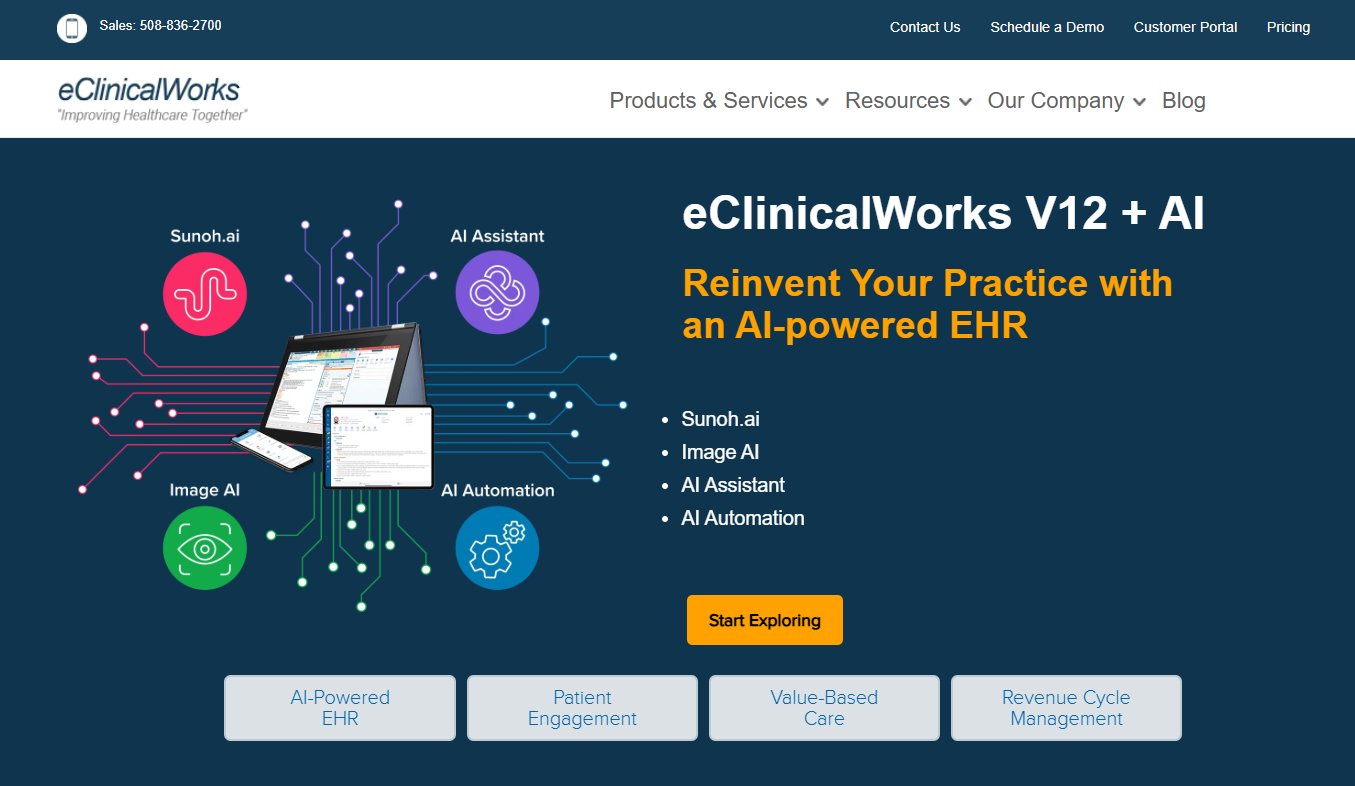
eClinicalWorks is a cloud-based ambulatory EMR vendor serving more than 180,000 providers across what it says is more than 50 specialties, including pediatrics. The platform offers integrated EMR, practice management, RCM, and patient engagement tools.
Key features
- Pediatric documentation templates: Pre-built templates for well child visits and immunization workflows.
- Sunoh.ai AI Scribe: Ambient listening that captures clinical conversations into structured notes.
- healow patient apps: Patient-facing apps for records access, scheduling, and provider messaging.
- Bidirectional immunization registry interfaces: Connects to state registries for vaccine reconciliation.
- Population health tools: Flags children overdue for vaccines or well child visits.
Pros
✅ One of the largest installed bases in ambulatory EMR at 180,000+ providers, which means deep payer rule libraries and broad integration coverage that smaller vendors can't match.
✅ Cloud-native architecture eliminates the on-premise IT burden and delivers central updates without local deployment work.
✅ Multi-specialty support across 50+ specialties suits practices that operate beyond pediatrics or expect to expand into other lines of care.
✅ AI scribe integration through Sunoh.ai, which is set up for eClinicalWorks workflows. It is a separate per-user subscription on top of the platform fee.
Cons
❌ Generalist design dilutes pediatric depth, particularly on family relationship management and developmental screener workflows that pediatric-built platforms ship native.
❌ Steep learning curve during implementation, particularly for smaller practices without dedicated IT support.
❌ The platform's $155 million 2017 DOJ settlement over Meaningful Use certification remains a due-diligence consideration for compliance-focused buyers.
❌ More clicks on common tasks than modern AI-native platforms, which compounds across high-volume pediatric visit schedules.
Best for
- Multi-specialty ambulatory practices wanting one platform across specialties
- Mid-sized to larger pediatric practices that can invest time in customization
- Organizations comfortable trading depth in any one specialty for breadth across many
Pricing
- $499/month per provider for EMR only, $599/month with practice management, 2.9% of collections for RCM as a service.
3. Develo
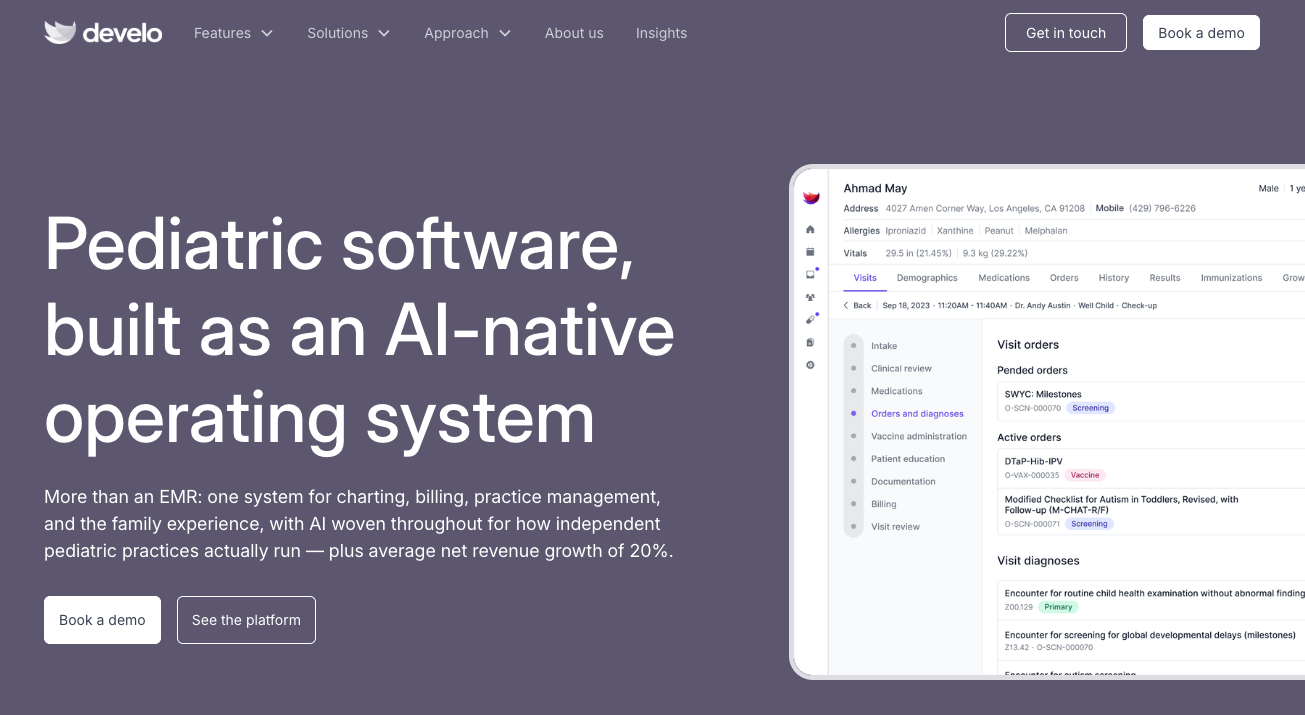
Develo is the AI-native pediatric operating system built solely for independent pediatric practices, unifying charting, billing, practice management, and family engagement in one modern system.
Built for outpatient pediatric care, the platform replaces decades-old legacy EMR systems and the patchwork of generic tools that slow down documentation and leave clinical data incomplete.
Key features
- A suite of AI, not one scribe: Develo provider scribe writes straight into the note using visit context beyond the transcript, with no copy and paste and multilingual support across roughly 100 languages. Ask Develo answers questions about a patient's chart, Develo doc intel auto-tags incoming e-faxes and uploads for single-click filing, and Develo reports Q&A answers plain-English questions of clinical and administrative data.
- Automated charge capture: Billing codes auto-populate from the clinical workflow.
- Family relationship management: Siblings, blended families, multiple guardians, and family-level billing handled natively.
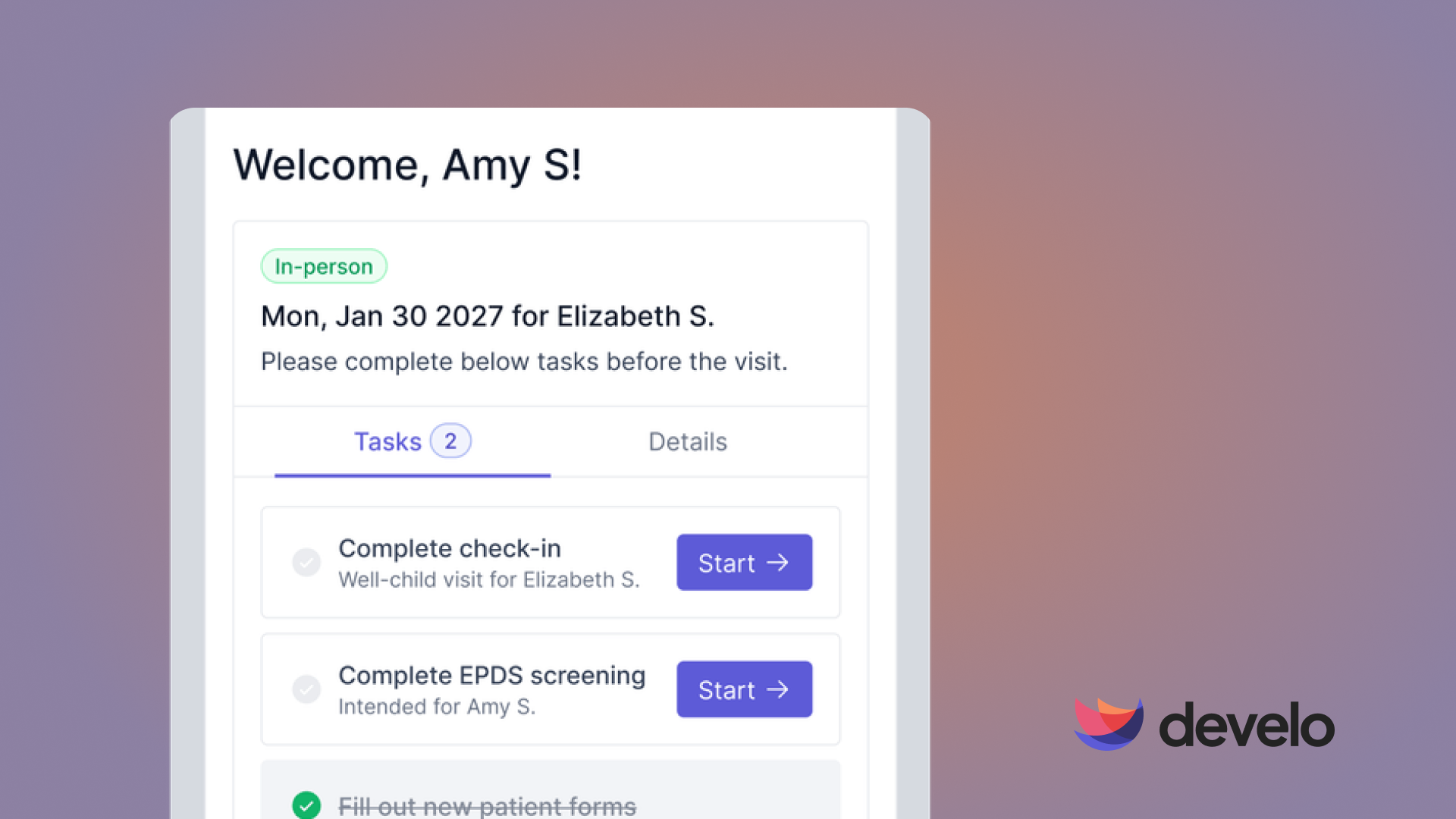
- Digital clinical screeners: Auto-populated by age, completed before the visit, scored and billed automatically.
- VFC and private vaccine stock: separate inventories tracked in the chart, with administration coding and bi-directional state immunization registry reporting in the same workflow — so the right dose comes out of the right fridge and the right code lands on the claim.
Pros
✅ Pediatric workflows ship natively — family relationships, age-appropriate screeners, growth charts, and VFC vaccine tracking are configured before your first login, not built out over the first year the way generalist EMRs require.
✅ Unified platform replaces the separate intake software, screener companies, and AI scribes most pediatric clinics juggle, reducing vendor count and contract overhead.
✅ MD founder-led ownership ships new AI and automation through weekly product updates, instead of the quarterly or annual release cycles common at legacy or private equity-owned vendors.
✅ AAP-aligned clinical workflows mean immunization schedules and well child visit protocols follow pediatric standards by default.
✅ Implementation, training, and data migration are in the subscription, and Develo has migrated practices off AdvancedMD — including immunization histories with lot numbers and VFC eligibility, growth and vitals series, and patient-caregiver links, the three things generalized migrations flatten.
Cons
❌ Shorter operating history than 30+ year incumbents, so there are fewer public case studies and less conference and peer-referral presence to point to.
❌ Smaller integration ecosystem, which can require workarounds for niche pediatric tools or regional payer-specific connections.
❌ Shorter public track record on RCM than vendors that have billed pediatric claims for decades, so there are fewer long-run benchmarks available.
❌ A still-growing regional footprint, so a practice should confirm payer and registry coverage for its specific area during evaluation.
Best for
- Independent pediatric practices wanting charting, billing, practice management, and family engagement unified in one modern system
- Tech-forward clinics ready to replace their legacy EMR plus their stack of separate intake, screener, and AI scribe tools
- Practices prioritizing automation, AI, cutting edge innovation, and high-touch support over decades-long vendor history
- Multi-site pediatric groups and MSOs running a centralized back office across locations
Pricing
- Comprehensive pricing covering charting, billing, practice management, and family engagement under one quote, sized to practice volume and workflow needs, with implementation, training, and data migration in the subscription rather than priced as add-ons. Book a demo for a custom quote.
4. NextGen Healthcare
NextGen Healthcare is an ambulatory EMR vendor with roots going back to 1974, now privately held under Thoma Bravo, which closed its $1.8 billion private equity acquisition in November 2023.
The company reports supporting more than 10,000 medical groups across 75,000 locations nationwide, with two products: NextGen Office for practices under 10 providers and NextGen Enterprise for practices with 10 or more.
Key features
- Specialty content templates: Pre-built clinical content across 30 specialties, including pediatrics.
- Ambient documentation: AI-powered note generation built into the platform.
- Integrated EMR, PM, and RCM: Clinical, scheduling, and billing under one vendor.
- MIPS reporting: Built-in support for value-based care reporting.
Pros
✅ Two-tier product structure (Office for small practices, Enterprise for larger groups) lets the platform scale with a practice as it grows, without a vendor migration.
✅ Five decades of operating history bring mature payer integrations and a deep library of specialty clinical content built up over time.
✅ Broad specialty content suits multi-specialty groups or practices that operate beyond pediatrics without running separate systems per specialty.
✅ Established payer relationships built over decades reduce billing transition risk during onboarding.
Cons
❌ Multi-year contracts with annual escalators are commonly reported by buyers, so get the term length, the renewal notice window, and the annual uplift in writing before signing. Long terms and automatic uplifts both limit flexibility and create switching costs.
❌ Steep learning curve, particularly during the first months of onboarding.
❌ Pediatric workflows handled through configuration, including family relationship management, age-appropriate screeners, and VFC tracking.
❌ Private-equity ownership and broad specialty breadth mean pediatric features compete for engineering time against many other specialty roadmaps.
Best for
- Multi-specialty practices wanting deep specialty content across many specialties
- Mid-sized to larger ambulatory groups with internal IT capacity for customization
- Practices prioritizing long operating history and broad specialty content
Pricing
- According to third-party aggregator FindEMR, NextGen's EHR runs roughly $300 to $500+ per provider per month for the base product, scaling with modules, specialty content, and add-ons. NextGen publishes no rate of its own. Contracts are typically 3 to 5 years with annual escalators.
5. Tebra
Tebra is the 2021 merger of Kareo and PatientPop, combining EMR, billing, and engagement tools on one cloud platform built for solo and small independent practices. It serves 142,000+ providers and is known for its billing heritage from Kareo and built-in practice-growth tools from PatientPop.
Key features
- Tebra Clinical: EMR and documentation with AI Note Assist for charting.
- Tebra Billing: Claim scrubbing, eligibility checks, ERA posting, and denial management from the Kareo billing heritage.
- Tebra Engage: Engagement and practice-growth tools inherited from PatientPop, including review management.
- Cloud-based mobile access: Manage the practice from any device.
- Open API integrations: Connects with third-party systems through Tebra's API.
Pros
✅ Low entry price makes it one of the most affordable paths for solo and small practices that want EMR, billing, and engagement in one platform.
✅ Strong billing infrastructure inherited from Kareo gives smaller practices claim scrubbing and denial management usually found only in pricier platforms.
✅ Built-in practice growth pairs reputation and patient-acquisition tools with the EMR, which would otherwise require a separate marketing platform and contract.
✅ Fast setup for small practices keeps the learning curve lower than mid-market platforms with heavier configuration.
Cons
❌ Clinical depth and reporting lag mid-market competitors, so practices that need advanced workflows tend to outgrow it.
❌ Not pediatric-specific, so family relationship management, age-appropriate screeners, and VFC vaccine tracking require workarounds.
❌ Post-merger integration between the Kareo and PatientPop product lines is still maturing.
❌ Scaling limits mean practices growing past a handful of providers often face a migration to a more capable platform.
Best for
- Cost-conscious solo and small practices
- Practices that value marketing and reputation tools alongside the EMR
- New practices launching that want low upfront cost
Pricing
- Tebra doesn't publish pricing on its own site. Third-party listings put the common range at $99 to $399 per provider per month based on modules selected, though quoted configurations run from roughly $49 to $799 per provider once implementation fees and per-user charges are added — see our full Tebra pricing breakdown.
How To Evaluate AdvancedMD Alternatives
These are the criteria that separate a true pediatric fit from a generalist platform with pediatric features added on.
- Pediatric-specific depth. Native family relationships, age-appropriate screeners, VFC vaccine tracking, and growth charts beat customized generalist workflows.
- Total pricing. Modular per-provider models add up fast. Map every module and add-on you'll use before comparing quotes — and remember that a per-provider AI fee or a percentage of collections lands on a payer mix weighted toward Medicaid and CHIP rates rather than commercial ones.
- AAP guideline alignment. Confirm immunization schedules and well child visit protocols follow AAP standards by default.
- Family relationship management. Test siblings, blended families, multiple guardians, and family-level billing during demos.
- Billing and RCM fit. Pediatric quirks (well child visit codes, vaccine stacking, EPSDT) trip up generalist RCM.
- Implementation timeline. Pediatric data migration runs longer than general EMR migrations. Ask for pediatric-specific examples.
- Pace of innovation. Weekly updates vs. annual releases compound fast on AI and automation.
Pediatric Clinics Aren't All Shopping For The Same EMR
The EMR market sorts into four categories, and the right pick depends on which one your practice fits.
- Generalist mid-market platforms (athenahealth, eClinicalWorks, NextGen) handle multi-specialty care well, but pediatric workflows become configuration projects.
- Legacy pediatric EMRs (PCC, Office Practicum) have the pediatric depth — growth charts, immunizations, pediatric orders — but run on cores built decades before AI, so the newest capabilities arrive as paid add-ons or as staged rebuilds of the system you already use.
- Small-practice platforms (Tebra) keep cost and complexity low, trading off clinical depth and room to scale.
- An AI-native pediatric operating system (Develo) unifies charting, billing, practice management, and family engagement on one modern platform.
If you're an independent pediatric clinic ready to replace your generalist or legacy pediatric EMR and the separate tools around it, book a Develo demo.
Frequently Asked Questions
How Much Does AdvancedMD Cost?
AdvancedMD costs are modular and priced per provider. Its own pricing page lists $429 to $1,070 per provider per month for medical specialties, 4% to 8% of collections for RCM services, and one-time data migration tiers of $800, $1,200, and $2,000. Map every module and service you'll use before comparing quotes.
Why Do Pediatric Practices Leave AdvancedMD?
Pediatric practices leave AdvancedMD mainly for pricing and deeper pediatric workflows. Family relationship management, age-appropriate screeners, growth charts, and VFC vaccine tracking need configuration on a generalist platform, so clinics often move to a system that ships those native.
Can You Migrate From AdvancedMD to Develo?
Yes, AdvancedMD is one of the systems Develo migrates practices off of. The fields that break in a generalized EMR migration are the pediatric ones: immunization histories with lot numbers and VFC eligibility, longitudinal growth and vitals series, and patient-caregiver links across siblings and multiple guardians. Ask any vendor to show you those three specifically in a test migration of your own data, not a demo tenant. Develo includes configuration, training, data migration, and go-live support in the subscription, with no implementation fee — worth comparing against AdvancedMD's published migration tiers of $800, $1,200, and $2,000.
Is AdvancedMD a Pediatric EMR?
No, AdvancedMD is not a pediatric EMR. It's a generalist multi-specialty system. Pediatric workflows like family relationship management, age-appropriate screeners, and VFC vaccine tracking need configuration rather than shipping native.
What Is the Best AdvancedMD Alternative for Pediatric Practices?
The best fit depends on the practice. For pediatric-specific clinics, Develo is the strongest AI-native option, while athenahealth and eClinicalWorks suit practices wanting a large generalist platform with full-service RCM, and Tebra fits cost-conscious, smaller practices.
What Is the Difference Between a Pediatric EMR and a Generalist EMR?
The main difference is who the record is built around: a pediatric EMR treats the family as the unit, links siblings natively, and ships pediatric templates and immunization workflows by default. A generalist EMR bolts those onto an adult-first system through configuration.

%20(1).png)

%20(1).png)
.avif)