

EMR meaningful use was the set of standards clinicians and hospitals had to meet to earn Medicare and Medicaid incentive payments for using certified record systems. If you're searching for its requirements in 2026, there probably aren't any left that apply to you. The program was renamed Promoting Interoperability in 2018, and the Medicaid side, which is how most pediatric practices participated, closed at the end of 2021.
What survives covers hospitals and clinicians with enough Medicare volume to fall inside the Merit-based Incentive Payment System (MIPS). Most independent pediatricians are outside both.
That doesn't leave a pediatric practice with nothing to do. The work moved to information blocking rules, certification requirements, state registry reporting, and payer quality programs, and those are the ones to focus on now.
From Meaningful Use to Promoting Interoperability
The April 2018 rename shifted emphasis onto interoperability and patient data access.
The Medicaid side closed on the schedule set by the Health Information Technology for Economic and Clinical Health (HITECH) Act, which allowed no incentive payments after 2021.
Does Any of This Still Apply to a Pediatric Practice?
For the large majority of independent pediatric practices, the incentive programs no longer reach you.
That leaves MIPS, and its low-volume threshold excludes any clinician with $90,000 or less in Medicare Part B allowed charges, 200 or fewer Part B patients, or 200 or fewer covered services to those patients. A typical pediatrician bills little to Medicare, so most fall under that threshold and are excluded from MIPS entirely.
Check your own status each year, since eligibility is reassessed for every performance period. Most practices end up running certified technology with no attestation to file, while the duties that replaced meaningful use sit in other rules.
The Rules That Still Apply
Four sets of rules and expectations picked up most of what meaningful use once asked for, and none involve an attestation. Information blocking binds every practice under federal law. The other mandates reach you through your EMR vendor, your state, and your health plans.
Information Blocking
The rules at 45 CFR Part 171 prohibit a practice from unreasonably interfering with access to, exchange of, or use of electronic health information. They took effect in April 2021 and apply to providers directly, alongside health IT developers and health information networks.
The rules carve out 10 exceptions for activities that don't count as blocking. Most fall into two groups: reasons for not fulfilling a request, such as preventing harm or protecting privacy, and limits on how a request gets fulfilled, such as the manner or the fees.
Each carries its own conditions, and a practice relying on one should be able to name which. A rule proposed in December 2025, HTI-5, would remove the TEFCA manner exception and narrow the infeasibility and manner exceptions, so check the current text before leaning on an exception.
Complying with HIPAA doesn't automatically mean complying with these rules. HIPAA governs what you may disclose. Information blocking governs what you may withhold.
Adolescent records are where pediatric practices feel this most, because the risk runs both ways. When a teen consents to their own care under state law, HIPAA generally doesn't treat the parent as the teen's personal representative for that care, so releasing those notes to a parent's portal view can breach the teen's confidentiality. Withholding them can fall under the privacy exception, but only if the practice follows written policies and applies them consistently. A system that can't separate a teen's confidential notes from what a parent sees leaves the practice exposed on every adolescent visit. The saving grace so far is that this is rarely checked: problems tend to surface through a complaint from a parent or teen, not a routine audit. We cover the setup in our guide to teen privacy in the portal.
What Happens if You Block
A 2024 final rule set disincentives for providers found to have committed information blocking. The mechanisms run through Medicare programs.
Because the disincentives attach to Medicare programs, a pediatric practice outside MIPS has no obvious penalty pathway. The rules still apply to you, complaints can still be filed through the ONC portal, and the enforcement landscape may change. The safer plan is to build records-request workflows that meet the rules now.
Certification and Registry Requirements
- Certified technology: The ONC Health IT Certification Program sets what a certified system must do, including a full electronic health information export for each patient. HTI-5 also proposes removing 34 of the program's 60 certification criteria and revising 7 more. Electronic health information export isn't among them.
- State immunization registries: Each state sets its own reporting rules, and those rules stayed in place when the federal incentive program ended.
- Payer quality programs: Healthcare Effectiveness Data and Information Set (HEDIS) measures and value-based contracts assess much of the data meaningful use once asked you to capture. For pediatrics, those include Childhood Immunization Status, Immunizations for Adolescents, and well child visit measures for the first 30 months and for ages 3 to 21.
What to Do With Your Certified EMR Now
The question changed from proving you use a certified system to choosing one that serves pediatric work. Four things carry more weight than certification status alone:
- Registry connection: Look for two-way registry exchange, so a child's full vaccine history is in the chart before a dose goes in.
- Quality measure capture: The data behind well child and immunization measures should come straight from documentation.
- Data portability: Confirm your vendor can export your records in a usable format if you leave.
- Pediatric-specific documentation: Growth series, age-based preventive coding, and vaccine administration have to work as standard.
We break down how to weigh these in our guides to choosing an EMR for pediatrics and the best EMR for small pediatric practices.
Where EMR Meaningful Use Came From
EMR meaningful use was the standard at the center of the Medicare and Medicaid EHR Incentive Programs, which paid clinicians and hospitals to adopt certified record systems and show they used them in defined ways.
It came from the HITECH Act, passed inside the 2009 American Recovery and Reinvestment Act, and began in 2011.
Two separate programs ran in parallel, one through Medicare and one through Medicaid, and a clinician chose which to participate in.
The Medicaid route is the one pediatrics ran on. Eligible professionals could earn up to $63,750 across six years. Pediatricians could qualify with 20% Medicaid patient volume instead of the usual 30%, though below 30% their six-year cap fell to $42,500.
The 3 Stages
The program ran in stages, each raising the bar on what counted as meaningful use.
Objectives across the stages included e-prescribing, clinical decision support, and patient electronic access. Public health reporting, including submission to immunization registries, appeared in all three.
For pediatric practices, registry reporting is still part of the daily vaccine workflow.
Where Develo Fits
EMR meaningful use asked practices to prove their software captured certain data. The incentive payments stopped, yet payers, registries, and the information blocking rules still lean on that same data.
Develo is the AI-native operating system for pediatrics, unifying charting, billing, practice management, and family engagement in one system.
- Registry integration: Where Develo connects with a state registry, it pushes administered doses and pulls immunization records in real time, and a forecasting engine flags doses due or invalid ones before they're given.
- Quality measure data: A dedicated quality module shows real-time performance on the quality measures that matter to a pediatric practice, including HEDIS measures such as well child visits, childhood and adolescent immunizations, appropriate antibiotic use for respiratory infections, and chlamydia screening. Care gaps surface as notifications inside the visit, with the fix right alongside them, so documenting an immunization or placing an order closes the gap without leaving the workflow. Develo reports Q&A answers any follow-up question about the same data in plain English.
- Data portability: Develo is ONC-certified, including the electronic health information export criterion. Authorized users export a patient's record as a FHIR bundle from the chart, and a full-panel export is available on request.
- Interoperability: Develo shares data with health information exchanges (HIEs), children's hospital networks, clinically integrated networks (CINs), and insurers in industry-standard formats, including C-CDA documents, 837 claims, and ADT feeds.
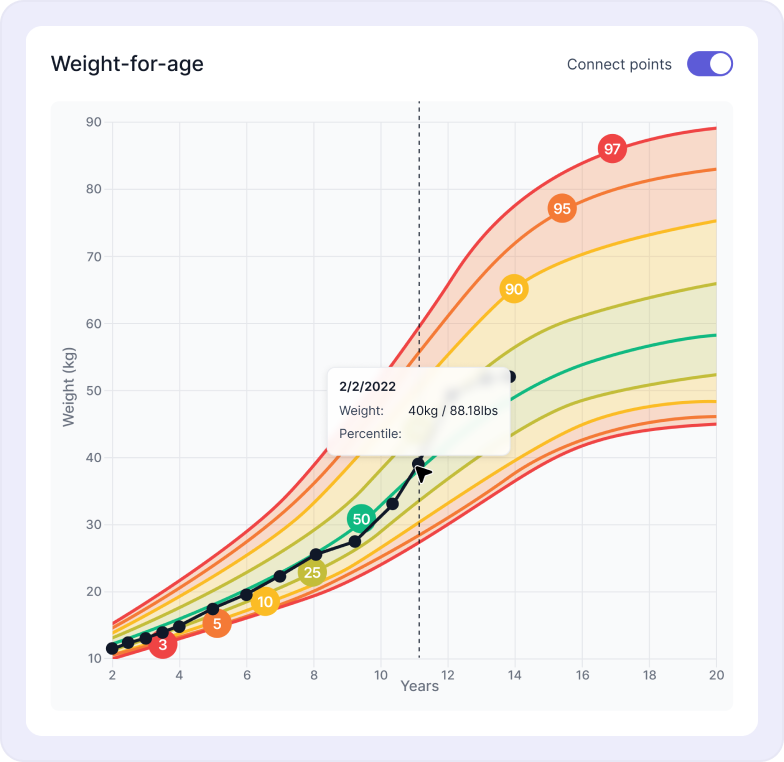
- Pediatric charting: CDC, WHO, and Down syndrome growth charts with percentiles and Z-scores, corrected-age plots, and end-to-end vaccine workflows come built into the chart.
- Automated charge capture: Rules set codes, units, and modifiers by visit type at the point of care, and the provider confirms the final coding.
- Family portal: Unlike a patient portal built around a single adult, it lets caregivers open immunization records, growth charts, and lab results and see balances across siblings in one view, with access set automatically by each caregiver's guardian and guarantor relationship to each child. Adolescent confidential visit summaries generate alongside limited parent summaries, and adolescents and young adults get their own direct portal access.
Most pediatric practices have no attestation left to file. Develo captures visit data once and keeps it moving to the payers, registries, and families who need it next.
Book a demo to see it on your own visit types.
Frequently Asked Questions
Does Meaningful Use Still Exist?
Meaningful use now exists as Promoting Interoperability. The Centers for Medicare and Medicaid Services applied the new name in 2018. The Medicare program continues for hospitals, including critical access hospitals, and clinicians report through the MIPS Promoting Interoperability category. The Medicaid side closed at the end of 2021.
When Did the Medicaid EHR Incentive Program End?
The Medicaid Promoting Interoperability Program closed at the end of 2021. Program year 2021 was the final year of participation. The six-year cap per eligible professional was $63,750, and no replacement incentive exists.
Do Pediatricians Have to Report Promoting Interoperability?
Most independent pediatricians fall below the MIPS low-volume threshold and are excluded from reporting. The threshold counts Medicare Part B charges, patients, and services, and Medicare covers very few children. Practices with an unusual Medicare mix should confirm their own status.
Do Information Blocking Rules Apply to Small Pediatric Practices?
Yes, the information blocking rules apply to healthcare providers regardless of practice size or Medicare volume. The disincentives finalized in 2024 operate through Medicare programs, so a practice outside MIPS has no direct penalty pathway today. Complaints can still be filed with ONC, and the rules themselves still bind you.
What Were the 3 Stages of Meaningful Use?
Stage 1 covered electronic data capture and sharing, Stage 2 dealt with advanced clinical processes and information exchange, and Stage 3 focused on outcomes and patient access. Common objectives included e-prescribing, patient access to records, and immunization registry reporting.
What Replaced Meaningful Use Requirements for Small Practices?
Information blocking rules are now the main federal obligation for small practices. ONC certification shapes what your EMR has to be able to do, and payer quality programs measure the data you record. State immunization registry reporting continues on its own track, under each state's own rules.