

Patient satisfaction survey questions ask families to rate each stage of a visit, from the first phone call to the bill.
In pediatrics, a parent or caregiver answers for the child, which influences the content and phrasing. The 40 questions below borrow wording from AHRQ's validated child survey and from published research on actionable survey questions.
Send a short starter set first, then use the rest to pin down areas that are slipping.
5 Patient Satisfaction Survey Questions to Start With
The starter survey rates four parts of the visit, from booking to the overall experience, then asks for one written suggestion. Use it as your first full survey if your practice hasn't collected family feedback before.
Send the link by text or email shortly after the visit, and address it to the caregiver who came in, since they're the one who handled the wait and heard the explanation.
When one score drops, add the matching questions from the bank below for a few weeks. A low wait-time score, for example, gets the four check-in questions so you can distinguish front-desk delays from rooming delays.
40 Patient Satisfaction Survey Questions by Category
The 40 questions below follow a visit in order, from booking to follow-up. Remember to use only the handful of questions tied to the stage you're looking to improve.
You can paste the columns into Google Forms, SurveyMonkey, or your EMR's survey builder and add details, such as scale points or a "Not applicable" option if a family may not have used the service.
Scheduling and Access
Learn how easy you are to reach when your practice is needed.
If parents answer "No" to question 4, compare the result with how many same-day sick slots your schedule holds open.
Check-In and Wait Time
These questions split delays at the front desk from the wait for the clinician.
If questions 5 and 6 score low, look at how much paperwork families still complete in your waiting room. With digital patient intake, parents handle registration, insurance, and screeners from home, so kids arrive ready to be seen.
Provider Communication
These help assess whether the parent felt heard and left understanding what their child needs.
Question 11 adapts an example from Penn Medicine physicians Jeffrey Millstein and Anish Agarwal in the Journal of Patient Experience. They argue that asking whether patients raised all their concerns names a behavior a clinician can change, whereas a general communication quality rating doesn't.
Staff Courtesy
Name the role in each question so a low score reaches the right supervisor.
Facility and Cleanliness
Ask about privacy in the exam room as well as cleanliness.
If question 19 scores low, our list of pediatric waiting room ideas covers seating, stroller space, and age-based play zones.
Telehealth
Send these only to families whose visit was by video or phone, using skip logic in your survey tool.
Log visits that dropped because of a connection failure separately, so a technical problem doesn't read as a care problem in your results.
Billing and Insurance
These questions measure how clearly the practice explained costs. They don't ask families to judge whether an insurer paid a claim correctly.
Send questions 27 and 28 only after the statement goes out, since a family surveyed the day of the visit hasn't seen a bill yet.
Follow-Up After the Visit
These check caregivers' confidence with home care and support from your practice.
If question 32 scores low, check how parents log in to the portal and what they can see once they're there. Pediatric portals also have to handle guardian permissions and teen confidentiality, which our EMR patient portal guide breaks down.
Overall Satisfaction and Likelihood to Recommend
Parents' answers will give you numbers to track over time.
Question 34 produces a Net Promoter Score: under Bain's method, subtract the percentage scoring 0 to 6 from the percentage scoring 9 or 10. If 30 of 50 parents score 9 or 10 and 8 score 0 to 6, the result is 44 (60% minus 16%).
That number won't tell you whether the problem was scheduling, communication, or billing, so pair it with at least one stage-level question.
Open-Ended Feedback
Written answers catch problems your fixed-choice questions don't ask about.
Use one or two open-ended questions per survey, and make each one optional, so a busy parent can submit the ratings without writing anything.
Should You Use a Validated Patient Satisfaction Survey?
Use a validated survey when you need scores to compare with other practices' ratings over time. Your own questions are fine when you're fixing one step inside your clinic. The 40 questions above haven't been through formal validity testing, so treat them as a working question bank.
CAHPS Clinician and Group Survey
AHRQ's Consumer Assessment of Healthcare Providers and Systems (CAHPS) Clinician and Group Survey asks about care from an outpatient provider across four domains, including access to care and communication with providers. AHRQ lists three versions:
For a pediatric practice, that leaves the Child Survey 3.1 or 3.0. The Child Survey 3.1 runs to 40 questions, with a Never/Sometimes/Usually/Always scale for its how-often items and a 0–10 rating of the provider.
It also asks whether the child can talk with providers about their own care, then whether the provider explained things in a way the child could understand.
AHRQ lets you add its supplemental items, but keep the core questions and answer scales as written, or your results won't line up with other practices'. AHRQ also advises against handing the survey out during or right after a visit, because in-office results can skew more positive and don't match data collected by mail or phone.
RAND PSQ-18
RAND's Patient Satisfaction Questionnaire Short Form (PSQ-18) has 18 items across seven subscales, including interpersonal manner, financial aspects, and time spent with the doctor. It takes 3 to 4 minutes to complete and is free for non-commercial use.
The PSQ-18 is written in the first person for an adult patient, using agree-or-disagree statements, like, "The medical care I have been receiving is just about perfect." A parent answering for a 2-year-old would need reworded questions, and reworded items lose the validation RAND published in 1994.
For routine checks about one problem, such as check-in delays, a short custom survey from the bank above gives you an answer in a few weeks. For formal measurement, use the CAHPS Child Survey and follow AHRQ's administration guidance.
How to Run a Patient Satisfaction Survey
A survey only pays off when it leads to meaningful change. These five steps cover setup through follow-through.
1. Pick One Question to Answer
Start with a question your team can act on. "Are families waiting too long after check-in?" points to four questions in the bank. "Are parents happy?" points to none.
If the goal is shorter waits, ask about check-in, time to rooming, and delay updates, and leave billing and telehealth out of that survey.
2. Keep It to 5 or 6 Questions
Millstein and Agarwal note that patient experience surveys should be concise. Five actionable questions plus an optional comment box keeps the whole survey on a single page.
Ask about one issue per question. "Were our staff friendly and efficient?" can't be scored when a parent found the staff friendly but check-in slow.
3. Time It Right (by Text or Email)
If you have a custom survey about one visit, send a mobile-friendly link the same day. Hold billing questions until families have their statements, and reserve follow-up questions the same way. Keep the send times about the same each month so results stay comparable.
If your survey tool receives patient names, visit dates, or phone numbers from your practice, it's handling protected health information on your behalf. HIPAA then calls for a business associate agreement with the vendor, so confirm that the vendor will sign one before you upload a patient list.
Families with several children can visit a pediatric practice a dozen times a year. Cap invitations at one per family every few weeks, and when siblings are seen on the same day, send one survey that names which child it covers.
4. Track Your Response Rate
Divide completed surveys by the invitations delivered, then multiply by 100. If 600 families receive the link and 120 finish it, your response rate is 20%.
Check who's missing, too. If nearly all responses come from well child visits, or from English-speaking families, you're missing valuable results. Send the survey in each family's preferred language; AHRQ publishes the CAHPS Child Survey in English and Spanish.
5. Assign an Owner and Measure Again
Give each recurring complaint to a named person, such as the front-desk lead for check-in scores or the billing manager for statement questions. Record what they changed and when.
Then repeat the survey with the same wording and answer scale after enough visits to compare. If you change the process and the question at the same time, you can't tell which one moved the score.
Turning Survey Answers Into Fixes
Each low score should lead to one check, one change, and a repeat of the question. The table below pairs common survey results with where to turn first.
Say 35% of respondents report waiting 30 minutes or longer, but clinician communication scores stay high. That pattern points to patient flow as the first thing to fix.
Your team could time each stage for two weeks, change the slowest one, and send the same wait-time question the following month. Our pediatric office workflow tips cover segmented schedules and buffer slots for add-on visits.
What Should Pediatric Practices Ask Parents and Caregivers?
Pediatric practices should ask the adult who came to the visit about their own experience and what they saw of their child's. Write every question about "your child's" care.
Name the child in the survey invitation when a family has siblings at the practice. AHRQ's CAHPS Child Survey 3.1 opens by telling the parent to answer only for the child named on the envelope. It also asks how the respondent is related to the child, with seven options that run from mother or father to legal guardian.
Consider adding these questions to your custom pediatric survey as needed:
The second question adapts a CAHPS Child Survey item, but none of the five is validated as written.
Teen visits need a privacy check before any survey goes out. A text sent to a parent's phone after a confidential adolescent visit reveals that the visit took place. Leave the visit type out of every invitation, and decide whether confidential visits get a survey at all. A third option is to send the survey to the teen's own phone rather than the parent's, where your state's minor-consent rules allow it, and to word it so it never names the reason for the visit.
Our guide to HIPAA-compliant text messaging covers shared family phone numbers and other pediatric texting risks.
Fix What Patient Satisfaction Surveys Uncover With Develo
Patient satisfaction survey questions show where families get stuck. Those sticking points tend to live in the handoffs between the front desk, providers, and billing staff, so the fix often means giving every team the same view of the family's visit.
Develo is the AI-native pediatric operating system built solely for independent pediatric practices, unifying charting, billing, practice management, and family engagement in one system.
Here's how it maps to the stages that families rate:
- Scheduling and access: Families book online for the visit types the practice chooses, and certain slots can be held open for same-day or next-day sick visits only. Recall campaigns remind families to book the well child visits each child is due for.
- Registration and check-in: Caregivers update demographics and insurance, sign forms, and complete digital screeners on their phones before the visit, with no app download or family portal login required. The front desk sees who has finished intake before the day starts.
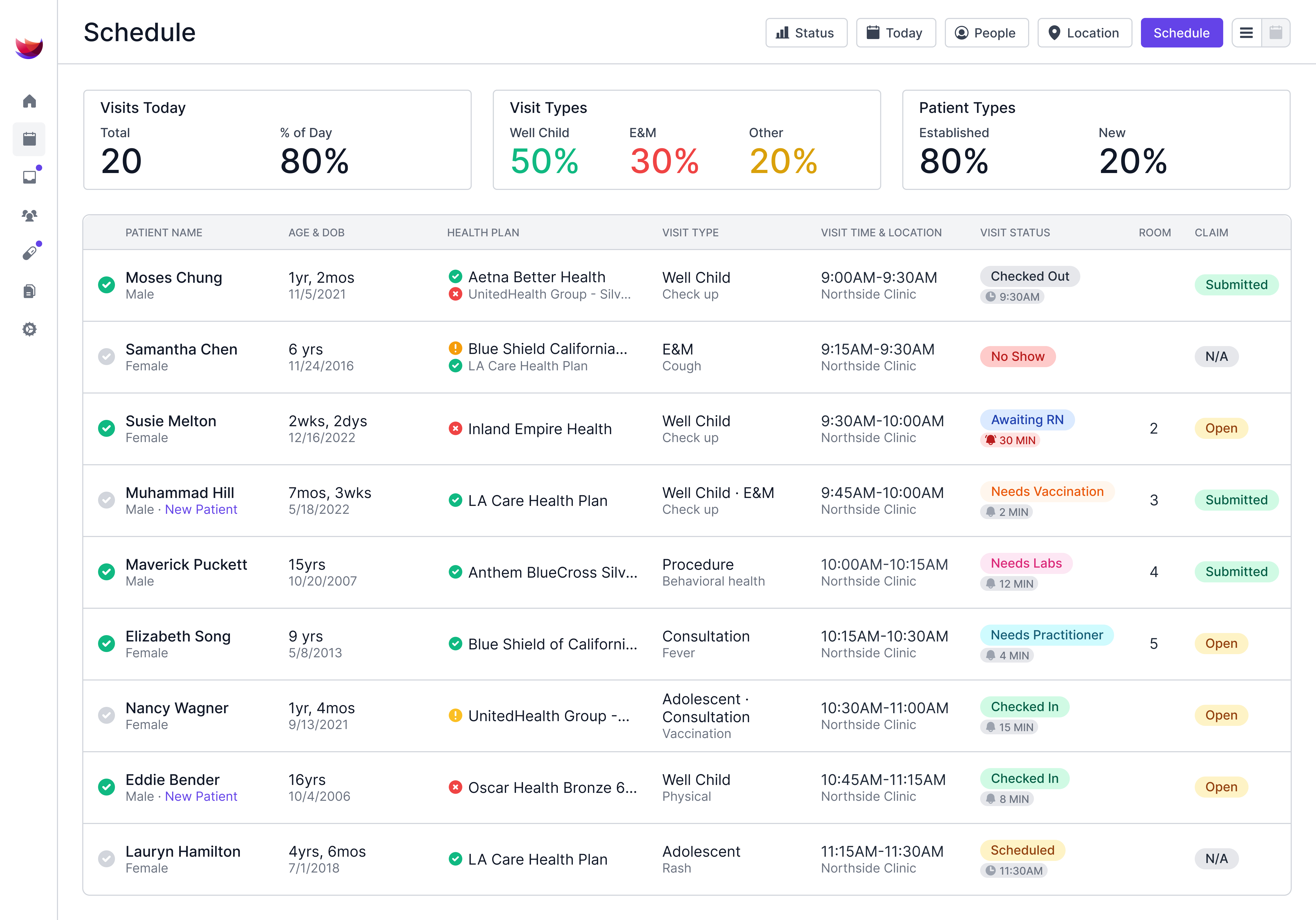
- Wait times, stage by stage: Develo records check-in, rooming, provider-entry, and checkout times, and Develo reports Q&A answers plain-English questions about them, so you can see which stage a low wait-time score points to. The schedule table shows how long each family has been in their current status and turns red when a wait runs long.
- Telehealth visits: A dedicated telehealth visit type sends the family the video link ahead of time, and visit reminders say whether it's a video or phone visit.
- Billing questions: Payment reminders go out by text with a payment link, and caregivers can pay balances across siblings, in full or in part.
- Follow-up after the visit: The family portal lets caregivers send messages and access visit summaries, immunization records, and lab results.
- Teen privacy: Develo generates adolescent confidential visit summaries for teens and limited summaries for their parents, and for a teen's confidential visit, the practice can mark the reminder to go to the teen instead of a guardian. Portal access is individualized for each family member.
- Family records: Guardian and guarantor relationships carry across siblings, including blended families, so messages and statements reach the right adult.
Book a demo to see how Develo handles each stage families rate, from scheduling and check-in to billing and follow-up.
Frequently Asked Questions
What Are 5 Good Patient Satisfaction Survey Questions?
Five good patient satisfaction survey questions rate scheduling, the wait, and the clinician's explanation. You could also ask for an overall score and one open-text comment. In pediatrics, word each one around "your child's visit" and send it to the caregiver who attended.
How Many Questions Should a Patient Satisfaction Survey Have?
A patient satisfaction survey about one visit should have five or six questions, with no more than one or two being open-ended. A validated survey runs longer: the CAHPS Child Survey 3.1 has 40 questions.
What Are 7 Ways to Improve Patient Satisfaction?
To improve patient satisfaction, target the parts of the visit with your weakest scores. You could start with easier scheduling and online intake forms. In the clinic, tell families when you're running late, and give parents time to ask questions.
After the visit, send written care instructions home and answer follow-up messages the same day. If billing scores are low, rewrite any statement that confuses families.
When Should You Send a Patient Satisfaction Survey?
Send a patient satisfaction survey about a single visit the same day, by text or email. Questions about the bill should wait until the family's statement has arrived. For the CAHPS Clinician and Group Survey, AHRQ advises against handing it out in the office (during or right after the visit), since results can skew more positive.
What's the Difference Between Patient Satisfaction and Patient Experience?
The main difference between patient satisfaction and patient experience is expectations vs events. According to AHRQ, satisfaction measures whether a patient's expectations were met, while experience measures whether, or how often, something that should happen in care actually happened, such as clear communication from a clinician.
Can Parents Complete Patient Satisfaction Surveys for Their Children?
Yes, parents and guardians routinely complete surveys for their children. AHRQ's CAHPS Child Survey is built for it. Make sure to incorporate safeguards for confidential teen visits before any survey invitation reaches a parent's phone.