
.avif)
Autism screening tools vary widely across pediatric clinics, and the guidelines often differ from what actually happens at the 18- and 24-month well child visits.
Here's a breakdown of the tools pediatric practices actually use, when to use them, and how to make the screening workflow stick.
Which Autism Screening Tools Do Pediatric Clinics Use Most?
The M-CHAT-R/F (Modified Checklist for Autism in Toddlers, Revised with Follow-Up) is a parent-completed questionnaire designed for children aged 16 to 30 months.
It's the tool most directly aligned with American Academy of Pediatrics (AAP) guidelines, which recommend autism-specific screening at both the 18-month and 24-month well child visits.
Beyond the M-CHAT-R/F, clinics use a handful of other tools depending on their workflow, patient age, and the level of developmental concern:
- Screening Tool for Autism in Toddlers and Young Children (STAT): A 20-minute, clinician-administered observational tool for ages 24 to 36 months. Used as a follow-up screen when developmental concerns are already on the radar.
- Communication and Symbolic Behavior Scales Developmental Profile (CSBS DP) Infant-Toddler Checklist: A one-page, parent-completed broadband screener for children 9 to 24 months. Catches early communication delays that may point to autism spectrum disorder (ASD) risk.
- Parents' Evaluation of Developmental Status (PEDS): A single-page parent interview form useful for surveillance across ages 0 to 8 years old. Often used between formal screening windows.
In primary care settings, the M-CHAT-R/F tends to be the go-to autism screen, with the CSBS DP filling in for broader developmental surveillance at earlier ages.
The STAT tends to be used more in specialty or developmental clinic settings than in typical primary care.
Why Autism Screening Timing Is Critical
Autism can be reliably diagnosed as early as 18 months but the median age of diagnosis in the US is 47 months — just under 4 years old — according to the Centers for Disease Control and Prevention (CDC)'s ADDM Network report for the 2022 surveillance year.
That delay can cost children months of early intervention eligibility.
The AAP recommends screening every child at the 18- and 24-month visits with a standardized autism-specific tool. Developmental surveillance alone depends more heavily on provider judgment and parent-initiated concern.
Structured screening at these exact ages, using validated tools, can lead to diagnosis of autism as young as 18 months, well ahead of historical averages.
Earlier detection is important because the brain is significantly more plastic in the first few years of life, meaning intervention during this window has a greater chance of shaping developmental outcomes.
Services started in this window, such as speech therapy, occupational therapy, and applied behavior analysis (ABA), give children more time to benefit from structured support.
For pediatric clinics, missed screens at 18 or 24 months mean children who needed early intervention didn't get it, and that delay could affect developmental outcomes for years.
How to Choose the Right Autism Screening Tool for Your Practice
The right autism screening tool depends on your patient's age, who's administering it, and what you're trying to detect. Here's a practical breakdown:
M-CHAT-R/F (Ages 16–30 Months)
The M-CHAT-R/F is a universal screener designed for primary care. It's free, parent-completed, and takes about 5 minutes.
Meta-analyses report a pooled sensitivity of around 0.83 and specificity of 0.94, though a separate AAP meta-analysis using stricter assumptions about screen-negative children found specificity as low as 0.46.
Best for: Universal ASD screening at 18 and 24 months in primary care.
STAT (Ages 24–36 Months)
The STAT is a clinician-administered tool using 12 interactive activities across play, communication, and imitation.
It takes about 20 minutes and is more resource-intensive than the M-CHAT-R/F, but useful when you're following up on a positive first screen or already have developmental concerns.
Compared directly to the Autism Diagnostic Observation Schedule, Second Edition (ADOS-2), it showed a sensitivity of 90.9%.
Best for: Clinics with developmental concerns already on the radar, or as a second-level screen.
CSBS DP Infant-Toddler Checklist (Ages 9–24 Months)
This one-page broadband screener catches early communication delays at ages younger than the M-CHAT-R/F covers.
It measures social communication skills including eye gaze, gesture use, vocalizations, word use, and object engagement.
An early validation study of 54 children showed sensitivity and specificity of 88.9% for identifying communication delays in children from 9 to 24 months old.
Best for: Earlier surveillance, particularly in at-risk populations such as children with a sibling with ASD.
PEDS (Ages 0–8 Years)
The Parents' Evaluation of Developmental Status is a single-page parent interview form covering development, behavior, and learning across children ages 0 to 8 years old.
It takes around two to five minutes to administer and can be completed by paraprofessionals.
It uses parental concerns as the primary data point, with responses mapped to evidence-based referral and management pathways. Its published validity data for the original PEDS screener reports a sensitivity of 0.86 and specificity of 0.74.
Best for: Developmental surveillance between formal screening windows, at visits where an autism-specific tool isn't indicated.
What a Positive Screen Actually Means (and What to Do Next)
A positive autism screening result means a child needs further evaluation. Screening tools detect risk and flag children who need a closer look, but they stop short of confirming a diagnosis.
The next steps should all be initiated at the same visit:
- Refer to a specialist for a comprehensive diagnostic evaluation (developmental pediatrician, child psychologist, or pediatric neurologist).
- Refer to Early Intervention (EI) under the Individuals with Disabilities Education Act (IDEA) Part C. Children under three are eligible for EI evaluation based on developmental concern alone, so this referral should go out before a diagnosis is confirmed.
- Refer for audiology to rule out hearing loss as a contributing factor.
Starting these referrals together is important because the wait for a formal ASD evaluation can be months in many regions. Delaying EI services until after a diagnosis means children lose valuable time in the early developmental window, the period when early intervention works best.
A negative screen warrants continued monitoring. Developmental surveillance should continue at every visit.
Some children with ASD will not screen positive at 18 months but will at 24 months, which is exactly why the AAP recommends screening at both visits.
Why Autism Screening Slips Through in Busy Clinics
Screens get skipped at busy visits, follow-up interviews aren't completed, referrals don't get documented, and results get lost between paper workflows and the Electronic Medical Record (EMR). Even clinics that adopt these tools can struggle with consistent implementation.
When screening is paper-based — or when the EMR was built for adult medicine and never modeled screening scores as data in the first place — it creates friction, and friction leads to missed steps.
Pediatric EMR platforms that integrate digital clinical screeners directly into the visit workflow can catch the kids who would otherwise slip through. True integration isn't a bolted-on intake tool that drops the completed screen into a PDF that someone still has to file into the visit by hand, and isn’t auto-flagged for review if there is an abnormal or critical result.
In a truly integrated experience, the M-CHAT-R/F goes to caregivers by text before the visit, gets completed on their phone, and arrives auto-scored and ready in the chart. From there, the follow-up gets prompted and the referral gets logged.
A screening protocol that lives on paper is only as reliable as the busiest day in your clinic allows.
How Develo Supports Autism Screening in Pediatric Clinics
Develo is an AI-native operating system for pediatrics, built from day one for outpatient pediatric care, with clinical, billing, and family engagement capabilities unified in a single system.
Most systems pediatric practices run on were built for adult medicine and adapted for children afterward. Developmental surveillance, screening instruments, and their scores were never modeled as structured data in those systems — which is why the screener ends up on paper, the score ends up inside a scanned PDF, and the referral ends up in somebody's memory. Develo was built for pediatrics from the first line of code, so screening is a native workflow instead of an add-on.
Having the right screening tools is only useful when the system around them ensures they're actually used. Develo builds that system into your clinical workflow.
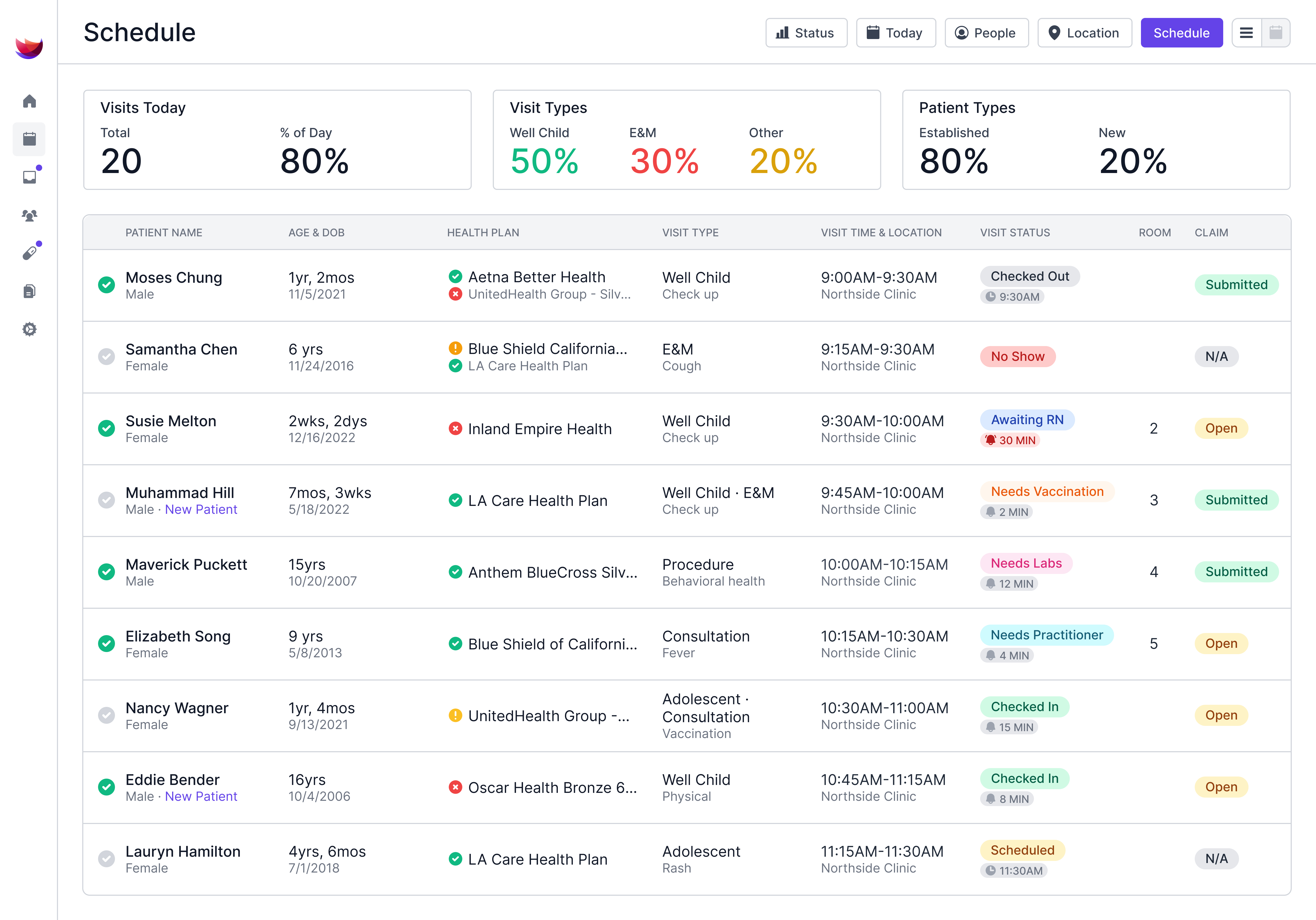
- Questionnaires go out before the visit, scored: Screeners are sent out automatically by text message, with patients and parents completing them on their own device — no clipboard, no re-keying. Scores calculate automatically, so the result is in the chart before the visit begins.
- Concerning results reach the provider before the visit: A positive M-CHAT-R/F generates a screening task that surfaces the result ahead of the visit, so the follow-up interview and the referrals are planned before anyone walks into the room.
- Age drives the process automatically: Develo links screener selection to the child's age and visit type, so the right autism screening tool appears at the 18-month well child visit automatically.
- Every caregiver connected: Develo handles multiple guardians, siblings, and blended family structures natively within a single family portal.
- Screening visits billed accurately: Automated charge capture applies the correct codes at the point of documentation — including 96110 for each developmental screening instrument administered — so completed screens don't drop out of billing.
- Referral results are auto-reviewed: Develo doc intel reads inbound faxes and auto-tags them by patient, document type, and sub-type. Specialist notes end up in the right chart, and results review tasks are no longer missed.
- Screening history you can just ask for: With Ask Develo, a question like "what were this child's prior screening results?" returns an answer from the whole record (specialist notes, practice visit notes, M-CHAT digital results, and more), with the chart references behind it.
If your clinic is still relying on paper screeners or your current system doesn't automate the screening workflow, book a free demo to see how Develo handles autism screening from the moment the visit is booked.
Frequently Asked Questions
What Is the Most Commonly Used Autism Screening Tool in Pediatrics?
The autism screening tool most directly aligned with AAP guidelines is the M-CHAT-R/F (Modified Checklist for Autism in Toddlers, Revised with Follow-Up), a free, parent-completed questionnaire validated for children aged 16 to 30 months. The AAP recommends it as the primary autism-specific screen at the 18- and 24-month well child visits.
At What Age Should Autism Screening Start?
Autism-specific screening should start at 18 months, with a second screen at 24 months, as part of routine well child care. Broader developmental surveillance runs at every well child visit, with standardized developmental screens recommended at 9, 18, and 30 months — in practice, clinics that don't hold a 30-month visit typically run that screen at the 3-year visit instead.
What Is the Difference Between Autism Screening and Autism Diagnosis?
Autism screening identifies children who may be at risk and flags them for further evaluation. Diagnosis requires a full developmental assessment by a qualified specialist, such as a developmental pediatrician or child psychologist, using comprehensive diagnostic tools.
What Should a Pediatric Clinic Do After a Positive Autism Screen?
After a positive autism screen, clinics should initiate three referrals at the same visit: a comprehensive diagnostic evaluation, an Early Intervention assessment under IDEA Part C, and an audiology referral to rule out hearing loss.
Can Autism Be Reliably Detected Before Age 2?
Yes, autism can be reliably diagnosed as young as 18 months by an experienced clinician, and early indicators such as reduced joint attention and limited gesture use can be observable even earlier. Tools like the CSBS DP Infant-Toddler Checklist are designed to catch communication delays from 9 months onward.
.png)


.avif)