
.avif)
Azalea Health pricing is quote-based. Azalea tailors each quote to your provider count, patient volume, and the modules you select. The clearest signal comes from Azalea's published cost disclosures and how its quote is structured. For a pediatric practice, fit matters as much as cost.
What Azalea Health Offers
Azalea Health sells a cloud-based EMR, practice management, and revenue cycle management (RCM) platform built for rural hospitals, community practices, and ambulatory clinics.
It combines clinical documentation, billing, telehealth, and a built-in clearinghouse in one system, with options spanning both outpatient and inpatient settings for organizations running satellite offices.
Azalea prices as a per-provider software platform, so quotes scale with provider count, patient volume, and the modules selected.
How Much Does Azalea Health Cost?
Azalea doesn't publish a rate, and it hasn't confirmed a public figure. Third-party software directory SelectHub estimates around $299 per provider per month as a minimum, though your actual quote tracks higher depending on your provider count, volume, modules, and integration needs.
When you contact sales, your quote is tailored to provider count, patient volume, the packages you pick, and whether revenue cycle management is included.
What's Included in Azalea's Plans
Azalea doesn't publish a public price sheet, but its own cost disclosures indicate suite pricing licensed per provider, with unlimited non-provider users and certain interfaces billed as add-ons.
What you pay depends on the suite and services you configure. Because the exact breakdown isn't public, the practical move is to get an itemized quote and confirm what's included line by line.
Several capabilities come bundled with the base platform:
- Built-in clearinghouse: Claims processing runs through Azalea's clearinghouse integration, with no separate third-party contract.
- Patient portal: Records access, self-scheduling, and messaging, built around the patient as the account holder rather than a family with multiple children and guardians.
- FHIR API: Interoperability with labs, imaging centers, and state reporting systems.
A few capabilities sit outside the base platform as separate lines:
- Billing-automation add-on: A revenue-focused option for billing automation and patient communication, added on top of the base platform.
- RCM billing: Sold as an optional managed service with its own pricing.
- AI Clinical and Billing Assistants: Ambient charting and coding support, available on the platform.
What lands in the final quote depends on which base package you pick and whether you add billing automation, managed RCM, or both.
Smaller practices typically start with the base platform. Organizations focused on collections often layer in the billing-automation add-on and managed RCM.
What Drives Your Azalea Health Quote
Here's what the number depends on:
- Number of providers: This is the single biggest factor. Azalea prices per provider, so a 5-provider clinic and a 40-provider group are priced very differently.
- Patient volume: The number of patients managed factors into the quote alongside provider count.
- Package and module mix: Layering on the billing-automation add-on, or expanded clinical tools, changes the math, as does managed RCM across a large provider base.
- RCM scope: Whether billing is software-only or a managed service shifts the total, since RCM is priced separately.
- Interface and prescribing fees: Per Azalea's ONC cost disclosures, lab and imaging interfaces can carry a one-time setup fee and annual maintenance fees. So can immunization registry and public health agency transmission — billed per interface, per account, which matters for any pediatric practice reporting to a state registry. Electronic prescribing of controlled substances (EPCS) and PDMP access add a per-provider cost.
- Contract length: Multi-year terms can earn discounts, but they also lengthen the commitment, so weigh both.
What Azalea's Pricing Doesn't Cover
Azalea promotes a model with no server fees, upgrade fees, or surprise costs. Even so, a few line items sit outside the base subscription and belong in any quote breakdown:
- Implementation and onboarding: Standing up the platform and configuring workflows can carry a one-time cost.
- Training: Staff training beyond standard onboarding may be quoted separately.
- Data migration: Moving records from a previous system is a common add-on line.
- Revenue cycle management: RCM is sold separately, either as software or a managed service.
- Billing-automation add-on: Billing automation and revenue tooling are an add-on cost on top of the base package.
- VFC and private vaccine inventory: Generalist platforms price vaccine tracking as inventory management, not as two parallel stocks with different funding sources. A pediatric practice running VFC alongside private stock needs borrowing, replacement, and dose-level accountability — confirm whether that's in the base platform or a configuration project.
None of these is unusual for an EMR contract. They can, however, meaningfully change the all-in cost in year one, so they belong in the quote breakdown, not as a surprise on your first invoice.
Contract terms can also run multiple years, so confirm the commitment length before signing.
How Azalea Health Pricing Compares to Alternatives
Azalea is one option in a market with several real alternatives. For a pricing comparison, what matters is how each one structures cost and where the all-in number lands.
Other Generalist EMRs
athenahealth ties its pricing to collections rather than to seats, so cost scales with practice revenue. Practices with higher collections pay more, regardless of provider count.
eClinicalWorks charges $499 per provider per month for EHR-only, $599 per provider for EHR with practice management, and 2.9% of collections for RCM as a Service. See our eClinicalWorks pricing breakdown for the full comparison, including add-on costs.
The three platforms structure cost differently: Azalea quotes by provider count and module mix, athenahealth ties cost to what you collect, and eClinicalWorks uses published per-provider tiers with add-on costs.
For a pediatric practice, the more relevant question is fit. All three are generalist platforms, so pediatric workflows like family relationship management and age-appropriate screeners require configuration. They don't ship native.
Pediatric-Specific Platforms
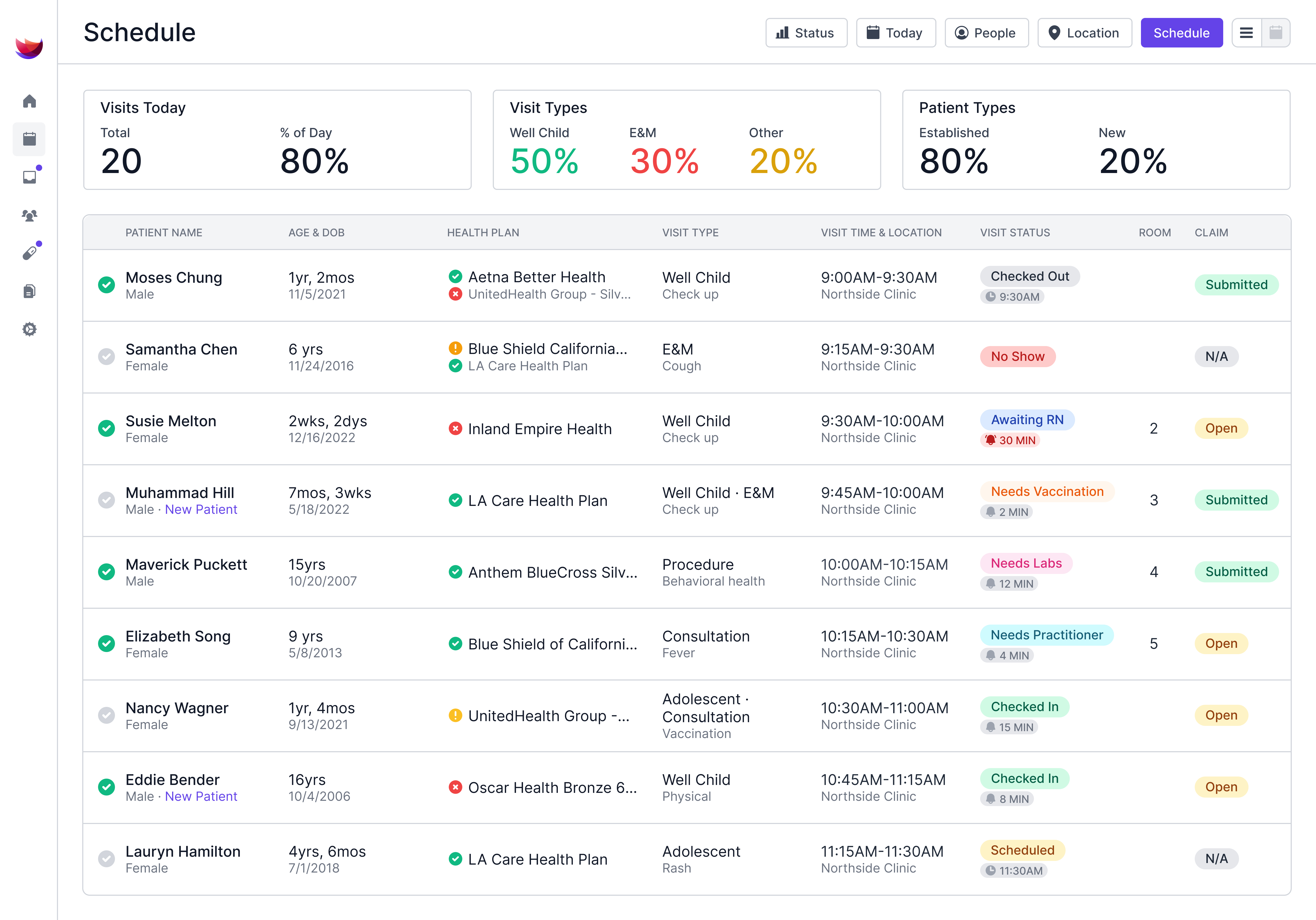
Generalist EMRs like Azalea handle pediatrics by bolting growth charts and vaccines onto an adult-first record. Develo takes the opposite approach. It's the AI-native pediatric operating system built solely for independent pediatric practices, unifying charting, billing, practice management, and family engagement in one system.
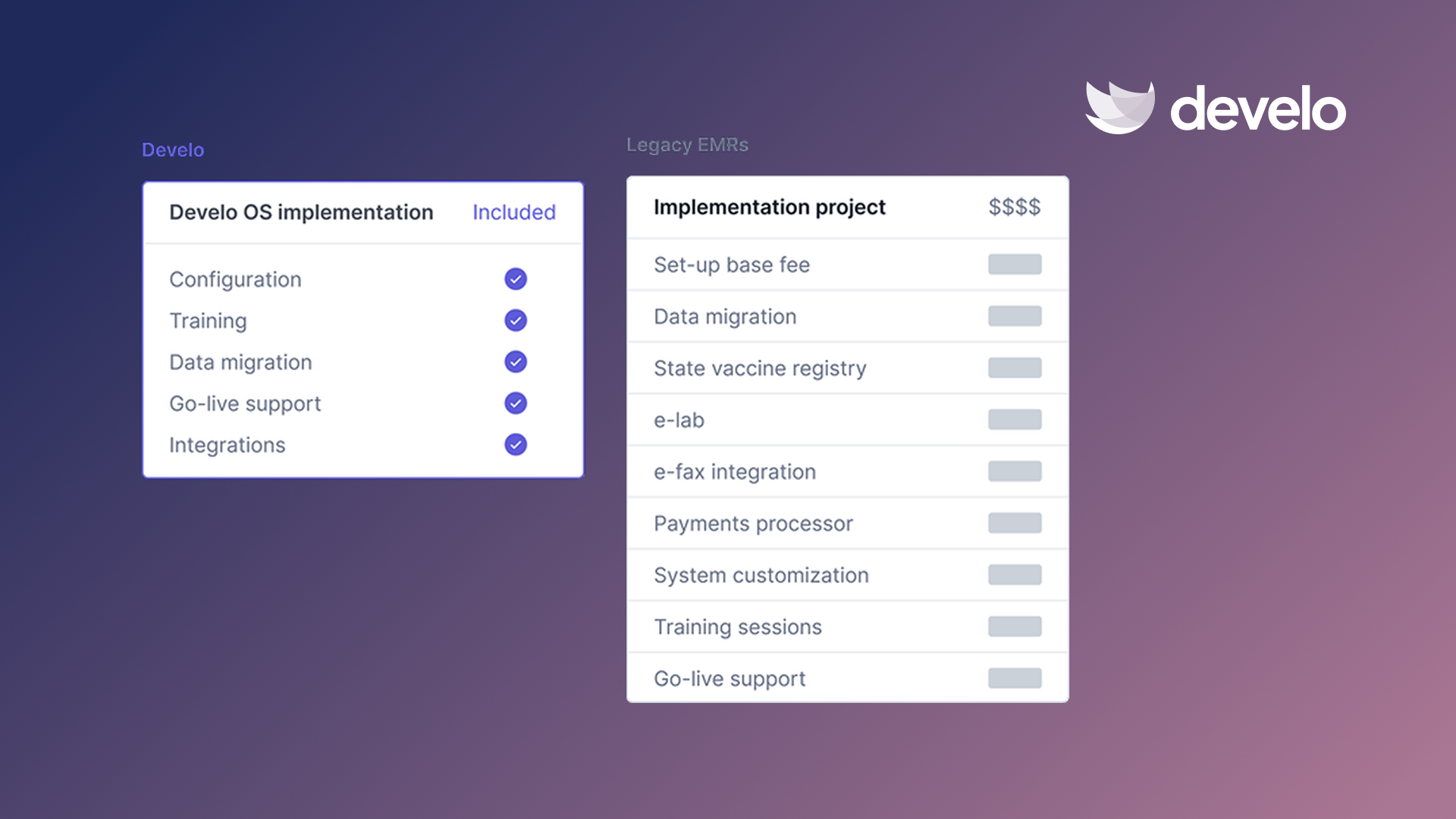
Develo uses comprehensive pricing: charting, billing, practice management, family engagement, and the full AI suite under one custom quote, sized to practice volume. The AI isn't a separate third party add-on — Develo provider scribe for ambient documentation, automated charge capture, Develo doc intel for auto-tagging incoming faxes and records, and Ask Develo for chart catch-up are part of the platform. Implementation, training, data migration, and non-provider staff seats are all included in Develo's pricing, not billed as separate lines. A lower headline number elsewhere can cost more once you price in everything that sits outside it.
Family relationship management across siblings and guardians, automated charge capture, digital screeners that auto-populate, score, and bill, and state immunization registry connections all ship native, with no configuration project and no per-interface fee.
Is Azalea Health Worth the Price?
Azalea is worth the price for multi-setting rural and ambulatory organizations. If you run satellite offices and want clinical, billing, and a built-in clearinghouse in one cloud platform, consolidating vendors is a reasonable trade, and the per-provider model stays predictable as you add sites.
For a pediatric practice, the math changes. Paying for a generalist platform and building pediatric workflows on top is usually the wrong fit. Develo handles those natively, from families with multiple guardians to age-based screeners, well child visit schedules, and vaccine tracking.
The comparison that matters isn't the monthly per-provider number. It's the number plus the registry interface, plus the screener configuration, plus the workflows your staff builds by hand because the system assumes one adult patient per chart. On a pediatric panel, that gap is where the real cost sits.
Book a demo to see what pediatric-specific pricing looks like for your practice.
Frequently Asked Questions
Does Azalea Health Publish Its Pricing?
No, Azalea Health doesn’t publish its pricing publicly. The company uses a custom-quote model that depends on provider count, patient volume, the packages selected, and whether RCM is included.
Is Azalea Health a Good EMR for Pediatric Practices?
No, Azalea Health is not a pediatric-specific EMR. It is built for rural hospitals, community practices, and general ambulatory care, so pediatric workflows like family relationship management, age-appropriate screeners, and VFC vaccine tracking require configuration.
What Does Azalea Health's Pricing Not Include?
Azalea Health's base pricing doesn't include several line items: implementation, training, data migration, the billing-automation add-on, and RCM, which are quoted separately. Interfaces are billed on top of that — including immunization registry transmission, which every pediatric practice needs. Azalea promotes no server or upgrade fees, but each add-on should be itemized in any quote.
Can I Negotiate Azalea Health's Pricing?
Yes, you can negotiate Azalea Health's pricing. Multi-year terms are the most common lever for discounts, and trimming the package and module mix to what a practice truly uses keeps the quote down.
.png)


.avif)